
Read the Reference Tables, Period analysis, Prologue and Chapter One free below!
Also available on the kindle page.
Also available on the kindle page.
UNDER BLADE AND LIGHT: The Showmen, the Hidden Hand, and the Knife Behind the Curtain (1780–1910)
Mind is the light of the soul, and by this light the hidden things become visible.
— Corpus Hermeticum, after XII
This is not a book about stagecraft. It’s a book about control.
Under Blade and Light follows 130 years of collusion between showmen, secret orders, police, colonial officials and “respectable” investigators: a slow, methodical construction of a system that learned how to charge people for belief, harvest their secrets, and turn every challenge into fuel.
Working from court records, seized lodge files, colonial reports, trade journals and trial transcripts, it tracks a single line from Cagliostro walking into a Strasbourg lodge in 1780 with fake credentials and real backing, to Houdini dying on Halloween in 1926 with intelligence contacts, missing papers, and a story that tidies up more questions than it answers.
The central claim is simple and dirty: magic didn’t sit next to power – it trained with it, worked for it, and taught it tricks.
Across three Parts, the book shows the same structure changing shape while solving the same problem.
Part I — The System Forms (1780–1850)
Lodges run the grid. Behind the romantic myths you get the raw view: Cagliostro’s Inquisition trial in Rome pulling back the curtain on how Masonic networks actually moved money and people. Illuminati files seized by police in Bavaria and spread across Europe, giving us one of the few times the state accidentally published the playbook. Phantasmagoria shows technology welded to ritual to frighten and steer crowds. Mesmerism is pushed out of medicine and dumped into entertainment, where it can be monetised instead of tested. The Fox Sisters’ farmhouse rappings ignite a mass belief market far beyond elite lodgerooms, and everyone serious rushes to work out how to tap it.
Lodges here aren’t colourful curiosities. They’re an early operating system for private coordination: membership as currency, secrecy as insurance, ritual as cover.
Part II — The Market Industrializes (1850–1880)
Railways and fixed venues turn the old lodge network into something harder and faster. Robert-Houdin doesn’t just own a Paris theatre; he gets shipped to Algeria as a colonial weapon, asked to humiliate local holy men on command so the French state can wrap domination in “rational” spectacle. American touring circuits professionalise: advance men, schedules, and cross-Atlantic copying of what works.
Widow Lyon’s lawsuit against D.D. Home drags elite séance economics into daylight: gifts, influence, “spirit advice” over fortunes measured in tens of thousands of pounds. The Davenport brothers use spirit cabinets and darkened halls to see how far you can push audiences before the belief/anger ratio flips and they tear the place apart. Henry Slade is prosecuted as a fraud in London, but the moment the legal weather turns bad, he simply jumps tracks to a friendlier jurisdiction and keeps going. The state has teeth, but the racketeers have routes.
Part III — The Machinery Consolidates (1880–1910)
Now the system shows its final form. Trade journals like Mahatma and The Sphinx quietly become central control rooms: they decide who is “professional,” who is a pariah, which methods are permissible, which scandals get buried or weaponised. Dealer networks—Martinka’s in New York, Hamley’s in London, Roterberg in Chicago—control the hardware of wonder, choosing which effects exist and who gets access.
The Society for Psychical Research gives ghost-hunting academic gloss; its investigations into mediums like the Crandons don’t just expose charlatans, they also point straight at missing children and disturbingly convenient gaps in the record. Theosophists and Golden Dawn initiates play at ancient wisdom while their feuds spill into court and the press; whenever a “secret” order implodes, what hits the papers is always just enough to keep the myth alive, never enough to close the account.
By the time Kellar formally sells his act, route and name to Thurston in 1908, you’re not reading an eccentric anecdote—you’re looking at proof that the whole system has matured. Identities can now be transferred like companies. Brands survive. People don’t.
What this book actually lays on the table:
How lodges, occult orders and “investigative” bodies operated on the same map, often with the same people in multiple roles
How colonial states and intelligence services used magicians as controlled agents and psychological weapons, then discarded or discredited them when useful
How trade press and dealer networks quietly overruled venues and audiences, deciding what was possible, who worked, and whose careers were erased
How “debunking” became a revenue stream and a discipline of control, not a moral crusade; opposition was not crushed, it was farmed
How the séance room and lodge became early laboratories for managing crowds, manufacturing consent, and laundering dirty work as entertainment
This isn’t a celebration of clever tricks. It’s a map of a control system learning to hide in plain sight—behind red curtains, Masonic aprons, respectable letterheads and glowing reviews.
Once you’ve seen the knife behind the curtain here, it’s very hard to unsee it anywhere else.
This section is the long, wider-angle view that sits behind Under Blade and Light. The book itself narrows in on a specific window—roughly 1780 to 1910—and stays close to the people, scenes and machinery inside that frame. These reference notes step back and follow the same structures over a much bigger span: how secret societies actually worked, what their class base was, how the science/occult line was drawn, and why that line keeps shifting.
They’re here to be used, not skimmed once and forgotten. When the chapters talk about lodges, the Illuminati, the SPR, or “the system” that manages belief, this is the place to come back to if you want the longer context and a clearer sense of how all the pieces fit together.
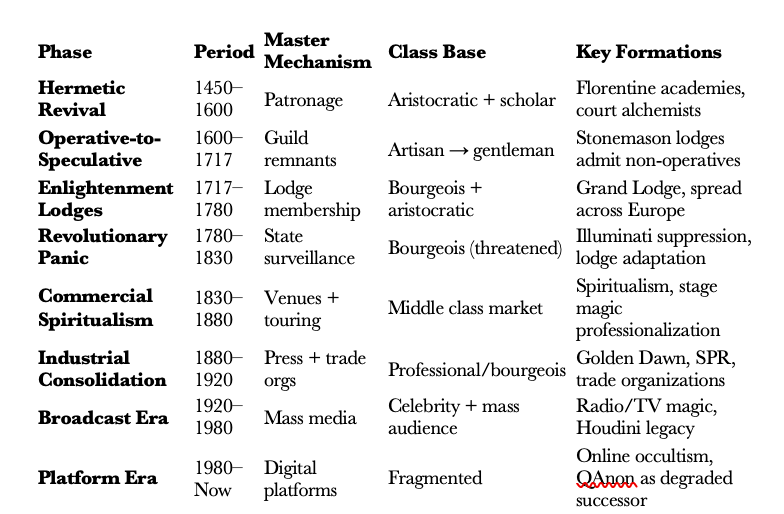
From the Renaissance onwards, the “weird” and the “respectable” don’t move on separate tracks. They share a spine, and that spine keeps changing shape. In the Hermetic Revival, the world of occult philosophy lives on court stipends and patronage. You get your alchemist along with your court painter. The mechanism is personal: a noble funds a thinker or a magician, and their experiments and rituals sit comfortably in the same palace as their astrology and their commissioned frescoes.
As you move into the seventeenth century, the remnants of actual craft guilds bleed into more abstract, speculative clubs. Stonemasons’ lodges begin admitting non-working “gentlemen” members, and a form that was originally about building literal walls gets repurposed to build social ones. Speculative Masonry emerges as a way for people who are not cutting stone to imagine themselves as inheritors of some deeper, technical, moral tradition. The class base starts shifting from artisans to professionals and minor gentry.
By 1717, with the Grand Lodge of England, you get the classic Enlightenment lodge: a bourgeois–aristocratic fusion space. Lodge membership itself becomes the coordination mechanism. To be inside the right room, under the right ritual, is to belong to a network that can hand you introductions, credit, protection and a story about yourself as a rational, morally uplifted actor. This is the point where Masonry becomes a respectable habit as much as an esoteric one.
Then the French Revolution and its aftershocks blow through. From roughly the 1780s to the 1830s you get what you can call the Revolutionary Panic phase. The same structural features that made lodges attractive for sociability also make them look dangerous from above: meetings in private, oaths, codes, and a habit of talking about justice and reform. The Bavarian Illuminati becomes the key object lesson. The state suppresses it, publishes its seized archives, and uses that very act to define “secret society” as a category of political threat. Lodges respond by de-politicising themselves, leaning much harder on charity and apolitical moralism.
Through the nineteenth century, you watch the action shift into the market. From about the 1830s into the 1880s, commercial spiritualism and professional stage magic carve out new sectors that look religious from one angle and purely entertainment-driven from another. The master mechanism is no longer membership alone; it is the venue: who controls platforms, tours, halls, parlours, and ticket flows. A middle-class paying audience becomes the basic unit, even when the imagery is seances and spirits.
By the 1880–1920 period, the industrialisation of all this is unmistakable. Golden Dawn, the Society for Psychical Research, and formal trade organisations for magicians are all attempts to impose system on chaos. The coordinating mechanisms now include the press, specialist journals, formal grade systems, and dealer networks. The class base has moved decisively into the professional and bourgeois layers: doctors, lawyers, academics, theatre managers, publishers. “Secret” activity is now embedded in a recognisably modern infrastructure.
The twentieth century’s Broadcast Era takes that structure and stretches it over microphones and cameras. Radio and television turn individual performances into signals that can be blasted across an entire country at once. The bottlenecks move: the crucial gatekeepers are no longer lodge officers and theatre bookers, but producers, schedulers, network executives. The class base turns into celebrity on one end and mass audiences on the other.
The current Platform Era just mutates those same dynamics into digital form. Platforms, algorithms, and recommendation systems take over the gatekeeping role. Online occultism, conspiracy communities, and things like QAnon are degraded successors to the lodge-and-lantern world of earlier centuries: recognisable in structure, emptied of craftsmanship, and driven by metrics rather than initiation.
The through-line across all of these phases is simple: class shifts and distribution mechanisms move together. Aristocratic patronage yields to bourgeois networking; that yields to mass markets; that yields to platform control. What counts as “secret,” “sacred,” or “scientific” is folded into those shifts rather than floating above them.
II. SECRET SOCIETY TAXONOMY
A. Freemasonry
Freemasonry begins as a set of practical craft guilds. Medieval stonemasons had lodges tied to real building sites, real cathedrals and fortifications. Over time, especially from the seventeenth century onwards, those lodges start admitting “speculative” members: men who are not masons by trade but are attracted to the symbolism and the networking. By the time the Grand Lodge of England crystallises in 1717, Freemasonry has essentially become a respectable club system draped in builder’s imagery.
Its real functions are mundane and powerful: introductions to people who matter, mutual aid when you fall ill or die, soft references for credit and business, a ritualised sense of moral improvement. The class base shifts fast. You still have artisan roots, but the centre of gravity becomes merchants, lawyers, minor aristocrats, and ambitious professionals. There is no single world directorate. Grand Lodges operate by jurisdiction and frequently clash with each other over recognition and rules.
Around that very ordinary reality, a mythology grows: tales of Egyptian, Templar, or Solomonic origin, pitched as an unbroken lineage of secret knowledge. Almost all of that “ancient” pedigree gets invented in the eighteenth century, usually by people desperate to make their new club look old. Conspiracy theories then come along and flip the perspective. Instead of a loose federation of quarrelling lodges, they imagine a unified central command manipulating revolutions and markets.
What Masonry really coordinates is business and belonging. The lodge serves as a place where you can be vouched for, where charity is distributed, where an employer or creditor might be reassured you are “sound.” Political networking certainly happens, but not as a single coherent project. It’s a fabric of overlapping interests, not a monolithic brain.
B. Illuminati
The historical Illuminati are much smaller and much more boring than their legend. The Bavarian Illuminati are founded in 1776 by Adam Weishaupt, a law professor, and survive less than a decade. At their peak they probably muster a few thousand members scattered through the German states: civil servants, minor nobles, clergy, professors. Their project is Enlightenment reform from the inside: anticlerical, rationalist, hostile to church dominance, and very interested in nudging existing institutions toward their programme.
They recruit through Masonic lodges, using the lodge structure as a conveyor belt for new members. That alone makes them a problem for Bavarian authorities, who have been watching lodges with a nervous eye since the French and American revolutions. In the mid-1780s the state moves. The Illuminati are banned, their papers are seized, and their internal correspondence—grades, oaths, political schemes—is published as a warning. Organisationally, that’s the end of them.
What survives is the story. Because the Bavarian government printed the archives, later readers had a perfectly packaged narrative: a secret order inside other orders, with an explicit political programme and real infiltration. Nineteenth- and twentieth-century reactionaries reuse that script over and over, swapping in new villains as needed. The Illuminati morph into eternal puppet-masters, often fused with antisemitic fantasies about “the Jews” or “international finance.” By the time you reach the contemporary conspiracy industry, “Illuminati” has become a floating label for whatever nameless “they” is required, with almost no reference to the short-lived Bavarian club that gave the name.
In reality: they coordinated reformist discussion circles for a few years, tried to leverage their members’ positions, and then ceased to exist. The organisational corpse rotted; the template lived on.
C. Rosicrucians
“Rosicrucian” starts life as a literary device, not a membership card. The early seventeenth-century manifestos—the Fama Fraternitatis and its siblings—tell the story of a hidden brotherhood bringing about a reformation of science and religion. Most historians now read them as a mixture of satire, allegory, and utopian religious politics emerging from within German Lutheran culture. There is no good evidence that a structured, international “Rosicrucian Order” existed at that point.
What you do get is a contagious symbol. Over the next two centuries, “Rosicrucian” is a name people claim rather than a documented continuous institution. In the nineteenth century, you finally see durable organisations using the label, especially the Societas Rosicruciana in Anglia (SRIA), founded in the 1860s as a Masonic research and study society. SRIA members will later create the Golden Dawn. In the early twentieth century, groups like AMORC emerge, selling graded Rosicrucian teachings by mail and through lodge systems.
The class base runs from Masonic professionals in SRIA to middle-class seekers in AMORC-style orders. The ancient lineage is mostly theatrical. There is no clean line running from the seventeenth-century manifestos to a modern temple in California, except the desire of later groups to borrow that aura.
D. Golden Dawn (and successors)
The Hermetic Order of the Golden Dawn appears in London in 1888, built by three men who already live inside Masonic and Rosicrucian networks: Westcott, Mathers, Woodman. They take the loose mixture of ritual magic, Kabbalah, Tarot, and Hermetic philosophy that has been sloshing around Europe for years, and they systematise it into a structured grade system with exams, set texts, and formal ceremonies.
The membership is drawn from the professional middle class and the bohemian edge of the bourgeoisie: doctors, barristers, writers, artists, minor aristocrats. For the first time in this story, women are not simply followers or auxiliaries; they are admitted as full members and can rise through the grades. That doesn’t mean gender hierarchies vanish, but the formal rules are less lopsided than Masonry’s.
Golden Dawn’s paperwork is unusually revealing. You get clear views of internal finances, disputes over authority, and the mechanics of schism when the order fractures around 1900–1903. Its successors—Stella Matutina, Crowley’s A∴A∴, various modern revival groups—inherit both the ritual technology and the organisational habits: grades, oaths, curriculums.
The order matters here because it turns occult practice into something that looks like a professional training pipeline. Advancement equals access. Grades decide who gets which texts and techniques. It is a laboratory for managing belief and access by paperwork.
E. Theosophical Society
The Theosophical Society is founded in 1875 in New York by Helena Blavatsky and Henry Olcott and then shifts its headquarters to Adyar in India. It positions itself as a bridge between “East” and “West,” mixing Hindu, Buddhist, and esoteric Christian motifs into one sprawling metaphysical system. It is also a very practical machine: a publishing house, lecture circuit and lodge network rolled into one.
The membership comes from middle-class readers, colonial administrators, and Indian intellectuals. For Western seekers, Theosophy offers “ancient wisdom” and a sense of rebellion against narrow church religion. For some Indian participants, it provides a space to think and organise under colonial rule, though the relationship to actual nationalist politics is complicated and often tension-filled.
Blavatsky is exposed more than once as fabricating phenomena and manipulating narratives, yet the movement doesn’t collapse. The reason is structural. The books and magazines have their own momentum; the branch network is decentralised enough that no single scandal can take everything down; and membership gives people a sense of identity and community that survives the founder’s reputation. Theosophy shows how a system can absorb exposures and carry on, because it offers more than “believe this one claim.”
F. Friendly Societies and Fraternal Orders
Alongside the glamorous or notorious secret societies sits a quieter majority: the friendly societies and fraternal orders of the nineteenth century. Odd Fellows, Foresters, Knights of Pythias and their many cousins sign up hundreds of thousands of working-class and lower middle-class men (and sometimes women) into rituals, lodges, and benefit schemes.
These organisations are about survival. They provide sick pay, funeral funds, occasional job contacts, and a framework for social life. They use oaths, passwords, and degrees not primarily to hide cosmic truths, but to create solidarity and a sense of seriousness. Structurally they resemble Masonry—local lodges, rituals, regalia—but their class base and practical role are different.
They matter to this book because they prove that the “secret society” form is not a purely elite toy. The same architecture of secrecy, grade, and ritual serves a working-class coordination function. They draw less mythologising because they threaten the ruling class less symbolically, but they share the form.
III. SCIENCE/OCCULT DIVERGENCE: NOT CLEAN, NOT COMPLETE
A. The Myth of Clean Separation
The reassuring story about the Scientific Revolution is that it neatly separates rational science from irrational occultism: Newton discovers gravity, the Royal Society enshrines experiment, and alchemy and magic get swept into the dustbin. That story is tidy. It is also untrue.
Newton himself spent vast amounts of energy on alchemical texts and biblical chronology. Early scientific institutions were full of people who read the stars, cast horoscopes, and experimented with “natural magic” alongside optics and mechanics. For a long time, “natural philosophy” and “natural magic” live side by side, with blurred boundaries and overlapping personnel.
You see the same ambiguity in the treatment of mesmerism in the late eighteenth century. Franz Mesmer’s claims are serious enough that the French Academy and state commission an official inquiry. The commission ultimately rejects his theory, but the mere fact of the investigation tells you mesmerism is not being treated as carnival nonsense. The line between acceptable inquiry and “superstition” is not discovered in the data; it is drawn in response to institutional needs.
B. Boundary Work as Social Process
The separation of “science” and “occult” is a piece of social engineering. Professional scientists need a clear identity to defend their authority, so they start drawing sharper lines between what counts as serious and what is beneath notice. Medical professionals, seeking to protect their livelihood and jurisdiction, push mesmerists, spiritual healers and other competitors to the margins by branding them as quacks.
These fights play out inside institutions. Medical societies decide who gets licensed and who gets barred. Scientific academies and journals decide whose papers get published and whose are ignored or mocked. Universities embed these judgments in hiring and curriculum. The press then amplifies those decisions, turning professional disputes into public narratives of “science vs superstition.”
The result is a boundary that has to be maintained. It doesn’t sit there naturally. It is constantly shored up in editorials, position statements, court cases and hiring decisions.
C. The SPR Problem
The Society for Psychical Research, founded in 1882, sits right on that fault-line. It is created by Cambridge academics and other credentialed figures who want to apply investigation to psychical claims: telepathy, apparitions, mediumship, hauntings. Its membership includes people with impeccable scientific credentials and others who are a lot more credulous.
The SPR is awkward for everyone. To the scientific mainstream, it is an embarrassment: serious names poking at disreputable phenomena. To committed spiritualists, it is presumptuous: outsiders applying cold tests to sacred experiences. Internally, it produces both debunking reports that expose fraud and investigations that tip some of its own investigators toward belief.
It demonstrates that the science/occult line is neither clean nor universally accepted even within elite circles. Putting “SPR member” and “professor of physics” in the same sentence makes it impossible to pretend that all real scientists stand on one side and all mystics on the other. The boundary is constantly being crossed, and the SPR makes those crossings visible.
D. Ongoing Porosity
The twentieth and twenty-first centuries don’t magically close this gap. You get parapsychology labs with university letterheads; you get consciousness studies that sometimes wander into metaphysical territory; you get quantum mechanics abused in popular culture to justify every form of “energy work” under the sun. Tech and finance elites preach rationalism while experimenting with meditation, psychedelics and simulation cosmologies in private.
The category “spiritual but not religious” emerges as a mass identity, allowing people to borrow freely from religious and scientific language without committing fully to either. Commercial sectors from wellness to self-help make money out of keeping the lines blurry. There is revenue in being just scientific enough to sound modern and just mystical enough to promise salvation.
Underneath all this is a stubborn fact: questions around consciousness, meaning and subjectivity are not neatly resolved by existing scientific frameworks. The explanatory gap leaves plenty of room for speculative, spiritual or esoteric projects. Those projects attract the same mix of elites, hustlers and earnest seekers as their nineteenth-century predecessors.
E. For the Book’s Purposes
For Under Blade and Light, the important point is that “science versus magic” cannot be treated as a simple opposition that explains behaviour. The boundary between the two is something institutions work to produce and maintain. The same class layers that populate lodges, spiritualist circles, and occult temples also sit on academy committees and editorial boards.
Within the period the book covers, you see that clearly. The Illuminati are suppressed in the name of order and rational government, yet their members are professors and bureaucrats. The SPR is set up by academics who want to test spiritualist claims using something like scientific method. Golden Dawn members read technical journals and magical grimoires in the same week. The border is not a wall; it is a contested frontier.
The narrative here treats that boundary as one more tool of coordination. Who gets framed as “scientific” and who as “occult” is part of how the system sorts people, distributes credibility, and decides which kinds of secrecy are tolerated, which are criminalised, and which are quietly exploited by the state.
IV. CLARIFYING COMMON CONFUSIONS
Confusion
Reality
“The Illuminati control everything”
Bavarian Illuminati lasted about nine years (1776–1785), then collapsed under state pressure. No hard evidence of a surviving organisation.
“Freemasons are the Illuminati”
Illuminati recruited through some lodges but did not create Masonry. Masonry is older, broader, and structurally decentralised.
“Freemasons are centrally controlled”
Grand Lodges are jurisdictional and often disagree. There is no single world command centre.
“Rosicrucians are ancient”
The early manifestos were likely literary constructions; no documented continuous Rosicrucian organisation exists before the nineteenth century.
“Golden Dawn was Masonic”
The founders were Masons and used Masonic elements, but Golden Dawn was a distinct magical order with its own grade structure and curriculum.
“Secret societies are anti-science”
Many members were scientists or professionals; the “anti-science” label reflects boundary politics, not fixed categories.
“Occultism died with the Enlightenment”
It mutated into new forms—spiritualism, Theosophy, ceremonial magic orders—and has never actually disappeared.
“Spiritualism was purely working-class”
Leadership and infrastructure were overwhelmingly middle-class, even though audiences cut across class lines.
“Theosophy was just fraud”
Fraud was part of the story, but the movement also functioned as a powerful publishing house and transnational network that outlived its founder’s scandals.
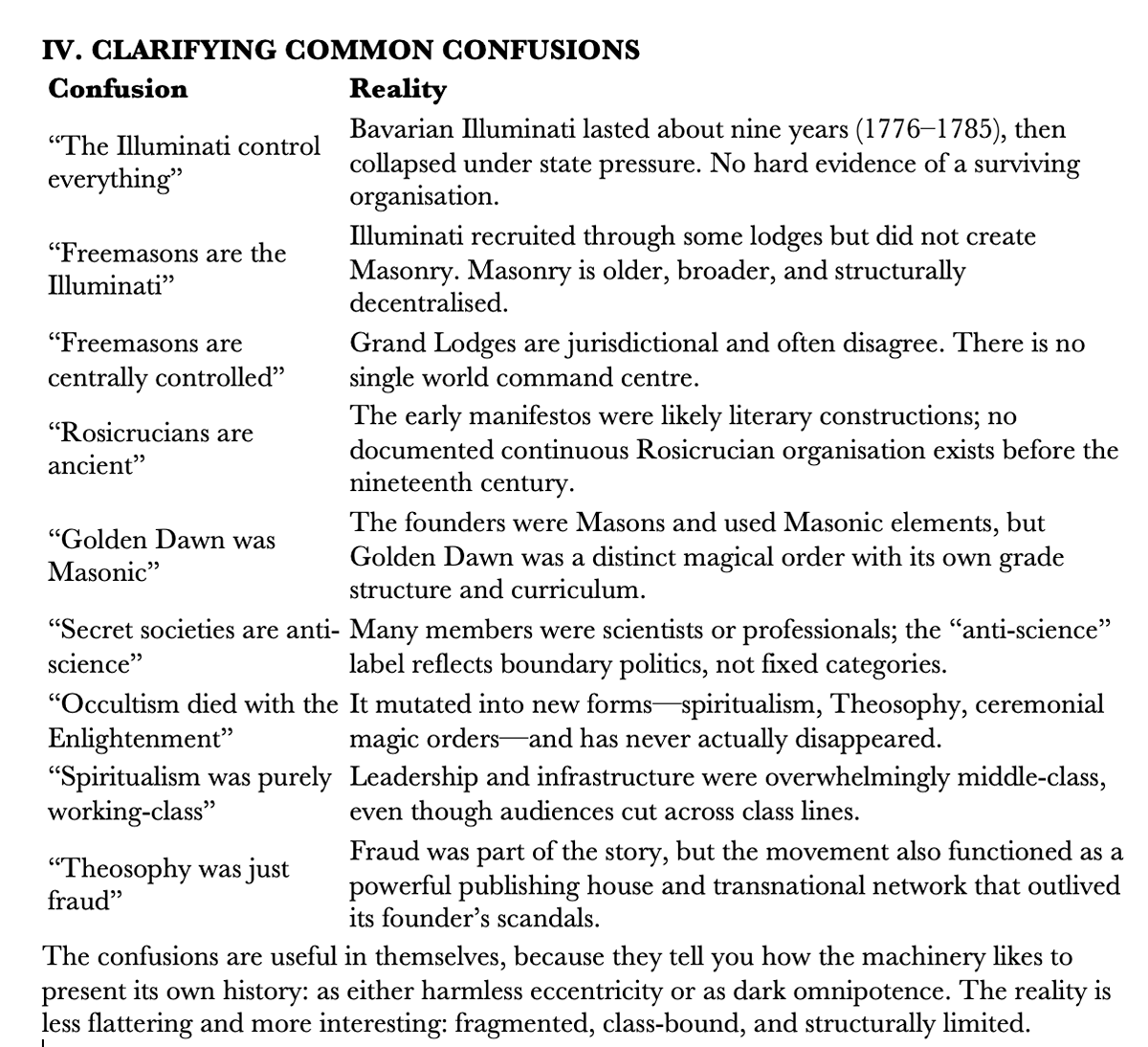
The confusions are useful in themselves, because they tell you how the machinery likes to present its own history: as either harmless eccentricity or as dark omnipotence. The reality is less flattering and more interesting: fragmented, class-bound, and structurally limited.
V. FOR
UNDER BLADE AND LIGHT
Within the time window this book cares about—roughly 1780 to 1910—you can see the machinery assembling itself in a few clear moves.
In the decades of revolutionary panic, the state discovers that “secret society” is a category it can weaponise. The suppression of the Illuminati becomes a model: seize papers, expose the internal workings, and then use the resulting narrative to justify ongoing surveillance and pressure. Lodges learn quickly. They tone down explicit political talk, foreground charity and moral uplift, and make themselves harder to attack as conspiracies.
From the 1830s to the 1880s, commercial spiritualism appears and effectively industrialises séance culture. It looks, from certain angles, like religion: messages from the dead, moral reassurance, ritual spaces. Structurally it behaves like a touring entertainment industry, complete with booking agents, venues, newspaper adverts and rival acts. Mesmerism is pushed out of mainstream medicine but thrives on stages and in back rooms as a hybrid of therapy and spectacle. The people doing the “boundary work” here are medical boards, academies and newspapers, not some abstract force called Rationality.
By the 1880s and 1890s, you see a convergence of system-building projects. The SPR tries to bring academic method into the psychical chaos, creating protocols, committees and reports, and discovering that the line between “investigator” and “believer” is very easy to cross. Orders like the Golden Dawn and its cousins try to rationalise ceremonial magic, turning it into a graded curriculum with exams and formal initiation rites. Trade organisations and dealer networks do something similar for stage magic, codifying professional ethics, controlling access to methods, and deciding who counts as legitimate.
All of this sits inside the broader coordination system that Under Blade and Light is describing. Lodges and orders offer belonging and graded access. Venues and touring circuits offer physical platforms and income. The press amplifies or ruins reputations. The state regulates, suppresses, recruits and occasionally prosecutes. Belief markets—spiritualist circles, occult temples, theatre audiences—provide the paying demand. The science/occult boundary is one of the levers used to manage this entire field, not a cliff that divides good people from bad or truth from lies.
In other words: the book is not about “true believers versus sceptics” or “honest inquiry versus fraud.” It is about a coordination system that learns to manage secrecy, exposure, belief and doubt as resources. Scientific language, occult language, and conspiracy language are all tools inside that system. The real story is who gets to use them, on what terms, and with which class interests in the background.
This table maps how the business of wonder evolved from 1780 to 1910. It shows not what performers believed or what audiences felt, but who controlled access to what, and how that changed.
Two Ways to Read
Read ACROSS a row to see how one element evolved over time. What performers needed in 1780 (lodge membership, aristocratic protection) became something entirely different by 1900 (trade org membership, dealer relationships, managed press exposure). The system didn't simply grow—it transformed.
Read DOWN a column to see how all interests aligned at one historical moment. In any given phase, performers, audiences, and the state all needed something from the system—and those needs interlocked. The table shows how coordination worked, not just what individuals wanted.
The Contradiction Row (→)
This is the engine of the table. Each phase's solution to the previous crisis creates the next crisis. Lodge networks worked—until the railway and spiritualism created demand that exclusive membership couldn't capture. Venue control worked—until reputation became unmanageable without press machinery. Press dominance worked—until mechanical reproduction eliminated the need for live performers entirely.
The system doesn't fail because people made mistakes. It transforms because each solution contains the seeds of its own obsolescence.
Master Mechanisms
Each phase has one coordination mechanism that dominates all others. Lodges (1780–1850) controlled who could access patrons, venues, and protection. Venues (1850–1880) controlled who could perform for paying audiences. Press (1880–1910) controlled who existed publicly at all. The previous mechanism doesn't vanish—it becomes subordinate to the new master.
What This Isn't
This is not a story of great magicians. The figures named—Cagliostro, Robert-Houdin, Maskelyne, Kellar—appear not as heroes but as pressure points where the system's contradictions became visible and generated documents. They are carriers of conflicts, not authors of history.
This is not a story of frauds versus real magic. The system deliberately blurred that line because the blur was profitable. Skeptics and debunkers were participants extracting value, not external enemies.
The Core Product
What did this system actually sell? Not tricks. Not belief. The commodity was managed oscillation—audiences suspended between belief and disbelief, performers suspended between revelation and concealment. Each oscillation enabled extraction. Synchronized oscillation enabled industry.
Follow the money. Follow the coordination. Follow the contradictions.
phase's "solution" becomes the next phase's crisis. The system doesn't liberate wonder—it reconfigures capture.
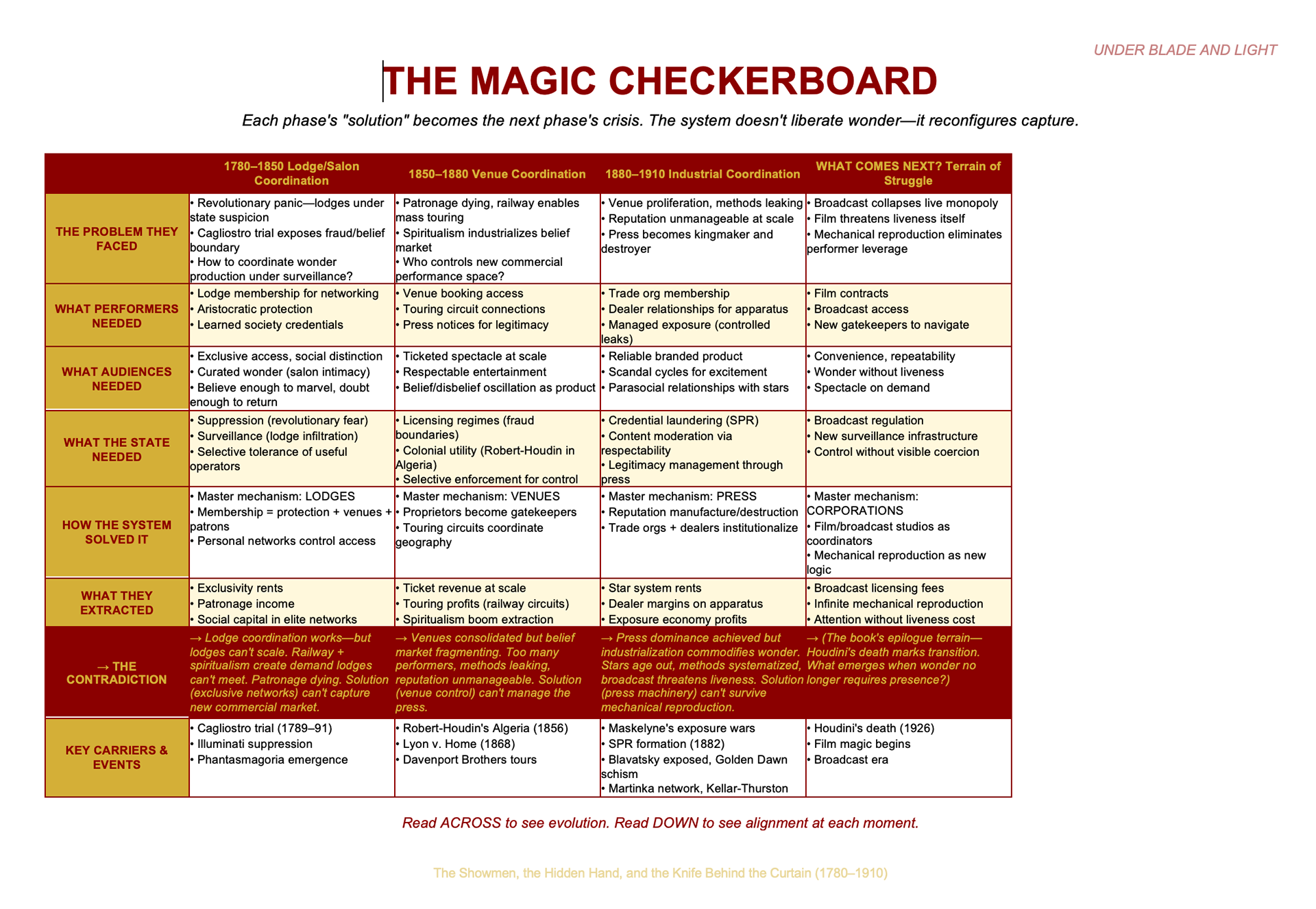
HOW TO READ THE MAGIC CHECKERBOARD
This table maps how the business of wonder evolved from 1780 to 1910. It shows not what performers believed or what audiences felt, but who controlled access to what, and how that changed.
Two Ways to Read
Read ACROSS a row to see how one element evolved over time. What performers needed in 1780 (lodge membership, aristocratic protection) became something entirely different by 1900 (trade org membership, dealer relationships, managed press exposure). The system didn't simply grow—it transformed.
Read DOWN a column to see how all interests aligned at one historical moment. In any given phase, performers, audiences, and the state all needed something from the system—and those needs interlocked. The table shows how coordination worked, not just what individuals wanted.
The Contradiction Row (→)
This is the engine of the table. Each phase's solution to the previous crisis creates the next crisis. Lodge networks worked—until the railway and spiritualism created demand that exclusive membership couldn't capture. Venue control worked—until reputation became unmanageable without press machinery. Press dominance worked—until mechanical reproduction eliminated the need for live performers entirely.
The system doesn't fail because people made mistakes. It transforms because each solution contains the seeds of its own obsolescence.
Master Mechanisms
Each phase has one coordination mechanism that dominates all others. Lodges (1780–1850) controlled who could access patrons, venues, and protection. Venues (1850–1880) controlled who could perform for paying audiences. Press (1880–1910) controlled who existed publicly at all. The previous mechanism doesn't vanish—it becomes subordinate to the new master.
What This Isn't
This is not a story of great magicians. The figures named—Cagliostro, Robert-Houdin, Maskelyne, Kellar—appear not as heroes but as pressure points where the system's contradictions became visible and generated documents. They are carriers of conflicts, not authors of history.
This is not a story of frauds versus real magic. The system deliberately blurred that line because the blur was profitable. Skeptics and debunkers were participants extracting value, not external enemies.
The Core Product
What did this system actually sell? Not tricks. Not belief. The commodity was managed oscillation—audiences suspended between belief and disbelief, performers suspended between revelation and concealment. Each oscillation enabled extraction. Synchronized oscillation enabled industry.
Follow the money. Follow the coordination. Follow the contradictions.
The tavern sat in St. Paul’s Churchyard with the cathedral looming over it like a permanent construction site and a permanent moral argument. The place had that particular London smell: damp wool and tallow, ink and horse, spilled ale in floorboards that never quite dried, and—when the wind turned—stone dust from the cathedral’s endless repairs. The city was always building something and always breaking something else to pay for it.
On an evening in late June, 1717—St. John’s Day, the sort of calendar hinge that makes ordinary men feel watched by history—small groups climbed the narrow stairs to an upper room above the talk and clatter below.¹ The heat sat trapped under the eaves. Candles made the corners pulse. The shutters were drawn, not because anyone feared an immediate raid, but because there are things a city teaches you to do automatically: close the room, guard the door, lower your voice, decide who counts as “we.”
They were not kings. They were not ministers. They were not the kind of men whose names the newspapers printed in reverent black. They were tradesmen and merchants, craftsmen and clerks, a few better-dressed gentlemen who could afford to treat secrecy as a hobby rather than a necessity. They came out of a London that was learning new habits fast: coffee houses humming with argument, pamphlets multiplying like flies, fortunes being made in ink and paper, reputations collapsing in a week. The city was becoming a machine for turning talk into power—and power into money—long before anyone would admit that was what it was doing.
They called themselves lodges. For years they’d been meeting in taverns—the Goose and Gridiron, the Crown, the Apple Tree, the Rummer and Grapes—small knots of men gathering by appointment, conducting rituals whose content they swore never to reveal.² In one telling, this night becomes the beginning: four lodges coming together, choosing a Grand Master, creating the first Grand Lodge. In another telling, the real consolidation happens a few years later, when the body becomes formal enough to leave an administrative trail that doesn’t rely on memory and loyalty.¹ Either way, the thing that matters for this book isn’t whether the “first moment” belongs to 1717 or to the paperwork-heavy world that follows. It’s the move itself.
They were trying to solve a practical problem.
A network was forming. People were travelling. A man could claim credentials in one tavern and be unknown in another. Disputes over legitimacy had no referee. Anyone could take the name. Anyone could offer the secret for sale. Growth without a shared rulebook doesn’t make a movement; it makes a market of fakes, rivals and opportunists—exactly the kind of market that, later on, will feed the wonder trade like blood.
So they did what modern people do when they want a dispersed world to behave: they built a gate.
They elected an office. They began keeping minutes. They created a way to recognise one another that didn’t depend on personal acquaintance. The result looks, in retrospect, like mysticism. It wasn’t. It was infrastructure.
Not the kind you pave and patrol. The kind you carry.
Old Stones, New System
If you listen to the stories the lodges later told about themselves, you never start in this hot little room. You start with the deep past.
The myths like to run backwards in time. Back to medieval building sites where stonemasons carve saints and pinnacles and need some way to keep wages, training and standards under their own control. Back further, if the storyteller is ambitious, to the Temple of Solomon or to imagined schools of geometry in Egypt. Back to places where stone and ritual and numbers blur into one another and the work of lifting blocks toward the sky feels like a holy act as well as a paid one.²
There were real medieval mason fraternities. They protected trade skills, regulated who was allowed on a site, enforced rules about training and pay. You can find traces of their internal discipline in town records and cathedral accounts: fines, oaths, rights to travel between lodges with a recommendation. They guarded know-how that could be ruined by a careless apprentice or stolen by a rival. Their secrets were practical: how to cut a joint that would not fail; how to read a drawing; how to make a vault stand up instead of fall in.³
By the seventeenth century, that world was already thinning out. The great gothic building booms had ebbed. Many of the grand projects were finished or slowed. The old operative lodges didn’t vanish; they drifted. Some kept working. Some became social clubs that kept the old language and invented new meanings. Gentlemen who had never lifted a stone joined lodges that still used mason’s words and symbols. The trade skeleton stayed. The muscle wrapped around it changed.³
That is where the confusion begins.
If you are inside the system and want it to feel timeless, it is tempting to stitch all of this together: medieval masons, biblical builders, ancient mysteries, and now you, in your apron, holding a glass in a London tavern. One continuous brotherhood running like a hidden river through history. It sounds better than “a group of men in hire-by-the-night rooms trying to make private coordination portable in a rapidly commercialising city.” It feels older. It feels weightier.
But the thing that is being founded at the Goose and Gridiron is not an ancient brotherhood. It is a new use for old shells.
The ceremonies pull on medieval tools and biblical stories because those are available and impressive. The symbols etched on working stones—the square, the compass, the eye—are lifted out of mud and dust and translated into allegories about personal improvement, morality, enlightenment. The “secret” moves from how to cut a keystone to how to belong to a certain kind of modern man.³
On paper, this shift is visible in the way early eighteenth-century documents talk. Anderson’s Constitutions of 1723 and the regulations that follow do not read like survival notes from a medieval building site. They read like the minutes of a new kind of club: rules for elections, fines for misbehaviour, instructions for settling disputes, obligations to charity, articles on how to behave in church and at table.³ The old stone-craft is there mostly as metaphor. The chisels and mallets are still named, but they have become moral props.
For this book, that distinction matters.
When we talk about a “founding” here, we are not trying to adjudicate centuries of internal myth about how far back the chain runs. We are looking at the moment when a particular architecture of power becomes clear enough to photograph: a structure that uses secrecy the way banks use ledgers; a structure that turns degrees into a formal ladder; a structure that converts private ritual into portable status.
Before this, you have pockets—operative masons protecting their skills, small fraternities with their own customs, scattered brotherhoods that may share some symbols but not a central office. During the shift you get hybrid lodges where tradesmen and gentlemen share rooms and start to treat old tools as emblems. After the Grand Lodge consolidation, you get something else again: a body that can license, exclude, correspond, and speak in the first person plural about what “we” believe and “we” require.² ³
The myths about Egypt and Solomon are not irrelevant to this story. They are part of the machinery. They give the new system a borrowed antiquity, a sense of inevitability. They help sell the idea that joining a lodge is not simply entering a club, but plugging into a line of transmission that stretches back to the foundations of civilisation. That is excellent marketing. It is also excellent cover. You can hide a very modern set of interests inside a very old costume.
So when the prologue plants us in this upstairs room, it is not claiming that everything begins here and nowhere else. It is saying: here is where the pattern finally stands up in clear daylight. Here is where we can watch, in real time, a group of men take fragments of guild practice, scraps of sacred story, and the needs of a commercial city—and weld them into a system for recognising each other, controlling entry, and moving trust through space.
Once you see that, the date on the noticeboard matters less than the shape of the thing being built.
The Door
Start with the simplest fact: you could not simply declare yourself in.
A lodge is a room with a line drawn across it. On one side: those inside the agreement. On the other: everyone else. The rituals mattered—of course they mattered, men don’t go through strange ceremonies for nothing—but the rituals mattered first as proof that the line existed, and that you had crossed it in the proper way.³
By the early eighteenth century, the Constitutions and regulations around Grand Lodge governance and lodge practice describe a world built on formal procedure: majorities, ballots, lists, officers, door-keepers, records—mundane features that make secrecy scalable.³ The point wasn’t simply to hide information; it was to make membership legible to other members, even at a distance. A boundary you can’t police is just theatre. A boundary you can police becomes capital.
And once you have a gate, you can charge rent on it—social rent first, then money, then access to whatever comes next.
The Ladder
Inside the gate, the lodges built a ladder.
Degrees, steps, stages—call them what you like. The early record shows apprentices, fellows, masters moving through an internal order that mattered because it made status portable.⁴ It also made obedience rational. If there is something “higher” you can become, then waiting becomes a virtue. Silence becomes proof you deserve the next step. Devotion stops being sentimental and starts being a strategy.
A ladder does two jobs at once. It tells the new man he is not yet entitled to everything. And it tells the old man his authority is not merely personal. His power is “the system.”
That is an intoxicating thing to own.
The Secret
Secrecy is usually described as a veil. It is closer to a currency.
A shared secret binds. A hidden sign creates instant trust between strangers. Scarcity turns ordinary knowledge into a prize. And the most useful part—the part that rarely gets said aloud—is that secrecy lets a group punish defectors without needing the state. The law doesn’t have to care what you know. Your peers care. Your reputation cares. Your access cares. That’s enough.⁵
The 1723 Constitutions are full of the practical language of control: who may be present, who may vote, how decisions are made, how records are kept, how officers are selected, the quiet theatre of security—committees arriving early at the place, door-keepers appointed, pretenders kept out.³ The secret isn’t just content. It’s an operating system.
And once secrecy becomes an operating system, it becomes transferable. People copy the trick. They copy the structure. They copy the tone.
The Passport
Then comes the move that makes the whole thing dangerous: recognition across place.⁶
A credential that travels turns a local club into a machine. It means a man can arrive in a strange district and still be “somebody.” It means protection can be networked. It means favours can be called in without the slow work of building trust from scratch. It means the boundary is no longer tied to one room.
And if a boundary travels, so can extraction.
That is the hinge you will see again and again in this book. The theatre man who can get a booking in a city where nobody knows him. The medium who can walk into a salon and be vouched for by signs and introductions that aren’t exactly evidence but function like it. The editor who can declare a performer legitimate with a paragraph and destroy him with a paragraph. The dealer who can decide, by controlling supply, whose “miracles” are even possible.
The Goose and Gridiron isn’t important because it is romantic. It’s important because it shows the first clean outline of a pattern: the modern art of making trust portable.
The Trouble Already Inside It
A gate, a ladder, a secret, a passport. Elegant. Efficient. And already cracked.
The first crack is simple: secrecy needs visibility.⁷
A lodge that is perfectly invisible can’t recruit, can’t rent rooms, can’t build prestige, can’t spread. A lodge that is perfectly visible can’t protect its boundary. So the system learns to live in a permanent half-light: visible enough to operate, hidden enough to feel powerful. That half-light becomes a habit. It becomes a style. It becomes—later—a whole aesthetic of power.
The second crack is deeper: private coordination sits uneasily inside a culture that is learning to worship “public reason.”
Eighteenth-century London is building new public rituals: newspapers, lectures, coffeehouse argument, civic improvement, the performance of rational debate. The lodges offer something else: coordination without accountability, trust without transparency, decisions made in rooms where the door is guarded not because a crime is being planned, but because power is being practiced. Even if the content is harmless, the form teaches suspicion. What are they doing in there? Who owes whom? Who was introduced? Who was excluded?
The third crack is the one that matters most for what follows: elite participation is both shield and target.⁸
Private networks flourish when the state tolerates them, and the state tolerates them when they don’t threaten its interests. But the same structure that makes lodges useful—portable trust, private obligation, cross-border recognition—also makes them legible as a problem when the political weather turns. When panic rises, when revolutions tremble through Europe, when religion and state power feel insecure, secret coordination stops looking like fraternity and starts looking like conspiracy—sometimes correctly, sometimes opportunistically, sometimes both.
Those cracks aren’t defects to be repaired. They’re productive tensions. They generate drama. They generate attention. They generate markets.
They also generate the basic rhythm that will carry the wonder trade for the next century: reveal and conceal, belief and disbelief, legitimacy and scandal—always in motion, always managed.
What Gets Inherited
You can draw a straight line from this room to the rest of the book—not by “influence” in the lazy sense, but by copied architecture.
Later operators learn the lesson quickly.
If you control entry, you control access. If you control advancement, you control status. If you control the secret, you control value. And if your credential travels, you can operate anywhere: praised in one city, pursued in another, and reborn again three borders away with a new story and the same machinery underneath.
That is why this prologue sits here, before the first scandal and the first courtroom scene. Because by the time the count is in the Roman prison, by the time the séance table begins to knock, by the time the stage fills with gaslight and applause, the hard part is already solved.
The hard part is coordination.
A wonder industry is not built out of tricks. It is built out of bookings, introductions, reputations, gatekeeping, and a thousand small acts of trust that are never called “trust” when money is changing hands.
And the cruellest part—the part that makes the system self-renewing—is that it learns to manufacture its own opposition. Exposure becomes a genre. Debunking becomes a career. Skepticism becomes an advertised service. The critic is not always outside the machine; very often, he is one of its necessary roles, turning scandal into attention, attention into authority, authority into the next round of belief.
This book begins in 1780, when the system is mature enough to produce a spectacular test: Cagliostro, arrested, tried, processed by church and state—wonder treated as fraud, heresy and political danger all at once.⁹ It ends in 1910, when the machinery has industrialised: trade journals, dealer networks, touring circuits, professional organisations, a press economy that can build a star and bury him in the same season.
What happens in between is not a parade of clever hands.
It is the construction of a system for commodifying wonder.
The work will move through five coupled layers—industry, belief market, secrecy system, state interface, press machinery—because each layer does something different, and none of them works alone for long. But every layer inherits something from the room above St. Paul’s: the half-light, the gate, the ladder, the secret, the travelling credential.
Down below, the cathedral keeps climbing toward the sky, stone by stone, year by year. Up here, a different kind of building begins: invisible, portable, and designed to last.
In the upper room of the Goose and Gridiron—windows shut, door guarded, air thick with smoke and sweat and old ale—the men solve their problem. They recognise one another across the city. They build a method for deciding who is “real.” They create a way to travel trust through distance.
They do not know what will be done with it.
They cannot know the widows who will pay to hear a voice from beyond. The colonial officers who will hire spectacle as policy. The editors who will sell exposure as purification while feeding the same market they condemn. The dealers who will monopolise hardware and dictate what kinds of miracles are even possible. The investigators who will become celebrities by “discovering” what the machine itself needs discovered.
They are just trying to coordinate.
The rest is consequence.
This book asks: how did a method for fellowship become a template for extracting value from belief, grief and curiosity? Who adapted it, who profited, who paid, and what did they leave behind—still operating, still repeating, still recognisable—when the nineteenth century ended and a new century of mass media began?
The story opens properly with a man in a Roman cell, waiting for the Inquisition to decide whether he is a fraud or a heretic.
It is 1789.
And the system is about to be tested.