
Read the Reference Table, Period analysis, and Prologue free below! Also available on the kindle page.
Bleeding You Dry: Self-Help Lies and the Hucksters Behind Them (1900-2025)
Self-help says the problem is you.
This book asks: who profits when you believe that?
Bleeding You Dry: Self-Help Lies and the Hucksters Behind Them is a 125-year autopsy of the self-help industry, from Gilded Age “success manuals” to manifestation TikTok.
It follows the big names—
Napoleon Hill, Think and Grow Rich
Orison Swett Marden, New Thought Philosophy
Norman Vincent Peale, The Power of Positive Thinking
Tony Robbins "Power Within" Franchise,
Stephen Covey’s The 7 Habits of Highly Effective People,
Rhonda Byrne’s The Secret,
Oprah Winfrey’s self-help media empire,
Tim Ferriss, 4-hour work week
Gary Vaynerchuks 10x program
James Clear’s Atomic Habits
and many more—
but treats them as what they are: career persuaders selling guilt back to their victims, con artists in barely respectable packaging, sales reps for a larger system that needs you to blame yourself for what capitalism has done.
Across 1900–2025, the book shows how self-help keeps updating its costume while doing the same job:
turning unemployment, burnout and debt into “mindset problems,”
selling individual “breakthroughs” in place of collective power,
and converting real fear and misery into a dependable revenue stream for gurus, publishers and platforms.
From prosperity gospel and positive thinking to hustle culture, optimisation porn and nervous-system wellness, Bleeding You Dry maps who these ideas really served: the anxious middle-class layers, the corporations that hired them, and the platforms that now monetise every click of “personal growth” content.

Drawing on 600+ sources but written in clear, unsparing prose, the book:
Reconstructs how each era’s gurus emerged from specific class layers and crises;
Dissects the bogus “critics” who attacked the worst excesses while protecting the underlying system;
and follows the money—book deals, seminars, coaching empires, content funnels, and the platforms that quietly own the audience.
This isn’t another “self-help about self-help,” promising a better morning routine. It’s an X-ray of an industry that has spent more than a century bleeding people dry and calling it transformation—and a warning that as long as the hucksters can keep you blaming your reflection, they never have to answer for what they’ve done.
Overview
This reference table maps the major eras of self-help: who it served, what form it took, what contradiction it faced, and what broke each phase. The petty bourgeoisie—small proprietors, professionals, anxious middle layers—remain the consistent target across 125 years. The form shifts constantly; the function holds. Use it as a guide when the chapters zoom in on specific periods.
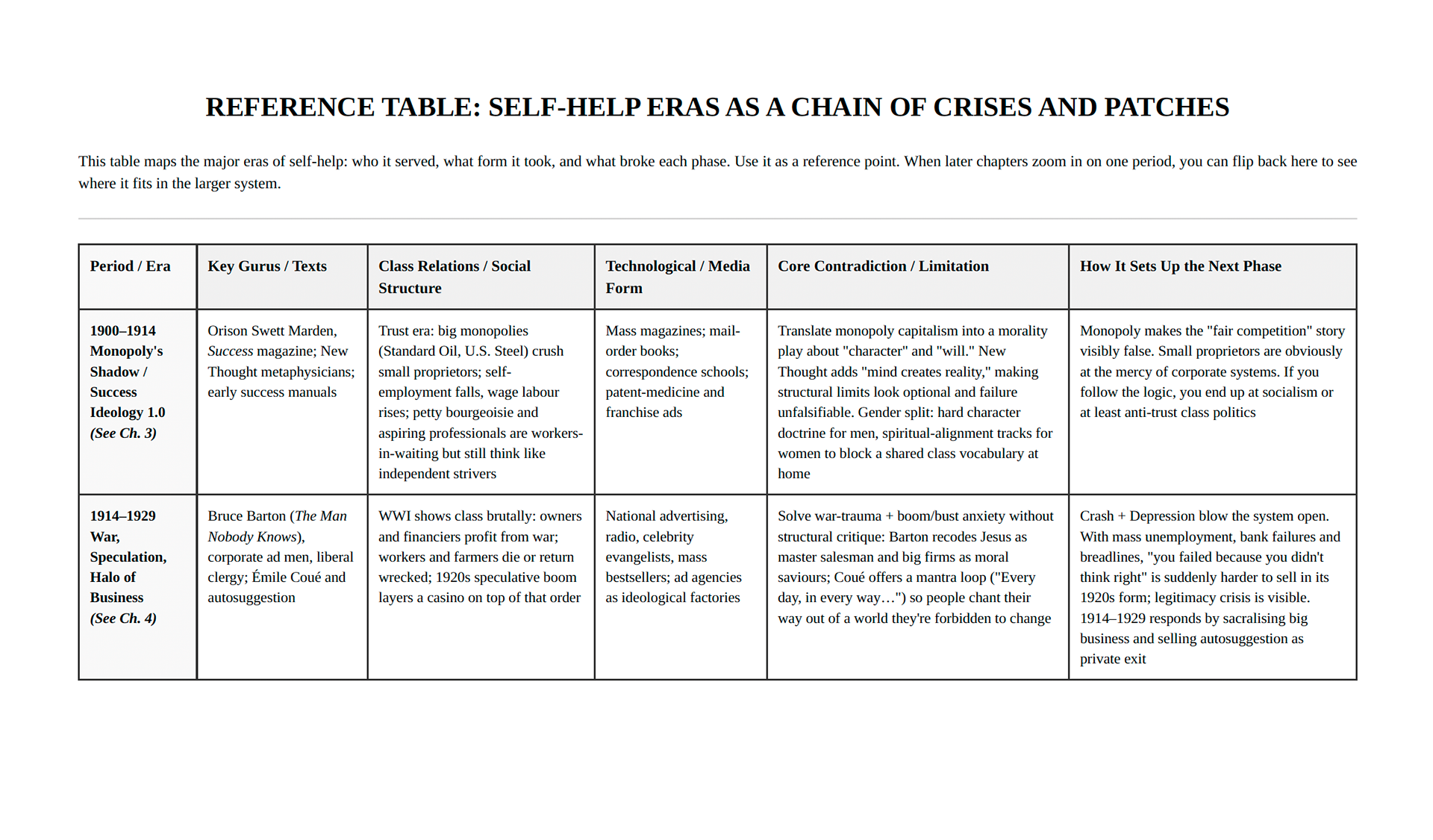
Monopoly and Mania (1900–1929)
The trust era created a problem. As Standard Oil and U.S. Steel swallowed whole industries, the independent proprietor discovered he wasn't facing competitors—he was living inside someone else's system. Self-employment fell, wage labour rose, and the petty bourgeoisie began to realise, half-consciously, that they were workers-in-waiting. Success literature exploded precisely here to stop that recognition. Orison Swett Marden's Success magazine offered a closed universe where outcomes were explained by "character" and "will," just as monopoly made those things largely irrelevant. New Thought fused in to provide the metaphysical engine: mind creates reality. Structural limits became optional; failure became unfalsifiable. You didn't get crushed by a trust—you didn't think right.
Then came war and speculation. World War I made the class structure violently obvious: owners profited from shells and uniforms, workers and farmers died or came home wrecked. The 1920s strapped a casino on top—stock bubbles, land scams, cheap credit. Self-help mutated to keep pace. Bruce Barton recast Jesus as master salesman and organisation-builder; his agency painted GE and U.S. Steel as benevolent civilisers. Émile Coué offered the pure mental escape hatch: autosuggestion as a way to chant yourself better in a world you're forbidden to change. The function was identical to Marden's: stop war-trauma and boom-bust anxiety from producing structural conclusions. Barton sacralised the system; Coué made it metaphysically optional. The petty bourgeoisie kept believing—until the crash blew the story open.
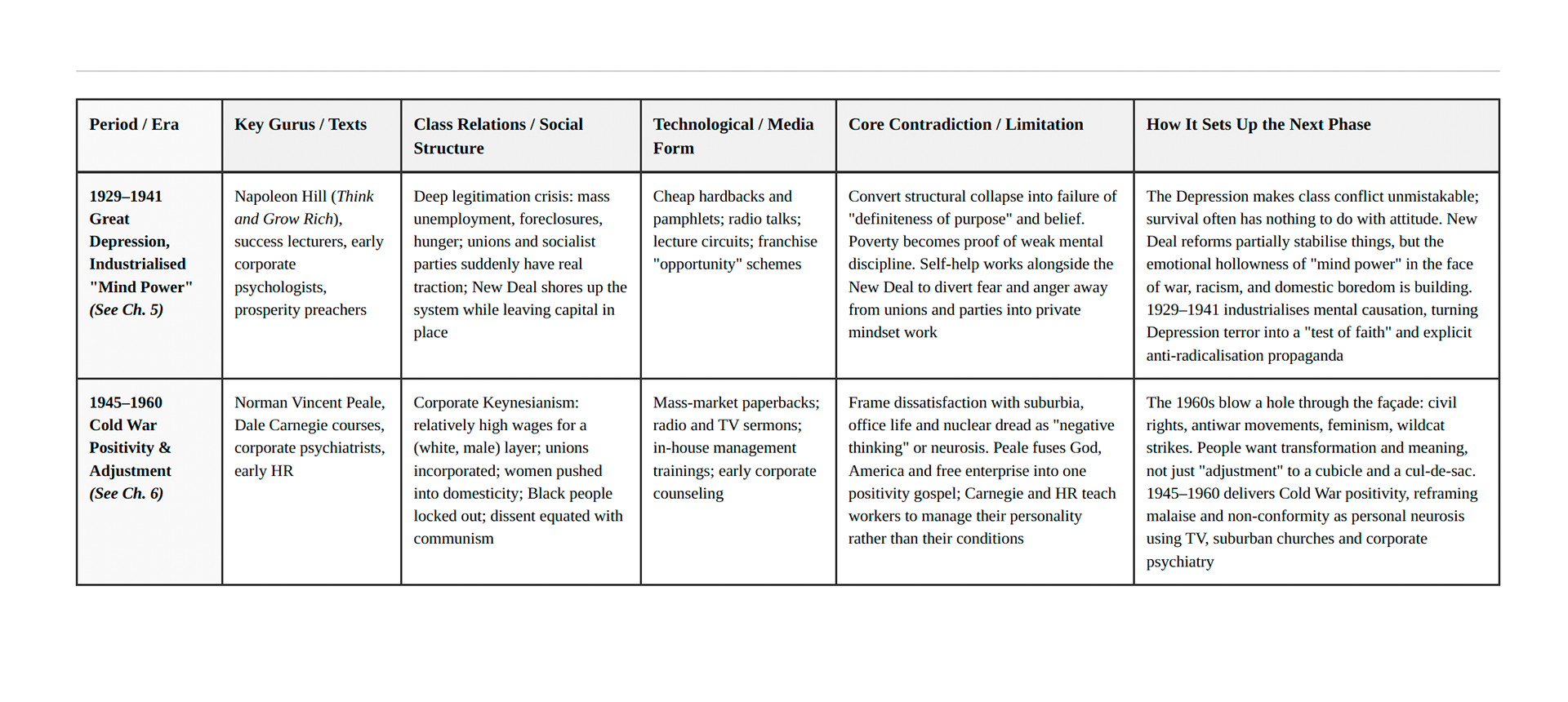
Depression and Cold War Discipline (1929–1960)
The Great Depression made class conflict unmistakable. Mass unemployment, breadlines, bank failures—a visible structural breakdown that should have made "you failed because of your mindset" impossible to sell. Instead, self-help industrialised. Napoleon Hill's Think and Grow Rich turned "positive thinking" and "definiteness of purpose" into a hardback franchise at the exact moment millions had no work at all. The crash became a test of faith, poverty a sign of inner failure, and the unemployed were told to study success more intensely. New Deal reforms shored up the system while leaving capital in place; Hill and his peers worked alongside, diverting fear and anger that might have gone to unions and socialist parties back into private "mindset work." The function was explicit anti-radicalisation: convert structural collapse into failure of belief.
The postwar settlement created a different problem. Corporate Keynesianism delivered high wages for a layer of mostly white, male workers—suburbs, TVs, cars in the driveway—and a hollow core no one was allowed to name. The structural deal incorporated unions, shunted women into domesticity, locked Black people out by design, and equated dissent with communism. The problem wasn't scarcity but the fact that abundance, hierarchy, and nuclear dread didn't add up to meaning. Norman Vincent Peale fused evangelical Christianity, patriotism, and prosperity into a single positivity gospel: doubt was sin, discontent ingratitude toward God and American capitalism alike. Dale Carnegie courses taught executives to smile and manage their "personality." Malaise became "negative thinking," non-conformity became neurosis. The petty bourgeoisie—now salaried, suburban, anxious—learned to blame their attitudes rather than their conditions. The 1960s would blow a hole through the façade.
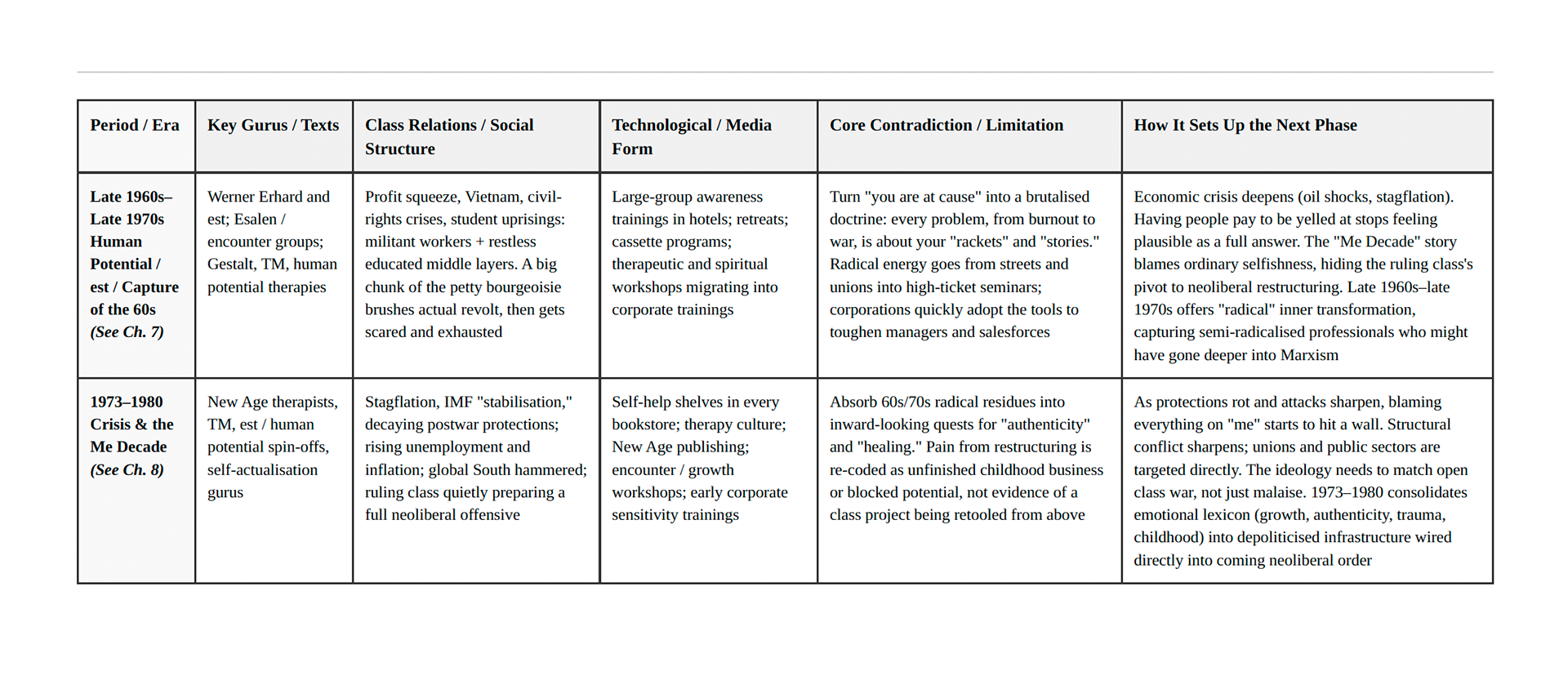
Capture and Consolidation (1960s–1980)
The late 1960s brought profit squeeze, Vietnam, civil-rights crises, and wildcat strikes. A whole layer of educated professionals and petty bourgeois youth briefly flirted with actual revolt. The human potential movement and est solved the problem for this restless middle stratum. Out of Esalen, encounter groups, and imported mysticism came a new product: transformation. Werner Erhard took New Thought metaphysics, behaviourist drill, and anti-authoritarian swagger, stripped out class and history, and sold a brutalised version of "you are at cause in the matter." Everything—war, exploitation, burnout—became a story about your "rackets" and "stories." Corporate America spotted the use-case fast: est migrated into management training and executive coaching. The same layer that might have gone deeper into Marxism instead paid to be yelled at in hotel ballrooms and sent back to work "reframed." Radical energy became high-ticket seminar content.
The 1970s profitability crisis—oil shocks, stagflation, collapsing postwar bargains—intensified the pressure. Real wages stalled, unemployment and inflation rose together, and the protections around wage labour began to rot. It was a moment when the system could have been forced in a different direction, if collective politics had survived. Instead, the human potential complex consolidated and soaked up the shock. Former radicals, burnt-out organisers, and anxious professionals all got handed the same script: the crisis is your blocked potential, your unfinished childhood, your unhealed trauma—not a class project being retooled from above. By 1980, the infrastructure was in place: a mass emotional lexicon that individualised pain, a depoliticised network of therapists, coaches, and publishers, and a story blaming ordinary people's "selfishness" instead of a ruling class preparing the ground for the neoliberal offensive ahead.
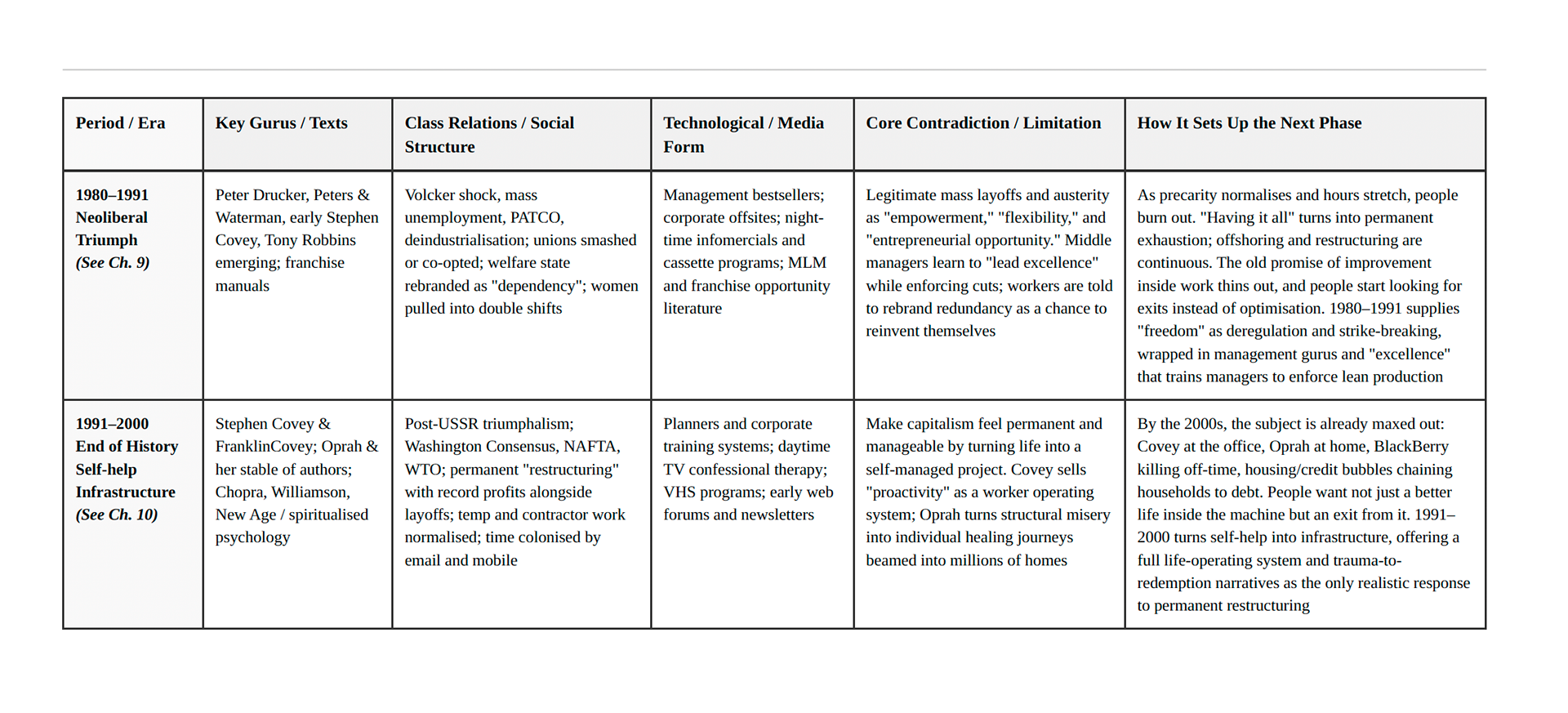
Neoliberal Triumph and the End of History (1980–2000)
The 1980s dropped the mask and called it freedom. The Volcker shock, mass unemployment, and strike-breaking reset the balance of forces; Reagan and Thatcher normalised permanent austerity, deregulation, and "there is no alternative." Deindustrialisation wiped out whole regions; lifetime jobs became temp contracts and rolling layoffs; the welfare state was rebranded as a dependency trap. Self-help mutated into full-spectrum performance ideology for this new order. Management gurus sold "excellence," "empowerment," and "intrapreneurship" to the professional-managerial layer now tasked with enforcing lean production. The same vocabulary—initiative, ownership, agility—covered wage cuts, speedups, and restructures. For workers facing redundancy, cassette empires and early infomercials pushed "personal power" and "state management," telling them to reframe terror as a chance to reinvent themselves. For women, "having it all" became the poisoned slogan: a double shift glossed as empowerment, with burnout presented as a scheduling problem.
The 1990s declared capitalism permanent. Fukuyama's "end of history" and the Soviet collapse locked in privatisation, deregulation, and global capital mobility while workers were told there was no alternative but to adapt. Restructuring became a standing condition: permanent downsizing, record layoffs amid record profits, longer hours, flat wages, exploding executive pay. Stephen Covey turned 7 Habits into corporate scripture—mission statements, planners, "proactivity" as a self-management operating system that transferred training and discipline onto individual workers. Oprah built a cross-platform therapeutic empire, manufacturing self-help celebrities and pumping trauma-to-redemption stories into millions of homes. Around them, a booming complex of EQ workshops, coaching, wellness programs, and New Age spirituality soaked up anxiety and sold inner work as the only realistic response to an unchangeable order. More hours, more insecurity, more money flowing upward—and a subjectivity that treated burnout and failure as proof something was wrong in you.
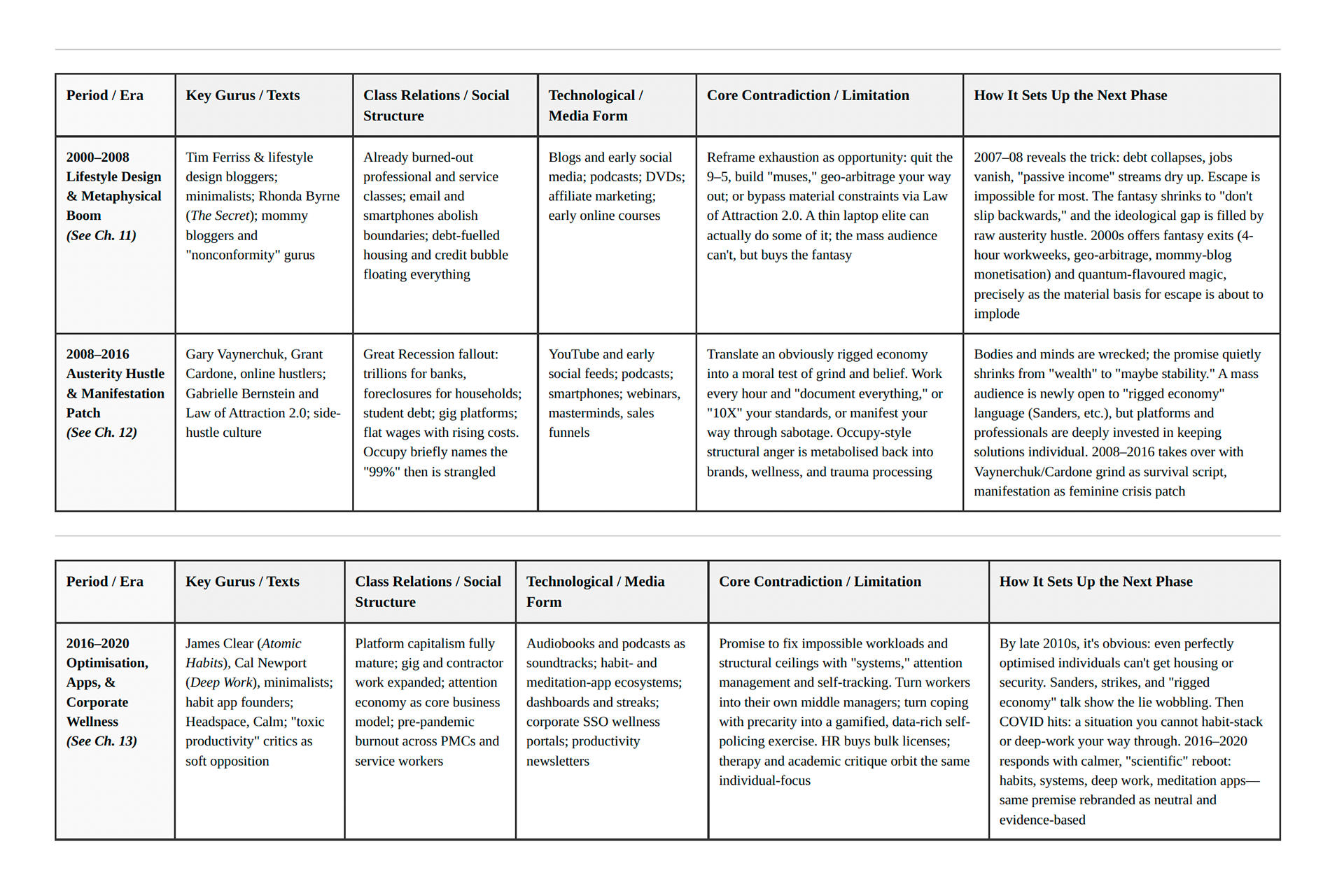
Escape Fantasy and Austerity Hustle (2000–2016)
By the 2000s, the self-help apparatus stopped promising improvement inside work and started selling escape from it—just as real exits were closing. Workers entered the decade already burned out: Covey at the office, Oprah at home, email abolishing any boundary between on and off, the housing bubble chaining households to ever-rising debts. Tim Ferriss and the lifestyle-design wave offered a fantasy of exit: geo-arbitrage, passive income, outsourced inboxes, mini-retirements. The model required cheap global labour and pre-existing advantage; it was sold downward to an exhausted mass who couldn't use it, functioning as a class filter that upgraded a thin laptop elite into mini-bosses while everyone else kept the system running. Around Ferriss, digital nomads arbitraged wages from Chiang Mai; minimalism blogs turned discontent into content; The Secret revived metaphysical get-rich-quick as quantum-flavoured wishcraft. Then the debt economy that underwrote the fantasy imploded in 2008. The material basis for escape vanished; the ideology remained.
The crash was a class lesson in broad daylight: trillions conjured for banks, millions of foreclosures, a "recovery" where the top one percent took almost everything. Out of the ruins of escape came austerity hustle. Gary Vaynerchuk sold endless grind framed as authenticity—document everything, never stop posting, treat your life as raw material—while quietly living off first-mover advantage and giant corporate clients. Grant Cardone was the pure death-drive version: 10X standards you couldn't possibly meet, a stacked product funnel, real-estate schemes where small investors took the risk. Both monetised the same layer: precarious petty bourgeois and downward-squeezed professionals trying not to slide, told that every failure was proof they didn't push hard enough. Platforms turned "work on yourself" into a 24/7 public performance with a scoreboard. Gabrielle Bernstein offered the soft-focus counterpart: manifestation as spiritual crisis-patch for millennial women drowning in debt and girlboss failure. Occupy flickered briefly—"99%" language, encampments, the obvious conclusion almost spoken—then was strangled, and hustle culture repurposed the fallout.
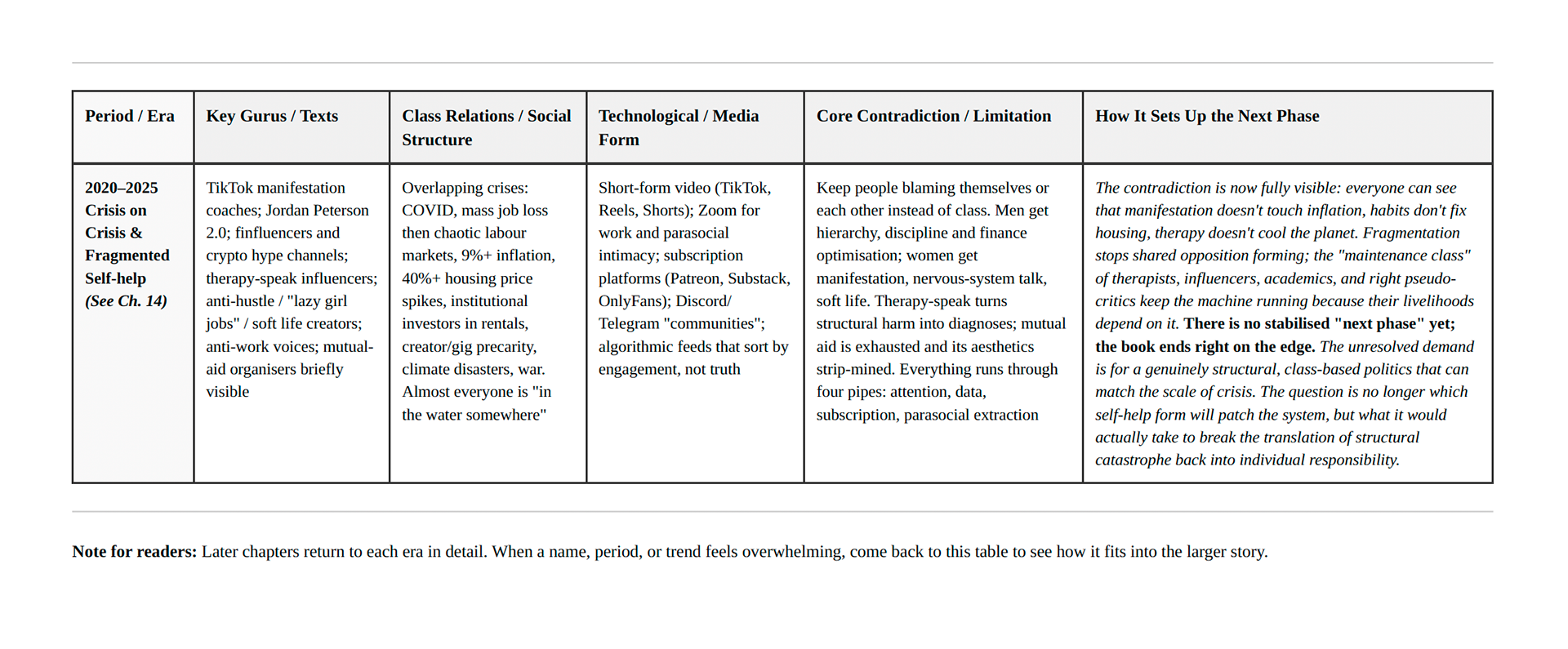
Optimisation and Fragmentation (2016–Present)
When "work harder" became obviously impossible, the ideology pivoted. Hustle's raw intensity got rebadged as optimisation: same premise, calmer narrators. James Clear's Atomic Habits offered "tiny changes" and "systems" to an exhausted professional class who did all the right things—degrees, unpaid internships, late emails—and still couldn't get what their parents got with less. Cal Newport told knowledge workers to treat attention as "career capital." Both located the problem inside the worker, not the workload. Habit apps gamified self-policing with streaks and badges; meditation apps used casino mechanics while talking about compassion. The apps didn't just train subjects—they harvested behavioural data on how people cope, teaching capital how far workers could be pushed and which narratives kept them self-regulating. HR loved it: deep-work trainings and Headspace subscriptions proved "we're addressing burnout" while changing nothing structural. By 2019, the promise had quietly shrunk from wealth to maybe stability, and Sanders briefly cut through with "rigged economy" language that named what optimisation wouldn't.
Then came 2020: pandemic, inflation, housing crisis, climate disasters stacked on top of each other. The scale made individual advice obviously absurd—you couldn't "system" your way through refrigerated morgue trucks. Self-help survived by fragmenting. Peterson offered authoritarian meaning for downwardly mobile men; manifestation TikTok sold magical hope when rational hope collapsed; finance influencers promised casino wins; anti-hustle coaches sold permission to stop as another product. Fragmentation prevented shared opposition from forming: you saw your niche and never saw mutual aid. Therapy-speak saturated everyday language—bosses as narcissists, poverty as "survival mode"—converting structural damage into diagnoses you manage, not conditions you organise against. The maintenance class of influencers, therapists, coaches, and critics all fed on the same crisis pool, apparently opposed on the surface but structurally bound to the same platform infrastructure, the same attention economy, the same function: keep the petty bourgeoisie blaming their habits, their mindset, their nervous system—anything but their class position.
Venice, 1786. Goethe stands at the edge of the lagoon looking at a ship that barely counts as a ship anymore. The Bucentaur: the state galley of the Venetian Doges. Forty metres of wood and gold leaf, built to move a few hundred metres on holy days and sit there glittering.
In his diary he calls it what it is:
“The ship is all ornament, so one may not say: overloaded with ornament, entirely gilded carving, otherwise useless, a true monstrance, to show the people their leaders as magnificent as possible. For we know: the people, just as they like to adorn their hats, also want to see their superiors splendidly and richly adorned.”¹
That last part was pure Goethe humour.
The point being, the ship isn’t about sailing, but display. A floating showcase for power: the rulers on deck, the crowd on the shore, everyone invited to feel that the splendour in front of them somehow belongs to them too.
The point being, the ship isn’t about sailing, but display. A floating showcase for power: the rulers on deck, the crowd on the shore, everyone invited to feel that the splendour in front of them somehow belongs to them too.
Once a year, on Ascension Day, the Doge rides this thing out to “marry” the sea. A ring into the water, a Latin line about everlasting dominion, centuries of ritual piled on a hull that by Goethe’s time is more relic than vessel. “Quite an item of inventory,” he notes – a theatrical prop for a republic already in decline. Within a decade French soldiers will strip the gold off it and turn the carcass into something closer to a gun platform. The empire rots; the ornament gets gutted.
Every dying ruling class builds its own Bucentaur.
The ornament changes. The job doesn’t.
Ours isn’t a barge.
Ours is the East Wing of the White House, being demolished, rebuilt as a ballroom, to be covered in gold and tacky hotel design.
Our splendidly adorned superior is Elon Musk, floated as the first possible trillionaire while he plays the markets like a meme page, fronting Dogecoin jokes. Talking, with a straight face, about his own Mars “Ascension Day,” giving voice to the bourgeoise fantasies that they will simply leave this rubble behind. All from the safety of NASA contracts, military deals and an electric car empire built in part on a shuttered plant and public money.
Our splendidly adorned superior is Elon Musk, floated as the first possible trillionaire while he plays the markets like a meme page, fronting Dogecoin jokes. Talking, with a straight face, about his own Mars “Ascension Day,” giving voice to the bourgeoise fantasies that they will simply leave this rubble behind. All from the safety of NASA contracts, military deals and an electric car empire built in part on a shuttered plant and public money.
The White House even named a cost-cutting unit the Department of Government Efficiency – DOGE – unironically giving its bureaucratic chainsaw the same name as his joke coin. He is sold as the ultimate self-made man while standing on deindustrialised ground, state support, and workers whose unions his companies fight tooth and nail.
Ours is also Donald Trump, failed casino owner turned reality-TV president, treating government as just another property to stamp his name on. The man who gold-plated everything he could touch, ran a fake “university,” then tried to cling to office through an attempted coup is now circling for another shot at turning the White House into a rentable backdrop. Plans for a lavish new ballroom complex on the grounds – a permanent party space for donors, reception lines and photo ops – are exactly the kind of static, glittering stage the Bucentaur was: a ceremonial room for a decaying order to congratulate itself while everything around it frays.
At one end of this order, Musk aims at a trillion while public services are cut to the bone in the name of “efficiency.” At the other, Trump promises greatness out of a building he’d happily reface in casino aesthetics. In between are the people watching all this from rentals, in casual jobs, juggling debts and panic, being told the problem is their attitude.
This is the American story stripped to its bones and exported everywhere: a frontier myth boiled down to personal grit, a settler creed of manifest destiny rewritten as “mindset” and “gumption,” now pumped through screens instead of sermons.
Open your phone. Scroll for thirty seconds.
A twenty-four-year-old in a rented room tells you the universe responds to your “vibration.” She knows because she “manifested” her apartment. The one she keeps by working three jobs and paying for groceries in instalments.
A man in a leased Tesla explains that you’re poor because you “think like a poor person.” His business is teaching people how he made money teaching people how he made money.
A wellness influencer offers “nervous system regulation techniques.” She doesn’t mention that your nervous system is reacting exactly as it should to the fact that one bad illness would wipe you out.
A former finance bro sells “abundance mindset” coaching. A thousand dollars for eight weeks. The “VIP proximity” tier costs more and sells out first.
A habit guru promises that tiny changes compound, just like interest. You already know how interest compounds. It’s on your student loans, your credit cards, the car you need to get to the job that doesn’t cover the loans, the cards, the car.
Scroll a little further and the feed splits.
For men: discipline, dominance, ice baths, a shaved-headed “performance coach” yelling into his phone in a car park about how pain is the only route to success.
For women: softness, healing, nervous-system care, a therapist explaining that rest is resistance. Different packaging, same message: your class problem is a personal problem, and here’s what to buy about it.
Between the coaches and the therapists, other tiles slip past. A map of opioid deaths gone the colour of dried blood. Another Covid wave written up like bad weather. Footage of armoured police in suburban streets. Clips from an attempted coup filed under “unrest” and left to scroll by.
Elon Musk on television calling Dogecoin “a hustle,” then a few years later buying Twitter with borrowed billions, renaming it X, firing the workers who pushed Trump off the platform after that coup attempt, and inviting the same currents back in the door. Donald Trump on a stage promising to “take back” the country he already tried to overturn, raising money off indictments while he talks about retribution beneath gold trim.
A podcast host says successful people wake at 5 a.m. You already wake at 5 a.m. You have a commute.
A therapist on TikTok says your boundaries aren’t firm enough. A productivity coach says your boundaries are why you’re not advancing. An astrologer blames Mercury. A life coach says you need to “get out of your own way.” A fitness influencer says discipline is freedom. A minimalist says your stuff is weighing you down. A manifestation coach says you’re blocking your blessings.
The app serves you another clip. And another. And another.
A lot of this doesn’t even need a screen.
In a chain hotel near the airport, two hundred people sit on plastic chairs in a ballroom that smells like carpet cleaner and coffee. A banner at the front shows a made-up company name and a logo that looks like a recycling symbol crossed with a sunrise. Under rented lights, a man in a slim-fit suit shouts that they are all “business owners” now.
The product this month is vitamins and skincare. Last year it was phone plans. Before that, cookware. The details change; the pitch doesn’t. Buy a starter pack. Recruit your friends. Climb the ranks. The slides flash photos of “Diamonds” and “Emeralds” standing in front of sports cars and holiday houses.
The script is part self-help, part sales meeting. You are the only one holding yourself back. Your friends who laugh at this are negative. Your family who worries about the debt are trapped in scarcity. If you’re not getting results, it’s because you don’t believe enough, haven’t “plugged into the system” enough, haven’t pushed through your limiting beliefs.
No one says the market is already saturated. No one says the people at the top make their money off the people at the bottom. No one says most of the room will leave with a garage full of unsold stock and a hole where their savings were. When it collapses, it will arrive pre-explained as your failure to think big.
This is the world according to self-help: your rent, your hours, your debts, your exhaustion, all rewritten as a story about your attitude.
By 2022, industry estimates were putting the U.S. self-improvement market alone at around thirteen billion dollars a year—books, coaching, seminars, apps, courses.² And that’s before you count the orbit of influencers who don’t even bother to call what they’re doing self-help.
If all of this leaves you dazed, burnt out and quietly furious, you’re not confused and you’re not alone. You’re seeing the story the industry is built to hide.
Work
In 2025, you’re exhausted.
Not because you lack discipline. You work more hours than your parents did, for less security than they had. Your phone keeps you half-on-shift every waking hour. You can be fired by email. “Flexibility” turned out to mean casual contracts, zero-hours scheduling and piecework disguised as freedom. Algorithmic timetables flick your shifts around; green and red numbers on a dashboard silently decide whether you’re “productive.” Warehouses run like punishment mazes. Delivery drivers piss in bottles. Office workers sink under email and Teams calls and “just jumping on a quick Zoom.” Prices climb. Your pay doesn’t.
The wall went up in the late 1970s. Since then, net productivity in the U.S. has risen roughly three to four times faster than typical workers’ pay; one major analysis put the gap at about 60 percent productivity growth versus roughly 16 percent pay growth between 1979 and 2019.⁵ That extra value didn’t evaporate. It flowed upward—into shareholder returns, buybacks, executive stock, soaring asset prices.
A layer of professionals and investors rode an asset boom and globalisation dividend—property, portfolios, partnerships—while the people who actually keep things running watched their real wages stall, their hours stretch, their security disappear.⁹
None of that reality makes it into the self-help aisle.
There you’re offered “burnout recovery.” “High-performance habits.” “Sunday reset routines.” You’re told to become the “CEO of your own life.” You get apps that track your steps, your sleep, your focus time, your “streaks”—Calm for your anxiety, Headspace for your thoughts, Notion and a dozen clones to map out your “ideal week.” More metrics, more self-surveillance, as if the central problem is your personal mismanagement, not the simple fact that three people now do what five used to and the targets keep climbing.
As the gap widens, the tone gets shriller. The more your time and security are stripped, the louder the cult of work-on-yourself shouts: optimise, hustle, build a brand, “outwork the competition.” The ruling layer leans harder on the story exactly when the numbers make it least believable. Inequality spikes; the pep talks get dumber and more aggressive to cover the distance.
When none of this fixes anything, the conclusion is preloaded: try harder. Upgrade your routine. Build a better morning. Book the productivity coach. The structure stays invisible; your stamina gets cross-examined.
Dread
In 2025, you are scared about the future.
You’re told that fear lives entirely in your biochemistry. Mental illness is real and treatment matters, but the dread isn’t falling out of a clear blue sky. Housing is locked behind speculation; wages stagnate; climate breakdown is no longer a model but smoke in your lungs and heatwaves that cook suburbs. New variants of old diseases circulate while governments talk about “personal responsibility.” Wars flare. Authoritarian laws slide through parliaments in the name of security. Regulators are staffed by ex-lobbyists. Whole institutions look openly captured. Under those conditions, not feeling anxious would be the strange reaction.¹⁰
At the top, people buy air filters, second passports, private clinics, climate bunkers, therapists on retainer. Everyone else gets content. As the material risks climb—fire seasons, flood zones, eviction waves—the gap between who can insulate themselves and who can’t widens, and the emotional load is quietly pushed downwards. Your dread becomes one more thing you’re meant to manage so the people writing policy and profit reports don’t have to—another unpaid job added to the pile.
But the way it’s sold back to you is always the same.
You’re fed “grounding exercises.” “Nervous system hacks.” “Anxiety as teacher.” You’re invited to sign up for breathwork subscriptions, cold plunge challenges, gratitude journals, magnesium blends and mushroom drinks promising “calm in a bottle.” Influencers tell you to log off the news and focus on “what you can control”: your breath, your routine, your mindset. The more the external world burns, the more content arrives urging you to perfect your inner fire extinguisher.
Your dread stops being a sane response to collapsing systems and becomes an individual technical issue, something to be managed alone with better rituals and a more expensive wellness stack. If you’re still scared, the implication is that you haven’t journaled hard enough, cold-plunged long enough, or optimised your sleep score properly.
Across housing, work, and the future itself, the same conversion happens: structural reality turned into a personal riddle; collective conditions turned into private neurosis; political questions turned into therapeutic tasks. That’s how the story gets rewritten.
The Office Version
The conference room has natural light and ergonomic chairs and a framed poster that says TEAMWORK in sans serif above a stock photo of rowers cutting through mist. There’s a fruit platter, bad coffee in metal urns, and a stack of branded notebooks no one asked for. The calendar invite called this a “wellbeing session.”
Fifty years ago, the same wall would’ve had a “Hang in there” cat clinging to a branch, promising that persistence would save you. A decade or two later it was Sylvester Stallone’s Rocky mid-punishment run, or Michael Jordan suspended in air on a glossy Nike print—the heroic individual who stayed politely out of politics and only let the behind-the-scenes story out decades later as a tightly controlled victory lap. Then came Lance Armstrong: yellow wristbands, shaved head, the cyclist who turned out to be running a small empire of doping, bullying and lying. One by one, the specific heroes collapsed; the posters disappeared. What’s left now is something vaguer—a misty stock image of anonymous rowers, no names, no faces. But in the bottom corner of the new canvas, very small and very clear, the logo still remains.
In January, the company laid off fifteen percent of the workforce. The share price jumped. The people in this room are doing their old jobs and the jobs of the people who got cut. The CEO’s compensation is a few hundred times the median salary and went up the same quarter the cuts went through. HR sent out an email reminding staff that “discussing individual remuneration is unprofessional and may create a hostile environment.”
Next to the door is a faded poster from last year’s R U OK? Day. Candid shots of executives in yellow T-shirts smiling for the intranet while the restructure was already being modelled in a spreadsheet. This month’s internal newsletter runs a feature on “finding your flow at work”—tips on time-blocking and deep-focus playlists to help you lose track of time while you burn unpaid hours into the night.
At the front stands a consultant in her forties. Lanyard, slide deck, wireless clicker. Her bio on the company website describes her as a “neuroscience-informed resilience expert.” She lists three published papers in wellness journals whose mastheads are quietly sponsored by a pharmaceutical giant and a couple of corporate HR associations. Her work is not regulated the way actual clinical practice is. She is here to teach “resilience.”
Resilience, she explains, is the ability to bounce back from adversity. Some people are naturally more resilient, but the good news is it’s a skill. She is going to share tools: breathing techniques, reframing techniques, gratitude techniques. She has a slide about “micro-practices you can use between back-to-back meetings” and another about “staying in flow even when targets shift.” Become the kind of person who thrives under pressure, she says, because pressure isn’t going anywhere—but your response is up to you.
There is no slide that says: the pressure is a management decision.
No one mentions that fifteen percent of the workforce did not vanish in an act of God. No one points out that the main “adversity” in these people’s lives was a deliberate choice by executives who were paid bonuses for making it. No one suggests an alternative technique called “rehiring staff and cutting the CEO’s stock grant.”
Pinned to the back wall is another notice: complimentary coffee will be discontinued from next month as “part of our sustainability and cost-optimisation journey.” Beneath it, a new cleaning roster asks staff to “take collective ownership of kitchen hygiene,” because the night-shift janitor was quietly let go after joking about the president on Twitter and being flagged in an automated social-media scan. HR holds lunch-and-learns about “digital footprint” and “brand-safe behaviour,” while software quietly scrapes your Instagram, your LinkedIn, anything tied to your name.
Down the hall, a group of unpaid interns is packing gift bags for a client event.
Their six months of full-time work is officially called a “development opportunity.” It used to be called what it is—labour with no wage—but now it’s a “foot in the door.” The foot isn’t in the door; it’s somewhere else entirely. You get the idea.
The people in the conference room don’t say any of this because they need the job. They saw what happened to the colleagues who didn’t make it past January. They know HR can see who’s “not fully engaged” from the participation data. They have spent their entire adult lives being told that their career is their responsibility, their trajectory is their personal brand, their fate is a reflection of their mindset, their habits, their hustle. You can’t pay the mortgage with an accurate structural analysis, but you can lose the mortgage if you voice it in the wrong room.
The consultant hands out a worksheet printed on thick pastel paper. In the middle is a big, cartoonish Venn diagram labelled, in friendly rounded font:
WHAT YOU CAN CONTROL / WHAT YOU CAN’T
Around it are example lists, laid out like it’s a lesson for ten-year-olds.
On the “CAN’T CONTROL” side:
• The economy
• Company decisions
• Other people’s behaviour
• Global events
On the “CAN CONTROL” side:
• Your attitude
• Your effort
• Your self-talk
• Your resilience practices
There’s a little illustration of a smiling stick figure standing calmly while storm clouds rage around them.
The headline message is tidy: focus on what you can control.
The real message is louder: stop looking at the things you’re not meant to touch. Don’t think about who writes the contracts, who sets the targets, who decided one person would now be doing two people’s jobs. Don’t think about why housing is unaffordable, why healthcare is tied to employment, why your “performance” now quietly includes free overtime and permanent availability on your phone.
This isn’t wellness. It’s a low-voltage loyalty ritual spoken in the language of therapy. You’re not being asked to sign an oath; you’re being asked to nod along while the oath is smuggled into the slides. The company pays for it because it’s cheaper than paying you more, hiring enough staff, or giving real security. The consultant sells it because there’s a boom market in turning structural damage into “mindset work.” You show up because attendance isn’t optional, and because declining an invitation to “take ownership of your wellbeing” looks like a performance issue.
By the end, most people have at least pretended to agree. They’ve filled in the worksheet, shared a “reframe,” written something in the “I commit to…” box. Even if they don’t believe it, they’ve spoken the words out loud, signed their name at the bottom. That’s how this kind of thing works: repeat the script often enough, under soft threat, and the line between what you say to keep your job and what you start to half-believe blurs.
And somewhere in the room, someone feels a small, sharp flicker of shame.
Maybe my attitude is the problem.
Maybe if I were more resilient, more positive, more grateful, this wouldn’t feel like drowning—it would feel like growth.
They write something obedient in the “I commit to…” box, because what else are they meant to do.
In that moment, what you’re living through stops being exploitation and gets rebranded as “a personal development opportunity” you supposedly chose.
Why People Keep Choosing It
This is where the lazy commentary usually stops: look at these suckers, buying crystal water bottles and productivity planners. That’s not what this book is doing.
The people who buy self-help are not idiots. They’re making calculations under pressure.
Therapy is expensive, waitlisted, and often impossible to get unless you have money, time, and the right postcode. Public mental health services are gutted. Private therapy can swallow a month’s rent, sometimes two.
The old organisations that were supposed to fight for workers haven’t just been weakened; they’ve been converted into part of the management structure.
In sector after sector, the unions now exist as large, well-paid bureaucracies sitting on top of shrinking, demoralised memberships. Officials draw six-figure salaries, sit on boards and government advisory bodies, and negotiate “partnership” deals with employers. Their revenue is tied as much to state-sanctioned arrangements and automatic payroll deductions as to any living, fighting base.
When factories close, when hospitals are privatised, when wages are held below inflation, they manage the process: run the “consultations,” police the anger, sell the settlement. It’s a career ladder now—today’s union secretary is tomorrow’s Labor MP, HR executive, or corporate director. Compared to this respectable circuitry, the old mafia strongman skimming off a dockworkers’ local looks almost straightforward. At least everyone knew whose side he was on.
Most people under forty haven’t seen a union lead a real, defiant struggle. What they have seen is union officials standing next to the CEO in a press conference announcing “difficult but necessary changes,” or telling members there is “no legal avenue” to resist.
The parties that once claimed to represent workers are no better. They operate as management teams for capitalism, spending most of their energy courting donors, soothing markets, and hiring consultants to test slogans on focus groups. The big mass organisations that once gave people a sense of collective leverage—parties, unions, clubs, associations—survive mostly as shells: letterheads and staffed offices wrapped around a professional bureaucracy, not fighting bodies.
You will see almost none of this named plainly. In the news, it shows up as “tough but necessary reforms” and “shared sacrifice.” In academia, it dissolves into neutral phrases about “stakeholders,” “social partners,” and “governance.” The conversion of unions and parties into instruments for managing the workforce is treated as a natural evolution, not a disaster.
Self-help, by contrast, is on every surface.
You can get it as a cheap paperback in the airport, a TikTok video in bed at 2 a.m., a sixty-dollar course, a subscription app that bills you monthly. You can consume it alone, in your headphones, without telling anyone. You don’t have to sit in a meeting. You don’t have to argue with anyone. You don’t have to risk being labelled “difficult” at work. You don’t have to put your name on a petition that lives on the company’s servers forever.
You also don’t have to admit defeat. Self-help lets you feel like you’re doing something. You’re making a plan, building a habit, working on your mindset. That feeling of motion is worth a lot when every other avenue you can see is blocked, dangerous, or simply invisible.
Under conditions where collective action is punished or neutered, where the official organisations of the working class tell you there is “no alternative,” and where individual grind is endlessly celebrated and marketed, choosing self-help is not irrational. It’s the obvious move. It’s the safest move. That’s what makes it so effective.
It gives you a way to respond to class conditions without ever saying “class.”
Self-help offers a way to manage life as a worker or lower-middle-class person—tired, indebted, anxious—without adopting a working-class identity. You don’t have to see yourself as part of a class that might fight. You get to see yourself as a temporarily stalled success story.
Your position becomes a glitch your mindset will eventually fix, not a shared condition that would require solidarity. You can keep aspiring to escape, not organise. You can keep imagining that you’ll graduate out of your class, not admit you’re in it.
That is why self-help keeps beating the things that might actually change your situation. Not because it’s truer or kinder or more effective, but because, in the world as it is, it asks less of you, exposes you less, and flatters you more than anything collective on offer.
Academia, in theory, should be better. Universities are full of people who know the statistics, teach the history, understand the graphs. They know exactly what’s happened to wages, rents, health systems, pensions. They know the words for it.
What most of them do instead is turn all of this into something to analyse, not something to fight.
A whole wave of theory—sold under brands like “postmodernism” and “post-structuralism”—spent decades eroding the idea that anything could be simply true or false. Under that lens, everything becomes “discourse” and “narrative.” A book telling you to manifest rent money and a report on wage theft are just two “texts” to interpret. One is not a lie and the other a receipt; they’re just “different ways of constructing reality.”
If you’re a working academic, this is a comfortable place to live. You get to write papers about “the self-help subject” and “neoliberal rationalities of the self.” You get grants, conferences, journal articles. You get to show how clever you are at decoding the slogans. You do not have to say: this is a fraud on millions of people; the culprits are here, here and here; they should be opposed, not interpreted.
From the outside, it looks like this: thousands of pages written about the self-help boom, almost nothing that calls it what it is in plain language and names who benefits. A whole layer of intellectuals paid to put the thing under glass, not to break it.
The NGO layer is where politics goes to be cushioned.
On the surface, NGOs and “social impact organisations” look like the answer: climate groups, gender-equity groups, anti-poverty groups, human-rights outfits. Their websites talk about justice and inclusion. Their launch events are full of words like “empowerment” and “community.”
Look at how they’re built and funded, and the picture shifts. Many of the biggest NGOs are staffed by well-paid professionals in capital cities, funded by foundations and philanthropies whose money comes from the same corporations and fortunes that wrecked public services in the first place. Their boards are packed with ex-politicians, ex-consultants, ex-executives. Their survival depends on not seriously threatening the donors’ interests.
That’s why so much of their “action” ends up as carefully controlled campaigns that steer anger away from class. You get petitions. Awareness weeks. Carefully worded policy submissions. You get endless talk about “resilience” and “community healing” and “empowering marginalised voices.” You do not get calls for coordinated strikes, expropriation, nationalisation, or any move that would actually hit profits.
In workplace politics, the same layer turns righteous anger into something safe. You’re urged to form a “wellbeing committee,” not a rank-and-file committee. You’re invited to a lunchtime talk on “trauma-informed leadership,” not a meeting about walking off the job. You’re pointed towards yoga, mindfulness, “rest is resistance” and “self-care as political act”—everything except solidarity.
The professional middle-class “left” that orbits this world—the festival speakers, podcast hosts, authors of tasteful critique—plays its part. They acknowledge the pain. They talk about burnout, precarity, mental health. Then they recycle it into ever more refined forms of self-management: better boundaries, better communication, better coping strategies. The idea that your main problem is your boss and the system he represents, not your “communication style,” never quite makes it onto the program.
The net effect is simple: anger is never allowed to settle on capital. It’s redirected inward, sideways, or into another workshop.
Into that vacuum walks the far right.
Far-right figures do one thing the respectable “centre-left” avoids: they name the anger. They say the economy is rigged. They say young men are being humiliated. They say ordinary people have been betrayed and sold out. On those points, they’re telling the truth.
Then they hand you the wrong culprit.
For one version of how it works, open a browser.
A nineteen-year-old searches YouTube for “how to be more confident.” He finds videos about posture, speaking clearly, turning off his phone. Harmless enough. The sidebar suggests “productivity hacks,” “no-fap benefits,” “how to stop being a loser.” He clicks.
Within a week his recommendations are full of men in tight T-shirts talking about “high-value males,” “female nature,” “weak soy boys,” “real masculinity.” Studies of YouTube’s recommendation system have found that it often nudges users toward more extreme or polarising content over time, especially around politics and gender.⁸ The pipeline is built in. They tell him his feelings of failure are real. They validate the humiliation, the sense of being left behind. Then they glue that anger onto women, queer people, migrants, “globalists”—anyone except the people who actually own and run anything.
The production values are good. The microphones are clean. The language mixes gym talk, war talk and self-help clichés: discipline, grind, becoming the best version of yourself. It feels like he’s finally being told the truth. What he isn’t being told is who actually took his future.
In different corners, other far-right currents do the same. Televangelists fuse prosperity gospel with nationalism. Conspiracy channels mix self-reliance rhetoric with paranoia about “global elites” and “degenerates.” Lifestyle influencers pivot from “optimise your mindset” to “defend your civilisation.”
They all feed on the same pool of disappointment that mainstream politics, the academic “critique” industry, and the NGO world have refused to address.
The centre and the NGO layer tell people to process their trauma and be kind to themselves. The far right tells them their rage is justified and misdirects it downwards. Both keep the economic structure intact.
One numbs the pain and sells you candles. The other weaponises the pain and points it at the wrong targets. Neither one touches the people who are actually in charge.
A Long Line of Gurus
What you’re seeing in 2025 is just the latest costume change.
Self-help as an industry grew up alongside monopoly capitalism in the early 1900s. The early writers promised “Success” to salesmen, clerks, would-be managers. They aimed straight at the lower middle class—the people terrified of falling into the working class and desperate for a ladder out. As profits concentrated and the gap between capital and labour widened across the twentieth century, the promises got bigger and the tone got louder, but the basic pitch never moved: history is unstable; your status doesn’t have to be, if you work on yourself hard enough.
The delivery systems have rotated ever since: magazine columns, hardbacks, radio sermons, mail-order courses, hotel seminars, multi-level marketing schemes, cassette programmes, infomercials, blogs, YouTube channels, email funnels, apps, Zoom masterminds. Different technologies, same proposition: sell people a way to cope with the very order that’s chewing them up.
Picture a different screen, two generations back.
It’s 2:15 a.m. in the early 1990s. A laid-off factory worker is half-asleep in front of the television. The movie ended an hour ago. Now a man in a blue blazer stands in front of a fake mahogany bookshelf. Behind him, a wall of cassette tapes glows under studio lights.
The man talks about “total personal power.” He says the economy is changing and old promises no longer apply, but the good news is you can “retrain your mind for success.”
Testimonials flash past: people who were broke and now “thriving,” people who were “lost” and now “on fire.” At the bottom of the screen: a phone number, a price, three easy payments, call now.
Nothing in the programme will reopen the factory that just shut after an “efficiency drive,” or bring back the warehouse a restructuring memo reclassified as “excess capacity,” or reverse the decision in some distant boardroom to move the call centre to a cheaper labour market overseas.
But the script is identical to the feed a generation later: the real action is inside your head. History is an excuse. Your thoughts are the lever.
On Sundays, the same story gets told under a cross.
In a converted sports arena, a pastor in a designer hoodie and white sneakers walks back and forth across a stage the size of a small car park. Giant screens show his face beaming. Behind him, a band holds a shimmering chord. He talks about “favour,” “harvest,” “breakthrough.”
God, he says, wants you to prosper.
If you’re struggling, it might be a “season,” but it might also be unbelief. Old patterns. Negative confession.
He invites the crowd to “sow a seed” as an act of faith. Buckets and card readers move down the rows.
Outside, volunteers queue for food banks that don’t get a tax break; inside, the church’s “non-profit” status covers the light show and the pastor’s second house.
The people giving are not idiots.
Many are behind on bills, juggling casual work, trying to keep children fed. What they’re being offered is the same bargain as any other self-help: the problem is between you and the blessing, not between you and your landlord, your boss, your government.
If the blessing doesn’t come, the explanation is ready-made. You didn’t believe hard enough. You weren’t faithful enough. It is never the pastor, never the politics that produced the situation in the first place.
The names change: Marden, Hill, Carnegie, Peale, Clement Stone, Erhard, Robbins, Oprah, Ferriss, Peterson, and a thousand mid-tier “coaches” and “thought leaders” you’ll struggle to remember ten years from now. Trump University slots neatly into this line: a real-estate con man running a “success” seminar racket for people already in over their heads.
The slogans change: character, positive thinking, peak performance, optimisation, authenticity, wellness, “alignment.”
The forms change: magazine, book, cassette, infomercial, webinar, app, TikTok.
The class reality underneath does not.
The function stays the same: whatever is happening to you is mostly about you—and the way out is to work on yourself.
When the Story Stops Fitting
There is one problem for this whole industry: reality.
Housing costs are not a mindset issue. When the median dwelling is eight or nine times median income in whole countries, and more than thirteen times income in some cities, the problem is not your latte habit or your “scarcity thinking.”³ It’s landlords, banks, tax law, and financial institutions buying whole neighbourhoods as assets. The numbers don’t care about your journaling.
Healthcare tied to employment is not a wellness problem. When losing your job means losing your medication, the solution is not breathwork. When GoFundMe doubles as a national health system and medical bills are a leading cause of bankruptcy in one of the richest countries on earth, the issue is not that you “failed to invest in self-care.”⁶
Wage stagnation is not a motivation issue. When net productivity rises several times faster than pay over forty years, that gap is stolen time and stolen value.⁵ You did your part. Someone else took the difference.
People know, at some level, that this is rigged. One survey in 2020 found about seventy percent of adults in the United States saying the economic system unfairly favours powerful interests.⁷
Other polls across the decade show similar majorities who think corporations and the wealthy have too much influence and ordinary people have too little. People feel the floor moving.
You can’t hide that forever behind vision boards and productivity planners.
So where’s the opposition? Who actually says, out loud, that these are class problems—that the people at the top built systems to keep it this way, and intend to keep it this way?
On paper, there are whole layers of society whose job should be exactly that. Social democrats. Union officials. NGOs. Academics. The official “left.” In practice, they specialise in not doing it.
Liberals are very comfortable mocking the surface of self-help. They roll their eyes at crystals, vision boards, hustle-bro TikToks and manifestation sound baths. Late-night hosts get monologues out of it. Opinion writers file columns about how silly it all is. What they almost never touch is the class role. That would mean admitting their own careers sit on top of the same economic order that makes people desperate enough to buy this stuff.
It’s easy to sneer at a woman paying for “money mindset” coaching; it’s harder to explain why your government left housing to the market for thirty years and handed whole suburbs to private equity. It’s easy to joke about a guy yelling “discipline” into his phone from a car park; harder to explain the bipartisan laws that gutted job security and unions. So the joke stops before it hits the people who wrote the rules.
Academia, in theory, should be better. Universities are full of people who know the statistics, teach the history, understand the graphs. They know exactly what’s happened to wages, rents, health systems, pensions. They know the words for it.
What most of them do instead is turn all of this into something to analyse, not something to fight.
A whole wave of theory—sold under brands like “postmodernism” and “post-structuralism”—spent decades eroding the idea that anything could be simply true or false. Under that lens, everything becomes “discourse” and “narrative.” A book telling you to manifest rent money and a report on wage theft are just two “texts” to interpret. One is not a lie and the other a receipt; they’re just “different ways of constructing reality.”
If you’re a working academic, this is a comfortable place to live. You get to write papers about “the self-help subject” and “neoliberal rationalities of the self.” You get grants, conferences, journal articles. You get to show how clever you are at decoding the slogans. You do not have to say: this is a fraud on millions of people; the culprits are here, here and here; they should be opposed, not interpreted.
From the outside, it looks like this: thousands of pages written about the self-help boom, almost nothing that calls it what it is in plain language and names who benefits. A whole layer of intellectuals paid to put the thing under glass, not to break it.
The NGO layer is where politics goes to be cushioned.
On the surface, NGOs and “social impact organisations” look like the answer: climate groups, gender-equity groups, anti-poverty groups, human-rights outfits. Their websites talk about justice and inclusion. Their launch events are full of words like “empowerment” and “community.”
Look at how they’re built and funded, and the picture shifts. Many of the biggest NGOs are staffed by well-paid professionals in capital cities, funded by foundations and philanthropies whose money comes from the same corporations and fortunes that wrecked public services in the first place. Their boards are packed with ex-politicians, ex-consultants, ex-executives. Their survival depends on not seriously threatening the donors’ interests.
That’s why so much of their “action” ends up as carefully controlled campaigns that steer anger away from class. You get petitions. Awareness weeks. Carefully worded policy submissions. You get endless talk about “resilience” and “community healing” and “empowering marginalised voices.” You do not get calls for coordinated strikes, expropriation, nationalisation, or any move that would actually hit profits.
In workplace politics, the same layer turns righteous anger into something safe. You’re urged to form a “wellbeing committee,” not a rank-and-file committee. You’re invited to a lunchtime talk on “trauma-informed leadership,” not a meeting about walking off the job. You’re pointed towards yoga, mindfulness, “rest is resistance” and “self-care as political act”—everything except solidarity.
The professional middle-class “left” that orbits this world—the festival speakers, podcast hosts, authors of tasteful critique—plays its part. They acknowledge the pain. They talk about burnout, precarity, mental health. Then they recycle it into ever more refined forms of self-management: better boundaries, better communication, better coping strategies. The idea that your main problem is your boss and the system he represents, not your “communication style,” never quite makes it onto the program.
The net effect is simple: anger is never allowed to settle on capital. It’s redirected inward, sideways, or into another workshop.
Into that vacuum walks the far right.
Far-right figures do one thing the respectable “centre-left” avoids: they name the anger. They say the economy is rigged. They say young men are being humiliated. They say ordinary people have been betrayed and sold out. On those points, they’re telling the truth.
Then they hand you the wrong culprit.
For one version of how it works, open a browser.
A nineteen-year-old searches YouTube for “how to be more confident.” He finds videos about posture, speaking clearly, turning off his phone. Harmless enough. The sidebar suggests “productivity hacks,” “no-fap benefits,” “how to stop being a loser.” He clicks.
Within a week his recommendations are full of men in tight T-shirts talking about “high-value males,” “female nature,” “weak soy boys,” “real masculinity.” Studies of YouTube’s recommendation system have found that it often nudges users toward more extreme or polarising content over time, especially around politics and gender.⁸ The pipeline is built in. They tell him his feelings of failure are real. They validate the humiliation, the sense of being left behind. Then they glue that anger onto women, queer people, migrants, “globalists”—anyone except the people who actually own and run anything.
The production values are good. The microphones are clean. The language mixes gym talk, war talk and self-help clichés: discipline, grind, becoming the best version of yourself. It feels like he’s finally being told the truth. What he isn’t being told is who actually took his future.
In different corners, other far-right currents do the same. Televangelists fuse prosperity gospel with nationalism. Conspiracy channels mix self-reliance rhetoric with paranoia about “global elites” and “degenerates.” Lifestyle influencers pivot from “optimise your mindset” to “defend your civilisation.”
They all feed on the same pool of disappointment that mainstream politics, the academic “critique” industry, and the NGO world have refused to address.
The centre and the NGO layer tell people to process their trauma and be kind to themselves. The far right tells them their rage is justified and misdirects it downwards. Both keep the economic structure intact.
One numbs the pain and sells you candles. The other weaponises the pain and points it at the wrong targets. Neither one touches the people who are actually in charge.
What This Book Is Going to Do
This book is about self-help as a way of managing class conflict without ever naming class.
It starts from something simple: the people buying these books and apps are not stupid. They are not the problem. They are doing what people have always done under pressure: grabbing whatever looks like a rope when they’re already halfway down the well. Exhaustion, debt, humiliation at work, a sense that their life is being wasted—those are real. In a world where the official organisations of the working class have been gutted or turned into management, and open struggle is punished, you reach for whatever tools are visible and socially acceptable.
Self-help is visible.
It is respectable.
It is cheap next to therapy and far safer than open conflict with your boss or your landlord.
Seen from the inside, reaching for a book, an app, a course is a rational move. You’re stuck, nobody’s offering you a serious collective way out, so you look for something you can do alone that doesn’t risk getting you fired or evicted.
That’s the trap: the “sensible” choice is the one that keeps the order running.
The people selling this stuff are not wise guides; they’re closer to Ponzi operators and travelling snake-oil salesmen, updated for a world of apps and HR slides. They live off the same structure that is chewing their audience up. The people buying in are victims in exactly the sense that victims of pyramid schemes and fake tonics are victims: lied to, blamed for the failure of the scam, then left to carry the debt and the shame while the operator walks away with the money.
This book is written on their side. It is not another gentle “critique” that says the tone is a bit harsh or the boundaries are a bit leaky. It is an attempt to strip the respectability off the whole edifice—to name, in plain language, who is doing what to whom, why they exist, how they get away with it, and what it would take to stop them. The collaborators and fake critics—the liberals, academics, NGOs and “left” brands who sand down the edges and keep the anger safely managed—are part of that story and will be treated as such.
Across twelve chapters, this book tracks how the “work on yourself” story has been packaged and sold for roughly 125 years:
• from early 1900s “Success” writers selling character and willpower to nervous clerks and salesmen,
• through Depression-era confidence men promising prosperity in a world of breadlines,
• Cold War positive thinkers telling people to smile through layoffs and nuclear terror,
• post-war management psychology training office workers to adjust to the cubicle,
• New Age prosperity preachers blending crystals with credit,
• 80s–90s infomercial empires selling “Total Personal Power” at 2 a.m.,
• corporate coaching and wellness programmes wired into HR,
• megachurch prosperity gospel,
• and finally the platform era of TikTok therapists, hustle bros and abundance coaches filling your feed.
Each period is treated as a specific set of material conditions and a specific kind of story told about those conditions. In every case, the questions are the same:
• Who were the key figures?
• What were they actually selling—not just in content, but in behaviour, obedience and belief?
• How did their message fit the needs of employers, landlords, banks and politicians at that moment?
• How did they help keep alive the idea that your fate comes down to your mindset, not your position in an order built by other people?
The book also tracks the people and institutions who should have fought this and mostly didn’t.
The liberals who sneer at crystals and hustle bros while reproducing the same individualism in their politics.
The academics who put self-help under glass as “discourse” instead of treating it as a weapon aimed at their students and their own lives.
The professional “left” that meets every crisis with another round of private coping: self-care, healing work, retreats—anything except coordinated action.
And the far-right currents waiting just offstage, ready to catch the people who feel that self-help isn’t working but can’t see anything beyond it—offering them a new script where the scam isn’t the individualism, it’s that the wrong people, the “weak” and the “degenerate,” were running it. The same grind, the same self-blame, now dipped in flag colours and resentment.
This book is not an attempt to write “better” or “more ethical” self-help. There is a whole mini-industry of that already: anti-hustle self-help, trauma-informed self-help, “leftist” self-help that swaps crystals for critical theory citations and leaves the basic premise untouched.
The premise is the problem.
By the time you reach the end, you should find it very hard to swallow the idea that your problems are private glitches you can fix with a better routine. You should be able to see the pattern:
• how you were trained to experience class conditions as personal failings,
• how every failure gets recycled as a reason to buy another fix,
• how the same small circle of interests—bosses, landlords, banks, platforms, parties—sits behind the books, the apps, the seminars and the “wellbeing” days,
• and how much of your life has already been spent trying to “work on yourself” instead of asking who benefits from you staying exactly where you are.
You’ve been sold the “work on yourself” story your whole life—in books, adverts, sermons, HR training, school programmes, social media. This book’s only real promise is that once you see how that story is built, it becomes much harder to believe, and much easier to aim your anger in the right direction. The aim here is not cathartic mockery; it’s demolition of credibility. These people and institutions are not harmlessly silly—they are functioning as an auxiliary police force for a failing order, and they should be understood and treated as such.
Goethe looked at the Bucentaur and saw what the Venetians were and imagined themselves to be: a rotting republic dressing itself in gold, asking the crowd on the shore to mistake ornament for strength. Our order has built its own Bucentaurs.
You see the modern Bucentaurs whenever power decides to put on a show.
Jeff Bezos strides onto a stage lit like a Vegas residency to promise a future of “limitless” growth and human flourishing in space, while reports pile up of Amazon workers urinating in bottles to make quota and organisers facing retaliation for trying to unionise a warehouse. The rhetoric is abundance; the reality is people timing their toilet breaks with an app.
Donald Trump, failed casino boss turned reality-TV president, hawks US$399 “Never Surrender” gold sneakers and a “God Bless the USA” Bible with his name stamped on it, while promising “retribution” from a podium wrapped in flags. The man who ran a fake “university” and tried to hold onto office through a coup-attempt now sells holiness and patriotism as merch bundles.
Bill Gates, who became one of the richest men on earth through a software monopoly and the usual mix of layoffs, outsourcing and crushed competition, presides over gala dinners and foundation keynotes where the same wealth is washed clean under the banner of “global health” and “innovation.” The audience is invited to applaud his generosity, not the power he wields over public policy without ever standing in an election.
None of this exists without the rest of the machinery: the boards that sign off the stock options, the banks that roll the debt, the law firms that make it legal, the think tanks that give it language. The huckster on stage is not the system; he’s the figurehead bolted to the prow.
Stanley Kubrick put that class in its proper room in The Shining. The Gold Room: a ballroom full of dead elites, frozen in evening wear, trapped in an endless party that feeds on whoever keeps the boilers running. Jack Torrance isn’t promised a revolution; he’s promised a seat at their table if he does what the hotel wants. “You’ve always been the caretaker” is how an exhausted middle layer gets addressed by institutions that expect loyalty right up to the moment it kills them.
That’s the social position of most self-help gurus and “thought leaders”: caretakers, not owners. Petty-bourgeois functionaries trying to earn a place in the Gold Room by keeping the rest of us turning the cogs without complaint, translating raw exploitation into “mindset work” and “personal responsibility” on behalf of people they will never actually meet except as donors and clients.
Outside that ballroom sits the maze. In Kubrick’s film, it’s a hedge labyrinth that lures Jack to his death while promising him a way through to glory. In our world, it’s built out of routines, morning rituals, “systems,” optimisation plans, ten-step frameworks—paths that always turn you back into yourself just as you’re about to look up at who designed the walls.
The name “Bucentaur” probably means half-ox, half-man—a cousin of the Minotaur myth: human intelligence welded to brute labour, trapped in a maze, surviving by devouring whoever gets thrown in. That’s what self-help has become at this stage of a degenerated ruling class: the most desperate, ridiculous expression of its belief that the individual—its individual—can bend history with mindset alone, while everything holding him up is kept out of frame. That’s Tony Robbins organising “debates” for Trump and other candidates during the 2025 election in town halls, trying to present the whole circus as a civic seminar instead of a class project.
They’re the ones stuck in that maze. The billionaires who can’t stop accumulating. The political operators who can’t stop performing. The guru-caretakers who can’t stop selling new maps through corridors that always loop back to the same ballroom.
You’re not trapped in there in the same way. Your way out doesn’t start with a vision board or a better miracle morning. It starts with seeing the structure clearly: where you actually are, who built the walls, who profits from you staying lost, and who else is walking the same corridors. The rest of this book is about that. Turning the lights on in the maze, naming the people in the ballroom, and making it harder—much harder—for anyone to convince you that what’s being done to you is just a personal development problem, rather than an organised attack that can and must be met with something better than another app and another slogan.