
Read the Reference Tables, Period analysis, Introduction and Chapter One below!
Also available on the kindle page.
Also available on the kindle page.
Noir has spent a hundred years telling us the same thing: the city is rigged, the powerful always win, and the smartest thing you can do is light a cigarette and live with it.
This City Belongs to Nyx Now: Noir and the Dead End of Fatalism (1920s–2026) takes that message apart. It starts from the fact that noir is one of the richest, most inventive genres we have, then asks how that brilliance keeps being used as a training program in resignation under capitalism.
The book starts in the 1920s and 30s, before anyone called it “noir.” Prohibition creates a real underground economy; the Depression convinces millions the game is fixed; pulps need copy fast. Into this walk Hammett, Chandler and exiled German filmmakers carrying Weimar shadows. Early stories are cheap products for a battered working class, teaching people how to live with organised crime, unemployment and a police force that’s just another gang.
Then comes classical studio noir, 1941–1958: Double Indemnity, The Big Sleep, Out of the Past. The Production Code bans crime that pays or authority that fails, so noir learns to hint and twist. At the same time the Hollywood blacklist crushes left-wing writers and organisers, driving unions back and making open politics dangerous. The “doomed loner” sits on top of that history: a mode made by workers discovering how costly resistance can be.
The 1960s and 70s bring breakdown and conspiracy. The Code collapses, blood hits the screen, and the state’s real conspiracies (COINTELPRO, Vietnam, Watergate, the Church Committee) come to light. Chinatown, The Parallax View and Taxi Driver don’t invent paranoia; they inherit a world where the paranoids keep turning out to be right. This section tracks how noir turns documented state violence and corporate crime into the feeling that “everything is rotten” and then stops there.
The neoliberal phase, 1980–2007, shifts the crime scene to deregulated markets and collapsing cities. From L.A. Confidential and Se7en to The Wire, noir follows junk bonds, broken police departments and a permanently casualised workforce. The book shows how conglomerates swallow studios and networks, and how noir’s anger gets repackaged as “prestige” television that still ends on an exhausted shrug.
Finally, platform noir, 2008–2026, lives in the world the crash made. The Financial Crisis Inquiry Commission spells out the fraud, no major banker goes to prison, and a decade later George Floyd is murdered on camera while the system rolls on. Streaming platforms industrialise true crime, algorithms decide who gets seen, and long-form series and games turn complicity into a mechanic. “Exposure without consequence” stops being a twist and becomes the background condition.
Across all five phases, the book keeps three questions in view: who owns the studios, networks and platforms; how noir keeps converting collective problems into individual tragedies; and what it means that noir is so often right about how power works, and so wrong about what can be done.
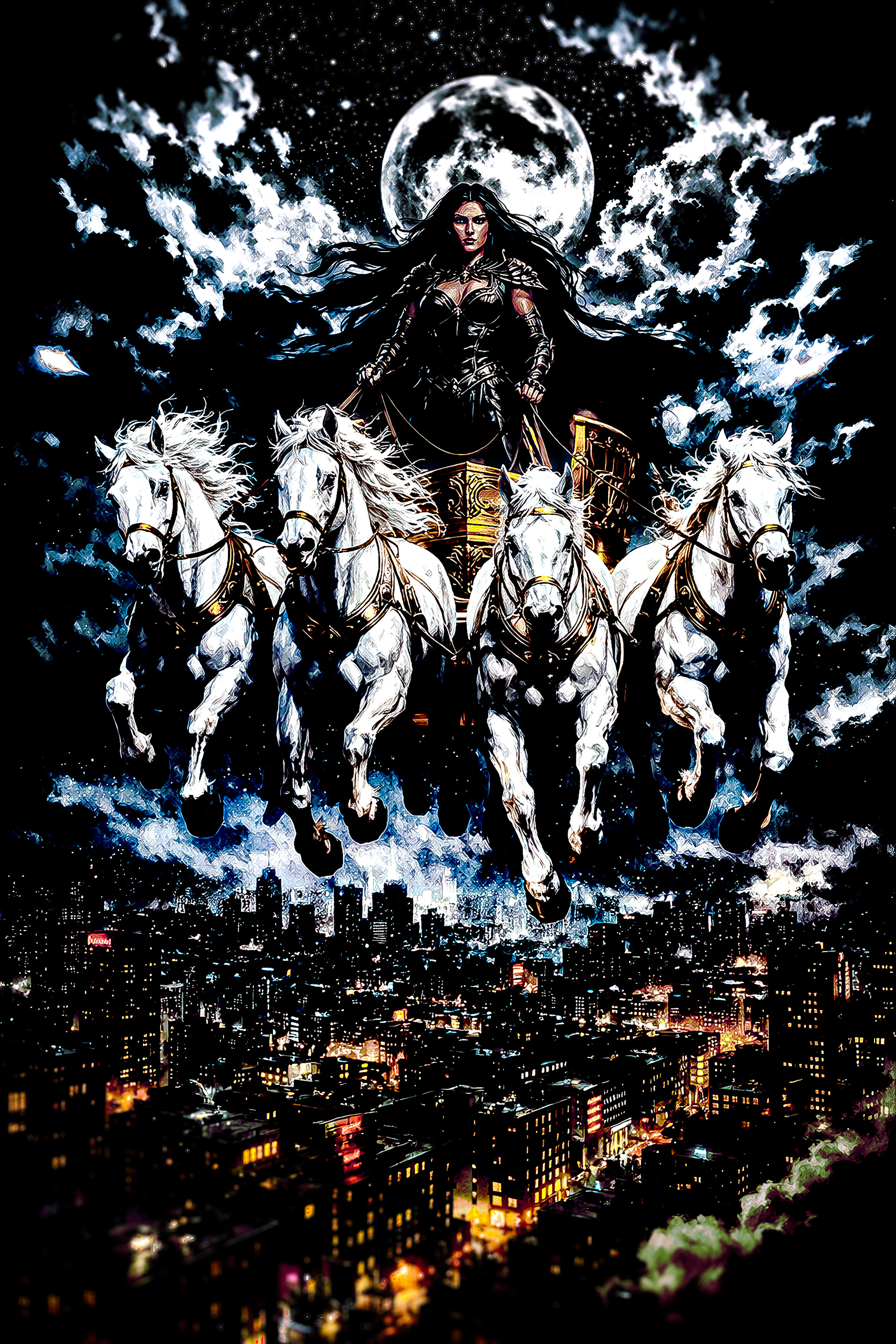
The last section, “The Reckoning,” turns back on the whole tradition. It argues that noir’s diagnosis is accurate—the system is rigged, individual heroics won’t fix it—but its conclusion is a lie. Between “one person can’t change this” and “nothing can change this” lies the space where organised working-class action lives, and noir’s real trick is erasing that space.
This City Belongs to Nyx Now is a long, angry, readable history that avoids academic fog. It moves between real events—the Black Dahlia, the St. Valentine’s Day Massacre, Watergate, the 2008 crash, George Floyd—and screen worlds from City of God to East Asian and European crime films. Across hundreds of films and series, it treats noir as a complex, compelling genre and a machine that keeps teaching us the game is rigged.
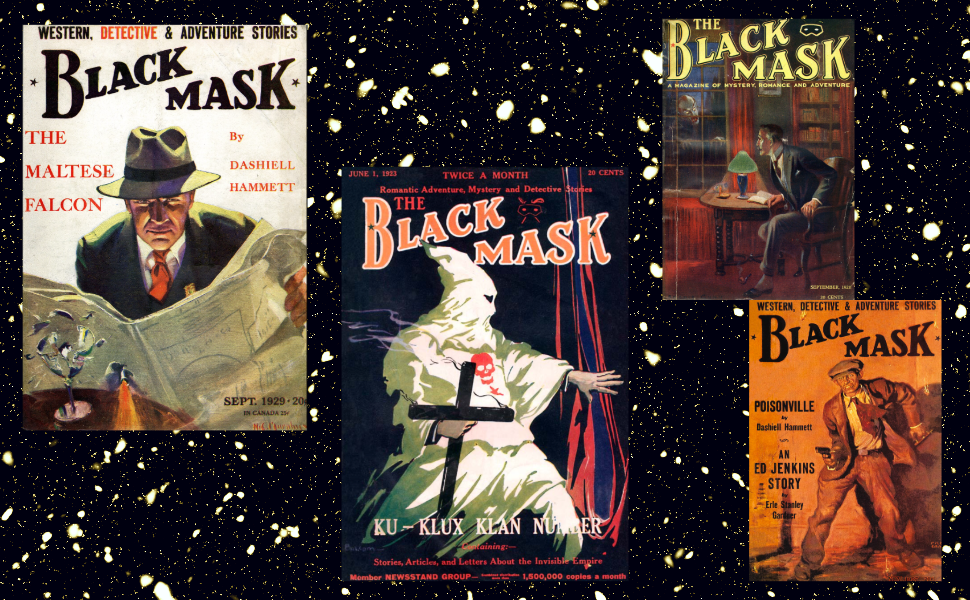
The Black Mask magazine, on the far left is part 1 of serialization of The Maltese Falcon, by Dashiell Hammett
Noir doesn’t start with a “classic” canon, it starts with work: pulp hacks paid by the word, Pinkerton detectives who turned strike-breaking into copy, and emigré directors who arrived in Hollywood with Weimar shadows in their heads. The early stretch of the book runs from Black Mask to the St. Valentine’s Day Massacre, from Hammett and Cain to the real parallel economy of Prohibition, where booze, cops and mobsters all ran on the same cash flow.
Then the studios and their censors get involved. The Production Code says crime can’t pay, authority can’t fail, se x can’t exist, and noir solves the problem by implication: the murder is off-screen, the corruption is hinted at, the despair is everywhere. HUAC and the blacklist smash the unions and drive socialist writers out of the industry just as the mode hits its stride. The femme fatale becomes an economic position—women pushed out of wartime jobs and punished on film for trying to claw their way back up.
These chapters treat “classic noir” as a factory product under censorship and Cold War discipline. It’s still stylish as hell, but the style sits on top of strikes, ruined careers and a very deliberate decision to turn class conflict into personal doom.
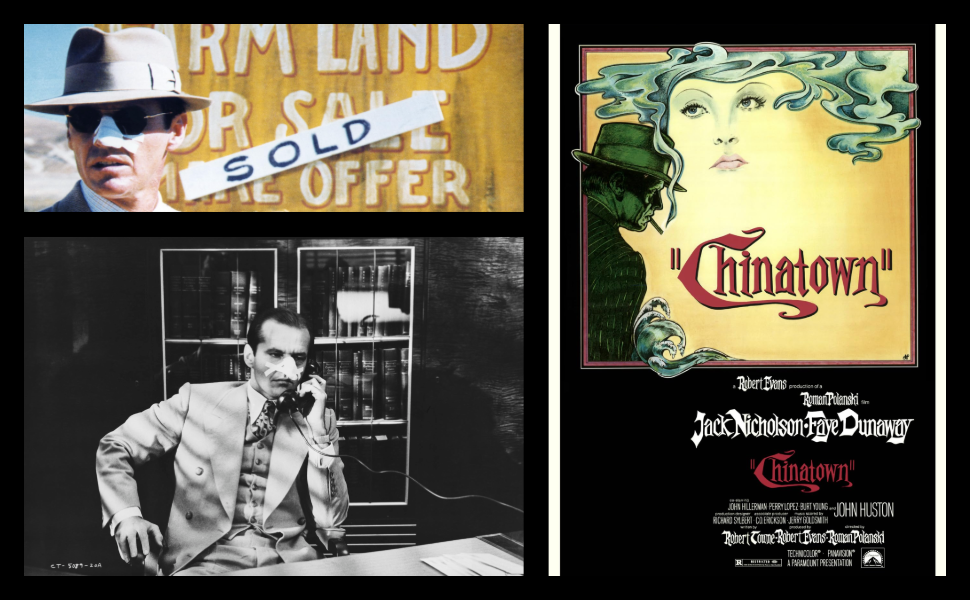
Above- Chinatown
Once the Code collapses, the blood finally hits the frame. Bodies fly apart in Bonnie and Clyde, gunfights turn into ballets of slow-motion death, and noir is suddenly allowed to say out loud what it’s been hinting at for decades: the system is rigged, and the people at the top are not confused or bumbling—they are predators.
This phase sits right on top of the assassination years, COINTELPRO, the Pentagon Papers and the Church Committee. The book walks through The Parallax View, The Conversation, Serpico and, of course, Chinatown, and sets them against the actual documents: bugging, black-bag jobs, murders of Black Panthers, lies under oath, shredded files. The paranoids were right. The paperwork proves it. And still, nothing fundamental changes.
There’s a brief opening for Black and radical perspectives—blaxploitation, Costa-Gavras, Pontecorvo, insurgent Latin American and European work that shows the state not as a neutral referee gone bad, but as a weapon of class rule. Then the window closes, the market shifts, and the lone whistleblower template takes over: Serpico, Silkwood, the reporter or insider who tells the truth, gets wrecked, and leaves the institution basically untouched. Exposure without change becomes a genre rule.
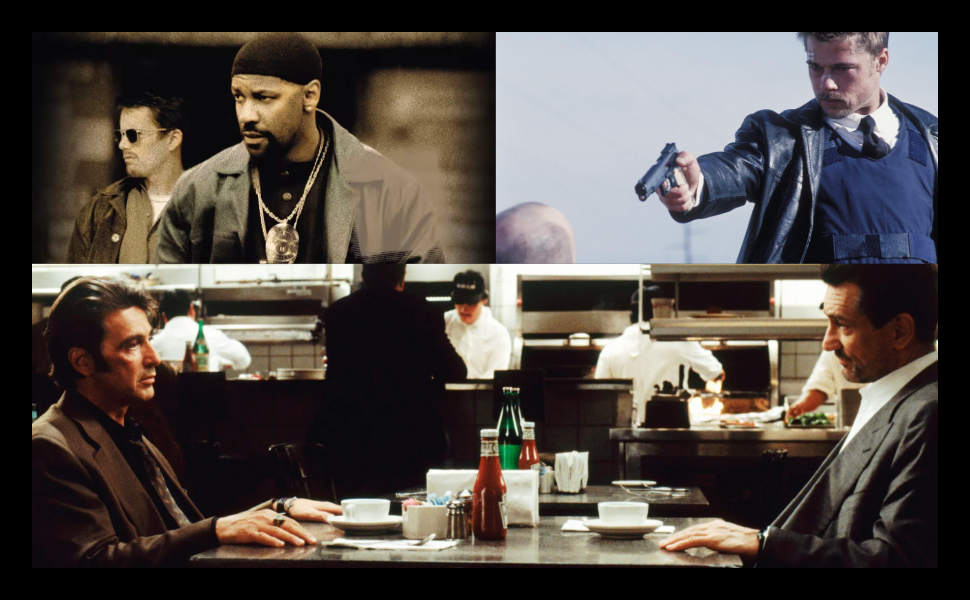
Above- Training Day, Se7en and Heat
By the 1980s, noir has to deal with a new kind of crime: deregulated finance, privatised everything, and global capital sloshing through cities like acid. Wall Street, Boiler Room, Enron docs and a string of corporate thrillers make it impossible to pretend the “bad guys” are just mobsters in alleys. The villains now sit on boards, and half their crimes are legal.
At the same time, media ownership reconsolidates. Studios get eaten by conglomerates, cable money arrives, VHS and DVD box sets turn “dark” material into prestige product. The book tracks films like Heat, Se7en, L.A. Confidential and Training Day against real scandals: the S&L collapse, Rodney King’s beating and acquittals, the Rampart case in Los Angeles. We see how a police department with a documented record of brutality becomes the star of an endless parade of “gritty” cop stories.
These chapters also push outside the US. City of God, La Haine, Elite Squad, Ken Loach’s class dramas, South African and other postcolonial work all get pulled into the frame. They’re used to show what American noir usually edits out: IMF programmes, debt crises, paramilitaries, the way empire and global finance produce noir conditions far beyond Los Angeles. The style is the same—dead bodies, corrupt institutions, doomed attempts to do the right thing—but the class lines are sharper and the blame is less coy.
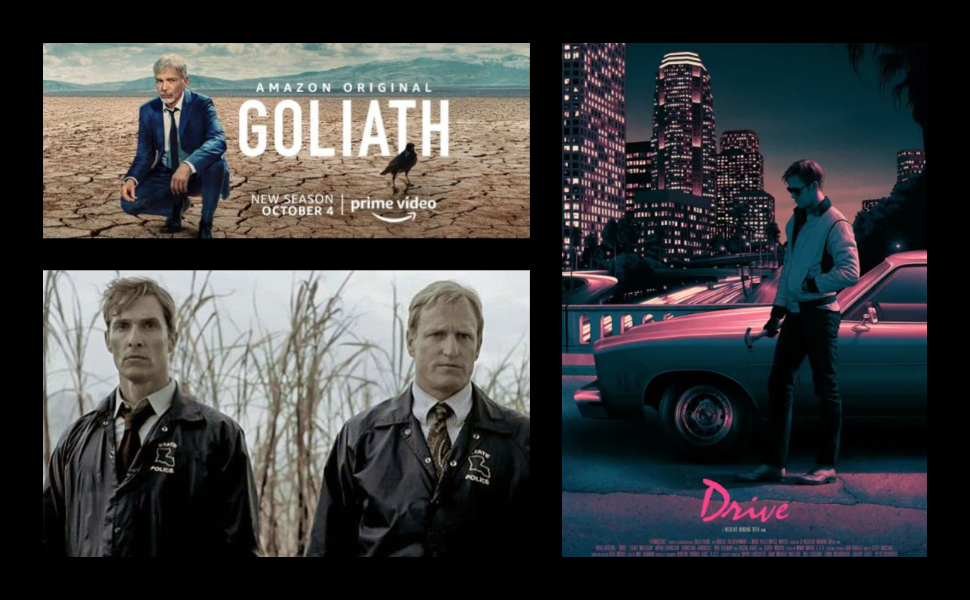
Above- Goliath, probably the strongest "Neo" noir, True Detective and the stylish film Drive, starring Ryan Gosling
The last run of the book lives where you live now: in the shadow of the 2008 crash, inside streaming dashboards, with true crime and algorithmic recommendation humming in the background. It starts with the Financial Crisis Inquiry Commission, a nine-hundred-page forensic map of fraud and looting that sends essentially no one to prison, and reads films like The Big Short and Margin Call as attempts to process that obscenity.
From there, it moves into platform noir proper: Netflix and HBO ordering “dark” series based on completion rates, podcasts like Serial and shows like Making a Murderer converting real injustice into cliffhangers, and a whole industry of “based on a true story” content. George Floyd’s murder and the global uprisings, the long CO-VID years, the endless churn of scandal docs and influencer collapses, the Epstein case with its sealed records and dead end—each becomes a test of noir’s core trick. Everything is filmed, everything is exposed, and almost nothing at the top changes.
The closing chapters stay angry but precise. They go after games like Disco Elysium and GTA, timeline noir on social media, and meta-critique like The Boys and Watchmen, asking when critique becomes just another skin for the same product. And then they turn the camera back on fatalism itself. The book doesn’t promise “better noir”; it argues that the working class is already fighting back—in strikes, revolts, international protests—and that a genre built to teach resignation doesn’t get the final say.
Deeply referenced but written to be actually read, this is meant to sit on the shelf as both a century-long map of noir and a pry bar against the idea that seeing clearly means giving up.

On the morning of January 15, 1947, Betty Bersinger was pushing her three-year-old daughter in a stroller along a thin strip of sidewalk by a vacant lot in Leimert Park, Los Angeles. The lot was patchy grass and bare dirt, a gap between tract houses and power poles. Out of the corner of her eye she saw what she thought was a broken store mannequin dumped in the weeds. It wasn’t. It was the body of Elizabeth Short, twenty-two years old, from Medford, Massachusetts. She had been bisected at the waist with surgical precision, drained of blood, washed clean, and posed—arms raised above her head, legs spread, the two halves of her body separated by about a foot of weedy grass. Her face had been slashed from the corners of her mouth toward her ears, the wound known as a Glasgow smile. She had been dead for approximately ten hours. She had been tortured for considerably longer.¹
Patrol cars and detectives’ sedans rolled up, black shoes and camera tripods sinking into the soft ground. The Los Angeles Police Department photographed the scene, collected what they recognised as evidence, and began an investigation that would never produce an arrest. Over the following weeks, more than fifty people would walk into stations or write letters confessing to the murder. None of them did it. The actual killer—whoever possessed the medical knowledge to perform that bisection, the time and space to conduct that torture, the vehicle to transport and pose the body—was never identified. The case files, box after box of paper and photographs, remain partially sealed seventy-eight years later.²
Within days of the discovery, the newspapers had given Elizabeth Short a name that would outlast her actual one. “The Black Dahlia,” they called her on front pages and in bold type, playing on the title of a recent film, The Blue Dahlia, and on her dark hair. The nickname did what nicknames do: it converted a dead woman into a character. Elizabeth Short had been a waitress, a clerk, a woman who moved between boarding houses and cheap rooms, riding streetcars, borrowing dresses, dating men who might help her get work in pictures. She was a member of the working class in postwar Los Angeles, a city that churned through young women looking for breaks that rarely came. But “the Black Dahlia” wasn’t a worker—she was a mystery, a symbol, an atmosphere. The unsolved quality of her murder, which in reality reflected LAPD incompetence or corruption or both, became an aesthetic asset. The case that couldn’t be closed became the story that couldn’t end.³
James Ellroy turned that story into a mass-market object in 1987, when The Black Dahlia appeared on spinner racks and bookstore tables as the first novel in his LA Quartet.⁴ Brian De Palma turned it into a studio product in 2006, with cranes, period cars, and lighting rigs recreating the vacant lot as a set.⁵ Decades after the murder, the limited series I Am the Night put Chris Pine’s hollowed-out reporter on cable television, folding Steve Hodel’s highly contested accusations about his father, LAPD doctor George Hodel, into a glossy Dahlia-adjacent conspiracy—another way of turning a real woman’s death into noir content, whatever the truth of the charges.⁶ Documentary after documentary continues to appear, with talking heads, crime-scene diagrams, and re-enactments promising new theories, new suspects, new solutions to a case that will never be solved because the people who might have solved it didn’t, and the evidence that might have convicted someone was mishandled, lost, or never collected in the first place. Elizabeth Short has become an industry. Her death generates content. Her body, posed in that vacant lot, has been reproduced in photographs, recreated in films, uploaded as thumbnails in endless true-crime playlists, described in hundreds of thousands of words of books, podcasts, and articles. What happened to her—the torture, the murder, the failed investigation—has been converted into entertainment.
Elizabeth Short’s story is not an exception; it is the pattern in miniature.
This is what noir does.
It takes capitalism’s violence—the disposable worker, the corrupt investigation, the system that produces murder and doesn’t solve it—and converts it into aesthetic pleasure. The body becomes atmosphere. The unsolved case becomes satisfying ambiguity. The woman who couldn’t get steady work becomes the femme fatale who got what was coming to her. What gets lost in this conversion is what this book is designed to recover: the material conditions, the class position, the actual life that preceded the content. Elizabeth Short wasn’t a noir character. She was a worker in a city that used workers up. She was killed by someone the system never caught, in a place the system had made dangerous, and her death was processed into product that the same system sold for decades.
The reader who finishes this book will see the body before the atmosphere.
This is a book about noir—but not the kind of book about noir you might expect. The other ways of approaching it matter. Noir has earned every serious history of its key films, every study of its visual grammar, every close reading of its dialogue, lighting, and performances. There is real value in treating noir as a style to be celebrated, a tradition to be mapped, a body of work admired on aesthetic, psychological, or formal grounds. Shadows, Venetian blinds, doomed lovers and barroom monologues deserve that attention.
This book takes a different route precisely because noir is so rich. It’s crowded with reveals and misdirections, with subtext and repression, with half-said truths and stories that veer away just when they get close to naming power. Unlike a neat genre with fixed rules, noir keeps slipping out of the frame. Is Double Indemnity noir? Chinatown? The Wire? Disco Elysium? A Netflix true-crime series that binges like a detective novel? Trying to pin it down by surface features is like trying to catch a shadow under a streetlamp—you reach for it and your hand just lands on concrete.
So instead of starting with a checklist—venetian blinds, voiceover, city at night—and asking whether a given film “counts” as noir, this book starts from what noir actually does.
On the surface, you can still describe noir as a familiar bundle: crime and corruption, morally compromised protagonists, urban streets after dark, plots where desire and money cross in fatal ways. That loose description is fine for a streaming menu or a film guide. Here, though, noir is not a mood or a club you get into if you tick enough boxes. It is a mode of cultural production that does a specific job for capital.
The argument is simple, though its implications are not. Noir appears wherever capitalist urban life becomes visibly precarious, corrupt, and rigged. It performs a double function. On the one hand, it validates what audiences suspect—yes, the system is corrupt, the game is fixed, the house does always win. On the other hand, it channels that recognition into fatalism rather than action. Noir tells you the truth about capitalism and then tells you there’s nothing to be done about it. The sophisticated response, noir teaches, is not to fight but to drink, not to organise but to resign, not to act collectively but to go down alone with style.
This is not a failure of noir. It is noir’s function.
The core contradiction that drives every noir text is this: the mode must simultaneously reveal and naturalise. It must show corruption—the bought cops, the rigged courts, the real estate grift, the insurance fraud—while presenting that corruption as eternal, inevitable, unchangeable. The detective exposes but cannot change. The whistleblower testifies but the institution survives. The protagonist sees everything and can do nothing. “Forget it, Jake—it’s Chinatown.“⁷ That line, from Roman Polanski’s 1974 film, is noir’s thesis statement. The water theft is real. The land fraud is documented. The incest and murder are known. And none of it matters. Noah Cross will get away with everything. The knowledge changes nothing.
Noir that showed corruption and showed collective action succeeding would not be noir. It would be something else—something the industry has systematically suppressed, marginalised, or failed to produce. The blacklisted filmmakers of the 1940s and 1950s, the ones who might have made that other thing, were driven from the industry precisely because they might have connected noir’s accurate perception of capitalism to a politics that could change it.⁸ What remained was the perception without the politics: the recognition without the action. The pleasure of watching the system exposed, and the deeper pleasure of accepting that nothing can be done.
This book tracks that contradiction across five historical phases, each with its own dominant institutions, dominant forms, and characteristic ways of doing the same job. The phases are not neat boxes; they overlap and bleed into one another. What matters is how each one reorganises the job noir performs: revealing and naturalising at the same time.
Phase I: Proto-Noir (1920s–1940). Before noir had a name, its conditions were being assembled. Pulp magazines like Black Mask paid writers a cent a word, sometimes less, producing the clipped, efficient prose that would become noir’s voice because extra adjectives meant less rent money. Prohibition turned bootlegging into a national industry, with syndicates, protection payments, and backroom deals that blurred the line between legitimate and criminal capitalism. The Depression produced mass dispossession—foreclosed farms, breadlines outside city missions, families riding boxcars west—turning millions of Americans into potential noir subjects: people who had played by the rules and lost anyway. Weimar exiles fleeing fascism brought expressionist aesthetics—canted angles, deep shadows—and political consciousness shaped by European catastrophe into studio backlots and writers’ rooms. By 1940, the materials were ready. What was missing was the name.
Phase II: Classical Studio Noir (1941–1958). The Production Code Administration, operating out of an office on Melrose with Joseph Breen’s signature at the bottom of the letters, shaped what noir could show and say. Crime could not pay; authority had to be respected; transgression had to be punished. These constraints produced noir’s famous indirection—the closed bedroom door, the cigarette smoke, the shadow of violence instead of the act. Doom feels like fate because the script is not allowed to say “wage theft” or “company town.” At the same time, the blacklist bent noir away from structural critique toward individual psychology. Hearings in Washington and New York hauled writers and directors into rooms with microphones and nameplates; the Hollywood Ten went from studio lots to prison yards. The writers who might have named capitalism were silenced or exiled. What remained was the doomed man, the scheming woman, personal corruption as explanation for systemic outcomes. Labour was crushed—the Conference of Studio Unions broken on picket lines outside the gates, collective action in Hollywood destroyed at exactly the moment classical noir flourished. The racial floor was absolute: Black protagonists effectively did not exist in studio noir; Black labour appeared, when it appeared at all, as servants and background. The femme fatale was punished for pursuing economic independence through the only means available to women denied economic independence: sexual bargaining inside a rigged market.
Phase III: Breakdown and Conspiracy (1959–1979). The Code collapsed, and noir could show what it had only implied. Bonnie and Clyde sprayed blood across the screen. The Wild Bunch made violence operatic, guns tearing bodies apart in slow motion.⁹ The more significant development, though, was what noir could now say. Chinatown stated the thesis explicitly: the system is built on theft, the theft is ongoing, and knowing changes nothing. COINTELPRO, the Pentagon Papers, Watergate—the 1970s revealed that conspiracy wasn’t paranoia but accurate perception. The state infiltrated, assassinated, lied, burgled; the evidence sat in filing cabinets and leaked memos. Conspiracy noir emerged because conspiracy was real. Blaxploitation briefly opened a door: for the first time since race films, Black protagonists commanded Hollywood screens as detectives, private eyes, and avengers. The opening was commercial, not political—studios discovered profit in audiences they had ignored—and the closing was equally commercial when the cycle exhausted and executives moved on. The whistleblower template emerged: the lone truth-teller who exposes and is destroyed, converting systemic critique into individual martyrdom. The film rolls credits; the audience leaves; the agency or corporation continues.
Phase IV: Neoliberal Noir (1980–2007). Financial deregulation produced financial crime at industrial scale. Junk bonds, hostile takeovers, and derivatives turned balance sheets into crime scenes. The line between legal and illegal finance blurred, just as Prohibition had blurred the line between legal and illegal alcohol. Noir processed this: Wall Street, The Firm, and a corpus of financial-crime entertainment that shows fraud while framing it as individual greed rather than structural inevitability.¹⁰ Conglomerates absorbed studios; rights libraries and cable channels became assets on the books of telecoms and entertainment conglomerates. Noir became one line item in a diversified portfolio. The filmed verdict arrived: Rodney King, 1991, 81 seconds of baton blows, the most-watched footage before viral video existed.¹¹ Everyone saw; the jury acquitted; LA burned. Exposure without change at city scale. Prestige TV emerged: The Wire, The Sopranos, The Shield—shows long enough to walk you through the whole system instead of two hours at a time.¹² We see housing projects, docks, city hall, police districts, union halls. But serialised critique became prestige commodity. The Wire is assigned in universities and recommended in think-piece lists while Baltimore stays broken. The Rampart scandal confirmed what noir had always suggested about the LAPD: the department operated like the gangs it policed—territorial, violent, criminal, with officers running their own side hustles in drugs and robbery.¹³ Exposure produced reports, some prosecutions, and structural persistence.
Phase V: Platform Noir (2008–2025). The 2008 crash was the template: universal exposure producing zero accountability. The Financial Crisis Inquiry Commission documented the fraud in hundreds of pages; no major banker went to prison; the banks got bailouts; the victims got foreclosure notices taped to their doors.¹⁴ This is platform noir’s defining experience: everyone sees, nothing changes. Algorithms replaced ratings and network executives’ gut instincts as noir’s steering mechanism. Completion rates shape commissioning; engagement metrics determine what gets made; the algorithm doesn’t censor but selects, pushing some stories to the home screen and burying others three scrolls down. True crime became noir’s dominant form—Serial, Making a Murderer, and the flood of docuseries where real injustice is converted to serialised entertainment, the pleasure lodged in the investigation rather than the resolution.¹⁵ George Floyd completed the loop that Rodney King had started: filmed murder, global uprising, one conviction, structural persistence.¹⁶ Everything filmed, nothing changed at the level of police budgets and union contracts. Games made noir participatory: Disco Elysium, L.A. Noire, the player as compromised protagonist, offered choices inside a world whose basic terms do not move.¹⁷ And critique was absorbed: The Boys, Watchmen, meta-noir that exposes corporate control and media manipulation while serving as Amazon and Warner content.¹⁸ By the mid-2020s, the writers’ and actors’ strikes over streaming residuals, data, and AI made the system’s terms explicit: platforms wanted to turn past work and biometric data into perpetual assets; workers fought to keep their labour and likenesses from being swallowed whole. The settlements drew lines in contracts, not in ownership. The machine remained.¹⁹ The system learned to profit from its own critique, to treat dissent as another genre.
Across all five phases, the same threads operate. This book tracks eleven of them.
Exposure Without Change—truth revealed, structure persists. From Chinatown through 2008 through Floyd, the pattern repeats: the corruption is documented, the documentation changes nothing.
Critique-to-Commodity—each phase’s critique becomes the next phase’s product. The blacklist produced paranoia; paranoia became conspiracy thriller; conspiracy thriller became prestige content. What was suppressed becomes what is sold.
Individual vs Collective—isolated protagonists, solidarity foreclosed. Noir’s detective works alone; noir’s whistleblower stands alone; noir’s audience watches alone. Collective action is absent not because it’s impossible but because noir cannot show it succeeding. Labour Invisibility—who makes noir, under what conditions, erased how. The writers in cheap offices, the crews on overnight location shoots, the effects workers staring at three monitors at once: their labour produces the content that celebrates individual vision.
Policing and Legitimation—cops as protagonists, state violence normalised. From the detective who bends rules “for justice” to the LAPD consultant who sits in writers’ rooms and shapes how LAPD appears on screen, noir trains audiences to see policing as flawed but necessary. Property and Dispossession—real estate, insurance, debt as noir engines. From Chinatown‘s water theft through The Big Short‘s mortgage fraud, noir returns obsessively to property crime because property is what capitalism is about.
Race as Class Mechanism—racial division as tool of class rule, not parallel oppression but specific technique for splitting labour.
Gender as Class Mechanism—the femme fatale punished for pursuing independence, the damaged woman as noir content, gendered violence as entertainment.
Memory and Erasure—lost films, buried archives, sealed records, algorithmic de-platforming. Prints destroyed, tapes wiped, files locked, thumbnails quietly removed: what noir can’t remember, it can’t analyse.
Fatalism Training—how noir teaches acceptance as sophistication. The posture is the product. Long-Arc Actors—the LAPD, the major studios, the banks, the insurers, the intelligence agencies, appearing across decades as continuous characters in a story they don’t know they’re in.
These threads are not decoration. They’re the wiring we’ll be tracing across a century.
The system produces both the noir and the desire for noir.
This is not conspiracy. It is structural inevitability. Capitalism produces urban precarity, corruption, visible rigging—the conditions that noir processes. And capitalism produces the entertainment industry that does the processing, the marketing that creates demand for the product, the campaign budgets that buy the billboards and autoplay trailers, the cultural positioning that makes cynicism feel like sophistication. You weren’t born wanting this darkness. The desire for noir is manufactured.
This does not mean the pleasures are fake. The pleasures are real. The aesthetic satisfaction of the doomed voiceover, the erotic charge of the dangerous woman at the bar, the investigative pleasure of following the detective through the corrupt city at night—these are genuine pleasures, genuinely felt. But the need for those specific pleasures is not natural. It is produced. You were trained to want noir by a century of noir production, by marketing departments, by studio publicity machines, by the sheer volume of noir product that makes the mode feel inevitable rather than contingent.
The question is not whether to enjoy noir. The question is what the enjoyment serves.
Every noir teaches the same lesson: someone else is handling it, and they’re failing, and there’s nothing you can do. The detective investigates so you don’t have to. The whistleblower testifies so you don’t have to. The protagonist goes down so you can watch from safety. Noir produces passivity as spectatorship. The audience position is: observe the corruption, feel the recognition, accept the resignation, move on to the next one in the queue.
This book is designed to interrupt that loop.
Not by making noir unpleasurable—the pleasures will remain—but by making visible what the pleasure serves. The reader who finishes this book will see the body before the atmosphere. Will see the labour behind the screen. Will see the extraction beneath the entertainment. Will see what the mode does while they enjoy it.
The book proceeds as follows.
Part I assembles the materials of proto-noir: the pulp economics that produced hard-boiled prose, the Prohibition crime that revealed capitalism’s legal/illegal blur, the Depression that created noir’s dispossessed subjects, the Weimar exile that brought European darkness to Hollywood. By 1940, everything was ready except the name.
Part II shows how the Production Code and the blacklist shaped classical noir into its famous form—and bent it away from structural critique toward individual doom. The postwar damaged veteran, the crushed labour movement, the absolute racial floor, the punished femme fatale: these were not artistic choices but industrial products.
Part III tracks what happened when the Code collapsed and conspiracy was confirmed. Chinatown‘s revelation, COINTELPRO’s documentation, Blaxploitation’s brief window, the whistleblower template’s emergence.
Part IV follows neoliberal noir through deregulation, conglomeration, the filmed verdict, prestige TV, and the Rampart scandal—tracking how the mode adapted to new ownership structures while preserving its function.
Part V analyses platform noir: the 2008 template, algorithmic selection, true crime capture, filmed murder, games, and the absorbed critique. The most recent phase shows the system at its most sophisticated—profiting from its own exposure, converting dissent into content.
The Conclusion asks what noir knows and what it forecloses. Noir’s diagnosis is accurate: the system is rigged. Noir’s prognosis is false: nothing can be done. The book refuses that prognosis—not through optimism but through analysis. Capitalism is historical, not eternal. It can be ended, not just exposed. The alternative to fatalism is not better feelings but materialist understanding: the recognition that the system noir depicts is contested, that collective action is possible, that resignation is ideology rather than truth.
Elizabeth Short was buried at Mountain View Cemetery in Oakland, California, on January 25, 1947. Her mother travelled from Massachusetts to claim the body, signing papers in a police building before seeing her daughter in a morgue drawer. The funeral was small. A simple casket, a short service, a grave on a hillside. The newspapers had already moved on to the investigation, the theories, the “Black Dahlia” brand they had created. Elizabeth Short’s actual life—the boarding houses, the waitressing, the hopes, the precarity—disappeared into the content.²⁰
She deserves better than to be atmosphere.
This book is not about her—she appears only in this introduction, as the body that became brand, the worker who became content. But the method this book uses is designed to recover what noir converts: the material conditions, the class positions, the actual labour that precedes and produces the entertainment. Noir processes capitalism’s violence into pleasure. This book processes noir into analysis—not to end the pleasure, but to see what the pleasure hides.
The reader who finishes will still watch noir. But they’ll see it differently. They’ll see the body in the vacant lot before it becomes the Black Dahlia. They’ll see the worker at the typewriter before they become the auteur. They’ll see the picket line before it becomes the heroically isolated protagonist. They’ll see what noir does—and why.
Part I begins with the materials. Before noir was named, its conditions were being assembled. A penny a word. A bootlegger’s empire. A foreclosed farm. A train leaving Berlin.
The darkness was being manufactured.
Noir doesn’t drop out of the sky. It’s built. Someone has to assemble it out of the mess in front of them.
In the 1920s and 30s, that mess was obvious. Prohibition didn’t just “encourage crime”; it created a parallel economy. Real supply chains. Real distribution. Real payrolls. Real bodies. The gangster wasn’t a mythic outsider; he was one more capitalist in a suit, working a different legal status code.
Then the market crashed and took the rest of the illusion with it. People lost jobs, homes, savings, and any remaining belief that the system basically worked. Whole towns found out overnight that the game was fixed and they were the ones it was fixed against.
Into that walked the pulps. Cheap paper, fast turnover, a few cents a word if you could hit your deadline. The magazines didn’t pretend they were making art. They were running a factory. Fill the pages, ship the copies, feed the distribution network. The writers we now treat as stylists—Hammett, Chandler, Cain—were workers banging out copy for wage. Their work would later be canonised as “noir.” At the time it was just how they paid rent.
And then there were the exiles. German and Austrian directors, cinematographers, designers who’d cut their teeth in Weimar and fled when fascism made that impossible. They brought with them expressionist framing, a feel for streets and shadows, and first-hand knowledge of what happens when the state drops its mask.
Proto-noir sits where all that meets: a real criminal economy, a betrayed working class, a pulp production line, and a wave of refugees who already knew what a modern police state looked like.
Before noir was a genre, it was a job. Before it was a “mood,” it was labour under deadline for bosses who owned the pages.
That’s the ground everything else stands on.
Paris, August 1946. The war had been over for a year, but the projection booths were only just catching up. American films banned during the Occupation were finally let through, and they arrived in a rush—six years of Hollywood product hitting French screens in a matter of months. The city’s cinemas, some still bearing shrapnel scars on their facades, were suddenly running double bills of films that had been rumours during the war: Bogart, Stanwyck, Andrews, Powell and Tierney flickering on screens where newsreels and German-approved features had played a year earlier. For critics, it was overwhelming and disorienting: an entire stretch of cinema history unspooling out of order, without the slow, year-by-year drift that would have made the changes feel gradual. They weren’t just catching up on Hollywood; they were watching another country work through its own occupation, corruption and quiet deals, frame by frame.¹
You can picture Nino Frank in one of those Left Bank theatres—a narrow lobby, threadbare carpet, tobacco haze thick in the beam of the projector—scribbling in a notebook while the reels change. He watches The Maltese Falcon, released in America in 1941. He watches Double Indemnity and Laura, both from 1944. He watches Murder, My Sweet, the adaptation of Raymond Chandler’s Farewell, My Lovely that had reached American theatres while Paris was still under German control.² Seen in American order, separated by release dates and weekly trade gossip, these films were just crime pictures scattered across a few years. Seen all at once, in a city coming out of occupation, they looked like something else entirely.
In August 1946, Frank tried to pin down what he was seeing. His article, “Un nouveau genre ‘policier’: L’aventure criminelle,” called it “a new kind of crime film,” and to name it he reached for a label already circulating in French publishing: film noir.³
The phrase came from the Série Noire, Gallimard’s crime imprint launched by Marcel Duhamel in 1945. The books had black covers—hence the name—and they translated Hammett, Chandler, James M. Cain, the American hard-boiled writers whose prose had a darkness the French recognised immediately.⁴ Copies of those paperbacks sat in kiosks and bookstalls not far from the cinemas now playing their adaptations. Frank took the name from the bookrack and stuck it on the screen. It held. By the end of the 1940s, French critics were using film noir routinely to describe a body of American cinema that American studios still treated as a loose pile of thrillers, murder stories, and “adults-only” melodramas.
That origin story matters. Noir was named from the outside. It wasn’t a line item on a studio slate or a marketing term born in a boardroom; the Americans who shot The Maltese Falcon and Double Indemnity didn’t think they were making “noir” at all. They thought they were turning out crime pictures, detective movies, melodramas—product that slotted into familiar industrial categories measured in release dates, shooting schedules, budgets, and stars. Warner Bros. had its house style; Paramount had another. The categories that mattered to them were practical: which stars were above the title, how many prints they could strike, how long a film could run before it cost another reel. Nobody sat down and decided to invent a new sensibility called noir. The sensibility came out of the conditions, and the French—watching from outside, watching five years of production compressed into months—could see the pattern more clearly than the people trapped inside it.
What did Frank and his colleagues actually see? Not just crime stories. Something darker, more bitter, more knowing. The detective who investigates but cannot fix what he uncovers. The woman who schemes because there is no legitimate path to independence. The city that feels like a trap rather than an opportunity—narrow streets, anonymous offices, stairwells that swallow people. The voiceover that already knows how the story ends and speaks to us from beyond the point of no return. A sense—pervasive, structural, impossible to miss once you notice it—that the system is rigged and everyone in the film knows it.
The French saw a mode, not just a genre.
Genre is an industry label; it tells the exhibitor which bin to put the film in or what headline to run in the ad. Mode is a way of processing historical conditions. For everything this book is going to do, that distinction is the hinge. If noir were just a genre, the problem would be simple: you could buy the hat, shoot at night, throw in venetian blinds and cigarettes, hire a sax player for the score and call it done. The fact that so many “neo-noirs” feel empty even when they tick every box is the evidence: the mode isn’t in the props, it’s in what the story does to the world.
If noir is a mode, it’s defined by function—by how it handles the raw material of its moment. You don’t get that by ticking boxes. You get it when a whole system responds to crisis in a particular way.
The conditions that produced noir were specific to capitalism in crisis: Depression, war, postwar disillusionment, urban alienation, the visible failure of the promises. French critics, emerging from occupation and collaboration, recognised something in American cinema that rhymed with their own reality—the sense that the official story was a lie, that corruption was structural rather than exceptional, that knowing the truth did not give you the power to change it. The films on those Paris screens—shot in Burbank and Culver City by workers who’d never seen Paris—carried the same intuition.
So noir begins as a recognition. Before it is a label on a box set or a shelf at the DVD store, it’s an “aha” in a critic’s notebook: this is doing something new to the world on screen. The Americans made that “something” without naming it. The French named it because they were far enough away to see it. Once the name existed, noir became visible—not just as a style, but as a way of turning capitalism’s violence into entertainment. That is the ground this chapter stands on.
⸻
The standard definitions of noir start with the images. Low-key lighting. Deep shadows. Venetian blinds cutting latticework across faces. Rain on black asphalt. German Expressionism put to work on Hollywood soundstages: tilted angles, looming shadows, faces half-swallowed by darkness. Or they start with plot furniture: the hard-boiled detective, the duplicitous woman, the crime that spirals, the flashback, the voiceover, the doomed ending.
Those definitions capture something real. You can screen a run of classical noirs and watch the visual vocabulary accumulate: the way windows are barred by shadow, the way back alleys and office corridors are lit like tunnels, the way cigarettes flare in cupped hands in the dark. You can list the story patterns. You can count the number of times a man in a cheap suit walks into a room he should have stayed out of. There are whole libraries devoted to noir’s style, its imagery, its acting, its influence, and those books are worth having. Noir really is rich enough to support a dozen different angles—star studies, production histories, rhetorical analysis of voiceover, close readings of venetian blinds and back alleys.
This book isn’t here to wave that away. It exists because, underneath all that style, noir is doing a piece of structural work that needs to be dragged into the light.
Style and plot conventions tell you what noir looks and feels like; they don’t tell you what noir does.
Noir is not defined by visual style. Films that look “noir” aren’t automatically noir, and films that look clean and bright sometimes are. The Asphalt Jungle has the shadows and the grimy city; Chinatown is shot in hard California daylight, orange groves and dust instead of wet streets and neon. Both are noir. The lighting is a symptom, not the cause.
Nor is noir just a shopping list of characters and twists. The detective, the femme fatale, the double-cross—these recur, but they aren’t magic ingredients. Plenty of crime films put a detective and a dangerous woman on screen without becoming noir. Some of the central noirs—Double Indemnity is the clearest example—don’t have detectives at all.
Mood isn’t enough either. Cynicism, fatalism, urban alienation, existential despair: those are atmospheric results. The serious question is what kind of machine is running underneath that throws up the same weather over and over again.
Noir is defined by its function under capitalism. It performs a double operation, and the tension between those two moves generates almost every recognisable feature of the mode.
The first move is validation. Noir tells audiences what they already suspect. The system is corrupt. The game is fixed. The cops are bought. The rich do get away with it. The official story is a lie. That’s the hook: noir tells you you’re not crazy. Your sense of how power works is right. The films don’t gaslight; they confirm.
The second move is foreclosure. Noir tells audiences there’s nothing to be done. The detective exposes the corruption but cannot change it. The whistleblower tells the truth but the institution survives. The protagonist sees everything and dies alone for his trouble. “Forget it, Jake—it’s Chinatown.”⁵ Knowledge doesn’t lead to power; it leads to a heavier, more stylish kind of resignation. Noir trains you to think that the “grown-up” response isn’t to fight but to shrug with flair.
That’s the core contradiction: noir has to reveal and naturalise at the same time. It has to show corruption—the bought cops, the rigged courts, the real-estate scam, the insurance scheme, the way crime blends into legitimate business—while presenting that corruption as eternal and rooted in “human nature,” not in a particular economic order. Noir says: the system is rigged. Noir also says: systems have always been rigged and always will be. The first sentence is accurate. The second is ideology in a trench coat. Calling it “human nature” isn’t observation; it’s a way of hiding who owns what, who writes the laws, and who gets paid when the dust settles.
You can’t fix that contradiction from inside the mode. A work that showed corruption and showed collective action succeeding, a work where the knowledge led to real change, would stop reading as noir and start being something else. There were people in Hollywood who wanted to make that “something else.” For a short time they did, with films where unions win, strikes matter, and solidarity changes outcomes. Then they were called before congressional committees, sacked, jailed, or blacklisted. The filmmakers who might have linked noir’s accurate perception to a politics that could actually do something were driven out precisely because they threatened to resolve the contradiction in the wrong direction.⁶ What survived after the blacklist was perception without politics: a clear view of how the system works, disconnected from any believable way of changing it.
Once you understand that, the formal choices stop looking mysterious. The doom-laden voiceover exists because the protagonist already knows where the story ends and is telling it after the fact, bleeding into a dictaphone or talking from death row. The whole point of the device is: I understood, and it didn’t save me. The femme fatale exists because systemic threat has to show up as individual seduction. The danger isn’t capital, or the wage relation, or the way property is organised; it’s this woman in this dress standing in this doorway. She schemes because economic dependency has blocked off every straight route to independence; she’s punished because her scheming threatens male control and the illusion of order. A structural problem—blocked access to money—comes back to us as suspicion of women. The detective exists to expose without changing. He walks the streets, pushes through the revolving doors of city hall, forces the rich man to admit what he’s done—and the world doesn’t move an inch. The Maltese Falcon turns out to be fake; the chase was a farce; Sam Spade hands Brigid to the cops and the city stays the same.⁷
Noir is one of the ways capitalism acknowledges its own violence while making that violence feel normal and permanent: a studio picture reassuring postwar audiences that the worst thing a man can do is fall for the wrong woman instead of the right boss; a prestige drama showing you every knot in a broken city’s wiring while the actual budget meetings go untouched. The system generates the corruption, the entertainment that depicts it, and the habits of resignation that make it livable. You put down money at the box office or pay the subscription fee, and in return you get a story that tells you you’re right about how bad things are—and that it’s hopeless.
⸻
If that’s what noir is doing, we need a way to track it. This book uses five texts as anchors, not as a “top five noirs” list but as structural samples. These aren’t the “greatest hits” or a definitive canon. They’re five points on a map where the machinery is unusually visible—good places to watch the mode doing its job. Each one crystallises the contradiction of its phase. Each shows the core machinery operating inside a specific set of industrial and political conditions. Together, they show how noir adapts to preserve its function.
The Maltese Falcon (1941) is Phase II in miniature.⁸ Sam Spade sits in his shabby office above San Francisco’s streets, looks down at his dead partner, and gets pulled into the hunt for a jewel-encrusted statue. He finds out the falcon is fake—a cheap copy of a legendary treasure that never even makes it to the screen. He finds out Brigid O’Shaughnessy killed his partner. He turns her in, sending her down in the rattling cage elevator while his secretary watches. The object that seemed to drive the whole plot is worthless; the woman who seemed like a partner becomes a prisoner; the greed, lying, and casual violence that set all this in motion roll on underneath. By the end Spade knows everything there is to know. Knowing doesn’t alter the order of things. He can send Brigid to jail; he can’t touch the conditions that produced her.
Double Indemnity (1944) is Phase II’s thesis stated straight into a microphone.⁹ Walter Neff staggers into his office after hours, the corridors empty, the building lit only by whatever the night watch has left on. He props himself against a dictaphone, blood seeping through his suit, and starts to record. From the first minutes we know he’s doomed, we know he did it, and we watch to see how he got there. Phyllis Dietrichson is the femme fatale as economic actor: trapped in a marriage she doesn’t want, dependent on a man’s money, looking for a way out in a world that has closed off the decent routes. The murder is not free-floating evil; it’s framed by the insurance company, the bureaucracy of risk that turns lives into tables and payouts. The profit structure—double indemnity clauses, actuarial calculations, suspicion of “accidents” on train tracks—shapes every conversation. Neff is not stupid. He understands the angles, understands what Keyes calls “the little man” in the back of his head. He goes down anyway. The voiceover understands everything. The understanding changes nothing.
Chinatown (1974) is Phase III saying the quiet part out loud.¹⁰ Jake Gittes starts in a cramped office doing adultery work, making his money off the small humiliations of rich clients. He ends with blood on his suit in Chinatown, looking at a dead woman in the street while police sirens whine. In between, he discovers the theft of Los Angeles’s water: the real-estate crime that built the city, the public resource turned into private fortune through fraud and murder. He discovers that Noah Cross raped his own daughter. He discovers that Cross will walk away with all of it—the water, the land, his daughter’s child. “Forget it, Jake—it’s Chinatown.” The line is noir’s whole operating manual in four words. The corruption is exposed; the exposure doesn’t matter. The system is built on theft, the theft is ongoing, and knowledge does not translate into power. Gittes finally sees the whole picture. Seeing doesn’t help.
The Wire (2002–2008) is Phase IV taking the gloves off and going systemic.¹¹ Across five seasons, David Simon’s series walks through five institutions—police, stevedores, city hall, schools, newspapers—and shows how each fails the people underneath. The dealers deal on West Baltimore corners; the addicts burn through their lives; the cops chase stats on whiteboards; the politicians chase polls; the docks die; the city rots. Long-form TV lets the show do something two-hour films never could: stack detail, follow consequences, show how failure in one institution cascades into the next. We watch meetings in fluorescent-lit squad rooms, arguments over shipping containers in windblown ports, school classrooms with broken heaters, editorial meetings where budgets are cut and stories killed. The problem sits in structures, not in a couple of bad men. But the punchline is familiar: The Wire becomes prestige content, held up as “the greatest TV drama ever made,” taught in universities, praised for its insight. Meanwhile, Baltimore’s murder rate stays near the top of the American league table.¹² The critique is absolutely real. So is its absorption.
True Detective (2014) is Phase V turning noir into pure aesthetic.¹³ Rust Cohle and Marty Hart drive through Louisiana refineries and flat fields, past rusting billboards and shut-down plants, and talk about meaninglessness in the cabin of a squad car. Rust’s nihilism becomes a brand. His monologues are clipped into video essays and quote graphics. The case—missing children, ritual abuse, conspiracies tied to wealth and politics—matters less in practice than the mood, the performances, the slow tracking shots through ruined landscapes. Platform noir leans hard into interiority: the detective’s psychology, his trauma, his philosophy. Structural exposure moves into the background as texture. The murdered kids and corrupted institutions become part of the show’s emotional weather. They are content.
Across those six decades, the through-line is painfully simple. One investigator at the centre. A corrupt system he can’t change. Knowledge that leads to a more elaborate, more self-conscious kind of giving up. Spade, Neff, Gittes, McNulty, Cohle—each digs, each uncovers, each fails to transform what he finds. The surface pleasures are different—Bogart’s amused cool, MacMurray’s sweaty panic, Nicholson’s raw frustration, Dominic West’s battered stubbornness, McConaughey’s cosmic gloom—but the lesson underneath is the same: someone else is on the case, they’re failing, and you’re stuck with it.
This book doesn’t aim to make those pleasures disappear. They’re real. Noir has earned a lot of the attention it gets: the performances, the scripts, the directed anger, the craft. The point isn’t that noir is bad art. The point is that noir is effective art that has been slotted into a very specific role. It lets capitalism describe some of its own rot, and it teaches people how to live with that knowledge.
⸻
To do that, we have to stop pretending noir is mainly the child of personal “vision.” Noir doesn’t grow in the heads of gifted directors and then magically appear on screen unchanged. It grows in workplaces: pulp offices, studio lots, writers’ rooms, edit suites, data dashboards.
Critics call it the auteur theory: directors as authors, films as personal statements, style as signature. You can see why it took off. John Huston directs The Maltese Falcon; Billy Wilder directs Double Indemnity; Roman Polanski directs Chinatown. It’s tidy to treat those films as extensions of personality—Huston’s cynicism, Wilder’s acid humour, Polanski’s darkness. There’s something to that. Directors do make choices. Styles do differ. But they all stand on the same concrete.
The director-as-author story leaves out the ground everyone is standing on. Huston, Wilder, and Polanski have more in common with each other, structurally, than their “personal styles” admit. All of them worked inside systems that controlled budgets, contracts, censorship rules, and distribution. Those systems—from the pulp magazine office to the streaming dashboard—decide what kinds of noir can exist.
Noir is made by institutions with interests. In every phase, the dominant institution sets the range of possible noir. It doesn’t always do this by issuing commands; most of the time, it happens through pay scales, rules, risk calculations, and scheduling. Whoever owns the means of noir production owns the boundaries of the mode.
In Phase I, the pulp magazines call the tune. Black Mask and its competitors pay by the word—a penny if you’re nobody, three cents if you’re hot.¹⁴ At a cent a word, you’re not crafting deathless literature; you’re trying to pay rent by Thursday. That simple fact shapes the page. Picture the office: desks pushed close together, typewriters clacking, cigarette butts piling up in ashtrays while editors flip through carbon copies with a stopwatch sense of time. Short sentences pay the same as long ones. Dialogue pays fast. Description slows you down. Hard-boiled style—the clipped, unsentimental prose people like to quote—grows out of that economy. Hammett’s lean paragraphs aren’t just an artistic preference; they’re one way for a working writer to hold the line against the landlord. The “voice” that will later be called noir comes out of rate cards and deadlines.
In Phase II, the big studios and the Production Code Administration are in charge. The majors own it all—production, distribution, exhibition.¹⁵ Think of a studio lot in 1944: soundstages the size of airplane hangars, backlot streets that can pass for New York one week and Europe the next, contract players and craftspeople who punch in every morning. That vertical integration lets the companies decide what exists, how it moves, and who ever gets to see it. On top of that sits the Code, policed by Joseph Breen’s office. Crime must not pay. Authority must be respected. Transgression must be punished. Sex must be off-screen, implied, handled with ellipses.¹⁶ If you want your film released into that network of theatres the studio owns or controls, you work inside those lines.
Those rules don’t just “limit” noir; they generate a particular kind of noir. What can’t be shown has to be suggested. Violence turns into footsteps, screams, shadows on frosted glass. Sex turns into banter and cigarette smoke. Punishment has to feel earned, or at least fated. Doom slides from politics to metaphysics. When people later praise the “subtlety” and “suggestiveness” of classical noir, they’re often praising the visual side-effects of a censorship regime. The fog and shadow, the way everything is implied and nothing is said outright—that’s not pure inspiration. That’s workers improvising under constraint.
In Phase III, the Code dies and the ratings are born. The MPAA system, rolled out in 1968, swaps mandatory cuts for age labels.¹⁷ Now you can show blood, corrupt cops, unpunished crime. Bonnie and Clyde fills the screen with slow-motion bullet impacts; The Wild Bunch turns violence into a symphony of carnage; Chinatown lets the villain win and puts incest in the middle of a studio picture.
Again, the system keeps its hand on the tiller. Ratings determine which audiences you can reach. Audiences determine revenue. Revenue determines what gets made. If an NC-17 kills the box office, the darkness gets trimmed back to R. Studio meeting rooms fill with people running numbers: what does a PG-13 gross versus an R? How much violence can we keep before the rating board pushes us over? Studios learn to walk the line: serious enough to look brave, not so serious it triggers commercial suicide. The censorship office is gone. The logic survives.
In Phase IV, the logos change on the letterhead. Gulf+Western buys Paramount. Sony buys Columbia. News Corporation buys Fox. The old studios become divisions inside conglomerates whose business reaches into electronics, publishing, news, and finance.¹⁸ Films are no longer the whole show; they’re one stream of content inside a portfolio. Intellectual property becomes an asset class. Franchises become strategy. Sequels become risk management.
In that world, noir has to justify itself. No one is spinning L.A. Confidential lunchboxes, but it can win Oscars and remind the world that the studio still makes “serious films.”¹⁹ Noir becomes prestige ballast. It props up legitimacy while the superhero universes and family brands do the heavy financial lifting. Awards season becomes part of the financial calendar; red carpets are just another marketing spend.
In Phase V, the owners are platforms and the day-to-day boss is the recommendation system. Netflix watches what you finish and where you stop. It slices that information by genre tag, runtime, country, age bracket.²⁰ Those numbers decide which projects get a green light, which get cancelled after two seasons, which get buried three rows down in the interface. Nobody in an office tells you not to make a certain kind of noir. They just don’t pay for it, or they let it vanish under ten thumbnails of safer bets. On the other side of those graphs are writers and crews whose livelihoods now depend on keeping a line on a Netflix chart from dipping below some internal benchmark they’re never allowed to see.
That opens up a new kind of shaping. Cliffhangers at minute forty-eight keep people auto-playing the next episode. Seasons are built for binging rather than weekly digestion. Structures are tuned to avoid drop-off spikes in the graphs. Platform noir is built inside dashboards and data reports the way classical noir was built inside the Production Code. The constraints look different. The result is the same: the system decides what you see.
The auteur story floats above all this and takes credit away from workers and structures. Wilder was brilliant, but he was brilliant inside Paramount, inside the Code, making films for audiences the studio had primed for a certain kind of “adult entertainment.” Polanski was distinctive, but Chinatown exists because Paramount bankrolled a dark script in a short New Hollywood window when that kind of risk briefly looked profitable. Simon is sharp, but The Wire exists because HBO’s subscription model and “quality TV” brand made sixty-hour tragedies a good bet.
Noir doesn’t drop out of the sky. It comes off a line. The line changes from pulp to studio to conglomerate to platform, but it’s still a line. If you want to understand noir, you have to walk the factory floor.
Chapter 2 does exactly that. It takes the question this chapter has been circling—who owns noir?—and answers it with contracts, pay scales, and balance sheets. Before noir was a style, it was someone’s property. The pulp word rate, the studio contract, the syndication deal, the streaming residual: those are the levers that set the range of what noir can be.
⸻
If this chapter has done its job, the reader is walking away with four claims in their pocket.
First: noir is a mode, not just a genre. Genre is a label for shelves and marketing copy. Mode is a way of handling historical conditions. Noir wasn’t invented by a single director or written into existence in a memo. It was recognised by French critics who saw, from the outside, what American studios had been churning out without a name. The label came after the pattern. The pattern came after the conditions.
Second: noir has a structural function under capitalism. It confirms suspicion—yes, the system is corrupt—while cutting off action—no, you can’t change it. That double move is the job: teach you that seeing through things is the end of the road. In this city, the clever response is to become Nyx—eyes open, hands off, watching the same night repeat. It turns structural analysis into individual fate, systemic problems into personal doom, political possibilities into aesthetic pleasure. The audience learns that corruption is real. The audience also learns that the “smart” response is to live with it.
Third: noir adapts to keep doing that work. The institutions change—pulp houses, studios, conglomerates, platforms. The forms change—magazines, films, cable dramas, games. The surface changes—expressionist shadow, noon-bright sunlight, shaky handheld footage, glossy digital. The job remains: train fatalism, stage exposure without change, fold critique back into product. Each phase finds its own way of performing the contradiction—reveal and naturalise—but none of them are allowed to resolve it.
Fourth: the contradiction can’t be fixed from inside noir. Noir has to show corruption and present it as permanent. Any work that lets people win collectively against the system, any work that shows a real break in the order of things, sits at the edge of the mode or outside it. Those works have been punished, ignored, or never commissioned. That isn’t because artists lack imagination. It’s because the mode’s boundaries are patrolled by money and power.
The rest of the book follows eleven threads through five phases to show how this plays out in detail:
Exposure Without Change—truth revealed, structure persists. Critique-to-Commodity—each phase’s critique becomes the next phase’s product. Individual vs Collective—isolated protagonists, solidarity blocked. Labour Invisibility—who makes noir, under what conditions, and how they’re erased. Policing and Legitimation—cops as protagonists, state violence normalised. Property and Dispossession—real estate, insurance, and debt as the engines of plot. Race as Class Mechanism—racial division as a tool of class rule. Gender as Class Mechanism—gendered scripts doing class discipline. Memory and Erasure—lost films, buried archives, sealed records, algorithmic burying. Fatalism Training—how noir sells resignation as sophistication. Long-Arc Actors—the LAPD, the studios, the banks, the insurers, the intelligence agencies, crossing decades like recurring characters in a series.
Not every thread will show up in every chapter. The book picks each one up where it actually appears and follows it, so you can see how noir functions as a system rather than just a pile of individual favourites. The point isn’t to turn you into a connoisseur of tropes. It’s to let you see, as a worker and an audience member, how your own position is written out of the story except as a pair of paying eyes in the dark.
Chapter 2 takes us to where the cheques were signed. The French named noir in 1946. The Americans had been making it since the Depression, through the war, into the postwar strike waves and anti-Communist purges. The mode came out of crisis and consolidation: urban corruption, corporate power, state repression. The institutions decided what could be said and what had to be bent back into fatalism.
They’re still doing it. Noir is still being made, pushed by platforms and sorted by algorithms. Audiences keep streaming it. The fatalism training hasn’t stopped.
Whether seeing that changes anything—that’s the question this book refuses to leave in the dark.