
Read the Reference Tables, Period analysis, Prologue and Chapter One free below!
Also available on the kindle page.
Also available on the kindle page.
In 1975, HBO went satellite and cable entered the American household. By 2005, there were five hundred channels, three TVs per home, and a generation raised on MTV who couldn’t remember life before the remote control. Television had fragmented—and the fragmentation was sold as freedom. Choice. Something for everyone. The tyranny of three networks finally broken.
It was a lie. Total viewing hours went up, not down. Attention didn’t scatter—it was sorted. The family didn’t come together around more options; it split into separate rooms, each member watching their own demographic slice, each slice packaged and sold to advertisers with unprecedented precision. The cage got bigger. The capture got deeper.
The Cable continues the history begun in The Box, tracing how the technology of liberation became the infrastructure of intensified extraction. The VCR promised time-shifting; it delivered a new revenue stream. The remote promised control; it delivered channel-surfing as compulsive habit. CNN promised information; it delivered permanent anxiety as background texture. And when the Gulf War came, the twenty-four-hour news cycle proved what it was really for: perception management in real time, war as living-room spectacle, consent manufactured while you watched.
This is not a story about channels. It’s a story about class.
Who owned the five hundred channels? By 2005, six companies. Who profited from niche targeting? Advertisers who could finally buy exactly the demographic they wanted. Who paid? Households—in subscription fees, in atomised families, in children raised by screens, in a political capacity so weakened that Americans couldn’t agree on basic facts, let alone change them.
Drawing on industry documents, advertising trade publications, regulatory records and ratings data, The Cable shows how fragmentation was never the opposite of concentration—it was its mechanism.
The 1996 Telecommunications Act didn’t unleash competition; it enabled the largest consolidation in media history. Fox News didn’t emerge to serve an underserved audience; it emerged to sort that audience ideologically, completing the demographic capture that ESPN and Lifetime had begun.
Reality TV didn’t reflect American life; it trained Americans to see themselves as content, as brands, as products—preparation for the social media self-commodification to come.

The book tracks how the state adapted to fragmentation without losing its grip. The pool system and embedded journalism of the Gulf War became the template for Iraq. The ideological sorting that cable enabled became the polarisation that made governance impossible and crisis permanent. September 11 didn’t change television; it revealed what twenty-four-hour news had been building toward: a population primed for fear, ready for permanent war, incapable of looking away.
The Cable doesn’t mourn the network era or celebrate its destruction. It shows how the same interests that built the three-network system rebuilt themselves inside fragmentation—and how the contradictions of cable, unresolved by 2005, demanded something even more total. The feed was coming. The algorithm was coming. But first, the sorting had to be completed, the family had to be atomised, and the audience had to be trained to mistake selection for freedom.
The box taught us to watch together. The cable taught us to watch alone. This book asks: who benefits when a family no longer shares a screen—or a reality?
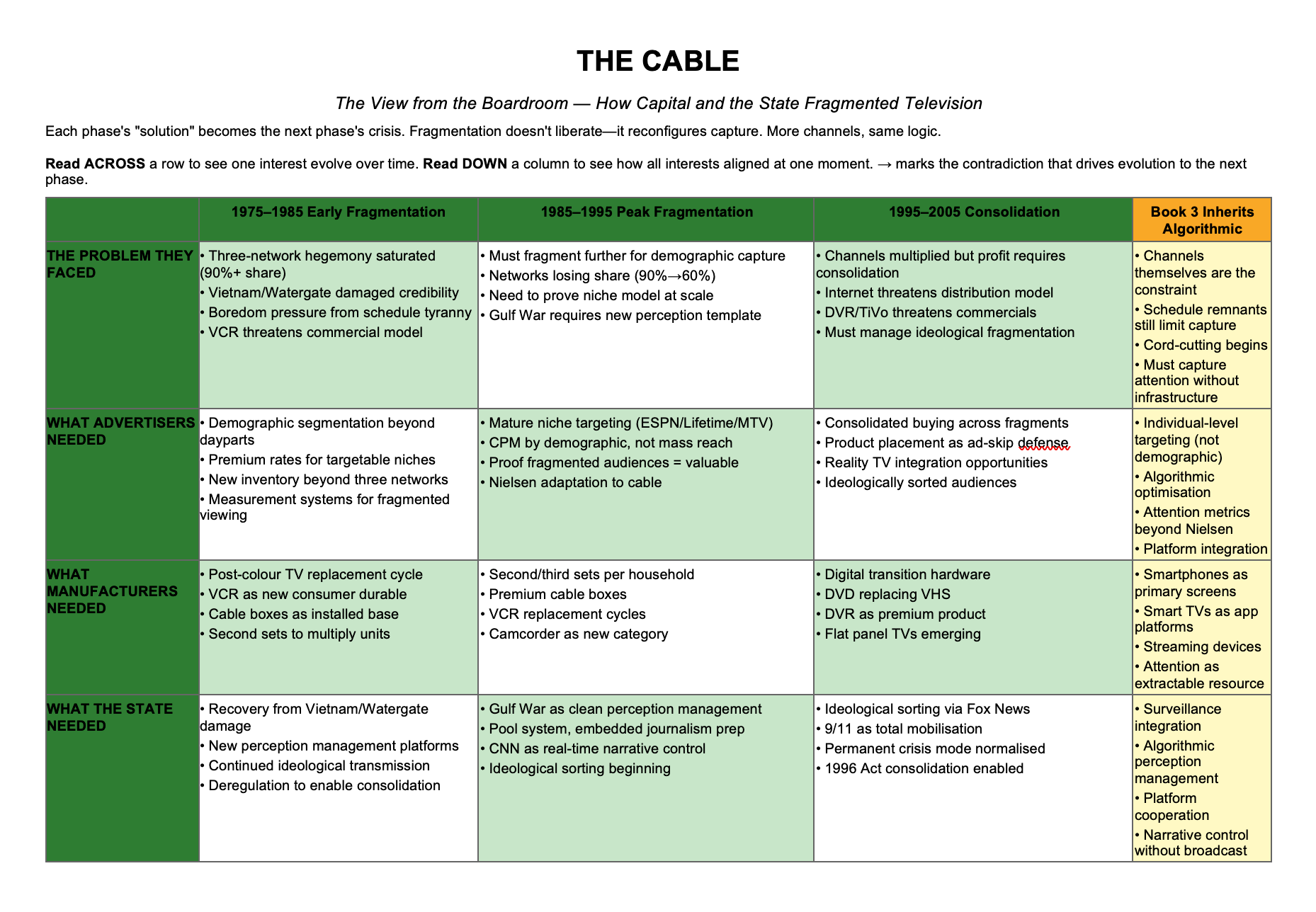
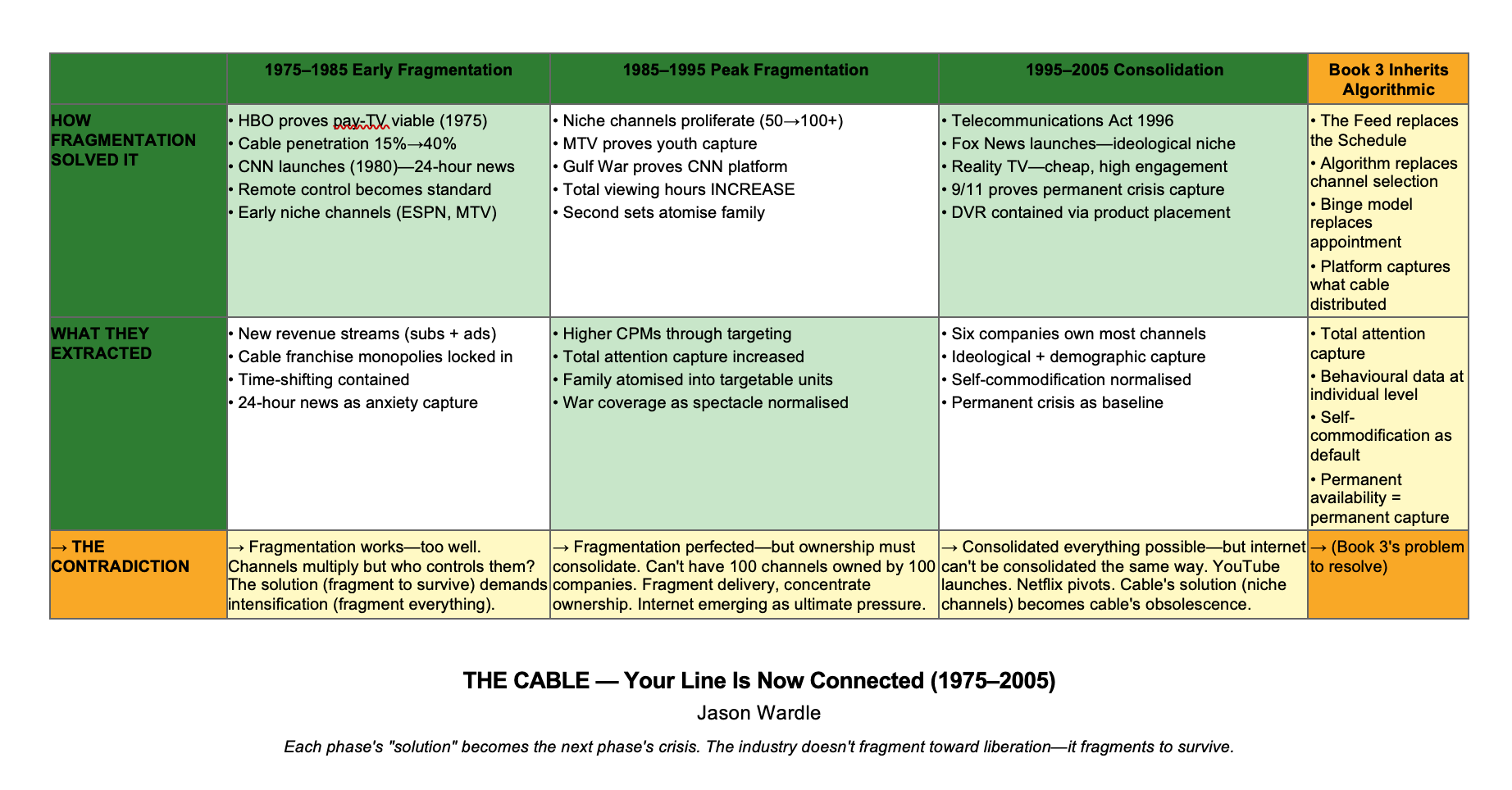
The following tables map the same thirty years from two perspectives. One shows what capital and the state needed; the other shows what households experienced. Read together, they reveal how television's fragmentation served specific interests while reshaping domestic life.
Table 1: The View from the Boardroom tracks what advertisers, manufacturers, and the state required from television at each stage—and how fragmentation solved their problems while generating new contradictions. This is the supply side: the interests that shaped the system.
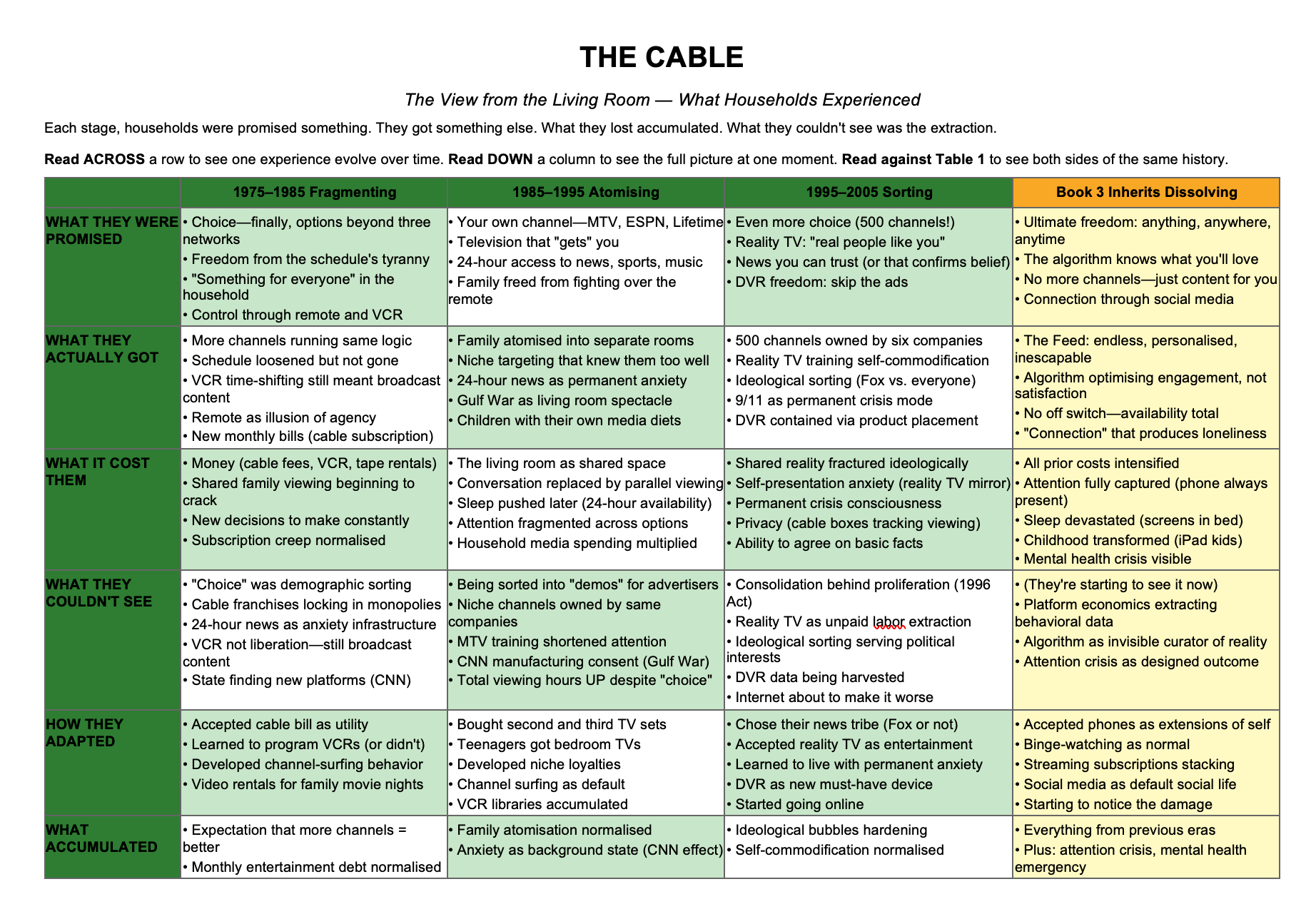
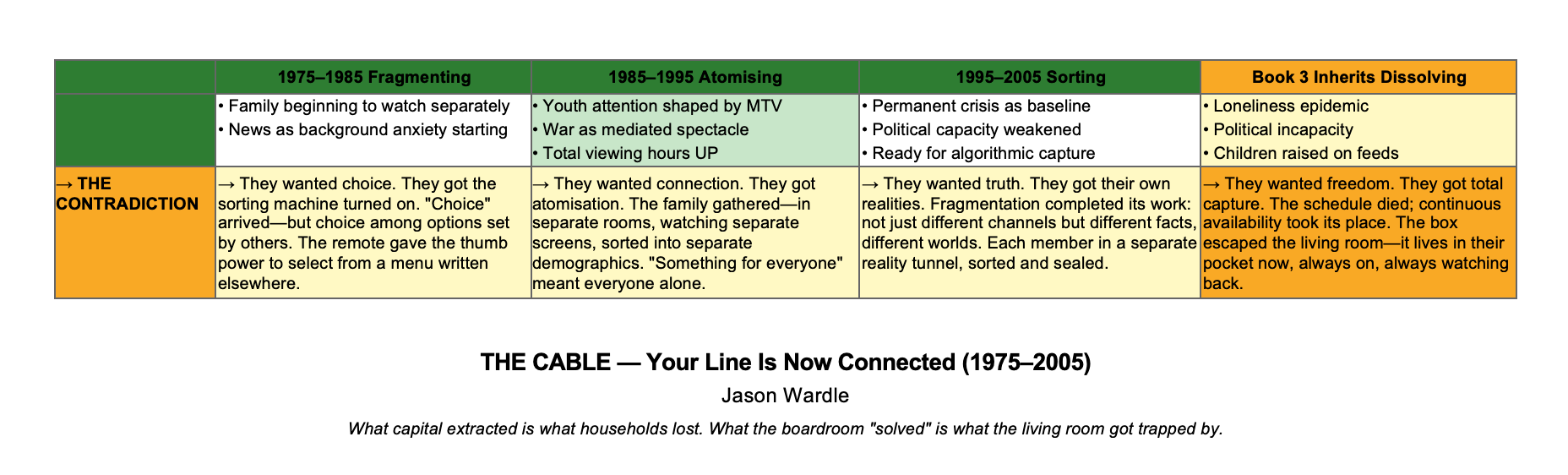
Table 2: The View from the Living Room tracks what households were promised, what they actually received, what it cost them, and what they couldn't see. This is the demand side: the experience of living inside a system designed for extraction.
How to read them:
Read ACROSS a row to see one interest or experience evolve through time
Read DOWN a column to see how all elements aligned at one historical moment
Read BETWEEN tables to see both sides of the same history—what the boardroom extracted is what the living room lost
Each column ends with a contradiction: the tension that era's "solution" could not resolve, forcing transformation into the next phase. These contradictions are the engine of the history that follows.
The tables are a map, not the territory. The chapters ahead fill in the human detail—the names, dates, decisions, and mechanisms. But the logic is here. Fragmentation didn't liberate. It reconfigured capture. More channels, same extraction. "Choice" serving the same interests the absence of choice once served.
The View from the Living Room — What Households Experienced
Each stage, households were promised something. They got something else. What they lost accumulated. What they couldn't see was the extraction.
Read ACROSS a row to see one experience evolve over time. Read DOWN a column to see the full picture at one moment. Read against Table 1 to see both sides of the same history.
The father has the good set.
It sits where the fireplace would have been in an older house, at the blunt end of the living room, a thirty-two-inch Sony Trinitron in a pale wood cabinet. The furniture faces it. The family faces it. The room faces it.
The chair in the best spot is his. No one had to say that out loud. He comes home, eats, sinks into the recliner with a Bud Light on the side table and the remote in his hand. This is the part of the evening that belongs to him.
ESPN is on. It usually is.
SportsCenter runs through last night’s scores. Highlights roll. The crawl at the bottom whispers injury updates and trade rumours and promises more after the break. Then the break comes, and his thumb moves on its own. CNN. TNT. Another ESPN channel he pays extra for. The Weather Channel. Back to SportsCenter before the host returns.
He doesn’t think of this as a decision. It’s become a reflex. Ten years ago, the remote felt like a gadget. Now it feels like another joint in his hand.
The channel gives his evening a shape that his day no longer does. The job is a blur of quotas and supervisor pressure and rumours about layoffs the company insists are “just talk.” The game is clear. There are rules, scores, winners. Where his workday gives him numbers he cannot control—productivity targets, mortgage balances, credit card interest—ESPN gives him numbers that respond when he yells at the screen. He knows the batting averages, the standings, the injury lists more intimately than the terms of his health insurance.
On some level he knows these games do not change anything in his own life. That’s part of the appeal. The drama is intense and completely consequence-free for him. The channel supplies a nightly dose of high-stakes feeling with no follow-up phone call, no meeting with HR, no second shift. His nervous system gets the arc—build-up, tension, resolution—without the risk that comes with fighting over wages or hours.
Down the hall, his wife has her own set.
Nineteen inches, Magnavox, perched on the dresser in the master bedroom, angled at the bed. When they bought it, they told themselves it was “for the kids” and “for the news.” In practice, it ended the nightly arguments over what to watch. The arguments stopped. So did watching together.
Tonight she has Lifetime on. A made-for-TV movie: Moment of Truth: Broken Pledges. College hazing gone wrong. A dead boy. A mother’s grief. She’s seen most of it once already. That doesn’t matter. The movie is background for folding laundry. She feeds clothes from the basket to the bed in neat stacks while the ads roll past: detergent, menstrual products, diet pills, a soft-focus prescription drug that didn’t exist when she was a teenager.
The bedroom TV was her idea. Her channel, her schedule, her space. It feels like a small victory.
The stories Lifetime feeds her move in tight, predictable loops. A woman notices danger before anyone else. No one believes her. The danger crests. Either she is vindicated, or she is crushed, or both. The rhythm is soothing because it matches something in her own life: feeling risk and worry first, being told she is “overreacting,” carrying everyone else’s emotional load and domestic labour while the house insists she is “lucky” to have what she has.
The channel recognises her and narrows her at the same time. Threats are personal, made for the courtroom scene, the hospital hallway, the kitchen table—but rarely made for the city council, the state legislature, the corporate board. Violence is a bad man in a car park, not a cut to shelter funding or a managed-care company denying coverage. By the time the movie reaches its courtroom climax, the real sources of danger in her life have been swapped out for a villain whose defeat fits neatly between ad breaks.
The television helps her arrange her evening. Fold six shirts. Check the screen. Fold the towels. Check the screen. The movie keeps her company while she does work the world calls “invisible.” The set flatters her with plots about women who notice everything, even as it helps keep her looking inward, into the family, into private tragedy, away from anything that might suggest organising with other women for something larger than a Lifetime ending.
Upstairs, their son has annexed a third screen.
The room was meant for a second child who never arrived. Now a fourteen-year-old boy lies across the bed, shoes on, a thirteen-inch set balanced on a milk crate. The phone cord snakes under the door; he is both talking and not-really-listening to a friend while MTV flickers in front of him.
On screen, a Smashing Pumpkins video stutters in two-second shots. The camera never rests. The edits run ahead of his thoughts. He does not feel that he is learning anything, but he is. His brain is taking notes on pacing, rhythm, stimulation. The lesson is simple: if images don’t move this fast, something is wrong. Something is “boring.”
Between videos, MTV News appears: a quick hit about the Oklahoma City bombing, or the trial about to come, delivered in the same bright tone as the concert announcements. Then an ad for Clearasil. Then an ad for the Army. Then back to the videos.
The channel is quietly setting his nervous system’s default settings. School already feels too slow, the pages in his textbooks too still. The teacher’s voice has no jump-cuts. In class his leg bounces under the desk because his body thinks someone, somewhere, is late with the next shot. When MTV News mentions a bombing, it lands in the same slot in his head as a music tour date and a skin cream discount. The world’s violence, his appearance, the idea of military service—each is a short segment between graphics, another piece of content punched through the same narrow tube.
The Army spot feels like just another video, half-ironic macho fantasy wrapped in the same editing language as the bands he follows. Nobody has sat him down for a lecture about patriotism or service. They don’t have to. The pitch arrives smuggled inside the tempo his eyes now crave.
In the family room, a fourth set—the oldest—sits half-abandoned.
Next to it, a VCR blinks 12:00, 12:00, 12:00, still un-set after the last power cut. A stack of rented tapes from Blockbuster, two already overdue, waits beside a taller stack of labelled cassettes: Seinfeld 11/9, ER Thanksgiving, Roseanne Halloween. A private archive of evenings once watched live and captured for later, “for when we have time,” which they never really do.
The tapes were meant to win back time from the schedule: no more rushing home for a favourite show, no more missing a finale because the kids wouldn’t settle. In practice, the pile has become a small shrine to evenings that never quite arrive. Each spine on the stack is a promise the week hasn’t kept. The technology that was supposed to free them from the tyranny of the network grid has given them a second grid, this one made of guilt and backlog.
The family has learned that television is not just a flow you dip into but a catalogue you are failing to keep up with. There is always another episode you “really should” watch, another film you’ve already paid for waiting by the VCR. The machine doesn’t only store shows; it stores obligations.
The family pays for one hundred and forty-seven channels.
They use, on a regular basis, maybe seventeen.
They have never had more to watch. They have never spent more hours watching.
This is what “choice” looks like in 1995.
Not one screen with three networks, a fixed schedule, and the sense that if you miss a show, you miss it forever. Three screens. Three rooms. Three separate evenings under the same roof.
The cable installer came eight years ago, in 1987. Drilled through the wall, dragged coaxial into the lounge, screwed a beige box into the carpet dust under the set. A wire from a headend facility in Atlanta, out through suburbs like this one, into houses like this one. Freedom, said the commercials. Freedom from the tyranny of the schedule. Freedom from boring programmes. Freedom from “nothing on.”
The salesman never mentioned that 1987 was also the age of Reagan’s last budget, of deregulation and “market discipline,” of the Fairness Doctrine already on its way out. No ad explained that the same political class cutting social programmes and breaking unions was clearing the runway for cable systems to grow, merge, and set their own terms. The pitch stayed simple: more channels, more freedom.
The father believes this. ESPN is his channel. The crawl speaks his language. Talk radio with pictures. A tunnel out of the house and into a world where sports news matters more than his job or the mortgage statement or the stack of unpaid bills on the kitchen counter. You can’t yell at the health insurer and get a replay. You can yell at the bullpen choices and feel heard.
The mother believes it. Lifetime is her space. The movies are tailored to her: women hurt, women doubted, women who see danger coming before anyone else. She feels recognised. The channel seems to understand something about her that no one else in the house does, even as it steers that recognition back into personal melodrama and away from the fact that women like her are working longer hours, for lower real wages, with less childcare support than their mothers had.
The son believes it most of all. MTV is his. No parents. No teachers. Loud, jump-cut, self-mocking and self-obsessed in the same breath. He cannot imagine his parents’ three-network childhood and never tries. For him, there has always been a channel whose whole job is to flatter his taste and feed his boredom.
To each of them, cable feels like an escape route.
What they cannot see from their separate rooms is that they have been sorted.
The father is a man between eighteen and forty-nine. That is how ESPN sees him. That is how the advertising market sees him. His channel exists because beer companies, car companies and razor brands will pay extra to reach “men 18–49 with disposable income” at scale. Programmes are built to hold him through each eight- or ten-minute stretch so the time can be sold in blocks: thirty dollars per thousand of him and others like him. He thinks he is the customer. On the books, he is the product.
The mother is a woman between twenty-five and fifty-four, in a household with children, making most of the decisions about groceries and medicine. Lifetime’s “television for women” slogan sounds like a service. It is also a specification sheet. Her movies sit between the ads for cleaning agents, medications, skin creams, credit cards. She is what is being delivered, in reliable numbers, every night.
The son belongs to the most valuable category of all: teenagers and young adults. He is slippery. Harder to reach. He zips past radio. Ignores newspapers. Spends more time at school and at the mall than at home.
MTV is designed to pin him down.
To the casual eye, the rapid edits and constant motion look like style. To advertisers, that style is a solution to a problem: how to keep a teenager from turning away long enough to push thirty seconds of sales pitch through his eyes and ears. The videos set the pace. The commercials match it. The attention pattern carries across.
He is not being courted. He is being trained.
Three screens. Three carefully defined groups. Three flows of ads running through the same house at the same time.
Someone owns those pipes.
ESPN, in 1995, sits mostly inside Capital Cities/ABC. Capital Cities/ABC, in turn, is about to be swallowed by Disney in a nineteen-billion-dollar deal that will make headlines and reassure shareholders that live sports plus children’s characters plus theme parks equals a future.
Lifetime sits between Capital Cities/ABC and Hearst, a joint property: part network, part magazine logic, a neat loop between “women’s content” and the brands that sponsor it.
MTV lives under Viacom, where it shares a roof with Nickelodeon, VH1, Showtime, and, thanks to a recent buying spree, Paramount Pictures and Blockbuster Video. Sumner Redstone’s operation now reaches into the cinema, the rental store, the kids’ channel, the youth channel, the adult music channel—layers of the same audience across a lifetime.
On the surface, ESPN, Lifetime, and MTV look like different planets. Sports, melodrama, music videos. Different tones. Different aesthetics. Different jokes.
On the balance sheet, they live in the same small neighbourhood.
Behind that neighbourhood sits a political and economic story that never appears in the programme guide. Deregulation in the 1980s loosened ownership rules. Cheap debt and junk bonds made it easy to borrow billions to buy stations, networks, and cable systems. Washington redefined communications as just another field for “competition,” meaning consolidation in practice. By the mid-1990s, Republican and Democratic administrations alike had accepted that the best way to run the country’s information systems was to let a handful of conglomerates do it for profit.
And the box in the living room does not just stop at three.
The family’s hundred and forty-seven options, once you peel off the logos, resolve into fewer than a dozen corporate owners: Disney, Time Warner, Viacom, News Corporation, a cluster of others. Different brands. Same class of people in the boardrooms. Same investor calls. Same pressure to squeeze more money out of each hour of each viewer’s attention.
From inside the Atlanta house, this is invisible. The father flips past logos. The mother recognises faces. The son follows bands and VJs. None of them sees the ownership tree. None of them is meant to.
What they see, and what the industry sells them, is simple: you are in control now.
Let’s climb out of the house for a moment.
Pull back from the cul-de-sac, the suburb, the city. Look at the pattern from the altitude where cable executives and advertisers look at it.
In 1975, most American homes with televisions pointed those sets at the same three networks. A major show could pull seventy million viewers in one night. Prime-time ratings reports treated “America” as one audience with minor differences around the edges.
By the mid-1990s, when this family is flipping and folding and half-watching upstairs, cable has rewired the country.
Roughly sixty-five million homes have cable or satellite. Around sixty percent of households. On average, each home has more than two sets instead of one. Each week, the household TV usage clocks in at about fifty hours. More sets. More hours. More screens glowing in more rooms for more of the day.
But the big hit is smaller now.
The top show in 1995 reaches around thirty million people, not seventy. The rest of the audience has been encouraged, escorted, and shoved off to dozens of other channels: “for women,” “for kids,” “for Black viewers,” “for Hispanics,” “for sports fans,” “for news junkies,” “for people who like true crime at eleven p.m.”
The polite word for this is “fragmentation.” It sounds like something that just happened. The culture “splintered.” The audience “became more individual.” People “wanted more choice.”
The truth is plainer and less flattering.
Fragmentation was built.
Not by the viewers. By the people who realised there was more money to be made if you could sort households more finely.
The same period that produced cable’s growth produced broken strikes, shuttered factories, and an official story that there was no alternative to market rule. Public institutions that might once have been used to widen access—to healthcare, childcare, housing—were being pared back or sold off. Private pipes running into the home did the opposite job: they turned the house itself into a saleable terrain, sliced into ever-finer demographic parcels. The more precarious and stressed the population became, the more urgent it was—for capital—to catch them in front of a screen.
John Malone did the heavy lifting on the pipe.
Through Tele-Communications Inc., he spent the 1980s buying local cable systems the way other men buy shirts. By the mid-1990s, TCI controls access to around thirteen million homes. That kind of leverage earns you a new angle: you don’t just carry channels, you demand a piece of them. Malone’s Liberty Media arm starts turning up on the ownership papers for networks like Discovery, BET, QVC, Court TV. When TCI pipes those channels into homes, it isn’t just delivering someone else’s product. It’s pumping value into its own investment.
Rupert Murdoch brings his newspaper instincts to television.
He buys Twentieth Century Fox. He cobbles together the Fox network. He eyes the gap to the right of CNN and decides the country will support a news service that tells an angrier, more openly partisan story. Fox News launches in 1996, turning cable news into a permanent campaign and teaching the rest of the industry that outrage is a renewable resource.
Sumner Redstone turns Viacom into a tower of nested audiences.
Nickelodeon, for children. MTV, for teenagers. VH1, for adults who still like music but no longer want to be shouted at. Paramount for films. Blockbuster for the weekends when you walk into a shop and pay real cash to take the box home. Later, BET joins the stack as a channel aimed at Black viewers. The same company tracks you across your life and across your living room.
Ted Turner, working out of Atlanta, proves that news doesn’t have to end.
CNN goes on the air in 1980 and never leaves. The same handful of stories can be cycled through the loop all day and all night. In the Gulf War and other crises, the network discovers what it already suspected: if you keep the picture moving and the tone at “urgent,” people will watch for hours.
Each of these men is solving a problem for capital.
How do you get into more homes?
How do you hold people longer?
How do you carve the audience into slices that advertisers can pay a premium for?
How do you own the pipes and the things travelling down them at the same time?
The answer is not “three networks and a national ritual.” The answer is “hundreds of channels, each tuned to a type of person,” all of them wired into the same billing system, the same back-end carriage deals, the same handful of balance sheets.
From high up, the story of the cable era is not: we got more choice. It is: they got more ways to package us.
The pitch that sold all this was freedom.
The National Cable Television Association went to Congress and to the press with the same language on repeat: more diversity, more competition, more voices. No longer three big networks deciding everything. Hundreds of channels. Whole genres that could never get airtime on ABC given their own homes.
At the same time, the hardware makers whispered their own promises.
The remote control: you’re in charge now. No more getting up to spin a dial.
The VCR: record what you want, when you want. Break the schedule. Watch on your own time.
In the Atlanta house, those promises feel true.
The father does click away from things he doesn’t like. The mother does record movies to watch when the house is quiet. The son does live in an MTV bubble his parents can’t easily pop. This feels like a gain.
But look at what happens underneath.
The remote doesn’t change who owns the channels. It just makes it easier to surf between them. The thumb on the button feels powerful. The hand behind the grid—deciding which channels exist and what they run—is untouched. The device also trains a reflex: the second something feels slow, awkward, uncomfortable, your body reaches for instant escape. Boredom and discomfort become technical glitches to be solved, not signals that something in your life might need changing.
The VCR doesn’t shrink the number of hours the screen is on. It expands the range of hours where television is an option. Late nights, Sunday afternoons, school holidays. Time-shifting doesn’t break the hold of TV on the home. It spreads that hold more evenly across the week. The machine sits there, humming quietly, reminding everyone there is always more they could be watching.
By 1990, two-thirds of American households have VCRs. By the end of the decade, that figure pushes toward nine in ten, with many homes owning two machines. A four-billion-dollar rental business grows out of nothing in less than twenty years. Blockbuster becomes as recognisable a brand as some networks.
Every new piece of equipment sold as “control” ends up deepening the reach of the screen.
Every extra channel sold as “choice” ends up being another finely tuned route into a demographic slice.
Every step that looks like liberation for the viewer shows up, on the other side of the ledger, as a new way to schedule, measure, and sell their hours.
This book is about what that did to the household.
Not in theory, but in practice. In the layout of rooms. In the way evenings are carved up. In the kinds of arguments that stop happening because everyone has retreated to their own set. In the way people’s inner lives start syncing to the rhythms of highlights, cliff-hangers, movie-of-the-week crescendos and music video cuts.
Between 1975 and 2005, television in the United States moves from three networks to five hundred channels, from one set in the living room to sets in every bedroom plus a blinking VCR, from a common schedule to a swarm of overlapping schedules. Cable is the engine that drives this shift.
Three questions sit under everything that follows:
What did fragmentation actually change?
Not what the industry said it would do, but what it did: how it changed who watched what, with whom, for how long, and under what sort of pressure. How it rewired attention, sleep, conversation, and how much of the day could be spent in someone else’s story. Whether it really loosened television’s grip on the evening or tightened it.
Who walked away richer?
Names, not abstractions. Malone, Murdoch, Redstone, Turner, their shareholders, their partners in the advertising trade, the bankers who financed the acquisition waves. Each chapter follows specific deals and regulatory changes and asks what they were for, beyond the slogans.
Why, with more channels and more remotes and more ways to watch, do people feel more watched?
Why does a man in a recliner in Atlanta in 1995 feel like the commercials know him? Why does a woman on her bed with laundry in her lap feel the ads are designed for her? Why does a teenager upstairs feel the Army recruits are somehow speaking directly to him?
Cable did not invent the idea of selling the audience. That’s baked into television from the start. What cable did was refine it. It took the crude, three-network model of “households” and turned it into a finely gridded map of age, gender, race, income, taste and fear.
It also laid the groundwork for what came after.
By the time streaming arrives, viewers already expect to have “their” shows, “their” niche. By the time algorithms start recommending everything, people already accept the idea that their previous choices should shape what they see next. By the time social media asks everyone to brand themselves, a generation has grown up watching reality shows that teach them self-presentation as survival. The son upstairs, learning to judge himself against the camera’s eye and the edit’s pace, is being prepared to live later in a world where he will be expected to curate his own feed and offer up his own life as content.
The cable years, in other words, are not a side-quest between “pure” broadcasting and “true” internet video. They are training.
Back in the Atlanta house, the night runs its course.
The father keeps ESPN on until his eyes sag. One last highlight, one last segment, one last update about a player’s knee. Then the click, the room going dark around the outline of the set.
The mother finishes her movie alone. The abused child is saved or not. The villain is punished or not. The film ends at a neat emotional pitch designed to melt into an ad break. She wipes her eyes, switches off the set, carries the laundry into drawers.
Upstairs, the boy falls asleep before the MTV logo does. The thirteen-inch screen keeps throwing blue light at his face, cycling through videos and news and ads until someone downstairs notices and comes up to turn it off. Or doesn’t.
Between them, they have given the cable operation perhaps fourteen hours of attention tonight. In return, it has delivered them a few stories, some scores, some songs—and several hundred advertisements.
They feel like they chose.
They did choose. Which channel. Which room. Whether to stay or to get up.
The question this book is interested in is not whether they chose. It’s what they were choosing among, who set those choices up, and who profits from their decision to stay in the chair, on the bed, on the floor, looking at the light.
The cable box in the living room keeps its own kind of vigil when they’ve gone to bed.
The green numbers glow in the dark. One hundred and forty-seven channels, waiting. All of them wired, in one way or another, to people they will never meet.
All of them ready to look back.
The Liberation Promise
The box had won. By 1975, television had completed its colonisation of American domestic time—over six hours daily, the living room reorganised around the glowing screen, the schedule discipline accepted as natural. Book 1 traced that victory: the invention sold as furniture, the advertising model locked in, the state integrated from inception, the audience transformed into product. The system worked.
But the system faced pressure. Three networks dictating content to sixty million households. The same programmes, the same schedule, the same mass audience delivered to the same advertisers. Viewers restless with limited choice. Advertisers hungry for segmentation. The apparatus straining against its own success.
Enter liberation.
Cable promised escape from network tyranny—not three channels but dozens, then hundreds. Something for everyone. The VCR promised escape from the schedule—watch what you want, when you want. Control over your own time. The remote control promised escape from passivity—you choose, you decide, you command. Agency restored. The marketing was libertarian: individual choice against institutional control, personal freedom against broadcast monopoly, consumer empowerment against corporate dictation.
Who made these promises? Cable operators selling subscriptions. Electronics manufacturers selling boxes. Tech journalists celebrating the coming revolution. A chorus of liberation rhetoric, all singing the same tune: choice is freedom, more is better, control returns to you.
Part I examines what these promises actually delivered.
Chapter 1 unpacks the ideology itself—"liberation technology" as sales pitch, the rhetoric of choice masking the reality of reconfigured capture. The VCR didn't free viewers from television; it let them be captured on their own schedule. More channels didn't mean more diversity; it meant more channels for the same owners to fill.
Chapter 2 introduces the remote control subject—that restless scanner, thumb perpetually ready, trained to sample constantly and settle never. The remote didn't give viewers power over television; it gave television a new way to shape viewers. False agency, real training.
Chapter 3 examines time-shifting—the VCR's promise of temporal liberation. Recording broadcast content, renting Hollywood movies, the pornography that drove early adoption. Time-shifting didn't reduce viewing; it extended it. The schedule loosened; capture intensified.
The tools of liberation were tools of intensified capture. The rhetoric of freedom was the ideological cover for deeper penetration. What felt like escape was reconfiguration.
Book 1 ended with the apparatus complete. Part I shows that apparatus learning new tricks—not abandoning capture but refining it, not serving viewers but sorting them more precisely. The liberation was never the point. The point was what liberation enabled: fragmentation as strategy, choice as ideology, the audience prepared for targeting.
The promise glittered. Part I follows where it led.
The installer’s van pulled into the driveway of a split-level house in Aurora, Colorado, on a Tuesday morning in March 1987. Mile High Cable had been wiring the subdivision for six months, and this household was finally getting connected. The installer—a young man in company coveralls—carried a clipboard and a sales pitch he could recite in his sleep: more channels, more choice, more control over your entertainment. He would repeat those words dozens of times that week, in dozens of living rooms, as Mile High raced to sign people up before a rival ever existed on paper.
The homeowner, a woman in her mid-forties, led him to the family room. She had already put in a half-shift at the supermarket bakery that morning, up since five, frosting cakes under fluorescent lights and trying not to think about the mortgage adjustment letter still sitting unopened on the kitchen table. Her husband’s hours at the plant had been cut again. Prices in the grocery aisles kept creeping up. The television felt like the one thing in the house that still delivered a predictable kind of comfort.
The main set sat against the far wall. While he drilled through the siding, he talked her through what was about to enter her house. Thirty-six channels. HBO if she wanted it. ESPN for whoever watched sports. MTV for the kids. Nickelodeon. CNN, all day and all night. No more wrestling with the antenna. No more hoping the networks had put something decent on.
The installer hit the script cleanly, but he wasn’t exactly liberated either. His wages depended on how many homes he wired that week. He was paid by the job, not by the hour. The company had just cut the health plan and folded his “overtime” into a flat day rate. The faster he drilled and stapled and fed coaxial through drywall, the closer he got to paying off his own credit-card balance—the same consumer credit system his employer advertised between shows.
“You’re in control now,” he told her, feeding coaxial cable through the hole. “You decide what to watch and when.”
She nodded, half listening, half already imagining what that might mean. No more missing the late local news because she was still packing school lunches. Soap reruns in the middle of the afternoon when the house was finally quiet. CNN on in the background when another shuttle launch happened or when the stock market dropped again and the anchors explained, briskly, what it meant for “Main Street.” For her, it was less about “content” than about mood regulation: something to fill the silence that had been getting louder since the kids started pulling away and her husband stopped talking much about work.
She signed the contract. On paper, basic service was $18.95 a month—up from $11.14 only four months earlier, before rate deregulation kicked in, though he didn’t mention that. Within a few years it would climb toward $16 and beyond, and she would pay it. There was no real decision to make. Mile High was the only cable operator in Aurora. There was no competitor waiting for a franchising round. There never would be.
He finished the install in forty-five minutes, walked her through the remote control—a chunky plastic rectangle with thirty-six buttons, one for each channel—left a printed channel guide on the coffee table and gave her the closing line: freedom from the tyranny of the networks. She could watch what she wanted now. She was liberated.
For her mother’s generation, television had meant three networks and a weather forecast you couldn’t pause. For her, standing in a living room lined with Reagan-era motivational posters about “opportunity” while real wages stagnated, the promise hit harder. If everything outside the house felt increasingly out of her hands—interest rates, health insurance, shifts vanishing with a memo—the idea that at least the screen would obey her thumb felt like a small, survivable victory.
Choice and Control
Two words floated over almost everything said about cable in those years: “choice” and “control.”
They turned up everywhere. In glossy advertisements. In editorials in trade magazines. In the way the National Cable Television Association described itself to Congress. In consumer electronics marketing. In glowing tech pieces about “the future of television.”
This wasn’t an accident. When the NCTA appeared before Congress pushing for what became the Cable Communications Policy Act of 1984, its representatives talked about giving Americans “the freedom to choose from a diversity of programming options” and “control over their own viewing experience.”¹ Zenith pushed remote controls with the promise that you could “Take Command of Your Television.”² JVC sold the VHS recorder as a way to escape the schedule altogether: no more missing your favourite show because you were at work, no more being pushed around by network timing.³
Behind those words sat a broader political language that had been drilled into the country since the late 1970s. “Choice” was the same magic word used to sell airline deregulation, school vouchers, the shredding of public housing—anything that moved power from public institutions to private firms. “Control” was the updated version of “freedom”: not freedom from exploitation, but freedom to behave like a consumer. The Chicago School had spent a decade insisting that markets were just democracy in a better suit. Cable arrived as the flattering household version of the same doctrine.
The slogans were specific and shameless. “TV the way you want it.” “Don’t let the networks tell you what to watch.” “Hundreds of channels at your fingertips.” The liberation being marketed was psychosocial as much as technical: you, the viewer, no longer humiliated by missing your show; no longer forced to sit through a programme you didn’t choose; no longer the passive object of a schedule drawn up in New York. The humiliation of being “just an audience” was repackaged as an affront to personal sovereignty.
Those words did a lot of ideological lifting. “Choice” sounded like the free market at its best: a spread of options where smart consumers picked whatever fit them. “Control” sounded like agency: you in charge of your own time, your own screen, your own living room. Put together, they turned cable and the VCR into something more than devices. They became tools of personal freedom.
No one stopped to ask the obvious follow-ups in public: freedom from what, exactly? And freedom toward what?
Those questions rarely made it into the brochures. It was enough to say “choice” and assume it was self-evidently good; enough to say “control” and assume more was always better. The cable industry knew that Americans had spent decades living under the network schedule. The idea that “finally, you get to decide” practically sold itself.
The catch was built into the terms. “Choice” meant picking among options someone else had already defined: channels designed, programmed, and owned by companies with their own interests. “Control” meant control over timing—when you watched, which channel you landed on—not control over what existed to watch, who owned it, or what it was built to do to you.
At the level of lived psychology, the shift was subtle and important. In the three-network era, people were used to feeling pushed around by a grid: shows started when they started, ended when they ended, vanished if you missed them. Cable and the VCR turned that external pressure into an internalised demand: you could always find something better, record something else, watch more. Liberation meant that if you were bored now, it was your own fault for not choosing correctly.
How the Story Was Sold
The liberation story did not bubble up from happy viewers swapping anecdotes about their new cable boxes.
It was written and rolled out by an industry that needed it badly.
In the early 1980s, cable operators had a legitimacy problem. They wanted cities and counties to grant them exclusive franchises—the legal right to be the only company allowed to wire homes in each area. They wanted Washington to let them set their own prices. They wanted households to agree to pay monthly for something broadcast television still offered “free.” To make any of that palatable, they needed language that sounded bigger than “we want to charge you a subscription.” “Liberation” did the job.
So the story went everywhere. Trade magazines like Multichannel News and Broadcasting ran ads and editorials casting cable as the cure for network dominance. NCTA conventions hosted keynote speeches about the coming “500-channel universe.”⁴ Tech writers in Popular Science and Popular Mechanics filed breathless dispatches about an imminent age when every household could get programming tailored exactly to their interests.⁵
In hotel ballrooms in Washington, cable lobbyists laid it on thicker. Congressional staffers and FCC officials drifted between cheese trays and open bars while executives from TCI, Warner, Viacom and regional systems walked them through slide decks: pie charts labelled “Expanded Consumer Choice,” graphs showing “Explosive Growth in Local Programming.” The audience was asked to picture not monopoly rents, but a flowering of voices. In the corner, a table of industry lawyers quietly drafted the franchise language that would make sure only one operator would ever string wire down each street.
As the 1984 Cable Act moved through Congress, the pitch went into overdrive. Cable operators insisted that deregulation would “unleash innovation” and “expand consumer choice.” Barry Goldwater, the act’s main sponsor in the Senate, told colleagues that cable television was “the free enterprise system at its best” and that keeping a lid on rates was “government interference” holding back the market’s natural tendency to serve consumers.⁶ The bill sailed through with support from both parties.
On paper, the act did more than let companies raise prices. It hardened the franchise model that made cable operators local monopolies. Cities granted exclusive rights to one company per area, promising in return that the operator would wire the whole territory and maybe carry a local public access channel or two. In practice, it locked out competitors before they had a chance to exist. Once a franchise was awarded, no one else could legally cable those homes.
At the local level, “public hearings” on franchise awards often amounted to theatre. Residents would line up to ask anxiously about rates or demand extra community channels. Behind them, the city council sat with a single actual bid in front of it. The decision had already been made in private meetings with company representatives, franchise fees quietly negotiated, campaign contributions noted. The democratic ritual was a formality that let officials later talk about “community support” for the winner.
That structure produced what economists politely call “natural monopolies”: one provider, no rivals. Operators could set prices as high as subscribers would bear. Broadcast TV was still free, but by the mid-1980s cable’s expanding roster of channels—plus premium offerings like HBO—meant that not having cable increasingly felt like going without electricity or a phone.
Rate deregulation took full effect on December 29, 1986. By then, about 97 percent of all systems were free of rate controls.⁷ The impact showed up immediately.
In the first six months after deregulation, the average monthly cable bill jumped 6.7 percent. Basic service alone climbed 10.6 percent.⁸ The rises kept coming. In 1987, basic rates went up nearly 17 percent. In 1988, another 11.5 percent. In 1989, another 10 percent.⁹ In three years, basic service rose 43 percent—from $11.14 to $15.95 a month—while the Consumer Price Index crept up only 14 percent.¹⁰
Costs weren’t ballooning at the same rate. Market power was. Operators realised quickly that subscribers kept paying because they had nowhere else to go. Between 1985 and 1990, 53 percent of cable systems changed hands, with sale prices climbing—not because the systems had transformed their service, but because holding a monopoly in a given town turned out to be extremely valuable.¹¹
The regulator–industry boundary blurred. FCC officials who had helped implement the 1984 Act left for jobs at cable companies and law firms representing them. Lobbyists who had pushed deregulation moved into “public affairs” roles inside the corporations they’d just helped. The people drawing up the rules and the people profiting from them were often, quite literally, the same people a few years apart.
The gap between the slogans and the reality was obvious. “Choice” had delivered steep price hikes. “Control” came bundled with locked-in local monopolies. The industry that sold itself as a break from domination had secured legal protection to act as the only game in town.
By 1989, even establishment figures were saying it bluntly. Senator Albert Gore Jr. complained that “precipitous rate hikes of 100 percent or more in one year have not been unusual since cable was given total freedom to charge whatever the market will bear,” and pointed to “an extraordinary concentration of control and integration by cable operators and program services, manifesting itself in blatantly anticompetitive behavior.”⁸
None of that dented the liberation story. It couldn’t. The whole business model depended on people believing they weren’t just paying for channels; they were paying for freedom.
For capital, this story wasn’t decoration. It was infrastructure. To justify turning neighbourhood wiring into a monopoly rent machine, you needed the population to experience it as an upgrade in their autonomy. If people had seen clearly that they were handing a private tollbooth control over their evenings, the anger might have gone somewhere dangerous. “Choice and control” absorbed that pressure and turned it inwards: if you felt trapped, it must be because you were choosing badly, not because the grid itself had been designed to enclose you.
The VCR and the Promise of Time
The video cassette recorder arrived with a cleaner promise still: not just more things to watch, but freedom from time itself.
With a VCR, you never had to miss a show again. You could tape it while you worked late, while you slept, while you watched something else. The fixed broadcast schedule that had ruled American TV since the 1940s suddenly looked negotiable.
On the surface, that promise held up. The VCR did let people time-shift. In 1984, the Supreme Court’s Sony v. Universal decision declared that recording programs for later personal viewing was fair use.¹² After that, the box’s spread was unstoppable. Fewer than one percent of homes had a VCR in 1980. By 1985, 14 percent did. By 1987, half. By 1990, two-thirds. By 2000, nearly nine in ten.¹³
The speed was startling. In 1983, fewer than one in ten households had one. Three years later, Americans were buying 12 million units a year.¹⁴ One forecaster in the mid-1980s said the VCR was “becoming a household appliance as common as a toaster.”¹⁵ By decade’s end, it was hard to find a middle-class home without at least one hooked up. In wealthier suburbs, it wasn’t unusual to see two decks stacked in the same entertainment unit: one “for taping,” one “for movies,” a small domestic division of labour built around magnetic tape.
But that distribution wasn’t neutral. Early adopters clustered in higher-income areas: homes that could afford a few hundred dollars on a box and an ever-growing collection of $19.95 tapes. In working-class neighbourhoods, a single VCR became a shared object: one machine in the living room, everyone negotiating whose show got taped over, whose birthday party got recorded, whose tape of Roots or The Godfather got preserved. The “freedom from time” experience looked different in a house where overtime shifts were swallowing evenings than it did in a house built around professional nine-to-five.
Reactions split down the obvious line. Viewers loved it. Hollywood panicked. In 1982, Jack Valenti, head of the Motion Picture Association of America, told Congress that “the VCR is to the American film producer and the American public as the Boston strangler is to the woman home alone.”¹⁶ Studios saw a single thing: a box that let people tape movies off TV or copy cassettes for friends.
They misread the threat. Piracy did not wipe them out. The VCR turned out to be a money machine. Home video exploded. Blockbuster grew from one store in 1985 to more than 9,000 by the mid-1990s, with over $4 billion in yearly revenue.¹⁷ The same studios that had dragged the technology through court ended up selling their films again on tape. By the 1990s, home video was often bringing in more money than theatrical runs.
Blockbuster and its rivals added their own layer of discipline. “Be kind, rewind” was the friendly slogan; the real message was on the receipt: return by noon or pay the fee. Weekends acquired a new ritual: the family trip through fluorescent aisles, scanning wall after wall of new releases, children lobbying for cartoons, parents bargaining between R-rated thrillers and PG-13 compromises. Then the clock started ticking. Forget to bring the tapes back and the film you “owned” for two nights quietly turned into an extra day’s wages siphoned into a corporate till. Leisure arrived with a due date.
Underneath the celebration, the core paradox went mostly unmentioned. Time-shifting was supposed to loosen television’s grip on the day. Record it now, watch when it suits you. In practice, total viewing went up. People with VCRs watched more television than people without them. The machine didn’t replace live viewing; it piled extra hours on top.¹⁸
The psychology followed. The stack of unplayed tapes next to the set became a kind of low-level obligation. “We should watch that before it’s due.” “We taped that and still haven’t gotten to it.”
Free time turned into a queue. Even the fantasy of “catching up” on culture became a small, constant pressure—another to-do list, written on plastic spines.
The economics always pointed that way. VCR makers earned money when people bought decks and blank tapes. Rental chains earned money when families checked out movies. Studios earned money every time a cassette was bought or rented. Everyone upstream had an interest in viewers spending more hours in front of screens, not fewer.
The ritual locked in quickly. Friday night became “video night”: the trip to Blockbuster, the slow walk along the new release wall, the stack of tapes for the weekend. It felt like maximum choice: shelves of colour, genres, and eras. It was also a quiet extension of television’s footprint. Hours that might have gone into other parts of life—reading, talking, walking, sleep—were now the hours given to rented films.
In hindsight, the most important thing the VCR did may not have been time-shifting at all. It normalised spending large blocks of home time in front of moving images. It trained people to see watching as the default way to use spare hours. Instead of freeing viewers from the schedule, it helped television seep into the parts of the day the schedule hadn’t fully colonised yet.
For capital, this was not a side-effect. The post-1970s economy depended increasingly on squeezing value out of every possible hour—overtime at work, second jobs, and, crucially, the unpaid time at home that could be turned into an advertising surface. A technology that converted evenings into measurable, rentable attention was not a threat to the system. It was the missing piece.
What “Choice” Turned Out to Be
By 1990, the typical cable household could pick from fifty or more channels. Five years later, that number had jumped past a hundred. By the mid-2000s, systems offered an average of 130, though families actually watched only around 17.8 of them.¹⁹ On the surface, the liberation pitch seemed vindicated: more options than anyone would have believed in 1975, something for everyone.
The channels weren’t neutral “options” appearing out of nowhere. They were products: carefully designed brands with specific schedules and target audiences, owned by specific companies with specific goals.
Look at who sat behind the logos.
ESPN was 80 percent owned by Capital Cities/ABC, which Disney would soon buy for $19 billion.²⁰ MTV, VH1, and Nickelodeon lived under Viacom, alongside Paramount Pictures, Blockbuster Video, and, soon enough, BET, which Viacom picked up in 2001 for $3 billion.²¹ CNN, TBS, TNT, and Cartoon Network fell under Ted Turner’s Turner Broadcasting, which Time Warner swallowed in 1996 in a $7.5 billion deal.²² The History Channel and A&E were joint ventures between major conglomerates.
By 1996, around 90 percent of cable programming was controlled by just ten parent companies.²³ More channels hadn’t spread ownership out. They’d concentrated it further. On-screen diversity soared; ownership diversity shrank.
Every channel shared the same basic reason for existing: to deliver particular audiences to advertisers.
That wasn’t subtext; it was the business model, spelled out in trade journals and investor decks. ESPN was built to gather men 18–49 and sell their attention to beer brands, car makers, banks, and sportswear companies, at CPMs 20–30 percent higher than general cable.²⁴ Lifetime was built to gather women 25–54 and deliver them to drug companies, household products, retailers. MTV was built to gather teenagers and young adults for advertisers willing to pay extra for that age group.
Inside the agencies, this looked even more clinical. In Manhattan media-planning offices, junior staff spent their days dragging cells across spreadsheets labelled “Women 25–54, children in home, cable penetration 80%+,” assigning them to networks and dayparts. A woman in Aurora folding laundry in front of Lifetime was reduced to a row: estimated viewing hours, likely brand loyalties, projected yearly spending on detergent, pharmaceuticals, and frozen dinners. Her “choice” of channel showed up on someone else’s screen as a number in a column called “deliverables.”
The gendering of cable was open, not covert. The point of having “his” and “her” channels was to sort viewing inside the same home. ESPN as his channel. Lifetime as hers. The fact that a household might carry both didn’t matter; what mattered was being able to measure, sell, and speak to each one separately. Lifetime’s “Television for Women” slogan didn’t just flatter viewers. It flagged to advertisers exactly which demographic the channel had pinned down.
Race and ethnicity were segmented the same way. BET and Spanish-language channels were sold as access points to “urban” and “Hispanic” markets—phrases that bundled culture, race, location and disposable income into neat bundles for ad buyers. The products pitched there were often different: cheaper fast food, pay-day loans, certain brands of alcohol, particular car models. Fragmentation wasn’t just about taste. It was about sorting populations and attaching different commercial and political scripts to each.
Children’s networks followed the same pattern. Nickelodeon lined kids up for toy companies and sugary cereals. The Disney Channel fed them toward Disney-branded everything. The old Saturday morning cartoon blocks that once lived inside the big networks moved onto dedicated channels that could run children’s programming all day, every day, turning childhood into a continuous marketing environment.
Psychologically, the system worked by making each slice feel like a home. ESPN cultivated a tone of insider banter: you, the guy who gets the stats and the rivalries, surrounded by other guys like you. Lifetime built worlds where women’s fears and injuries were finally taken seriously, even if only inside melodramas bracketed by ads for antidepressants and stain removers.
MTV assembled a 24-hour collage of youth style: the sense that you were plugged into the real pace of the world, not left behind with the old. People weren’t just watching programmes; they were being told, channel by channel, who they were meant to be.
These channels were built as targeting machines. Programmes were tuned to pull in specific groups and keep them long enough to feed them a reliable stream of ads. “Choice” meant you got to pick which slice you’d live in, which set of commercials would tailor themselves to you.
For capital, this precision solved a problem that had dogged the three-network era. When everyone watched the same show, advertisers bought “households” in bulk, wasting money on people outside their real targets. Cable replaced that blunt instrument with a scalpel. The more finely you could slice audiences—by age, gender, race, income, taste—the less money you wasted and the more pressure you could apply. Fragmentation wasn’t an accidental side-effect of technology. It was how the system made the audience more profitable without raising their wages a cent.
What could a viewer actually control in that environment?
She could flip from ESPN to CNN to MTV, from Lifetime to Nickelodeon to HBO. She couldn’t pick who owned those channels, what they ran, which ads got slotted in, or how much her subscription cost. She could decide when to turn the TV on or off. She could not decide whether the time she spent watching would be turned into a product and sold.
That gap between felt choice and structural power is where the rest of the book lives.
More Channels, Fewer Owners
If cable brought freedom, it did so under very strange conditions.
The same industry that promised choice was busily narrowing it at the structural level.
John Malone understood this better than anyone. As CEO of Tele-Communications Inc., he built the biggest cable operation the country had seen by constantly buying more systems. Between 1973 and 1989, TCI closed 482 deals—roughly one every two weeks.²³ “To Malone, a subscriber was a subscriber was a subscriber,” one longtime investor said. “In the pursuit of scale, he was willing to look at beachfront property even if it was near a toxic waste dump.”²⁴
That approach made sense because of how cable worked. A local monopoly meant steady income: subscribers paid every month and rarely cancelled. Regular, predictable cash flow made it easy to borrow. TCI took on debt to buy systems, used their subscription revenue to service the loans, then borrowed more to buy more systems. The bigger they got, the more leverage they had with programmers and the better terms they could demand, which meant more cash to roll into more acquisitions.²⁵
By 1982, TCI was the top cable operator in the US, with 2.5 million subscribers. By 1985, Malone had spent over $3 billion buying into more than 150 cable companies.²⁶ By the end of the 1980s, TCI served 8 million subscribers. By 1995, that number hit 13 million.²⁷
He stayed out of the most glamorous fights. While some rivals overbid for franchises in big cities, making grand promises about high-tech systems and community channels they then struggled to deliver, TCI went after smaller and mid-sized markets where expectations were lower and systems were cheaper. When those overextended urban operators started to buckle, Malone bought them after the damage had been done. His own description of this strategy was simple: wait for the arrows to hit the pioneers.²⁸
TCI’s power didn’t stop at the curb.
Through Liberty Media, it bought pieces of the networks themselves. By the late 1980s, TCI owned stakes in BET, Turner Broadcasting, Discovery, QVC, American Movie Classics, and others.²⁹ Programmers needed access to TCI’s millions of subscribers; Malone could use that leverage to demand equity. Networks that resisted risked being dropped from TCI systems, instantly losing millions of potential viewers.
In the boardroom, this was just good capital allocation: turn a “pipe” company into a company that owns what runs through the pipe as well. At the level of the living room, it meant that the supposedly separate forces shaping what people watched—the local cable operator, the national channels, the programming decisions—were increasingly the same group of men talking to themselves about how to extract more value from the same households.
Service on the ground was notoriously bad. TCI moved local offices out to cheap warehouse space, cut payroll, and skimped on upgrades. Subscribers complained about long waits, outages, billing messes, and no one answering the phone.³⁰ The complaints bounced off. There was no serious rival to defect to.
Psychologically, that sense of being trapped mattered. People learned that the system could waste their time, double-bill them, leave them on hold, and there was nothing they could do except yell at a call-centre worker with no power. The “choice and control” fantasy met the reality of sitting on a crackling line for forty minutes while a recorded voice repeated that “your call is important to us.” It was a small but regular lesson in how little control most people had over the infrastructures that organised their daily lives.
“Terrible customer service was part of the business plan,” one analyst said. “He was working in a regulated monopoly and behaved differently because of it. Those were just the incentives in the space.”³¹
When AT&T bought TCI in 1998 for $48 billion, the sale confirmed the logic. These systems were not worth that kind of money because they were beloved or efficient. They were worth it because they were tollbooths—monthly payments for access to something people now felt they couldn’t live without.
TCI was only one example.
Under Sumner Redstone, Viacom assembled a stack of assets: CBS, MTV, Nickelodeon, Comedy Central, Paramount, Blockbuster, Simon & Schuster. Time Warner fused Time Inc.’s magazine empire with Warner’s film and TV businesses, then added Turner Broadcasting, creating the largest media company on the planet.³² Rupert Murdoch’s News Corporation moved from newspapers into Fox, then into cable with Fox News and FX, building an openly political media arm. Disney swallowed Capital Cities/ABC and, with it, ESPN and other cable properties.³³
Each of these conglomerates specialised in a slightly different tone—Fox’s right-wing pugnacity, Disney’s family gloss, Time Warner’s prestige—but they shared the same basic economic problem: shareholder returns needed to keep rising while wages in the wider economy stalled. One answer was obvious: take more command of how people imagined the world. If you owned the news, the sports, the kids’ shows, the late-night comedy and half the films at the multiplex, you owned a disproportionate share of the stories people reached for to make sense of what was happening to them.
By the mid-1990s, a handful of conglomerates controlled most of what Americans saw. The person sitting on their couch with a remote in hand was flipping between different colours and logos drawn from the same small pool of owners.
More channels. Fewer owners. That was the real shape of “choice.”
What “Control” Really Controlled
The remote control was the perfect prop for the liberation story.
You could hold it. You could point it. It did what you told it to do. Press a button, and the picture changed. No more trudging up to the set and twisting a dial. The industry cast it as proof that the viewer was finally in charge.
It did give people something real: speed.
The ability to switch channels instantly altered how people watched. “Channel surfing” became a habit—a thumb-driven scan through the line-up, sampling a bit of this and that, rarely staying long. By the late 1980s, Nielsen was tracking “viewing-while-scanning,” and advertisers were adjusting to a world where a viewer might land on their spot mid-sentence.³⁴
In the mind, that new speed left a mark. Instead of settling into a programme and letting it unfold, viewers learned to keep a small part of their attention off to the side, ready to cut away. Boredom became both less bearable and more common: the slightest lull was now an insult to the thumb’s sense of possibility. The old, slower rhythm of television—shows that assumed you would stick around—gave way to a kind of permanent audition, where every segment had to prove itself worthy of not being surfed past.
But look closely at what this “control” actually covered.
The remote controlled which channel appeared on the screen. It didn’t control what those channels put there, who owned them, which ads ran, or how viewing was recorded, sliced and sold. It gave you control over your choice inside the menu. It gave you no control over the menu itself.
That distinction matters, because it’s easy to confuse the feeling of steering with actual power. You pick programmes. You feel like you’re directing the evening. But the options you’re choosing among—what’s on, what exists, which view of the world gets airtime—are all the result of decisions made by companies whose main job is to sell your time to someone else.
That’s true in most consumer markets. Television just amplifies it. You’re not just buying a product once; you’re stepping into a flow of stories and images built to hold you there and show you one sales pitch after another.
The remote also nudged behaviour in ways that suited the industry.
Surfing meant your eyes brushed past more channels, more often. You discovered new programmes mid-scroll. You landed on content designed to grab attention quickly. Ad-makers responded by front-loading hooks. Nobody wanted to waste the first five seconds anymore. The restless scanning the technology encouraged wasn’t an unfortunate side effect. It was a pattern that television and advertising were happy to feed and refine.
The VCR remote worked the same logic in a slightly different way. Fast forward. Rewind. Pause. It genuinely let people skip ads on recordings, which triggered real anxiety among advertisers. They responded, over the 1990s, by pushing more product placements, branded shows, and commercial messaging woven straight into plots and set dressing.³⁵ Even when you sped past the breaks, the sales pitch could still be sitting inside the show itself.
A sitcom kitchen suddenly filled with conspicuously labelled products; a drama where the characters discussed a car model like they were reading from a brochure; a game show where the prize was a week at a particular resort. The desired psychological effect was simple: whether or not you watched the commercial, the brand would live in your memory as part of the story. “Control” over the obvious ad slot pushed capital further into the interior of the programme.
There was another limit to this “control” that had nothing to do with buttons.
The remote lived in the present tense. It let you reshape the moment: up, down, channel, volume, play, stop. It did not touch the past: decades of franchise deals, deregulation, mergers, and infrastructure build-out, all the choices that produced a country full of local monopolies and a few giant owners. It did not touch the future: the continuing consolidation, the gradual tightening of targeting, the slow construction of a system designed to watch you watching.
You had a small lever inside a machine whose main parts were out of reach.
More Screens, More Hours
The story the industry told was simple: more choice, more competition and more channels should mean better outcomes for viewers. You could find what you liked. If you didn’t like it, you could click away. In theory, this should have pushed television to serve people better.
The numbers tell a different story.
Around 1990, the average American household watched about 48 hours of television a week. By 1995, it was 49.5. By 2000, over 50. By the 2007–2008 season, it had hit 58 hours and 27 minutes—a rise of more than ten hours a week in less than twenty years.³⁶
More channels meant more watching, not less. The widening of choice did not weaken television’s hold. It made it stronger.
The quality of attention shifted too.
Channel surfing trained people to watch in fragments: to turn away quickly, to be ready at any moment to find something “better.” The MTV style—fast cuts, constant movement—spilled into everything from ads to news to drama. Shot lengths got shorter. Pacing accelerated. Shows adapted to an audience whose thumb could eject them at any second.
Whole genres re-timed themselves to match the new nervous system. Local news adopted the “if it bleeds, it leads” rhythm, stacking crime and catastrophe up front before the viewer could flee.
Sports programming added more graphics, more sound effects, more talking heads in boxes. Even niche documentary channels cut away more often, dropped more music under everything, treated quiet as a risk instead of a tool. The medium was teaching the audience to need constant stimulation, then citing that trained need as proof that only constant stimulation would do.
Inside the house, the changes were physical.
More sets meant more rooms with screens. By 1990, the average home had two televisions. By 2000, 2.4. By 2008, 2.86, with more than half of households owning three or more.³⁷ Families that once gathered around a single set now often scattered to separate rooms: dad with ESPN, mum with Lifetime, kids with Nickelodeon or MTV. The old “everyone watching the same thing at the same time” ritual was giving way to parallel nights under the same roof.
In working-class homes, this split often tracked stress lines that were already there: parents exhausted, kids simmering with their own frustrations, everyone too tired to fight over the single screen. In more affluent homes, extra sets appeared as amenities—TVs in kitchens, in finished basements, above exercise equipment—little luxuries that quietly turned every corner of the house into potential screening space.
For advertisers and networks, this was ideal. Each person could be targeted separately, their viewing measured and priced as a separate line-item. What had once been one “household” in the ratings became multiple, finer-grained demographics, each with their own channel, their own programming style, their own ad mix.
At the psychological level, the results were double-edged. People felt less forced to compromise—no more arguments over whose show would win the single-set lottery. But they also lost the friction that comes from being exposed to other people’s tastes in the same room. Cable-era “choice” helped dissolve a certain kind of everyday negotiation inside the family: the small arguments over what to watch that used to double as chances to talk, joke, and sulk together. In their place, the industry offered a smoother, quieter night, with each person privately bathed in tailored light.
None of this is surprising once you remember how the system makes its money.
Cable operators, programmers and advertisers all do better when viewers spend more time in front of screens. Everything that increases viewing—more channels, higher production values, VCRs, remotes, extra sets—is, from their perspective, an improvement. It’s not a side-effect that people watched more. It was the entire point.
For capital confronting falling unionisation, offshored manufacturing and an increasingly precarious workforce, this was the domestic counterweight: if you couldn’t promise stability at work, you could at least sell an endless river of entertainment at home. The more that life outside the door felt insecure, the more valuable it was to own the glowing environment people retreated into at night.
The liberation talk wasn’t completely empty. People really did get capabilities their parents didn’t have: more things to watch, more control over timing, content that felt tailored to their age and tastes. But those gains came bolted to a structure built to squeeze as much attention out of each day as possible, carve that attention into units, and sell it.
Every new step that felt like freedom carried a deeper form of capture with it.
The Remote in the Hand
The remote control deserves its own moment because it sums up the era so neatly.
As an object, it feels like power. A slim plastic stick or a squat rectangle, covered in buttons, fitting comfortably in the hand. Point, press, and the picture jumps. The promise is clear: the networks that once ordered you around now answer to you. You are the one in command.
Watch how it actually gets used.
The hand fidgets. The thumb taps. The viewer lands on a show, drifts, senses a lull, moves on. A commercial hits; the thumb jumps away. Something dull appears; the thumb leaps. The remote doesn’t encourage people to sit still and watch carefully. It encourages scanning—short bursts of attention, always ready to be redirected.
Before the remote, changing channels took effort. You had to stand up, cross the room, twist a knob. People were more likely to pick something and stay put. The remote took that friction away. Without friction, “choice” became constant movement: the inability to stay, the constant suspicion that something better must be on somewhere else.
The device also quietly rewrote domestic etiquette. The person holding the remote didn’t just control the picture; they controlled when it was acceptable for the conversation to pause, for a joke to land, for silence to fall. A partner mid-sentence could be chopped off by a channel change. Children learned quickly that the remote-holder set the rhythm of the room. In countless households, the small plastic object concentrated authority in one hand, usually the father’s. “Control” inside the frame mirrored existing hierarchies around it.
Advertisers adapted quickly. They shortened spots. They stuck the most eye-catching images and sounds at the front. They aimed to hit the channel-surfer hard enough in the first seconds that the thumb would hesitate.
The remote promised control and delivered a learned restlessness. It promised freedom and helped create a new sort of dependence: on the screen, on the act of choosing, on the sense that there was always something else to check, one more channel to flip to.
It also prepared the nervous system for what would come next. By the time scrolling feeds arrived—endless lists of clips, posts, thumbnails—viewers had already spent decades training a thumb to search, reject, and accept in rapid succession. The remote was the rehearsal; the smartphone would be the main event.
Where the Thumb Leads Next
The woman in Aurora, Colorado, kept her subscription.
She watched the bill climb—from $18.95 at the start, up toward $16 by 1989, $18 by 1992, $22 by 1995, and onward—and paid it because the idea of going back to three channels and snow on the screen felt like going backwards. She eventually put a second set in the bedroom. Later, a small one ended up in the kitchen, tuned to morning news while she made breakfast. Her children grew up watching MTV in their rooms while she watched Lifetime in hers. Nights in the living room as a full family grew less common.
Her days arranged themselves around small, screen-shaped landmarks. Weather and headlines over coffee before the school run. CNN murmuring in the background while she cooked dinner, bleeding images of foreign wars and Wall Street into the corner of her eye. A taped movie for the nights she was too tired to follow the news but too restless to sit in silence. Television became less something she “put on” and more the default setting of the house: always there, always ready to fill in any unclaimed patch of attention.
She used the remote constantly. She learned the line-up by feel: news channels in this range, sports there, movies over here. Her thumb developed its own path through the channels, its own rhythm. During commercials, it went walking. It returned “on time” more often than not.
On paper, she was free. She had more channels than her parents could have imagined. She controlled the timing and the mix of what she watched. She’d escaped the strict three-network grid.
But the number of hours she spent in front of screens went up, not down. Her home fractured into private viewing zones. Her attention was chopped into demographics on someone else’s spreadsheet and sold to advertisers who knew, roughly, how many dollars she represented per CPM point. She paid more money every year to stay in the system, and there was nothing she could do about that. In Aurora, Mile High Cable was the only wired route in. That decision had been made in a room she’d never enter.
The transformation was internal as well as external. Her sense of the world now arrived through a controlled drip of images and narratives decided far from Aurora: which wars mattered, which scandals got replayed, which consumer panics were worth panicking about. When the plant announced another round of layoffs, the strongest stories in her head about what that meant came not from union meetings—long since weakened or broken—but from news segments about “restructuring,” “global competition,” “belt-tightening.” The screen that soothed her also narrowed the vocabulary she had for naming what was happening to her.
The technology sold to her as liberation did deliver something real.
What it delivered, again and again, was tighter capture dressed as freedom.
The remote control resting on the arm of her couch is the emblem of the whole thing: a small object that feels like power in the hand, wired into a structure that runs on her time.
Her thumb is ready.
The next chapter looks at what that thumb became in the aggregate: the remote-control viewer, trained for fragmentation, perfectly primed for whatever came next.