
Read the Reference Tabls, Period analysis, Prologue and Chapter One free below!
Also available on the kindle page.
Also available on the kindle page.
Pump it Up: Popular Music and Who’s Really Calling the Tune (1900–2025)
You know that feeling that the music you love is also somehow exploiting you?
That your favourite songs are also ads. That your playlists know too much about you. That the artists you care about are getting screwed while someone else gets rich.
That your favourite songs are also ads. That your playlists know too much about you. That the artists you care about are getting screwed while someone else gets rich.
That feeling is accurate. This book explains the machine that produces it.
Pump It Up is not a history of popular music. It's an investigation into the industry that captured it — the specific infrastructure that emerged in Anglo-America at the turn of the twentieth century, became the global template for how recorded and broadcast sound is owned, distributed, and monetised, and now dominates how most of the world hears music through streaming platforms.
From minstrel stages where Black sound was first stolen and sold, through parlours, radio towers, vinyl plants, MTV studios, and server farms, popular music has been progressively transformed from collective human expression into a planetary grid for organising time, capturing feeling, accumulating catalogue wealth, and training populations in the rhythms of managed consumption.
This book traces that transformation across 125 years and asks a simple question: Who's really calling the tune?
Drawing on declassified intelligence documents, court records, financial filings, investigative journalism, and academic research, Pump It Up follows seven investigative threads through five historical phases:
The threads:
State-sponsored cultural warfare — from Jazz Ambassadors to platform-government partnerships
Policing and criminalisation — from cabaret cards to drill lyrics prosecuted as evidence
Live music cartels — from vaudeville circuits to Ticketmaster's monopoly
Catalogue financialisation — from Tin Pan Alley to billion-dollar IP funds
Platform power — from radio formatting to algorithmic mood management
Nightlife under siege — from speakeasies to venue closures as gentrification tool
Occult panic and real class power — what Illuminati theories get wrong, and what they accidentally point toward
Formation (1900–1945): How the extraction template was built on racial theft
Capture (1945–1980): Cold War weaponisation abroad, COINTELPRO at home, rebellion packaged and sold
Enclosure (1980–2010): MTV discipline, CD windfalls, live cartel formation, catalogue as asset class
Grid (2010–present): Platforms as factories, surveillance nodes, and soft police stations
Terrain (present–forward): Where the cracks appear and struggle becomes possible.
Pump It Up is ruthless toward the owners and respectful toward the people — listeners, musicians, workers — navigating a structure they didn't build. It names the racial extraction at the industry's foundation. It tracks the state-corporate alignment without conspiracy theory. It shows how your personal refuge became their behavioural infrastructure.
And it shows where the walls are weakest.
If you've ever felt that something was wrong with how music works — that the joy was real but so was the trap — this book will show you the whole picture.
Once you see it, you can't unsee it. And once you see it, you can start to fight it.
And it shows where the walls are weakest.
If you've ever felt that something was wrong with how music works — that the joy was real but so was the trap — this book will show you the whole picture.
Once you see it, you can't unsee it. And once you see it, you can start to fight it.
HOW TO USE THIS MAP
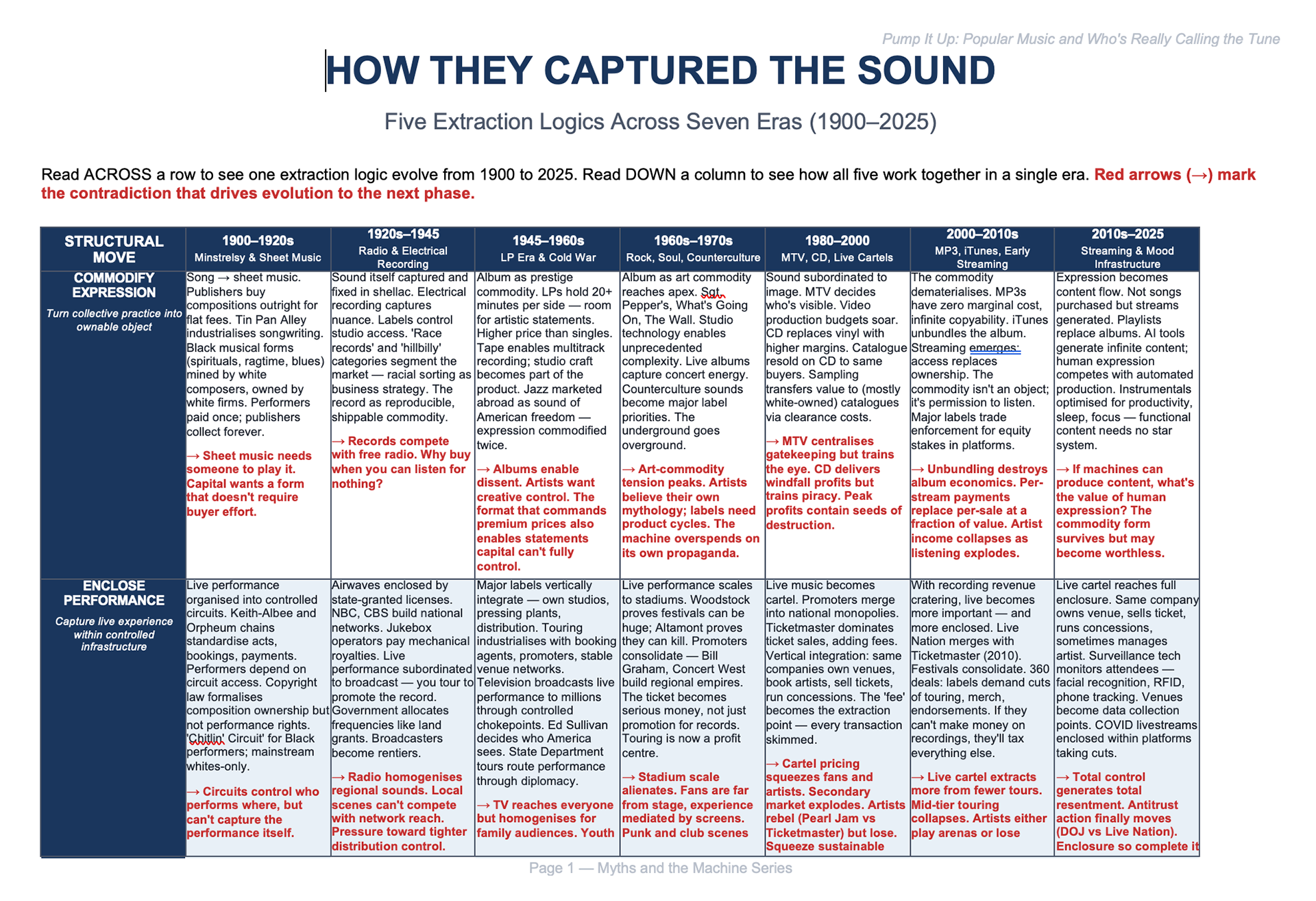
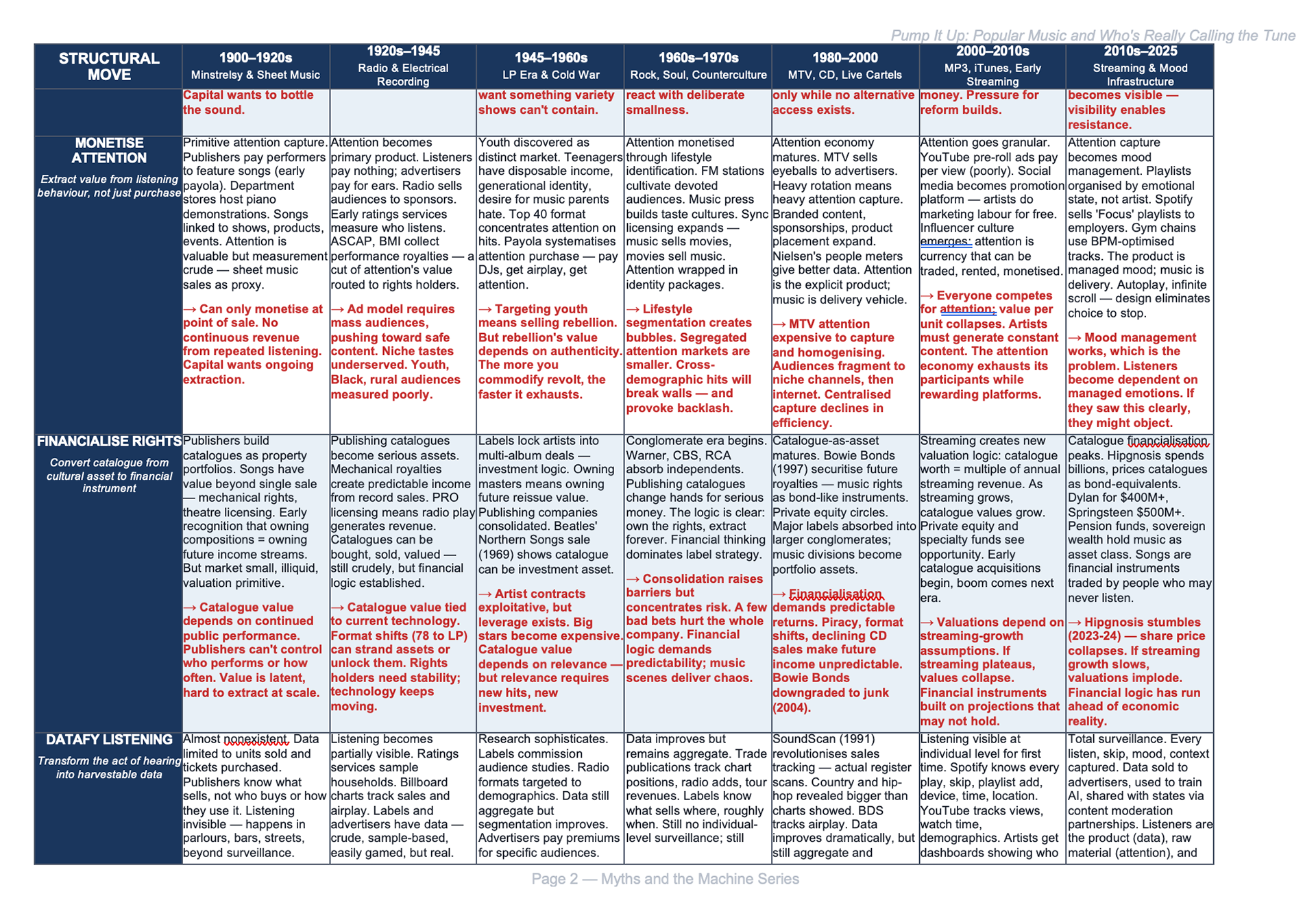
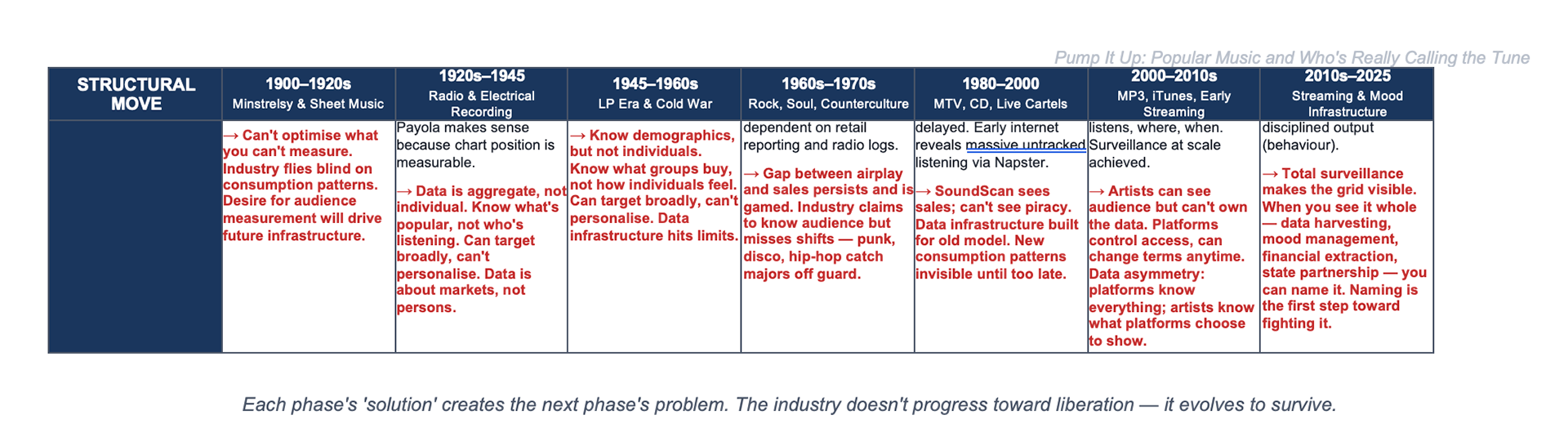
The table below is the book in miniature.
In the chapters, we move through the history the long way round: from minstrelsy and sheet music to radio, LPs, Cold War jazz tours, rock and counterculture, MTV, CDs, MP3s, streaming, mood playlists, catalogue funds, platform–state partnerships. We look at particular scenes, artists, companies, laws and deals.
The table strips that down to the underlying pattern.
Each row is one of the five basic operations the industry repeats in every period:
turning collective musical practice into something that can be owned and sold,
enclosing performance inside controlled circuits and venues,
finding ways to charge for listening itself,
treating rights as financial instruments,
and turning listening into data that can be stored, traded and used to steer behaviour.
If you read across a row, you can see one of those operations changing shape from 1900 to 2025 as new technologies arrive and older formats break down. The concrete forms change – sheet music, shellac discs, LPs, CDs, MP3s, streams, mood playlists – but the underlying move stays the same.
If you read down a column, you see one historical phase at a time. In each era, those five operations lock together into a particular settlement: who owns what, how live work is organised, what is being sold to listeners, how rights are treated on the balance sheet, how much anyone can actually see of what listeners are doing.
The last line in each cell is the key. That is the contradiction built into that arrangement – the point where it starts to work against itself and generates the conditions for the next phase.
That is the logic running through the book. Each period is not just “followed by” the next; it produces it.
Sheet music solves the problem of how to sell songs, but depends on pianos and musical literacy and leaves too much up to the buyer → recording appears to reduce that dependence.
Records and radio solve reach and promotion, but train people to expect “free” music and make revenue harder to stabilise → tighter control over formats, catalogues and attention follows.
The album era and corporate consolidation stabilise the chaos of the 1960s, but produce bloat, risk and dependence on blockbuster acts → MTV discipline, live cartels and financialisation follow.
CDs and MTV deliver record profits, but also train listeners to expect perfect digital copies and enable large-scale copying → MP3s, piracy and the move towards access models follow.
Streaming and mood infrastructure patch the piracy crisis and collapsing CD income, but strip value out of the individual song, deepen surveillance and expose how much control has been centralised → the present phase of catalogue bubbles, mood management and backlash.
Seen this way, the history is not a series of disconnected “eras” or changes in fashion. It is a causal chain of problem–solution–new problem. Each solution stabilises the system for a while, while quietly laying the groundwork for the next breakdown.
Throughout the chapters, I point back and forth between periods: a ticketing case that echoes earlier payola, a drill prosecution that looks like a re-run of earlier policing of Black music, a “focus” playlist that functions like Muzak in a more polite interface. When the detail starts to pile up, this is the page to return to. Find the era we are in, scan down that column, and remind yourself what all five operations are doing at once and what pressure they are creating.
Use this table as a set of coordinates. The chapters supply the concrete cases. The map here shows how they fit into one apparatus, moving through time because of its own contradictions, not in spite of them.
Part I: Minstrelsy & Sheet Music (1900–1920s)
The story opens in the sheet-music era, where songs are paper products and performers are interchangeable delivery systems. Publishers buy compositions outright, own them forever, and make their money selling scores to middle-class parlours and Tin Pan Alley venues. Live performance runs on tightly controlled theatre circuits; Black musicians generate the sound, white firms and song-pluggers capture the income. Attention is only visible at the point of sale: did the sheet move or not? Capital wants repeatable income, but it can’t see repeated listening—only purchases. That blindness to actual audience behaviour sets up the first contradiction: records and radio are arriving, and once people can hear music for free, sheet-music sales will no longer tell the whole story.
Part II: Radio & Electrical Recording (1920s–1945)
Electrical recording and broadcast radio let capital bottle the sound itself. Labels sell physical records; radio networks sell advertiser access to ears. “Race” and “hillbilly” bins segment the market along class and colour lines, turning social hierarchy into catalogue strategy. Live performers are subordinated to the microphone; airplay decisions made in Manhattan determine what small towns hear. For the first time, listening is measurable—by station ratings and chart positions—so advertisers and sponsors can treat attention as a product. But the data is crude and aggregate. Labels know what’s popular, not who’s listening, and free radio competes head-on with paid records. The industry has finally found a way to watch audiences, but it still can’t personalise what it sees. That tension between mass reach and blunt instruments pushes the system toward the LP age.
Part III: LP Era & Cold War (1945–1960s)
The long-playing record turns the album into a prestige object. Artists can now stretch out over 40-plus minutes; labels can charge more for a single unit and frame it as serious culture. Television and postwar affluence create huge family audiences, and youth emerges as a distinct market with disposable income and its own identity. Royalties and publishing rights become serious, tradeable assets, even as contracts keep most leverage with labels. Advertising models get more sophisticated: charts and demographics let executives target youth as a bloc, but they still don’t know individual listeners. The LP era solves one problem—how to get more money from each sale—but creates another: you can know what groups buy without knowing how specific people feel. The industry wants finer control; the data infrastructure can’t deliver it yet. That gap opens the door to the rock and counterculture era.
Part IV: Rock, Soul, Counterculture (1960s–1970s)
Rock, soul and the counterculture turn records into identity badges. Albums are treated as art statements; fans buy them to belong to a scene as much as to hear a song. FM radio and specialist press carve the audience into lifestyle segments—hippies, prog heads, soul fans, punks—each with their own stations, zines and venues. Live performance scales up from clubs to arenas; touring becomes a major profit centre as promoters and managers professionalise. Research improves, but labels are still largely guessing which bands will stick. The gap between airplay and actual sales persists, and whole movements—disco, early hip-hop—catch majors off guard. Capital has found ways to monetise rebellion, but the very scenes it mines also carry critiques of the industry itself. That volatility prepares the ground for MTV, corporate consolidation and tighter formatting.
Part V: MTV, CD, Live Cartels (1980–2000)
The MTV–CD era fuses image, sound and retail into one tightly managed pipeline. CDs promise crystal-clear audio and convince listeners to repurchase entire catalogues at a premium margin. MTV decides who exists visually; radio playlists narrow; chart methodologies like SoundScan finally show exactly what’s selling, even as they miss off-book listening and piracy. Live music consolidates into cartels: a handful of promoters control stadium tours, ticket prices, and venue access. Every transaction—ticket, merch, album—is skimmed by multiple intermediaries. For a while this looks like the perfect equilibrium: predictable returns from catalogue reissues, blockbuster tours, and music television. Underneath, however, Napster and file-sharing expose huge amounts of untracked listening and a generation that expects digital music to be free. The very efficiency of CD-era infrastructure leaves it brittle when MP3s hit.
Part VI: MP3, iTunes, Early Streaming (2000–2010s)
MP3s dematerialise the record. Files can be copied infinitely at near-zero cost, destroying the old link between physical units and revenue. iTunes unbundles the album, selling tracks à la carte for cents, while early streaming services test all-you-can-eat access. Catalogue becomes an asset class: labels and private equity treat song rights as financial products that will generate future cashflows. Surveillance quietly scales up—platforms learn who listens, where and when—but artists still don’t control the data that defines their worth. P2P piracy, cheap digital tools and the first wave of social media collapse old gatekeeping, even as new platform dependencies form. Streaming looks like a fix for piracy and collapsing CD sales, but it introduces a fresh contradiction: valuations depend on endless growth in listening hours and subscriber numbers that may not be possible.
Part VII: Streaming & Mood Infrastructure (2010s–2025)
In the latest phase, music is less a discrete product than a background condition. Subscription platforms sell access to vast catalogues while playlists manage mood—“Focus,” “Chill,” “Workout,” “Deep Sleep”—for employers, commuters and students. Catalogue itself is financialised; hedge funds and majors buy up song rights as investment vehicles, betting on future streams. Recommendation systems, autoplay and skip data create an always-on feedback loop where platforms know more about listeners’ habits and emotional states than artists ever can. Expression is squeezed into formats that serve the feed: short tracks, looping hooks, endless content to fill the grid. If machines and templates can generate functional music on demand, the obvious question follows: what is the value of human expression here? The table’s final move names this openly—total visibility of listening exposes the whole structure, and once you can see it, you can start to fight it.
The lyrics came up on the courtroom screen in Atlanta looking less like music and more like a Word document someone had dragged into the wrong meeting. No beat, no drums, no bass, no ad-libs, no crowd—just lines in a polite serif font, double-spaced, an exhibit number tucked in the corner, hanging over a jury box full of people who, for the most part, had never heard of Young Slime Life and could not have named a Young Thug track if their lives depended on it. Whatever those words had been inside a song—looped, chanted, carried by bodies and bass—here they were pinned down, held still.
The room did what courtrooms always do. Fluorescent lights hummed. The air-conditioning ran a few degrees too cold. Deputies shifted their weight by the doors, bored but alert. A clerk shuffled papers. Someone coughed into a sleeve and tried to disappear into the bench. Under the state seal at the front of the room, the prosecutor rose, adjusted his tie, and began to read.
He didn’t perform the lyrics; he drained them.
He read them the way you read a confession or a threat aloud to a jury: slowly, evenly, making sure every line landed with maximum weight and minimum ambiguity. Jokes flattened into admissions. Exaggerations—the ordinary inflation of rap bravado—were presented as literal intent. Punchlines were stripped of timing, context, and sound, and left to sit on the screen like they had incriminated themselves. What had been a hook you could lose yourself in was now treated as a trap the defendant had built with his own mouth and walked into on purpose.
It was May 2022, and Jeffery Lamar Williams — the artist the world knew as Young Thug — sat at the defence table in Fulton County Superior Court, charged under Georgia’s Racketeer Influenced and Corrupt Organizations Act.¹ Not a stray possession charge, not a gun found in the wrong place at the wrong time, but RICO — the law written for the Mafia and long marketed as a weapon against organised crime. On paper, YSL was a record label and creative collective. In the indictment, it became a “criminal street gang.” The state’s evidence file treated that transformation as simple common sense.
Instagram posts appeared as “overt acts.” Still frames from music videos were treated the way you’d treat surveillance photos. Jewellery, hand signs, and performance images were repurposed as proof of hierarchy and allegiance. At the centre of it all were the songs: hooks Young Thug had written, verses other YSL artists had recorded, lines designed to live inside beats and crowds and car stereos after midnight. Here, they were separated from all of that and offered to the court as sworn statements. It was the latest example of a craft the American legal system has refined over decades — the art of making Black music prosecute Black people.
The case would grind on until it set a record as the longest trial in Georgia history.² Years of pre-trial motions, jury selection battles, evidentiary arguments, delays, and restarts. Millions of dollars in public money and private fees. Local outlets, national outlets, and YouTube channels all circling for angles and live-bloggable drama. And underneath the spectacle, for anyone willing to look, sat a simple, uncomfortable point: the songs you stream, the artists you follow, the words you know by heart all exist inside a structure that can, whenever it decides to, treat creative expression as evidence of criminal conspiracy.
Young Thug was not the first to find his art pulled into court like this, and he will not be the last. Across the United States, prosecutors have introduced rap lyrics in hundreds of criminal cases as proof of motive, membership, or state of mind.³
The same system that would never dream of treating a crime novelist’s plot as a confession or a screenwriter’s dialogue as a diary has learned to treat rap verses as documentary truth.
In the UK, drill artists have watched their tracks played back in front of judges and juries as the primary evidence that they were dangerous gang members rather than musicians describing the conditions they live in.⁴ City to city, jurisdiction to jurisdiction, the details shift; the pattern does not. Young Black men make art about their realities; the state insists that art is autobiography, confession, and intent.
This book doesn’t live inside that one courtroom. It isn’t a blow-by-blow of a single RICO prosecution. That trial is a doorway, not the destination. What matters here is the larger system that makes cases like this available on demand — the system that runs outward from that Atlanta courtroom into your headphones, your playlists, your workday, your city.
It stretches from the prosecutor’s exhibit list to the mood playlists that organise your commute, from the contracts and catalogue sales that decide who actually owns the songs you grew up with to the surveillance infrastructure that quietly records every skip, replay, and late-night spiral. It ties together the judge who allows the lyrics in as evidence, the A&R who structures a deal so the label owns the masters, the product manager tweaking a recommendation algorithm in Stockholm, and the private equity analyst modelling royalty flows in New York.
The prosecutor in Atlanta almost certainly didn’t walk into court thinking, “I am the latest functionary in a centuries-long machinery of racial extraction and cultural control.” In his own mind, he was doing something much narrower: applying a statute to a set of facts, pushing for a conviction in a case he’d been assigned. The detectives saw themselves as following leads. The judge was managing a docket. The jurors, once they were finally seated, were doing what they’d been told was their civic duty.
And that is the point. That is how systems work when they’re embedded deeply enough. No one needs to see the whole grid. No one has to sign a secret pact or attend a midnight meeting; there is no control room with a master switch. The structure assembles itself through a long chain of ordinary decisions — charging choices, bail recommendations, plea offers, risk assessments, licensing conditions, promotion strategies — each one defensible in isolation, all of them disastrous in combination.
By the time the lyrics appear on the screen in that too-cold courtroom, most of the machinery has already done its work.
The Playlist
Six thousand miles from that Atlanta courtroom, on an ordinary wet Wednesday in Manchester, a woman unlocks her phone and taps the green circle without thinking about it.
Spotify. It’s part of the muscle memory that gets her from bed to desk: kettle, shower, headphones in, thumb on the app. She doesn’t “decide” to open it any more than she decides to breathe. The app has been watching her for years. It knows what she plays, what she skips, when she lets an album run, when she kills a track in the first fifteen seconds. It knows when the volume goes up, when it drops, how long she hangs on a song before sleep. It knows she needs something sharp at 7:15 a.m. and something soft by ten at night. It knows when she’s sad, though she’s never typed that word into a search bar. The data told it.
The playlist that starts playing is called “Morning Motivation.” She didn’t make it. She never has. An algorithm pulled it together out of her past listening, cross-referenced with millions of strangers who behave a bit like her, tuned for one thing above everything else: keep her streaming. The goal is not to play her the “best” music. The goal is to stop her leaving. The same logic that once sorted records into “Race” and “Pop” now files her into “Chill,” “Focus,” “Sad Songs” and “Energy.”
The names changed. The basic move — slice people into profitable categories and feed each slice something different — stayed the same.
Later in the day, when her chest is tight and she can’t say exactly why, she’ll go straight to “Sad Songs.” When she needs to bash through a report, “Deep Focus.” When she can’t sleep, “Sleep.” Without anyone ever explaining it, she has learned to experience her own emotions through the platform’s menu. Grief, anxiety, boredom, concentration: all available as a playlist. Her inner life has been tagged and filed, ready for analysis. The app doesn’t just capture her attention. It captures her moods, learns where she’s soft, and sells the path in to advertisers who want her at her most suggestible.
She doesn’t notice the Spotify “Focus” playlist sitting in her company’s shared workspace yet. She will, later that afternoon, when the Teams notifications pile up and the spreadsheet won’t balance and she reaches for something “neutral” to keep her going. That playlist exists because Spotify pitched it to corporate clients: music as productivity tool, a way to keep people at their desks a little longer, a little calmer, a little quieter.⁵ The tracks weren’t chosen because somebody loved them. They were chosen for tempo, lack of lyrical distraction, and an ability to blur into the background. Soundtrack for the white-collar treadmill.
And it isn’t just the songs she thinks of as hers. In the coffee shop where she buys her morning flat white, a curated playlist keeps the pace up — quick enough that nobody lingers too long in a chair, warm enough that a second pastry feels like a treat, not a mistake. In the shopping centre, beats-per-minute are matched to the flow of bodies past the displays.
On hold to her bank, a loop of gentle nothing is there to smooth out her irritation and make five minutes feel like three.⁵
None of this was chosen by her. Most of it won’t even register as “music” in her memory of the day. It’s just there, working on her behaviour without her consent. What feels like refuge has been built into part of the shop floor. Her feelings are raw material.
Every tap, every half-listen, every background loop produces data. That data doesn’t sit still. It flows to advertisers who want to reach “stressed office workers” or “late-night scrollers.” It flows to labels watching for songs that move from “niche” to “viral.” It flows, when a government agency asks for it, through the channels laid out in the transparency reports.⁶
The terms and conditions she flicked past on page forty-seven — who actually reads them? — gave permission for all of this.
From her point of view, this is “her music.” Her careful taste. Her personal soundtrack that proves she isn’t like everyone else on the tram. She has no idea she’s on the clock. Every stream is a data point. Every skip teaches the recommendation engine what to bury and what to push on millions of other people. Every playlist she builds is unpaid labour: training set for mood prediction, free consulting for product design, a tiny contribution to behavioural profiles that someone else will monetise. The platform takes the sum of human listening — the hours, the habits, the attachments — and turns it into a private asset.
The woman in Manchester and the rapper in Atlanta will never cross paths. They live in different countries, under different pressures, making and using music for different reasons.
But they’re locked into the same basic arrangement: one end turns creative work into potential evidence, the other turns listening into measurable behaviour, and the money made in the middle rarely reaches either of them.
The Venue
On a Saturday night in September 2016, the Metropolitan Police turned up at Fabric.
Fabric wasn’t just “a club.” It was a landmark carved into the brickwork of Farringdon — low ceilings, concrete, a sound system that felt like it was tuned directly to your bloodstream. For seventeen years it had sat at the centre of British dance culture. Carl Cox had played there. Richie Hawtin. Any DJ who mattered in electronic music had stood behind those decks at three in the morning while a roomful of strangers lost track of where their bodies ended and the bass began. For a generation, Fabric wasn’t a venue. It was a rite of passage.
The police weren’t there to queue, pay a cover, and complain about drink prices. They were there because Islington Council had revoked Fabric’s licence, and the club was being shut down.⁷
The official story was simple: drugs, death, public safety. Two teenagers had died after taking MDMA at the club earlier that year. The loss was real. Nobody who’s worked a dance floor pretends drugs aren’t present or that the risks are imaginary. But what followed went well beyond grief and precaution. Undercover officers were sent into the club. Covert surveillance ran for months. At the licence review, Fabric’s regulars were described not as a crowd to be protected but as a threat to be contained — the dance floor recast as a crime scene waiting to happen, the culture itself marked as untrustworthy.
Fabric did eventually reopen, but it came back on a leash. Public outcry, a heavyweight legal team, and an international campaign forced a compromise, but the terms made the new reality unmistakable.⁸ Lifetime bans for anyone caught with drugs. ID scanners at the door. A battery of conditions that turned the place from a dark, semi-autonomous world into something closer to a monitored facility. The message was plain: you can have your club, for now, on our terms, and we can take it away again whenever we like.
Fabric, in that sense, was a rare survivor. Most rooms never get a second act. Across London, the number of nightclubs dropped by more than half between the mid-2000s and the end of the 2010s.⁹ The reasons, on paper, were varied: rent hikes, “antisocial behaviour” complaints from new luxury developments, licensing friction, changing “consumer habits.” On the ground, the effect was blunt.
Places where people gathered to hear music, sweat on each other, and feel briefly less alone in their own lives were being shut down and stripped out.
The closures weren’t evenly distributed. It wasn’t the champagne bars in regenerated districts that mysteriously kept failing safety checks. The spaces that went first, and hardest, were the ones that played Black music, drew working-class crowds, or attracted police attention on the basis of who was inside rather than what was happening. In the UK, a risk assessment document called Form 696 asked promoters to list the genre of music on offer and, until 2008, the ethnic makeup of the expected audience.¹⁰
On paper, this was about managing risk. In practice, it meant that grime, garage, bashment and anything adjacent might as well have been stamped “dangerous.” Shows flagged as high-risk faced extra conditions, swollen security bills, and cancellation that arrived as a polite email the week of the event.
When a room like Fabric closes, what replaces it? In Farringdon, the answer was predictable: luxury flats, offices, “mixed-use developments” with glass foyers and private gyms. The same pattern repeats from London to Berlin to New York: spaces built for collective experience converted into spaces built to store capital. The square metre of floor that once held a hundred dancing bodies now holds one kitchen island and a property listing.
A venue going dark is always reported as a “business” story — a failed enterprise, a tough market. That’s not wrong, but it’s not the whole thing. Each closure is also a quiet victory in a different campaign: the steady removal of places where people can gather in numbers, in the dark, with loud music and very little supervision. Places where you might bump into someone you don’t already know from work or school or your feed. Places where feeling something together doesn’t immediately generate data.
The system — state, developers, landlords, licensing boards — would rather you be at home, on the couch, with headphones on, streaming alone. Easier to police, easier to measure, easier to monetise. A closed club is not just a lost business model. It’s one less crack in the map where unsupervised joy might leak through.
The Catalogue
In December 2020, Bob Dylan sold his entire songwriting catalogue to Universal Music Publishing for an estimated $300 million.¹¹
A short press release, a few reverent headlines, some stock photos of young Dylan with a harmonica. “Blowin’ in the Wind,” “Like a Rolling Stone,” “The Times They Are A-Changin’.” For half a century those songs have been treated as the soundtrack to conscience: civil rights marches, anti-war rallies, every dorm-room mythology of rock as rebellion. With one deal, that whole body of work moved from Dylan’s column to Universal’s — from living symbol to line item.
He wasn’t lonely on the way to the bank. Bruce Springsteen sold his catalogue to Sony for around $500 million.¹² Stevie Nicks sold a majority stake in hers.¹³ Members of Fleetwood Mac have been signing away slices of “Dreams” and “Go Your Own Way” in carefully staggered bursts of liquidity. Those deals made news because the names are famous enough to fit in a headline. Behind them, thousands of quieter catalogues changed hands — the kind of songbooks you’ve never heard of but have definitely heard, written by the people who live in the liner notes. Whole lives of work, bundled and shipped in bulk.
More and more, the buyers weren’t “music people” in any meaningful sense. Hipgnosis Songs Fund, floated in 2018, marketed music rights on investor roadshows as an “alternative asset”: steady royalties, low correlation with the stock market, less temperamental than commercial real estate.¹⁴ Private equity firms like KKR and Blackstone piled in, not because they suddenly discovered the joys of the bridge on “Landslide,” but because the numbers said: dependable cash flow, growing streaming market, room for “optimization.”¹⁵ The song your parents danced to at their wedding, the track you cried to after your first breakup, the chorus that still gets you in a supermarket aisle — they’re now sitting in portfolios next to toll roads, student housing, and distressed debt.
What does it actually mean for a private equity fund to own “Blowin’ in the Wind”?
It means the song’s first obligation is no longer to whoever needs it at 2 a.m. on a bad night. Its obligation is to quarterly returns. Decisions about where it turns up — an ad, a biopic, a prestige drama about sad men in hats — will be made on the basis of projected yield. The history of the song, the people who marched to it, the kid who first heard it on a scratched CD in the back of a bus: none of that appears on the spreadsheet. The track is a cash flow. The cash flow has a modelled future.
The model decides what happens to the chorus.
For most of the twentieth century, popular music sat in a messy, uncomfortable space between art and commodity. Records were obviously sold, but they were also fought over, bootlegged, hoarded, taped off the radio, played to death at house parties. Money and meaning were tangled together. In the catalogue boom of the 2020s, that mess is treated as a problem to be solved. The song becomes a revenue stream with a neat graph. The graph has a net present value. The only interesting question is how much more can be squeezed out of it and how fast.
On paper, the contract that moved Dylan’s catalogue into Universal’s control is just an updated, more polite cousin of the contracts that stripped Black artists of their material in the 1920s and 1930s. The boilerplate is longer, the royalty provisions have more decimals, the lawyers wear better suits. The underlying move is the same: take something that came out of messy collective life — church basements, juke joints, union halls, dive bars — and convert it into private property that can be owned, traded, leveraged.
That pattern has been there from minstrel publishing through Tin Pan Alley, through the early record industry, through every wave of “modernisation.” Music comes up from communities; ownership drifts upwards. The catalogue deals just make the drift more visible. The faces change. The paperwork thickens. The direction doesn’t.
The Grid
The prosecution in Atlanta. The playlist in Manchester. The shutdown notice at Fabric. The catalogue deal in New York. These aren’t four separate stories. They’re four angles on the same thing.
Call it the industry, the system, the set-up — whatever you like. The name doesn’t matter. The logic does. Take collective expression, turn it into property. Take attention, turn it into a managed habit. Take both and wire them into an arrangement that reliably sends value upwards.
It doesn’t do this in one place. It does it through a few well-rehearsed fronts.
There’s the ownership front. Three major labels — Universal, Sony, and Warner — control around 70 percent of the global recorded music market.¹⁶ They own the masters. They own huge chunks of the publishing. They own the pipes that move music around. When a new artist signs, they don’t just get a shot at an audience; they usually give up ownership of their recordings in the process. The deal is simple: you bring the songs, we keep the house.
There’s the platform front. Spotify, Apple Music, YouTube, Amazon: a tiny cluster of companies sits between you and almost every track you hear. They decide what floats to the top and what quietly drowns. Their recommendation systems train your listening habits at a scale no radio programmer could have imagined. They collect data on every click, skip, replay, and mood-tagged playlist, and monetise it in ways that technically fit inside the terms of service and practically escape most people’s comprehension. The playlist tends your feelings. The platform bags the data.
There’s the state front. Police units tasked with “problem” music scenes. Prosecutors who hold up lyrics in court as if they were sworn testimony. Licensing authorities who can end a venue’s life with one meeting. Intelligence agencies that once funded jazz tours as Cold War propaganda and now sit across the table from platforms discussing what should be taken down and who should quietly disappear from recommendations.¹⁷ The file that used to live in a cabinet now lives in the cloud.
And there’s the finance front. Investment funds that buy catalogues, ticketing companies, and slices of streaming platforms. Private equity firms that treat music businesses like any other asset: buy, strip, flip. Songs, venues, audiences, and data streams all reclassified as revenue lines on a spreadsheet. Everything run through the same filter: does it hit the return target?
Put all that together and you don’t just get a loose ecosystem. You get something much tighter. Not a single mastermind, but not an accident either.
This is where conspiracy talk bites at the edges of something real and then veers off. The popular image is a secret room: candles, symbols, a shortlist of artists to destroy. Rooms like that do exist, in their own way. There are invite-only clubs, industry retreats, “listening sessions” and donor dinners where deals are done and careers are quietly redirected. There are executives and cops and bureaucrats who understand perfectly well which scenes need to be chilled and which ones need to be pushed.
The point is not that there are no plots. The point is that the plots grow out of the soil.
You can swap out the people in the room and the room stays the same. The incentives don’t change. Labels are rewarded for squeezing catalogues and disciplining artists. Platforms are rewarded for extracting more data and smoothing out anything too disruptive. States are rewarded for making potentially volatile populations legible and predictable. Finance is rewarded for turning all of that into reliable yield. You don’t need a grand council of villains when the promotion ladder itself selects for the people most comfortable treating music, bodies, and cities that way.
So yes, there are back rooms and whisper networks and people who believe they’re doing more than just “their job.” There are zealots who lean into the work with real enthusiasm. But even the most fanatical club owner, label executive, platform strategist, or police commander is operating inside a structure that existed before them and will keep going after they’re gone.
The prosecutor in Atlanta didn’t get a memo from Universal Music. The playlist editor in Stockholm isn’t on a group chat with the Metropolitan Police. The private equity analyst in New York has never heard of the licensing officer in Islington. They don’t have to talk. They’re working to the same basic tune — profit, order, accumulation — and that’s enough. Each person sees their tiny patch of ground. The larger pattern assembles over their heads.
The Question
This isn’t a fairy tale where “pure music” got ruined by “the industry.” People have been singing for gods, kings, clans, villages and themselves for as long as there’ve been people. Temple choirs, court orchestras, village dances, work songs, lullabies—whole musical worlds have existed, and still exist, with their own rules, hierarchies and fights that have nothing to do with record deals or streaming dashboards. Music and power have been tangled together for centuries.
What changes in this story is not “music appears,” but how it gets organised, owned, and sold.
In the nineteenth century United States, something new and especially vicious took shape: the minstrel show. Travelling stage acts where white performers painted their faces black, copied and mocked Black speech, song and dance, and sold it back to white audiences as entertainment. It was racist caricature as national pastime—but it was also business. White producers owned the theatres, white publishers owned the sheet music, white managers owned the touring circuits.
You don’t need to know every famous minstrel performer’s name for this to matter. What matters is the pattern it set:
Black creativity as raw material. White ownership in the contracts. A version of “Black music” packaged for people who held the money and the power. That basic trick—take what Black communities make, sell a safer imitation, keep the rights—gets picked up and reused, in softer disguises, for the next hundred-plus years.
When recording technology arrives in the early twentieth century, that pattern hardens into infrastructure. Early jazz and blues records are pushed as “race records” through white-owned labels. Contracts are opaque on purpose. Songwriting credits get shuffled. Masters are controlled by people who have never set foot in the neighbourhoods where the music was born. Rock and roll, soul, funk, hip-hop—decade after decade, Black communities invent whole new languages of sound, and most of the ownership still drifts upwards into white hands.
That isn’t one sad subplot. That’s the through-line.
And it doesn’t stop at the U.S. border. Reggae in Jamaica, Afrobeat in Nigeria, baile funk in Brazil, reggaeton and Latin trap out of Latin America—local scenes invent something new, then companies based in New York, London and Los Angeles strip it down, smooth off the edges, and sell it back to the world.
Across the twentieth century, in a handful of rich cities, this way of handling music—who gets heard, who gets paid, who holds the rights—solidifies into a model. Copyright law, collection societies, radio and TV networks, charts, distribution deals, A&R departments, marketing budgets. It works so well at making money and keeping things orderly that it spreads and wraps itself around older traditions, dragging local scenes into its orbit or shoving them to the margins.
The tools keep changing. The basic move doesn’t.
Every new technology arrives with the same speech:
the phonograph will bring music into every home
radio will break the grip of the old publishers
television will make stars answer to “the public”
the Walkman will set you free from the living-room stereo
the iPod will give you control—“a thousand songs in your pocket”
the smartphone and streaming will let artists bypass middlemen and “go direct to fans”
Each time, there’s a brief window where it almost looks true. Then the usual pattern snaps back into place. Chaos, consolidation, contract. A few companies get hold of the pipes and the rights. New gatekeepers step in where the old ones stood. The casing changes shape. The logic doesn’t.
Now the whole thing runs on data.
The app that serves you a song is also silently logging what you listen to, when you stop, what you turn to on bad days, what you loop to get through a shift. It clusters you with millions of other people who move in a similar emotional pattern—and sells that pattern. The main product isn’t the track any more. It’s how your listening can be predicted and nudged.
The kind of watching that once needed informers and wiretaps now runs automatically, all the time, backed by the “I agree” button you hit without reading forty-seven pages of legalese. The paper file that followed musicians in the COINTELPRO era has mutated into a metrics dashboard that artists, labels, advertisers and cops can all look at, each for their own reasons.
When critics call this “addictive,” and parents worry about screen time, the platforms respond like wellness brands: here’s a “digital wellbeing” toggle, here’s a bedtime reminder, here’s a productivity mode. The implication is: your lack of discipline is the problem. Not the fact that an entire industry is paid to figure out how to keep your thumb moving and your headphones on.
This book follows that shift.
From blackface stages to algorithmic playlists.
From Tin Pan Alley song pluggers to private-equity funds buying retirement packages made of choruses.
From Cold War jazz tours run through front organisations to twenty-first century “content moderation” teams coordinating with governments.
It moves through five phases:
Formation – how shared sound was first fenced off into property; how theft from Black artists and audiences was baked in from the start.
Capture – how the postwar state and the music business found they could use each other; how youth revolt was bottled, labelled, and shelved.
Enclosure – how MTV trained bodies for the camera, how live music was swallowed by ticketing and venue cartels, how finance discovered that songs behave like bonds.
Grid – how platforms did what no earlier format could: not just selling you music, but shaping and recording the act of listening itself.
Terrain – where the seams are, where people fight back, and what those fights are really up against.
Five parts. Eighteen chapters. One argument:
Popular music has been built as a way of managing people that sometimes throws off joy, not as a pure source of joy that occasionally gets misused.
If I’ve done this right, by the end you’ll be hearing double.
You’ll hear the song, and the scaffolding it hangs from.
The pleasure, and the price tag.
The rush, and the quiet steering hand.
The song itself is still yours. The memories it drags up, the private meanings you pin to one line, the particular way your shoulders drop on the first beat—that doesn’t sit in any catalogue sale. No spreadsheet can own the way a chorus hits you five years after a breakup. No fund manager has a claim on your dancing.
But the rest of it—the contracts, the pipes, the data trails, the money—belongs to the usual suspects. It goes where it has always gone: upwards. Seeing that clearly doesn’t make the music stop working on you. It just means you know whose building you’re in when it does.
Once you can see the building, you can start looking for cracks.
The young man in that Atlanta courtroom.
The woman scrolling through playlists in Manchester.
The club regulars who watched Fabric nearly vanish.
The songwriter whose work now lives on Universal’s balance sheet.
Different lives, different stakes, same underlying build.
What comes next is the story of how that build happened. How it kept adjusting its shape to hang onto control. How it stretched until it covered almost every part of musical life: making songs, moving them, gathering around them, listening alone at 2 a.m., using them to get through wage work, heartbreak, war, boredom.
And how, even inside all that, the collective noise it feeds on keeps breaking the frame.
That’s the opening scene.
Now we rewind to the first theft. Before studios. Before radio. Before smartphones and dashboards. Back to white men in blackface, copying the sound of Black America and selling it back to white crowds.
That’s where the pattern was set.
That’s where this history starts.
This is not a book about music.
Not in the way people usually mean when they say that word. It’s not about the songs you clung to at seventeen, or the artist who got you through a breakup, or the one live show that made everything feel briefly bearable. All of that is real. It matters. It’s just not what’s under the microscope here.
This is a book about the industry that got its hands around music and never let go. A specific system — born in the US and Britain, refined over more than a century, now spread across the planet — that takes collective human sound-making and turns it into owned property, managed listening, and a quiet architecture of control. A system that decides what gets recorded, who owns those recordings, how they travel, who gets paid, and more and more, what you hear and when you hear it.
Most official histories don’t start there.
They give you a parade: genres, stars, scandals, “moments that changed everything.” Rock and roll explodes. The Beatles reinvent the album. Disco dies, grunge arrives, hip-hop speaks truth to power. Elvis, Aretha, Bowie, Beyoncé — singular talents in the spotlight, framed as the main event. Those stories aren’t lies. They’re just cropped very carefully. They keep your eyes on the stage while the ownership paperwork happens in the dark. They toast the genius while skipping the question of who owns the masters, who cashes the sync cheque when a protest anthem turns up in a car ad, who actually controls the catalogue your feelings now depend on.
The structure is the subject.
And the structure is older than it looks from inside a Spotify interface. When the app sorts you into “Chill Vibes,” it’s using a descendant of the system that sorted Black music into “Race Records” in the 1920s — a second-tier category with less money behind it and a lot of quiet assumptions about who listens and what they’re worth. When a SoundCloud rapper signs away their publishing for an advance that won’t last a year, they’re walking into a contract that’s a great-great-grandchild of the deals that stripped Black composers of everything while white bandleaders got famous. When a council lets a venue die on a licensing technicality, it’s enforcing the same kind of spatial control that once kept Black musicians out of white circuits altogether.
The names change. The paperwork gets longer. The basic move — take what people make together and lock it up — has been in place since before your grandparents were born. The tech keeps updating. The logic doesn’t.
FILE UNDER: FOR SALE
When people say “popular music,” they’re usually talking about the songs themselves — the tracks that live in your headphones and in the background of your memories. First cigarette in a car park, first funeral, first kiss in someone’s terrible share house kitchen: all scored by whatever was on at the time.
There’s another meaning, less romantic and a lot more useful for what we’re doing: popular music as a category of business.
Not folk music, which moves through families, neighbourhoods, and scenes without needing a label deal to exist.
Not art music, propped up by conservatories, patrons, and cultural ministries.
Not sacred music, tied to churches, mosques, temples, and the institutions that fund them.
Popular music, in the sense that matters here, is much simpler and much harsher:
music made to be sold, shipped through commercial channels, and usually owned by someone other than the people or communities it came out of.
That way of organising sound is not timeless. It had to be built.
Through most of the nineteenth century, if you wanted music, you needed a body in the room. Someone had to play: in the parlour, the church, the pub, the town square, the work camp. Music was an activity, something people did together, not an object you could buy and repeat on command.
Industrialisation changed that. The player piano, the phonograph, and the rise of commercial sheet music took music off the purely human circuit and wired it into the factory one. Suddenly a performance didn’t have to vanish when it ended. It could be captured on paper rolls, discs, wax, and then multiplied, shipped, stacked in shops, and owned by whoever controlled the rights. A song became something you could stamp, inventory, and sue over.
That’s the object in view here: not “music” in general, but the Anglo-American popular music industry — the system that took shape in the US and Britain in the late nineteenth and early twentieth centuries, hardened through records and radio, and then exported everywhere as the default model.
When a Brazilian funk artist signs to a major, they’re stepping into machinery designed in New York and London. When a Nigerian Afrobeats star fights for a place on a global playlist, they’re dealing with gatekeepers whose assumptions were set by American market logic. When a K-pop group hits number one on Billboard, they’ve cracked an algorithm and a rulebook they didn’t write.
Framing it this way changes the questions.
If you treat popular music as a cultural phenomenon — a history of sounds, styles, and stars — you ask aesthetic questions:
What made rock and roll detonate like it did?
Why did hip-hop outlive every “this is just a fad” prediction?
How do new genres bubble up and spread?
Those are real questions. Whole libraries exist to answer them.
But if you treat popular music as an industrial system — a structure of ownership, distribution, and control — the questions shift.
Who owns the songs?
Who owns the recordings?
Who controls the channels that decide what gets heard?
Where does the money actually end up?
What happens to the people who make the music, and what happens to the people who live inside it as listeners, fans, and workers?
Or, put more bluntly:
How did collective human noise become a set of assets on someone else’s balance sheet?
The first set of questions treats music as culture.
The second treats culture as a place where value is mined and moved.
Both matter. But the second set almost never makes it into the liner notes or the music documentary. The answers aren’t good for business, and the people who benefit most from the current set-up have no reason to make those answers common knowledge.
1. Turn shared noise into private property
Most music starts as something no one owns. A rhythm someone claps on a worksite. A melody passed around a neighborhood. A sound a scene builds together over years of trial, error, and stolen gear.
The industry’s first trick is to fence that off.
Songs that emerge from communities, genres that grow through shared practice, sounds that “belong” to everyone who lived them — the business model treats all of that as raw material waiting to be enclosed. Copyright turns musical ideas into ownable assets. Publishing deals move those assets from the people who wrote them to the companies that filed the paperwork. Recording contracts hand over master rights in exchange for a shot at being heard. What was common becomes a commodity. What was shared becomes somebody’s property.
None of this was natural or inevitable. For most of human history, you couldn’t own a melody any more than you could own the weather. The legal scaffolding that lets someone claim exclusive rights over a pattern of sound had to be built, clause by clause.
The timeline is very specific. Britain’s Statute of Anne in 1710 creates the first modern copyright law, but only for books. Music is an afterthought. In the US, musical compositions don’t get clear coverage until the Copyright Act of 1831. Mechanical reproduction rights — the right to control recordings of a composition — only arrive with the 1909 Act, pushed through because the player-piano business is starting to bite. Sound recordings themselves aren’t protected by federal copyright until 1972.¹
None of those expansions are accidents. Each one takes lobbying, lawsuits, and an industry that understands exactly what it’s doing: building a legal fence around things that used to be unownable.
And once the fence exists, it keeps getting higher.
Where copyright once lasted fourteen years, it now stretches to seventy years after the creator’s death. The “public domain” — the pool where works were supposed to go after a reasonable period — keeps getting pushed further away. The 1998 Copyright Term Extension Act, better known as the “Mickey Mouse Protection Act,” adds twenty years to the clock, right on schedule to keep Disney’s early catalogue out of public hands.² Every extension is the same quiet move: shift value from the commons to the owners, and call it harmonisation or modernisation.
2. Let everything roll uphill
The second move is concentration. Ownership doesn’t just get created; it gets funnelled.
Three companies — Universal Music Group, Sony Music Entertainment, and Warner Music Group — control roughly 70 percent of the global recorded music market.³ Their publishing arms sit on comparable slices of the songwriting side. Behind them are larger conglomerates: Vivendi, Sony Corporation, Access Industries. Behind them sit private equity funds and institutional investors who file music rights next to toll roads, airports, and debt portfolios.
The shape is always the same: a long, wide base and a very sharp tip.
Millions of people make music. A much smaller number ever get within sight of a label contract. Fewer again get properly promoted. Only a thin layer earn a living. And right at the top — not the artists, but the owners — is where most of the money stays. That’s not a glitch in an otherwise kind system. That is the system. The point is to concentrate.
You can see it in the numbers.
Spotify pays somewhere around $0.003 to $0.005 per stream, depending on territory and tier.⁴ That money doesn’t beam itself into an artist’s bank account; it goes to rights holders — labels and publishers — who then pay artists according to whatever they signed. A standard major-label deal might give an artist 15–20 percent of streaming revenue after the label has recouped the advance and costs.
Roughly speaking, an artist would need about a quarter of a million streams in a month just to hit a minimum-wage income — and that’s if they wrote the song and own the publishing. Most don’t. That “life-changing” advance at the start quietly functions as debt. Streaming income crawls toward recoupment; the label owns the masters in perpetuity.
Underneath the handful of names everyone can list, there’s an entire workforce the industry depends on and almost never talks about.
Session players paid a flat fee, no matter how many times the track gets streamed, synced, or replayed in someone’s breakup loop.
Touring crews hauling gear into arenas at 6 a.m. and back out at 2 a.m., living gig to gig with no safety net.
Venue bar staff and security on minimum wage, watching a single night’s gross that could cover their annual rent.
Engineers whose fingerprints are all over the sound of a record but whose names rarely make it past the small print.
Songwriters parked in publishing camps, throwing hook after hook at a wall and lucky to get a sliver of a percent on something that sticks.
The machine runs on this mostly invisible labour by design. If you saw everyone it takes to make a “moment” happen, you’d be a lot more likely to ask where the money went.
The funnel doesn’t just operate at the artist level. It works on catalogues and companies too.
A new act signs: masters go to the label, usually forever, in exchange for money that looks huge at nineteen and tiny once you read the royalty rate. A legacy act cashes out: the buyer is a major, a fund, or a specialist vehicle that plans to extract value for decades. Bob Dylan’s publishing goes to Universal for an estimated $300–400 million in 2020.⁵ Bruce Springsteen’s masters and publishing go to Sony for about $500 million in 2021.⁶ On the surface, these are big cheques to individual artists. Underneath, they’re transfers — decades of songwriting sliding from personal hands into corporate ones, destined to serve shareholders, not descendants.
Independent labels that get too successful face the same gravity. They’re bought outright, locked into distribution deals that skim most of the upside, or pressured into selling their catalogues. Over time, rights drift toward the centre. The funnel does what funnels do.
3. Survive every “revolution”
The third move is endurance. The structure doesn’t fear new technology. It eats it.
Every major shift in how we listen has arrived with the same hopeful pitch:
This will blow the gates open. This will end the stranglehold. This will put power in artists’ and listeners’ hands.
Every time, the result has been roughly identical: a messy few years followed by a tidier, more profitable version of the same old hierarchy.
Radio was meant to kill records. Why would anyone buy discs when they could hear music for free over the air? The labels’ answer was simple: don’t fight radio, capture it. Payola and “promotion” money turned playlists into paid-for billboards. The practice was so common that Congress held hearings in 1959–60, dragged DJs into the spotlight, and pretended to clean house.⁷ Payola didn’t vanish; it mutated into “independent promotion” and other euphemisms that did the same work through channels that could pass a legal sniff test. The labels gained soft control over airplay. Airplay drove sales. The supposed threat became a marketing arm.
Home taping was supposed to kill records next. “Home Taping Is Killing Music,” the industry insisted in the 1980s, slapping skull-and-cassette logos on everything in sight. In practice, they pushed for levies on blank tapes where they could get them, used the panic to justify tighter distribution control — and then rode the compact disc boom into the most lucrative decade they’d ever seen. Scarcity stayed in place. Profits soared.
File-sharing was meant to be the real annihilation. Napster, launched in 1999, let anyone with a half-decent connection grab almost any song for free. The industry responded like an offended god: sue Napster into the ground, then sue individual users — including a twelve-year-old girl in public housing whose family settled for $2,000.⁸ It didn’t stop peer-to-peer networks, but it did buy time.
By the time Spotify appeared in 2008, the majors had learned the real lesson. You don’t try to crush the new pipe; you secure a tollbooth on it. The big labels negotiated equity stakes in Spotify in exchange for their catalogues. When Spotify went public in 2018, Universal, Sony, and Warner collectively cashed out around a billion dollars in stock.⁹ The “disruptors” had, in effect, paid tribute to the old guard for permission to exist.
Same story, different tech:
disruption, panic, accommodation, reconsolidation.
The formats change — shellac, vinyl, tape, CD, MP3, stream. The interfaces change — jukebox, radio, TV, iPod, app. The language changes — “fans,” “users,” “creators,” “partners.”
The underlying structure does not. The gatekeepers get new clothes. The gates stay where they are.
The Catch
At the heart of this whole build is a contradiction that can’t be solved, only managed. Music comes out of collective human life. It’s how communities mark time, process grief, celebrate joy, pass stories down, coordinate labour, shout back at power, and make sense of existing at all. Before it’s a file or a “track,” music is people making sound together, or making sound that speaks to a shared experience. That’s as true for field hollers traded between workers in nineteenth-century cotton fields as it is for church hymns that kept Black communities alive through slavery and segregation, dancehall rhythms that let Caribbean migrants make London feel less hostile, or bedroom beats uploaded at 3 a.m. by teenagers who only know each other through a SoundCloud scene.
Music comes from somewhere. It belongs, in a real sense, to the people and places that produce it. The blues belongs to the Mississippi Delta. Jazz belongs to New Orleans, Chicago, Harlem. Hip-hop belongs to the Bronx. Grime belongs to East London. The industry can record it, package it, distribute it, and profit from it, but it cannot produce the raw material. That comes from outside its walls.
The industry’s job is to capture that material and convert it into privately controlled infrastructure: to take what comes out of communities and fence it off as corporate property; to take what people create together and sell it back to them, or use it to sell other things, or deploy it to manage their moods and behaviour in ways they never agreed to and may never notice. And the capture doesn’t stop at the songs you deliberately choose. It runs through the playlist that manages your commute.
The soundtrack in the coffee shop that quietly paces your visit, chosen because slower tempos keep you browsing and spending longer, not because anyone thinks it’s your favourite tune.¹⁰ The hold music that smooths out your sense of time while you wait on customer service, designed to make five minutes feel like three so you stay on the line. The gym playlist tuned for member retention rather than taste. The “Focus” mix Spotify pushes for work and study—a tool as useful to employers who want calmer, more compliant staff as it is to you trying to finish a report.
Bit by bit, music has been turned into infrastructure for managing behaviour at scale, and most of that work happens on you without your awareness or consent. Your refuge is their wiring. Your emotional life is raw material. The relief music gives you is real; what’s changed is that the escape route now runs through their systems. More and more, you experience your own feelings through their menu. You feel low, you tap “Sad Songs.” You need to grind through a shift, you tap “Workout.” You want to feel romantic, “Date Night” is waiting. The platform has trained you to route your inner life through its taxonomy. Your feelings become their data.
That’s the contradiction in one line: collective expression versus private control. The industry can’t fabricate the musical innovation, the cultural energy, the specific, local, lived reality that makes a sound feel true to people. It has to wait for others to create it, then move in. It can only capture. And capture never stops, because captured things decay. The rebellion that once felt dangerous becomes a campaign slogan. The sound that once cleared a room becomes background noise in a supermarket. Underground scenes go overground, get flattened, and die. So the industry is always hunting for fresh supply: new scenes to mine, new communities to strip-mine for style and slang, new generations to sell a borrowed idea of rebellion back to.
The rebellion that sells is always yesterday’s rebellion, commodified and defanged, turned into a pose that can be marketed without threatening anything. Today’s rebellion is already being scouted for capture. The cycle is permanent because the contradiction is structural. Capital can’t create. It can only capture. And captured things rot.
That makes listeners workers, whether they know it or not. Every stream is a data point. Every skip teaches the algorithm what to push and what to bury. Every playlist share is unpaid marketing. Every “like” trains the recommendation engine. The platforms have turned listening itself into a kind of labour—unwaged, unrecognised, but essential to the system’s functioning. You’re not just the customer. You’re the product and the workforce at the same time.
The rest of this book is just that contradiction in motion. The industry builds new systems to catch expression. Expression escapes or burns out. New systems get built. The contradiction never resolves. It just keeps changing shape.
Running on Stolen Rhythm
If the contradiction is the motor, racial extraction is the fuel.
This is not one theme among many. It’s not a dutiful stop at “history” before we get back to clever takes on Spotify. Racial extraction is the founding logic of the Anglo-American popular music industry — the pattern set at the beginning and never really taken out.
The pattern is brutally simple and insanely persistent: Black communities create; white capital owns.
It starts with minstrelsy: white performers in blackface ripping Black musical forms for white crowds, while white publishers own the songs and white theatre owners own the room. The minstrel show was America’s first mass entertainment industry, and it nailed down the basic move everything else would copy: Black creativity as raw material, white ownership as default, Black performers locked out of the wealth their own culture generated.
The numbers tell it in miniature. Stephen Foster, the white songwriter behind “Oh! Susanna” and “Camptown Races,” built his career by lifting from Black musical traditions and then sold the rights to “Oh! Susanna” for $100 in 1848 — a bad deal, but at least there was a cheque.¹¹ The Black musicians whose styles he drew from got nothing. The white minstrel performers who made fortunes bellowing those songs in burnt cork owed nothing to the communities they caricatured. The extraction was total and perfectly legal, because the law was built to make it legal.
Then you just hit repeat.
The blues: created by Black musicians in the Mississippi Delta and across the South, recorded and distributed by white-owned labels like Paramount and OKeh, published by white-owned companies that took the copyrights. Robert Johnson, now treated as one of the pillars of American music, died at 27 with nothing; his recordings were owned by Vocalion and later Columbia. The royalties from decades of reissues, compilations, documentaries, and licensing went to corporations, not to his family.¹²
Jazz: shaped in Black communities in New Orleans, Chicago, Harlem; pressed and sold by white-owned corporations; marketed to audiences who often couldn’t name half the Black players whose ideas they were hearing. Louis Armstrong, arguably the central figure in jazz history, spent years under exploitative contracts with manager Joe Glaser, who took half of Armstrong’s earnings and controlled his career. Armstrong got world-famous. Glaser got rich.¹³
Rock and roll: built directly on Black rhythm and blues, then run through white performers like Elvis Presley and Pat Boone for white radio. Big Mama Thornton recorded “Hound Dog” in 1952 and sold about half a million copies. Leiber and Stoller owned the publishing. Elvis cut it in 1956; his version sold millions. Thornton walked away with a total of $500 from her hit.¹⁴ Little Richard’s “Tutti Frutti” gets cleaned up and covered by Pat Boone; Boone’s version outsells the original and Richard doesn’t see the bonus. The originators make the language. The system owns the dictionary.
Soul. Funk. Disco. Hip-hop. Drill. Same pattern, updated hardware. Black musical innovation comes out of Black communities. The industry swoops in, pushes the artists who fit its marketing comfort zone, locks the value into ownership structures tilted against the people who made the sound, and moves on when the style is drained. What’s left behind: bad contracts, no generational wealth, a back catalogue that still earns for everyone except the people who built it, and a cultural debt that never gets paid.
The structure makes this happen automatically. Copyright law protects the owner, not the creator — and Black creators have been systematically pressured, tricked, or frozen out of ownership. Publishing deals reward whoever walks into the room with lawyers, capital, and connections — which, thanks to slavery, segregation, and centuries of accumulated advantage, usually means white executives and white-owned companies. Distribution networks sit in the hands of whoever already controls the market. Radio programmers, playlist editors, and sync people make “taste” decisions shaped by bias and by decades of segregated marketing — who they imagine is listening, and what they think that listener is “ready” for. At every junction where money might have flowed back down toward the communities that generated the music, the structure steps in and diverts it upwards.
And the extraction doesn’t stop at U.S. borders.
The sounds of the Global South — reggae from Jamaica, Afrobeat from Nigeria, bossa nova from Brazil, K-pop assembled in Korean studios for global rollout — all run through the same Anglo-American infrastructure, captured by the same corporations, processed through the same ownership logic. Island Records starts in Jamaica, helps carry Bob Marley’s sound across the world, then gets sold to PolyGram in 1989 and ends up inside Universal Music Group. The reggae catalogue Marley built, the one that made Jamaica’s sound globally legible, is now an asset on a French conglomerate’s books.¹⁵ The racial extraction pattern built on Black American music turns out to travel just fine. Anywhere the industry marks as peripheral, it can mine.
None of this requires a cartoon racist in every boardroom. The executives who sign Black artists to brutal contracts might genuinely love the music. The playlist editor who quietly pushes some genres down the stack might never consciously think about race. The structure doesn’t need villains. It just needs people doing their jobs inside rules written to produce exactly these outcomes.
Gender runs through the system on the same rails, if less loudly advertised. Women get funnelled into “acceptable” lanes — pop, country, the lone singer-songwriter at a piano — while the producer, engineer, and executive chairs stay overwhelmingly male. A 2021 study found women made up 2.6% of producers and 3.9% of engineers on popular songs.¹⁶ The visual regime that locked in with MTV turned women’s bodies into another site of unpaid labour: endless image management, performance of desirability as a condition of visibility. Credit lines have routinely erased women’s contributions — hooks originating with women buried under a “featuring” or lost entirely while guys with long résumés collect the backend. You don’t need a cartoon misogynist at every level when the hiring practices, studio cultures, and “who we think of first” lists are all shaped by the same old assumptions.
Racial extraction isn’t a glitch in how the industry works. It’s the model. Gender hierarchy is threaded all the way through it. Everything else is just remix.
Paper Chains
Three basic tricks turn collective expression into locked-up infrastructure. They were nailed down in the industry’s first decades and they survive every format, every platform, every “disruption.”
Ownership is the first trick and the ground everything else stands on. Copyright law invents a legal fiction: that a song — this pattern of notes and words in the air — can be owned like land or machinery. Two kinds of rights matter most. Publishing covers the composition: melody, lyrics, the underlying musical work. Master rights cover the recording: that specific take, that specific performance, frozen on shellac, vinyl, tape, or file. Those rights can be split, traded, sliced into percentages, bundled, inherited, securitised, used as collateral. A song stops being “a song” and becomes a stack of claims, each with a price tag.
So the question is never just “who made it?” It’s: who owns the paper? The person who wrote the song? The publisher they signed with at nineteen because any deal felt like a lifeline? The label that paid for the studio time? The corporation that swallowed that label in a merger? The private equity fund that bought the music division five years later? With every step upward, control concentrates. By the time you reach the top of the chain, the person who actually wrote the thing may have no say at all in where it turns up — which advert it sells, which politician blares it at rallies, which playlist buries it on page six of the search results, which prestige drama leans on it for emotional weight. The contract stripped that control away years ago. They signed because they wanted to be heard. Now they’re everywhere and own none of it.
The contract is the weapon that makes the transfer look like a favour. The modern 360 deal — the house style since the mid-2000s — doesn’t just give the label a cut of record sales. It reaches into touring, merch, brand deals, anything that might one day turn into money.¹⁷ The advance looks like a payday but behaves like a loan: until the label has “recouped” every cent, the artist sees nothing from their own recordings. After recoupment, they get a slice — but the label still owns the masters, often forever, so the big value stays upstairs. The document the artist signs as a ticket out of obscurity is, in practice, a blueprint for how the system will extract from them for as long as the songs earn.
Keeping the Gates
Distribution decides who gets heard. Owning a song is useless if it never reaches anyone’s ears. The industry has always controlled the pipes: sheet-music jobbers in the Tin Pan Alley era, record shops and radio networks in the broadcast era, MTV and big-box retail in the CD era, streaming platforms now. Every pipe has its gatekeepers. Every gatekeeper charges rent. And in every era, those gates tend to collapse into the hands of a few players who can dictate terms to everyone else.
The streaming era was sold as the break in that pattern. Anyone can upload to Spotify, Apple Music, YouTube. Distribution is “democratised.” The middlemen are dead. Except they aren’t. The platforms are the new middlemen. They decide how listeners discover music; their recommendation systems decide what floats and what vanishes. A track that never lands on a big playlist might as well not exist. Spotify’s editorial behemoths — “RapCaviar,” “Today’s Top Hits,” the whole family of mood lists — now wield the kind of power radio programmers used to guard like a family secret. A single placement can build a career; being left off means shouting into a soundproof room.¹⁸ And behind the apps’ glossy interfaces, the same three majors sit on the catalogues most people actually want to hear, cutting equity deals and minimum guarantees that no indie can match. The gatehouse got a UX overhaul. The gates stayed put.
Rooms and Ruins
There’s also the question of where the sound happens. Music is not just files; it needs rooms — clubs, halls, festivals, studios, back rooms above pubs, basements with damp ceilings. Those spaces have always been fought over. Segregated circuits in the early twentieth century meant Black artists were confined to particular venues and neighbourhoods while white artists took the “respectable” rooms. New York’s cabaret card system made a police rubber stamp a condition of working in a club — a handy tool for sidelining musicians with the wrong politics or the wrong arrest record. Moral panics sent cops crashing into dance halls in the 1920s; modern licensing regimes can kill a venue with a meeting and a form letter.
Control the room and you control the music. What gets booked. Who feels welcome. Which scenes survive and which scenes quietly disappear. A venue shutting its doors is usually reported as a business story — rent too high, margins too thin — but it’s also a policing story and a property story. Every room that turns into luxury flats or an office is one less place where bodies gather in the dark with the volume up, outside the easy reach of dashboards and risk models. The shuttered club is as much an instrument of control as the contract that takes the masters.
The Maze
Licensing is where the system turns every use into a revenue stream. Any time a song goes anywhere — radio, stream, live set, bar, gym, TV show, film, advert, video game, supermarket aisle, lift — somebody, on paper, is supposed to pay. To do that, the industry has built a maze: different rights (performance, mechanical, sync, grand rights), different societies (ASCAP, BMI, SESAC, PRS and dozens more), different rates and rules for each context. It looks like an accounting problem. It behaves like a sorting hat for power.
Big publishers and labels have staff whose whole job is tracking these flows: lawyers, rights managers, data people who chase down every use. Independent artists mostly don’t. Money spills out at every junction — royalties that end up in “black box” accounts because nobody can match a use to a writer, recordings where the composition and master aren’t properly linked, mystery pots that eventually get distributed according to market share.¹⁹ Market share means the majors. They get a slice of the money that was meant for everyone else.
The complexity is not an accident or a tragic side effect of “a complicated business.” The complexity is the business. It slows down and confuses the people with the least leverage, while the biggest players move through it with guides, maps, and a direct line to the people running the toll booths.
Ownership, distribution, licensing: that’s the skeleton. Formats come and go. Genres rise and get strip-mined. Platforms show up promising revolution and end up working the door. Whatever skin the industry grows next, you’re looking at the same bones.
At the Edge of the Map
The Anglo-American popular music industry is not the only way to organise musical life. It isn’t natural or inevitable. It’s a specific historical build, and seeing it clearly means knowing what’s inside its frame and what sits outside it.
Inside the frame: recording, broadcasting, live performance, streaming, publishing, sync licensing, catalogue ownership, venue control, ticketing, merch, environmental music — the whole grid through which popular music gets made, moved, owned and monetised in the Anglo-American model and its global copies. Also inside: the state’s hand in that grid, through copyright law, broadcast rules, policing, “public order,” and cultural policy.
The state and the industry have always shared a table — sometimes through formal programmes, sometimes through the quieter overlap that comes when the same class of people cycle between labels, regulators, consultancies and government departments.
This isn’t a secret cabal plotting from a basement. It’s structural alignment. The industry wants stable consumption and manageable crowds. The state wants social order and predictable taxpayers. When a licensing regime makes it easy to close a venue that plays the “wrong” kind of music, that helps police who want nightlife under control, developers who want to clear a block, and industry players who don’t mind seeing a competitor die. Nobody has to send a memo. The structure takes care of it.
That doesn’t mean there’s no coordination. There is. Industry associations lobby legislators. Former regulators drift into label jobs. Intelligence agencies use music as soft power and propaganda — programmes like the Jazz Ambassadors tours, where the State Department sent Black musicians abroad as proof of American “freedom,” while COINTELPRO watched and harassed Black musicians at home.²⁰ Those operations are on the record. The informal networks — the dinners, the club memberships, the revolving doors between boardrooms and ministries — are harder to photograph but just as real. The point isn’t that a single hidden group runs the show. The point is that the industry sits inside a political order that shares its basic interests and protects its position.
Where interests line up, information moves. The file that trails a musician — from FBI dossiers on jazz and civil rights artists to platform dashboards logging every stream, skip and playlist add — never really goes away. The container changes: paper folders, mainframes, cloud analytics. The logic doesn’t. Music that might unsettle the order gets watched. Music that oils the gears gets optimised. The file cabinet just migrated to the server farm.
Outside the frame: folk and traditional music that spreads hand-to-hand instead of catalogue-to-platform. Art music held up by orchestras, conservatories and patronage.
Sacred music rooted in churches, mosques, temples. Local musical practices that have never (or not yet) been dragged fully into commercial channels. These forms exist. They matter. They run on different logics. Blurring them into “the music industry” muddies what the industry actually is and what it does.
The boundary isn’t a wall. It’s a hunting ground. The industry is forever reaching across it, prospecting for material. “World music” is that process turned into a genre label — sounds from outside the Anglo-American core, captured, cleaned up and sold back through the same ownership structures. A folk style gets “discovered”; its players sign contracts they may not fully understand; the sound is mastered for international markets; the local meaning is bent around export value. The line between commercial and non-commercial musical life isn’t separation. It’s predation.
This book follows the predator. How it came together. How it evolved. How it laid itself over more and more of musical life. And how, despite all that, the collective noise it feeds on keeps slipping out of its hands — leaking through the cracks, mutating, reappearing where the system doesn’t expect it. The machine is powerful. It is not all-powerful. Those gaps and fractures are part of what this history is trying to map.
The First Theft
The system was set long before microphones, vinyl or radio towers.
White men in blackface, on stages across the United States, doing grotesque imitations of Black music and Black life for white crowds who paid at the door. White publishers owning the songs. White theatre owners owning the rooms. Black creativity stripped for parts, turned into product, sold at scale — and Black performers pushed to the margins or shut out entirely from the profits.
That was the minstrel show: the first mass entertainment industry in the U.S., and the first full dress rehearsal of the logic that still runs the business.
Minstrelsy emerged in the 1830s and, by the 1850s, dominated American popular entertainment. It drew directly on Black musical traditions — rhythms, call-and-response patterns, dance, the banjo itself, lifted from West African instruments — but put them on stage through white men in burnt-cork makeup, performing caricatures of Black speech, movement and desire for white amusement.²¹ The performers made money. The theatre owners made more. The publishers who held the copyrights made the most. The Black communities whose culture was being plundered and mocked were paid nothing and portrayed as the joke.
The template was brutally clean. Take Black musical innovation. Run it through white bodies or white-approved Black bodies. Lock down the rights. Control the venues and routes. Extract the money. When audiences get bored, move on to the next sound and repeat.
From Tin Pan Alley to radio, from rock and roll to MTV, from sampling lawsuits to TikTok “sounds,” that template keeps resurfacing. The technologies change. The genres change. The cut of the suit changes. The underlying move — turning collective Black expression into white-owned infrastructure — remains the core engine.
Understanding how that first template was set isn’t a warm-up exercise. It’s the key. The paperwork and platforms that come later sit on top of that original theft. The minstrel stage is where Black sound was first industrialised, first converted into owned property, first wired into a national market as entertainment for people who did not live the reality being lampooned.
That’s the ground floor. That’s where this history starts.