
From Jack the Ripper headlines to Netflix docuseries and Ring cameras, Blaming the Boogeyman: The Business of Fear – True Crime and the Architecture of Control (1888–2025) charts 135 years of crime storytelling, showing how true crime has been used to organise fear, stabilise authority and help build today’s surveillance-driven media system.
Read the Authors Note and Chapter One free below! Also available on the kindle page.
True crime is not just a genre. It is one of the main ways modern societies learn what to fear—and whom to trust.
Blaming the Boogeyman: The Business of Fear – True Crime and the Architecture of Control (1888–2025) follows the long arc from late-nineteenth-century murder coverage to today’s algorithmically curated feeds, asking how stories of violence became central to the way media and the state manage social order.
The book opens in the 1890s with H.H. Holmes, Jack the Ripper and the rise of mass-circulation newspapers, showing how telegraph wires and competitive city presses turned scattered crimes into national dramas. It moves through J. Edgar Hoover’s FBI, which learned to script its own radio shows, newsreels and comics to sell “law and order” in the Depression and Red Scare. It tracks the consolidation of television cop shows and procedurals that normalised everyday police presence from the Cold War into the “war on drugs,” and then into the cable era, where 24-hour news and reality formats industrialised panic in the name of ratings.
From there, Blaming the Boogeyman follows true crime into the platform age: the boom in prestige docuseries and podcasts, the data trails they generate, and the way streaming services, social media and smart devices fold crime storytelling into a wider surveillance economy. Serial killers, satanic cults, missing children, cartel dramas, home-invasion footage and doorbell-camera clips all pass through the same circuits that now feed predictive policing systems, risk scores and behavioural advertising.
Across these periods, the book traces how crime narratives repeatedly step in to manage crises for ruling institutions: deflecting attention from structural breakdowns onto individual offenders; laundering state violence through heroic storytelling; and turning diffuse public anxiety into a dependable market for both security products and media content. True crime appears not just as entertainment but as part of an architecture of control—linking fear to policing budgets, platform engagement metrics and the everyday routines of monitoring that now frame social life.
Drawing on media history, industry records and contemporary tech reporting, Blaming the Boogeyman offers a single continuous story: how a century and a half of crime entertainment helped build, stabilise and update the alliance between media, capital and the coercive power of the state.
Spans 1888–2025: from Jack the Ripper and H.H. Holmes to Netflix, podcasts and doorbell cameras.
Shows how crime coverage sells “law and order” while obscuring structural crises, from depression-era crackdowns to the “war on drugs” and post-9/11 security politics.
Connects true crime’s familiar icons—serial killers, missing children, satanic panics, cartel dramas—to today’s data-mining, predictive policing and always-on surveillance.
Combines narrative history with clear analysis, making complex media and technology systems readable without academic jargon.
For readers of true crime, media criticism and political nonfiction who suspect the real story isn’t just who did it—but who profits from the fear.
The word boogeyman looks like it belongs in a children’s story, but its roots are older and sharper than that. It likely comes from Middle English words like bugge or bogge—a “frightening spectre,” a scarecrow, an undefined terror used to keep people in line. The same root runs through boggart, bugbear and a whole family of European fear-creatures: the Scots bogle, the Irish púca, the Welsh pwca, and others that live at the edge of the firelight as warnings. As terror aimed at children, the figure settles into language from roughly the fifteenth century onward, alongside the rise of a bourgeois order that needed both discipline and superstition to stabilise everyday life.
There’s another echo hiding in plain sight. Spectre and spectacle share a Latin ancestor—specere, “to look at.” A spectre is something that appears before the eye; a spectacle is a display staged to be seen. The boogeyman sits right where those meanings cross: a shapeless fear turned into an image, then paraded as a show. The monster is both apparition and performance.
In this book, the word sits in the title for a reason. The “boogeyman” is not just a monster; it’s a job description. It is the moving target through which modern media—newspapers, radio, television, streaming, platforms—organises fear, discipline and attention. The figure changes costume over 135 years: the “fiend” in the alleyway, the gang, the serial killer, the satanic cult, the terrorist cell, the sex offender, the home invader caught on a Ring camera. The function stays remarkably stable: keep people frightened, isolated, receptive to policing, and looking in the wrong direction.
You can see the loop forming almost in real time in the H.H. Holmes case that opens the book. For most of his active years, Holmes was treated as a con man and a suspect landlord, dangerous mainly in the way capital is usually dangerous: fraud, debt, quiet disappearance. It was only when missing children entered the story that the tone snapped. The “devil of the White City” was born in that moment, a demon made manifest as spectre in the broadsheets. Newspapers discovered that a “Murder Castle” sold better than another story about bankruptcies, labour unrest or machine accidents. Holmes became the prototype of the modern serial killer in the press: a personalised vessel for the chaos and brutality of an entire social order.
A century later, that same story is still being recycled. Leonardo DiCaprio bought the rights to Erik Larson’s The Devil in the White City years ago. Martin Scorsese attached to direct. The project bounced between studios, at one point reappearing as a prestige streaming series—Holmes reborn as long-form, high-budget content for the true crime era. The point isn’t whether the show finally gets made, but what its development history reveals. The first “modern” media boogeyman, constructed by yellow journalism in the 1890s, becomes IP to be packaged by the most powerful film industry figures of the early twenty-first century. The circle really does close.
True crime sits at the centre of that circle, but it also overflows its own label. The same basic template spills into horror, mafia stories, political thrillers, cop shows, “prestige” limited series about cults and conspiracies. The details change—ghost, hitman, cartel, terrorist, serial killer—but the underlying message is consistent: the real danger lives in the stranger, the neighbour, the criminal type, the corrupted individual brain. The system that creates the conditions for violence becomes scenery. The state that presides over social breakdown casts itself as the heroic counter-force.
Fear is the key commodity here, but not just as emotion. Anxiety has a specific political function. A frightened mind tends to freeze or narrow. It becomes easier to imagine survival as a private project: you protect your house, your children, your phone, your purchases. You look for personal fixes. You do not necessarily look “upwards” to ask who built the conditions that keep you in a permanent low-level panic, or sideways to the people in the same position as you.
Capital has understood that dynamic from the beginning. The same newspapers that ran lurid crime coverage in the 1890s sold patent medicines in the facing column: nerve tonics, sleep aids, “female complaints” remedies to steady the hands shaken by modern life. As the medium changed, so did the product line, but the logic stayed intact. Cable news sells you rolling catastrophe—murders, kidnappings, terror plots—and then breaks for pharmaceutical ads promising relief from anxiety, insomnia and depression. Streaming platforms play you hours of police procedurals and true crime, then drop you into algorithmically targeted adverts for mindfulness apps, home security, therapy services and antidepressants. Podcasts that dissect grisly cases carry sponsorships for better locks, better pills, better sleep, better help.
Fear and its “solutions” travel through the same circuits. The story raises your heart rate; the ad offers to lower it—for a fee. The end result is not collective action to solve the social conditions that produce both the crime and the anxiety. The end result is an individualised loop: an anxious subject, a marketplace of soothing commodities, a state that appears as protective father rather than an instrument of class rule. What gets sold is not just a product, but a way of being in the world: hyper-alert, mistrustful, attached to personal safety and personal consumption as the only realistic options.
The term boogeyman helps name how childish this can look when you strip it back to basics. A shadow is turned into an all-explaining threat. Children are told: behave, or the thing in the dark will get you. Adults get the same story at higher resolution: comply, accept more policing, accept more surveillance, stay home, keep scrolling, and we will tame the threats we just spent an hour convincing you are everywhere.
The targets, crucially, are never the people who actually run society. The banker who guts a town through foreclosure, the politicians who gut public services, the executives who offshore jobs and then offer gig work back to the same workforce—all of these mostly appear, if at all, as side characters. The “bad guy” is safely located elsewhere: in the alley, in the housing project, in the van, in the online chatroom, at the border. Spectacle turns what is fundamentally a class problem—how society is organised, who holds power, who pays the costs—into a drama of isolated pathology.
This book takes that apparatus seriously because it works. It has helped stabilise capitalist rule through wars, depressions and crises by turning justified, diffuse fear about the future into fear of carefully chosen figures and groups. It has helped neutralise moments when people could have drawn connections, asked systemic questions, or joined struggles that moved beyond individual survival. The “boogeyman” is not a side effect; it is one of the core tools by which scattered anxieties are steered away from solidarity and towards paranoia.
But the same history that shows how the boogeyman is built also shows that it can be dismantled. Once you see that the monster changes costume every decade while the underlying institutions remain in place, you start to ask different questions. Once you notice that the channel selling you fear is also selling you the cure, you can treat the whole circuit as a business model rather than a natural fact.
Once you recognise that your own unease is not a private failing but a rational response to an irrational system, the ground shifts.
That is what this book is for. It is not a call to “feel less anxious” about crime or to trust the institutions that created the mess. It is an attempt to map how fear has been organised and monetised, where it intersects with the state and capital, and how those arrangements might be confronted. Starting with a nineteenth-century fairground killer and ending with twenty-first-century algorithms, it follows a single figure—the boogeyman—through the circuits that built the modern surveillance-spectacle machine.
The stories themselves are familiar. What matters is seeing whose purposes they serve, and what else our fear could be used for besides keeping us alone in the dark.
Chapter 1 — Panic! Said the Machine -Overview
True crime does not begin with detectives, criminologists, or high-tech forensics. It begins with newspapers learning how fear can be shaped, framed, and sold. The chapter opens with the H.H. Holmes coverage, where a string of routine frauds and disappearances is transformed into the myth of the “Murder Castle.”
The facts were scattered and inconsistent, but the image was irresistible: a villain who could be printed in huge type, illustrated in dramatic sketches, and sold by the tens of thousands. The press discovers that audiences return not for accuracy, but for the feeling of dread.
In tracking this transformation, the chapter shows how early media turned crime into a dependable commodity. A single case could carry entire news cycles, distract from labour conflict and political scandal, and generate a story template that would outlive its subject.
Holmes becomes the prototype for what the modern machine will refine over the next century: a figure who can absorb the anxieties of a society in upheaval. Panic is not a by-product — it is the point. The emerging media economy realizes it can manufacture terror whenever circulation drops, long before cameras, radios, or streaming platforms exist to amplify the formula.
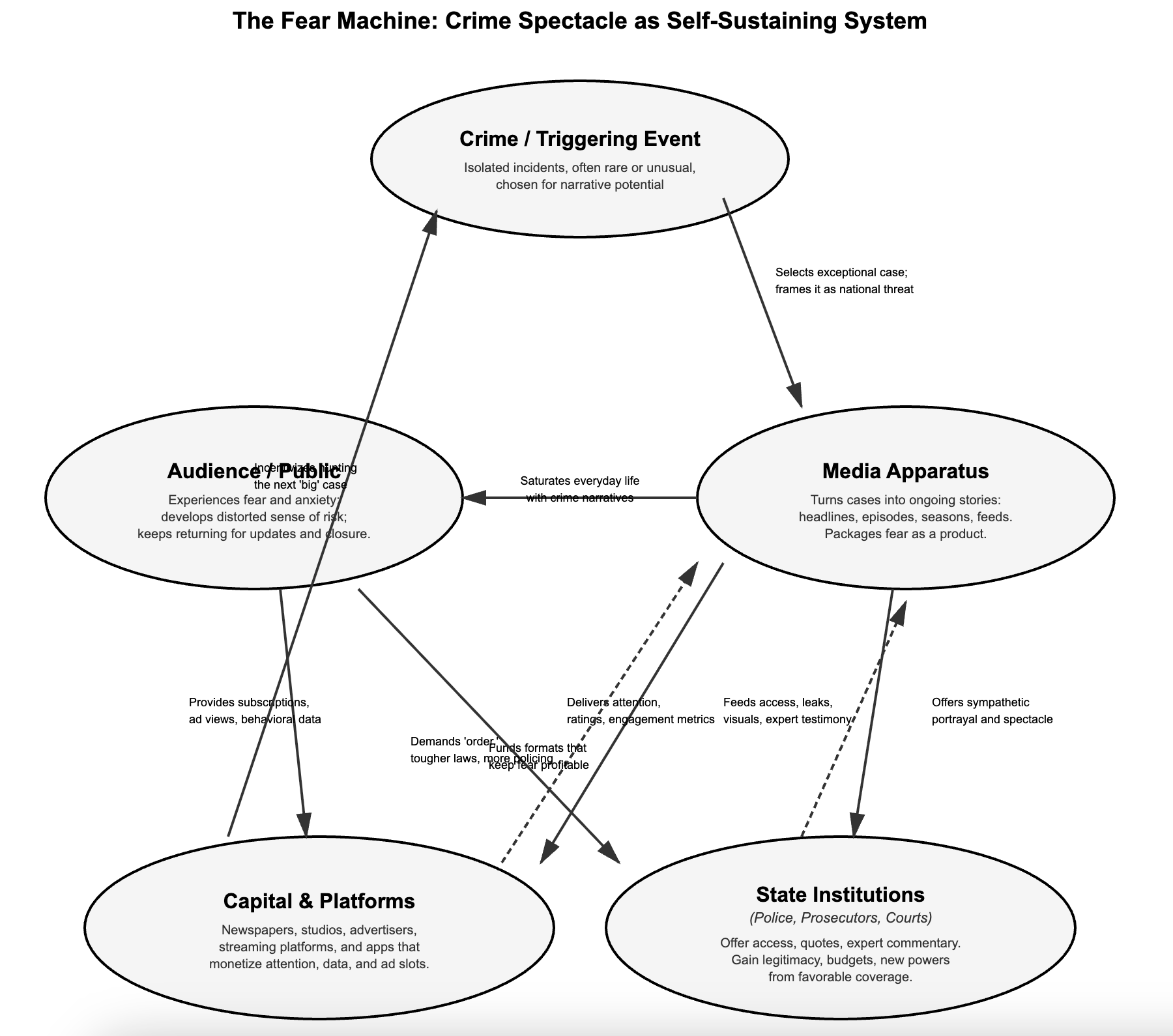
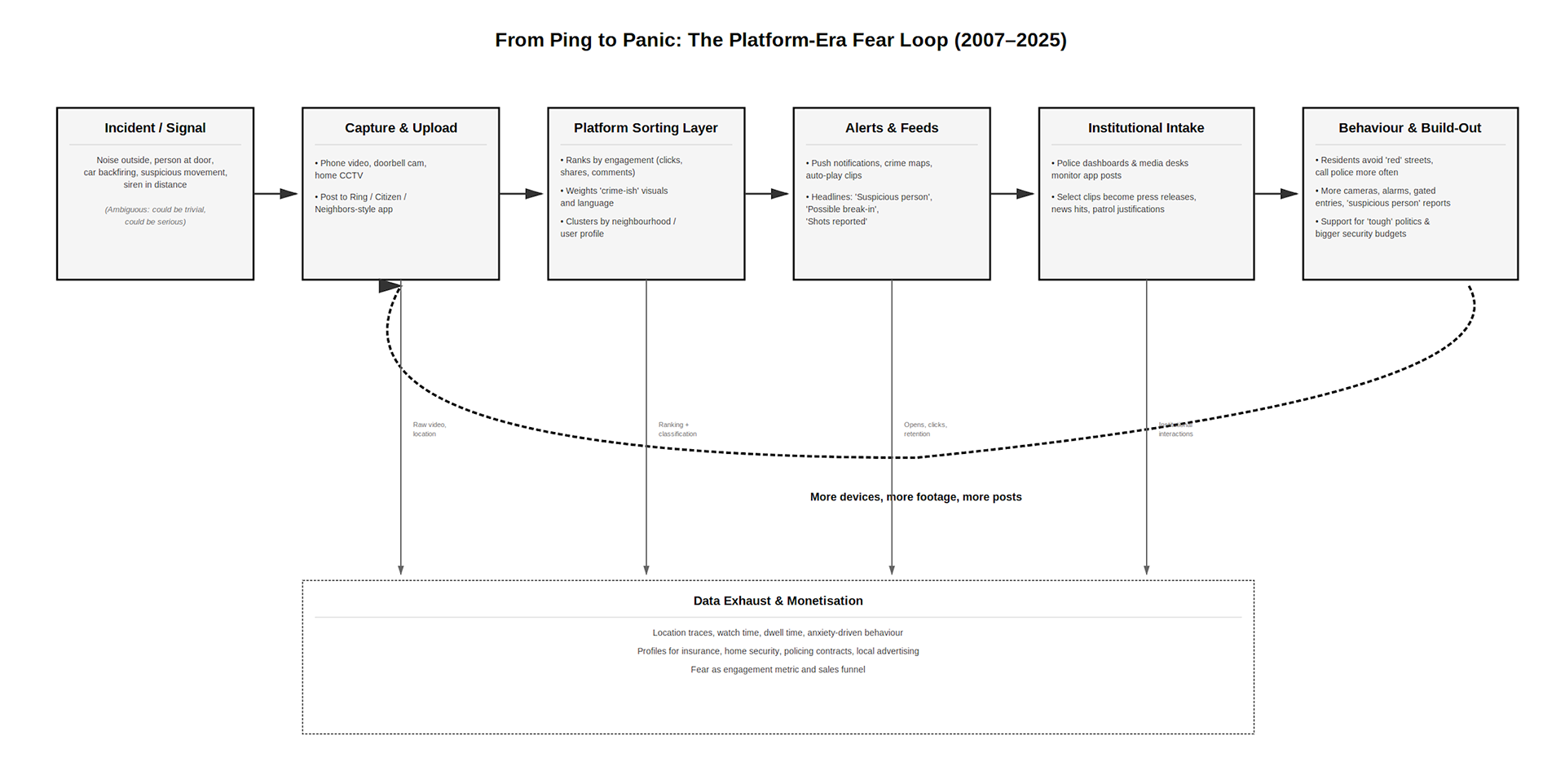
The fear machine. How an exceptional crime is turned into a repeatable product, as media, state institutions, capital and platforms, and the public feed one another in a closed loop that converts fear into profit and power.
Chapter 3 — Surveillance Theater
This chapter examines how policing and media align to create a shared stage where authority is performed rather than demonstrated. As news outlets increasingly rely on official statements, leaked documents, and courtroom access, criminal justice narratives assume the shape of serialized drama.
Closed cases, like the Manson prosecutions, provide tidy resolutions packaged as moral triumphs. Open cases, like Zodiac, offer endless interpretive space—clues, puzzles, dead ends—that keep audiences transfixed even as institutions fail to resolve the violence.
The effect is the same on both sides of the ledger. Successes legitimize state power; failures dramatize danger and justify expanded authority. Crime becomes the set piece through which institutions present themselves as indispensable, even when the facts point to limits, contradictions, or outright incompetence.
Surveillance ceases to function as a tool of investigation and becomes a public performance calibrated for impact, spectacle, and reassurance. The system’s ability to control the narrative outweighs its ability to control crime.
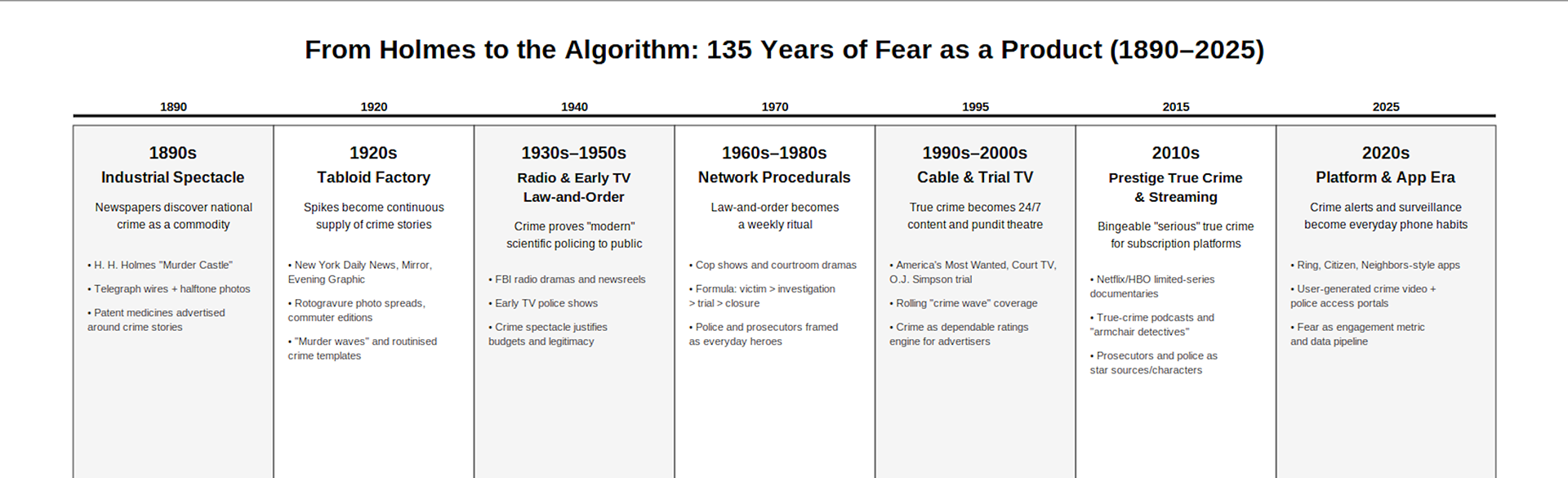
Key eras in how crime stories, media technology, and state power learned to turn fear into a repeatable product.
Chapter 5 — The Prosecutor’s Narrative
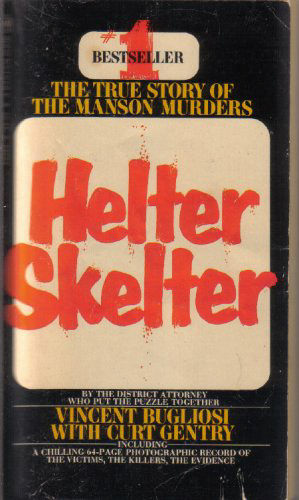
This chapter follows the transformation of prosecutors into storytellers whose interpretations shape the national memory of violent crime. The Manson trial demonstrates how a courtroom can operate as a broadcast environment, with Vincent Bugliosi delivering closing arguments timed to television rhythms and camera angles.
His later book, Helter Skelter, becomes the definitive account not because it resolves the case but because it offers an authoritative, dramatically structured version that eclipses more mundane or institutionally inconvenient explanations.
Bugliosi’s narrative achieves two things at once: it turns state authority into a bestselling commodity, and it redirects attention away from deeper systemic contradictions—informant relationships, policing failures, and buried leads—that would complicate the official story.
The success of Helter Skelter establishes a new business model: the prosecutor as public intellectual, celebrity narrator, and commercial engine.
True crime becomes a space where the state’s perspective is not merely reported but sold, and where the official text becomes cultural canon.
Chapter 11 — Total Capture
The modern platform era completes the cycle that began with sensational newspapers. “Total capture” describes the convergence of surveillance systems and streaming platforms into a single apparatus that absorbs every available signal: body-cam footage, interrogation videos, CCTV feeds, home-security clips, social-media uploads, and the behavioural patterns of viewers themselves.
True crime is no longer an account of past events but a continuous data-driven loop where content and surveillance reinforce each other.
Platforms monetise both sides of the equation. They extract spectacle from police archives and extract data from audiences who watch. Every pause, rewind, device choice, and viewing drop-off becomes part of an optimisation cycle designed to intensify engagement. Families rarely receive compensation, yet their trauma fuels a retention engine calibrated by algorithms.
By the time this chapter concludes, the boogeyman has become fully modular and programmable—an endlessly adjustable figure shaped by metrics rather than myth.
Control no longer resides in a newsroom or police precinct; it resides in platforms that can engineer attention at scale while remaining largely invisible.
H. H. Holmes and the Birth of the Modern Spectacle
(1893–1896)
Philadelphia, November 17, 1894. When detectives arrested Herman Webster Mudgett—better known as H. H. Holmes—for insurance fraud, no major newspaper put it on page one. The Chicago Tribune ran a brief inside notice about a con man caught in a bad scheme. The Philadelphia Inquirer gave it three paragraphs on page six. In New York, the World ignored it. Two weeks later, those same papers were calling Holmes “America’s first serial killer,” his Chicago building the “Murder Castle,” and his arrest the spark that fused what the prologue laid out—capital chasing profit, the state seeking legitimacy, distribution tech ready to move copy, and audiences hungry for explanation—into the first nationwide crime spectacle run at industrial scale. ¹
What mattered here wasn’t the specific murders so much as the moment the separate parts snapped together. Before November 1894, the wires were already strung, papers were already fighting for readers, police wanted public credit, and city audiences were already on edge—but each ran on its own track. Holmes’s arrest showed how to bolt those tracks together and make steady money while serving state interests. The result was a shift from local sensation to national commodity: crime packaged and sold through a coordinated press–police–telegraph system—an alignment with few real precedents. †
Comparative Note: Jack the Ripper and the Limits of Proto-Spectacle
The 1888 Whitechapel murders in London had already shown how crime could be branded and commercialized. “Jack the Ripper” was an early experiment in mass anxiety as product: letters, maps, lurid illustrations, and the promise of secret knowledge turned terror into circulation.
But the Ripper case remained geographically contained and technologically partial. The telegraph moved rumors between London papers, not a coordinated wire network across continents; police leaks were inconsistent, and state legitimation was limited to moral panic rather than institutional expansion. In short, the Ripper murders demonstrated the market for fear but not yet the machinery to industrialize it.
What Holmes added—through national telegraph distribution, halftone photography, and sustained police–press cooperation—was scale and repeatability. The spectacle ceased to be a burst of fascination and became a workflow. Where the Ripper panic proved the demand, Holmes built the supply chain.
Think of this as the setup phase of the machine—commercial media proving that crime-as-entertainment pays, setting the stage for deeper state use to follow. This chapter walks through three working parts that were mostly invisible to readers at the time: the money math behind coverage, the police–press deal that turned casual cooperation into policy, and the story kit—templates and tropes—that later spectacles followed whether or not the facts fit.
The Snap-Together Moment
When police picked up Holmes in Philadelphia on November 17, 1894, the charge was plain insurance fraud tied to the death of his associate, Benjamin Pitezel. Pitezel had died that September under circumstances the insurer found suspicious.
Holmes had taken out a $10,000 policy with Fidelity Mutual Life Association, named Pitezel’s wife as beneficiary, and arranged to collect on her behalf. After Pitezel’s body turned up in a rented house on Callowhill Street—partly decomposed, identified by dental records—Holmes claimed the payout and told investigators the death was an accident caused by exploding patent-medicine chemicals. Fidelity smelled a scheme, hired trackers to follow Holmes’s trail, and the paper chase ended with his November arrest.¹
Chicago cared because Holmes ran a building at 63rd and Wallace—right across from the World’s Columbian Exposition grounds that drew more than 26 million visitors in 1893. He’d put it up between 1887 and 1891 as a drugstore with apartments, then added a third floor in 1892, telling contractors it would be a hotel for the Fair. The architecture would later become the center of the legend, but in November 1894 the local papers treated it as nothing more than his place of business: a three-story mixed-use structure—retail below, rooms above—unremarkable in fast-growing Englewood.²
The slide from small-time fraud to national spectacle took a few weeks. Through late November and early December 1894, Chicago papers ran brief updates on the Philadelphia case and cast Holmes as a garden-variety swindler—serious, yes, but not sensational. Then Detective Frank Geyer, working for Philadelphia D.A. George S. Graham, started pulling at loose threads in Holmes’s account of Pitezel’s death.
He suspected a killing for the insurance money, but at first had little more than odd timing and bad explanations. It might have stayed a fraud case—until Geyer found something worse: three of Pitezel’s children—Alice, Nellie, and Howard—had vanished while traveling with Holmes after their father died.³
That changed the stakes immediately. Missing children drew attention in a way forged signatures never would. By mid-December 1894, Holmes was being treated as dangerous beyond financial crime.
The Chicago Tribune moved the story to page one. The Inter Ocean and Times-Herald put reporters on it full-time. From June 1895, Geyer chased leads through Chicago, Toronto, and Indianapolis, and the papers tracked his every move.
When hard evidence arrived—Howard’s remains discovered in an Indianapolis cellar in late June 1895; Alice and Nellie found in a Toronto house in early July—coverage spiked. The recovery of the children’s bodies supplied the emotional charge the fraud narrative lacked.⁴
One more turn made it a full national sensation: Holmes’s Chicago building as a crime scene. In mid-July 1895, Chicago police began tearing through the 63rd Street property looking for other victims.
Papers had already floated the idea that Holmes killed beyond the Pitezel family, but the excavation delivered visuals—walls ripped open, basement floors broken up, bone fragments and personal effects turning up—that kept attention locked.
The Tribune ran tight architectural descriptions and leaned on features that read as sinister: windowless rooms, doors that locked from the outside, chutes dropping to the basement, an oversized furnace, chemical gear that could, in theory, dissolve bodies. Whether those items were actual tools of murder or just irregularities and pharmacy equipment stopped mattering—the gothic frame sold papers.⁵
The dig became a daily serial. Each day might yield a fragment to identify, a belonging to link to a victim, a feature to reinterpret. That slow-reveal rhythm kept readers waiting for the next find. Outlets scrambled for exclusives. The Tribune secured direct access to the site. The Times-Herald hired private investigators to run parallel searches. The Inter Ocean worked former tenants and architects for copy that didn’t rely on police handouts. In the end, the excavation produced limited hard proof, but the chase itself became the story—justifying months of intensive reporting that far outpaced the evidence.⁶
After the Dig: Fire, Crowds, and the Commerce of Ruin
In mid-August 1895—months before the Philadelphia verdict—a fire gutted the 63rd Street building (reported the week of August 19). Whether arson or accident, the blaze did what rumor couldn’t: it turned a disputed interior into a spectacle in the open. Flames drew crowds; crowds drew vendors; vendors drew more coverage. By morning, papers ran panoramic descriptions of charred timbers and collapsed floors, paired with fresh photographs that revived the “Murder Castle” frame just as excavation fatigue set in. Where floor plans needed interpretation, the fire offered something anyone could read—ruin as evidence. ¹¹
The burn also birthed a quick cottage trade. Souvenir hunters sifted for charcoal, brick chips, and bits of hardware touted as relics; postcard sellers and broadside hawkers appeared within days; neighbors complained about foot traffic but rented window vantage points.
Even without an increased body count, coverage spiked: “after” shots let editors re-run the “before” diagrams, a two-panel visual implying closure and justifying “What the Fire Revealed” follow-ups. If the excavation had supplied the slow-release serial, the fire hit the reset—new photos, new angles, a fresh excuse to reprint the old maps, and a reason to revisit every rumor with updated captions. ⁶ ¹¹
For the apparatus, the lesson was simple: spectacle doesn’t need new facts if it can get new surfaces. A site that can be photographed again can be sold again—as fresh pages, plates, and street-corner interest. The fire previewed the later logic of crime tourism: locations turned into recurring attractions once they could be named, framed, and merchandised.
Long before studio backlots and streaming thumbnails, a burned Chicago corner showed how physical traces could be repackaged whenever attention sagged. ¹¹
The First National Crime Spectacle
What followed didn’t look like earlier crime coverage. In the register one Chicago daily adopted, he was the “multimurderer, bigamist, seducer, resurrectionist, forger, thief and general swindler… a man without parallel in the annals of crime.” —Chicago Chronicle, May 1896. ¹⁰
That accelerated vocabulary—stacked epithets, totalizing claims—became the tone template as the story scaled nationally.
Instead of brief local items, papers in multiple cities moved the same details at the same time over coordinated telegraph lines, then tried to outdo one another with ever-sharper sensational angles. Crime shifted from local event to national commodity, laying the groundwork for an apparatus that would keep scaling. The Tribune, Inter Ocean, and Times-Herald kept expanding their Holmes columns through late 1894, but the move to full national spectacle snapped into place in July 1895, when Chicago police began tearing into the building on Sixty-Third Street.⁷
The dig was a perfect engine: it combined strong visuals with open questions. Any given day might turn up bone fragments, personal effects, chemicals, or a newly “discovered” architectural feature—reliable fuel for daily copy. Philadelphia’s Detective Frank Geyer ran the core investigation, but Chicago police support meant both departments basked in the glow.
Reporters were rewarded with walk-throughs and early looks at evidence; papers amplified each step, which in turn helped justify more digging. The Tribune put multiple reporters on Holmes full-time, effectively inventing the modern crime beat: specialists who could produce stories from incremental steps. By late July, as crews literally deconstructed the building, every major Chicago paper was chasing exclusives from detectives, architects, chemists, and former tenants.⁸
The coordination didn’t stop at the city limits. The Associated Press, Western Union’s press service, and United Press sent daily dispatches from Chicago: excavation notes, police statements, witness quotes.
Those wires landed on editors’ desks in New York, Philadelphia, San Francisco, St. Louis, and dozens of other cities at nearly the same moment.
Editors still chose placement, but the pipe made simultaneous national release possible in a way no earlier crime had managed.
The San Francisco Chronicle kept Holmes on page one through late July and August. The New York World posted a Chicago correspondent. The Philadelphia Inquirer ran a two-front operation: trial at home, dig in Chicago.⁹
Seen together, the pattern reads less like “news judgment” and more like synchronized distribution. The wires had existed for decades; Holmes showed how capital would redeploy them when the return penciled out.
The same lines that carried stock quotes and weather suddenly moved crime narratives because circulation and ad revenue justified the spend. Papers often ran identical wire copy, then layered on local color.
For the first time, millions of readers in different cities consumed the same sensational story at once, with newspapers promising that continued coverage would ease the anxiety they’d just amplified. That economic logic—use existing communication infrastructure to manufacture spectacle when it pays—would repeat across radio networks, television, cable, and streaming platforms, each medium inheriting the playbook first proven here.¹⁰
The spectacle also ran on pictures. By the late 1880s, halftone printing—tiny dots that resolve into an image on the page—let newspapers run photographs without hiring engravers. During the Holmes story, papers printed the Sixty-Third Street building’s exterior and interior, close-ups of odd architectural details, portraits of Detective Geyer and Holmes, and images of the Pitezel children.
Wire services circulated these plates nationwide, so readers in San Francisco and New York were looking at the same “Murder Castle” photos—a shared visual script local reporting had never managed. Those architectural shots did special work: they made “sinister intent” look built into the bricks, inviting readers to imagine the crime inside spaces they could now literally see.¹¹
Moving those images took real kit and coordination. Wire services sent staff photographers to the scenes, processed negatives, made halftone plates, then shipped duplicates by express to subscribing papers. It was slower than telegraphing text but far quicker than hand-engraved art—and fast enough to keep pace with a daily serial.
The Chicago Tribune upgraded cameras and darkrooms specifically for Holmes, assigning at least two photographers to track the dig. Their work did double duty: it verified the copy (here is the furnace, here are the chutes) and stoked demand for the next day’s pictures. Images became both evidence and engine—justification to keep digging and a reason for readers to keep buying.¹²
Courtroom as Stage: Serialization by Procedure
By late 1895, the Philadelphia courtroom worked like a stage with a schedule. Procedure delivered cliffhangers on cue. Reporters packed the rail near the lawyers. Sketch artists angled for a clear view of the witness stand. Stenographers sat where their notes could be rushed to night editors in time for the morning papers. The calendar itself serialized the story—motions, jury selection, openings, rulings, expert testimony, summations, verdict—regular enough that editors could block out pages in advance and wire operators could book line time.
The mechanics mattered. How fast a stenographer could work set the length of the day’s story. When testimony ran long, papers split it: a quick telegraphed digest that evening and a fuller Sunday spread. Reporters learned to clip the most portable bits—chemical names, a dramatic demonstration, a quote that fit neatly under a one-column cut—because those traveled cleanly over the wire and landed as headlines in other cities. Court officers adjusted too. Bailiffs informally managed the scrum—who saw transcripts first, who could linger at counsel table—creating a rationing system that rewarded cooperative outlets and squeezed skeptics.
“Open justice” was also a distribution plan. Deadlines decided what led. A splashy evidentiary ruling at 4 p.m. outranked a quieter but stronger morning witness, not on merit but on timing. Closing arguments were built for quotability, paced to stenographic speed, and staggered so the prosecution’s finale hit the morning sheets and the defense reply hit the evening ones—two markets, two arcs, one case. Even the verdict played along: a late-day announcement produced an instant wave of bulletins—GUILTY—followed by a weekend package of “inside the jury room” features, interviews, and engraved portraits sized for the Sunday showcase.
None of this was accidental. The trial showed how the apparatus turned legal ritual into repeatable content. The court supplied cadence and authority. The press handled extraction and amplification. The wires made it simultaneous. Out of that mix came a durable form—tight scope, quotable beats, day-by-day suspense—that the next century of courtroom drama would reuse almost unchanged.
Escalation and Profit Calculation
Behind the spectacle sat careful math that publishers watched closely and discussed rarely. The Chicago Tribune’s circulation logs from the period show clear lifts tied to Holmes coverage—evidence that crime stories could sustain profit, not just spike it for a day. Exact counts are hard to pin down—papers treated figures as trade secrets—but contemporary notes and later analyses point to sharp gains from July through October 1895. You can see it in the choices publishers made: bigger page counts, special editions, extra reporters assigned to Holmes. Those are not moves you green-light unless you’re confident they’ll pay.¹³
In 1894 the Tribune’s weekday run typically sat between 60,000 and 80,000, with Sundays in the 100,000–120,000 range.
During July–August 1895, Holmes coverage appears to have pushed weekdays to 90,000–110,000 and Sundays past 150,000—roughly 25–35% above baseline. The Inter Ocean and the Times-Herald saw similar percentage bumps from smaller bases (about 45,000–60,000 and 40,000–55,000 on weekdays, respectively). Competition helped everyone: readers often bought a second paper to compare details, lifting the whole market during peak spectacle.¹⁴
Transmission costs, logged in ledgers now at the Newberry Library, were covered by those circulation gains and then some. Western Union billed by the word, with distance and priority surcharges.
A standard 500-word wire from Chicago to New York ran roughly $3–$5 in 1895 dollars (about $100–$170 in 2025 terms). At the height of coverage the Tribune filed multiple dispatches daily, spending $50–$100 a day—$1,500–$3,000 a month. The math penciled out easily: every extra 10,000 copies sold brought in around $100 at a penny a copy, plus the more important kicker—advertising sold against a larger audience. If Holmes moved an extra 20,000–30,000 copies a day (a cautious reading of the period notes), revenue comfortably cleared both wire and print costs.¹⁵
And the real money wasn’t just today’s sales. Ad rates were pegged to certified circulation and reset on schedules. Holmes-era lifts let publishers lock in higher rate cards that persisted after the case cooled. N. W. Ayer & Son’s Annual lists Chicago prices between $0.50 and $2.00 per line in 1895, tiered by placement and reach. The Tribune raised its rates roughly 15–20% in 1896, citing the prior year’s growth—a durable gain linked in part to Holmes. Advertisers paid because the audience was measurably bigger. Profit, in other words, arrived on multiple clocks: immediate single-copy sales, sustained multi-month engagement, and lasting ad-rate resets justified by documented increases.¹⁶
Selling Sleep to the Sleepless
The ads wrapped around the Holmes stories closed the loop. Patent medicines promised to fix exactly what the headlines stirred up: palpitations, “female nervousness,” sleeplessness, “disturbing imaginations,” “modern fatigue.” Copywriters echoed the news with a vocabulary of imbalance and cure—“tone the nerves,” “quiet the mind,” “restore vigor”—offering a chemical answer to the unease that serialized coverage created. For publishers, the setup was perfect: a one-cent paper that got paid twice—at the counter and again in ad inches sold to marketers whose pitch only made sense in a readership taught to be afraid.
Placement told the story. Anxiety cures and stomach tonics flanked courtroom summaries; “soothing syrups” faced architectural cutaways. Weekend “health pages” ran testimonials from respectable types—bookkeepers, seamstresses, traveling salesmen—who looked a lot like the readers the Holmes case had gathered.
Even when the claims drifted toward the miraculous, they didn’t clash with the day’s news; they finished it with something you could buy. If the front page taught people to feel unsafe in their own rooms, the back pages taught them how to purchase relief.
This wasn’t side income; it was the frame that held everything together. Circulation rose, rate cards followed; rate cards rose, copy budgets fattened; budgets fattened, the city’s sharpest ad writers learned to write in key with the news cycle. The apparatus learned to harmonize with itself.
Newspapers then chased exclusives, and escalation did the rest. The Chicago Tribune leaned into the building’s gothic features, printing floor plans that spotlighted supposedly suspicious elements—doorless rooms, sealed chambers, chutes between floors. The Times-Herald pivoted to victims, running photos and short lives of the missing as families came forward. The Inter Ocean highlighted “method,” interviewing architects and chemists on how the structure might enable murder. That contest set the pattern for the next century: push further, shout louder, and let exaggeration creep in where facts run thin.¹⁷
The tempo was predictable because schedules made it so. Morning papers sprinted to land fresh details—police finds, witness quotes, the next investigative step—before afternoon rivals could catch up. Afternoon sheets counter-programmed with explainers, expert takes, and a steadier pace. Sundays did the big wrap—multi-page packages with drawings, diagrams, and profiles—justifying the five-cent price when weekdays were still a penny. That cadence kept attention alive for months, not days.¹⁸
And the money tied it all together in more than one direction. Because ad rates rode on circulation, every extra bundle sold didn’t just sweeten the balance sheet; it reshaped who the paper imagined as its public. At the 1895 peak, Chicago dailies were packed with notices from patent-medicine firms, mail-order houses, and urban amusements: outfits willing to pay above the old card rate to sit next to the Holmes copy.
Classifieds and small display ads still anchored working-class readers, but the big blocks of patent cures and “nervine” tonics chased a more anxiously respectable audience—clerks, shopkeepers, skilled workers—who recognised themselves in the symptoms the headlines stirred up. The spectacle didn’t just sell to a crowd; it helped select and polish the crowd advertisers most wanted.
Telegraph companies and advertisers quietly became partners in the same circuit. Wire fees rose with the volume and urgency of crime copy; patent-medicine makers and other big buyers underwrote the experiment by paying for access to the newly enlarged readership.
The result was a layered payoff: newspapers collected at the counter and again in advertising, telegraph firms billed for the transmission spikes, and manufacturers booked sales off readers whose fears had been primed on page one.
Holmes supplied the pretext, but the returns were distributed across the whole chain; once that division of spoils settled in, everyone with a stake in the apparatus had a reason to keep finding the next case.¹⁹
A handful of editors tapped the brakes. Civic-reform papers and a few staid metro pages ran editorials warning against rumor inflation, pushed speculative lists below the fold, and stuck to dull verifiables—court calendars, sworn testimony, coroner’s reports. It was principled and it didn’t sell. The market answered overnight: the papers that printed the diagrams, the whispered totals, and the “exclusive” architectural renderings outsold the cautious ones by margins big enough to show up in the next week’s ad buys.
Even the “restrained” outlets couldn’t fully opt out. They still took the wire when it moved, still ran the photographs when a rival’s plate was circulating nationally. In practice, restraint meant slower cadence, fewer images, weaker placement: a one-column headline instead of a banner, a caption without the floor plan, a late-edition add after the morning rivals had already set the day’s frame.
Readers learned a simple lesson about scarcity: the paper that withheld the lurid details felt incomplete, not virtuous. That feeling walked straight to the newsstand.
The experiment clarified the incentives. The product that sold best matched the wire’s tempo, the courtroom’s quotability, and the camera’s surfaces. Accuracy wasn’t competing with truth so much as with speed and format. By the time a cautious editorial assembled its caveats, the diagram had already done its work. Restraint didn’t vanish; it retreated to the editorial page, safely outpaced by the front.
Making the Ordinary Menacing
The Holmes coverage didn’t just fill pages; it built new newsroom machinery and locked in relationships that lasted well beyond his execution. The clearest change was the rise of the specialized crime reporter—someone assigned primarily to criminal cases instead of bouncing between whatever stories came in. Before Holmes, general-assignment staff handled major crimes as needed. Sustained, day-after-day attention to one case forced a different skill set: comfort with police procedure and court process, fluency in forensic talk, and enough grasp of architecture and construction to turn small site updates into copy.²⁰
By August 1895, the Chicago Tribune had at least three reporters on Holmes full-time: John McEnnis on the dig and the police search, Edward Dean on the courts, and George Ade on features and profiles. That focus made them more valuable than generalists. They had sources inside the departments, understood the technical bits, and could shape incremental developments into daily stories.
In 1896 the Tribune made it official, naming McEnnis chief crime correspondent and tasking him with spotting the next big case. Rival papers followed suit, creating a small cohort of crime specialists competing for access to detectives and prosecutors.²¹ Specialization changed the job and the institution. Crime reporters developed their own identity inside the newsroom, distinct from city-hall scribes or business writers, by cultivating law-enforcement sources, learning the rhythms of arraignments and inquests, and practicing the narrative tricks that make routine steps feel like turns in a thriller. A career ladder appeared—general assignment to the crime rail to the crime desk—and publishers treated the beat as a predictable profit center rather than a one-off response to a spectacular case. By 1900, most big-city papers had named crime reporters or crime editors.²²
Police adapted, too, formalizing the media side of the house once it became clear that publicity was an institutional asset.
Before Holmes, cooperation depended on personal relationships—an officer here, a reporter there. The scale of the case—stretching across Philadelphia, Chicago, Toronto, and Indianapolis and involving prosecutors, insurance investigators, and assorted experts—made ad hoc coordination impossible. Detective Frank Geyer embodied the shift: he worked with Chicago police on the building search, briefed reporters on methods and finds, and later published an “official” narrative that doubled as promotion for the department’s scientific image.²³
City records back the institutional turn. Chicago police appropriations rose after the Holmes cycle, and so did headcount. The 1894 budget sat at $2.1 million; 1896 climbed to $2.4 million and 1897 to $2.6 million—a 14% and then 24% jump over the 1894 baseline, with personnel moving from roughly 3,000 to 3,300 to 3,500 across the same span.
No single case explains municipal finance, but the timing—and the rhetoric—matter. In his 1896 report, Police Commissioner John Brennan leaned on what he called “public confidence,” pointing to newspaper coverage of “recent investigations” as proof that citizens wanted a larger force. The loop was neat: bigger appropriations funded high-profile cases; those cases generated flattering stories; the clippings came back to council as evidence that expansion was warranted.
Spectacle converted into political capital, then into money and staffing.²⁴ ²⁵
Set against strikes, wage disputes, and council scandals, the Holmes story let the department change costumes without leaving the stage. Chicago in the mid-1890s was brittle with industrial conflict and graft hearings; trust in city institutions was thin. Crime spectacle offered a different script.
Instead of officers breaking picket lines or escorting strikebreakers, readers met detectives as patient guardians hunting a singular monster across jurisdictions. Same institution, new role. Favorable coverage acted like convertible currency: months of serialized competence—coordinated searches, cross-city cooperation, “scientific” testimony about chemicals and dental IDs—could be cashed in at budget time as proof that “the work you have seen in the papers” had to continue.
That pivot also pushed structural critique offstage. Labor violence and municipal corruption are systemic narratives—owners, councils, courts, taxes. A sensational murder centers an individual antagonist who can be hunted and punished. The frame moves from distributional conflict to deviance, from policy to pathology.
Inside that frame, police become narratively indispensable: only they can perform the rituals—search, seizure, arraignment, trial escort—that promise closure on a daily deadline. The question shifts from why the city is organised the way it is to whether the detectives will get their man before tomorrow’s edition.
Newsrooms adjusted in lockstep.
Reporters who once split time between council notes and neighborhood briefs now lived on the police rail, turning procedure into cliffhangers and nurturing sources whose quotes could carry three editions a day. Both sides got predictability. Detectives could expect sympathetic framing—grim faces, “method and persistence” captions—while editors could count on a steady flow of printable increments: a trunk opened, a witness found, a map updated, a ruling made.
That is the ideological dividend: legitimacy delivered as entertainment. At the very moment audiences might have asked why the city’s institutions were failing them on wages, rents, or graft, they were taught instead to feel precarious in their own rooms and grateful for the men at the threshold. The higher budget lines in 1896–1897 did not follow a solved social problem; they followed a solved story. Authority traveled faster through the front page than through the hearing room.
What began as favors between individuals hardened into policy. Holmes turned occasional cooperation into a system with clear mutual incentives. Police gained favorable publicity that could be cashed in for bigger budgets and broader powers; newspapers gained privileged access and a reliable pipeline of exclusives that kept the presses humming.
Detective Frank Geyer’s book, published soon after Holmes was hanged in May 1896, is the clearest example of the new bargain: an official police narrative wrapped as popular entertainment that delivered both institutional prestige and sales.
The Holmes-Pitezel Case presents detection as a kind of traveling laboratory—Geyer poring over “clues,” cross-checking hotel registers, and following a perfectly rational trail across cities until, as he puts it, “each circumstance pointed with unerring certainty to the hiding places of the children.”
In the text, delays and dead ends compress into a seamless arc of method and persistence; jurisdictional friction and earlier investigative failures (Julia and Pearl’s disappearance in 1891, Emeline Cigrand in 1892, the Pitezel children killed while Holmes was already under fraud scrutiny) barely register.
The gap between the book and the record is the point: it packaged a messy, often-belated investigation as proof of modern, scientific policing and set the tone for how detectives would be portrayed in crime media for the next century—fallible institutions recast as singular, rational heroes moving through a world of irrational evil.
The same pattern—private platforms supplying distribution and polish, police supplying access and legitimacy—echoed through radio dramas made with department cooperation, TV procedurals granted behind-the-scenes access, and, later, networked surveillance that links private cameras to police databases.²⁶
During the Holmes cycle, crime-as-entertainment coalesced into a genre with recognizable parts. Newspapers had always covered crimes, but now there was a reusable kit: the gothic building (“Murder Castle”), inflated body counts, quick-and-dirty psychological profiles, sympathetic victim sketches, the detective as hero, courtroom set pieces, and the execution coda. Producers learned which components moved copies; readers learned what to expect. Templates meant later spectacles didn’t have to invent structure from scratch—they could slot new facts into a proven frame.²⁷
The architectural template proved especially sticky. Holmes’s building became the “Murder Castle” through floor plans and captions that implied design-for-murder—doorless rooms, sealed chambers, chutes, an oversize furnace.
Many of those features had prosaic 1890s explanations; the framing did the work. As Adam Selzer notes: “When he added a third floor onto his building in 1892, he told people it was going to be a hotel space, but it was never finished or furnished or open to the public… The whole idea was just a vehicle to swindle suppliers and investors and insurers.” ²
That’s the hinge: the same rooms that read as mundane in a ledger could be sold as sinister in a caption.
Once established, the same gothic lens could be aimed anywhere. Even the plain Victorian house in Fall River linked to the Lizzie Borden case was described with similar menace. Ordinary features, selectively described, could be made to feel criminal.²⁸
Infrastructure adapted to the opportunity. Telegraph firms rolled out priority tiers for breaking crime copy and charged premiums that papers paid because the circulation lift covered the bill. Wire services stood up specialist roles for criminal cases rather than tossing them to generalists. The Associated Press put at least three reporters on Holmes full-time, treating crime spectacle as its own content category with dedicated staff and workflows.²⁹
Newsrooms upgraded their own systems to keep pace.
Clip morgues—internal archives of articles, photos, and notes—were expanded and reorganized so crime reporters could pull precedent cases on deadline. The Tribune created a dedicated crime morgue in 1896, hiring two clerks to manage cross-references and retrieval. That kind of back-end spend only happens when publishers trust the revenue stream; it signaled that crime spectacle had moved from one-off windfall to an ongoing line of business.³⁰
A Machine That Feeds Itself
By the time Holmes was hanged on May 7, 1896, the machine was running on its own. Each part fed the others: higher circulation justified bigger ad buys; bigger ad buys paid for more wire copy and photographs; more coverage lifted police prestige and budgets, which yielded more access and story.
The paper trail—circulation jumps of 20,000–30,000 a day in Chicago, police appropriations up 14–24% in 1896–1897, $50–$100 in daily telegraph spend covered by new sales, the same gothic floor plans and inflated body counts printed across rival pages—doesn’t just suggest the conclusion; it is the mechanism in view.
What looks like cultural taste or a master plot is simpler: separate actors aligning around profit and institutional self-interest, reproducing the system because everyone at the table gained from keeping it going.³¹
Publishers had their proof. From November 1894 to May 1896—roughly eighteen months—Holmes coverage delivered steady copy and steady returns, not a one-week spike. Revenue came in layers: day-to-day sales during peaks, sustained lifts across the run, permanent ad-rate bumps justified by audited circulation, wire syndication fees, and book sales from compiled accounts after the hanging.
Stack those lines against the cost of foreign bureaus, legislative reporting, or in-depth finance desks, and the logic is blunt: crime spectacle paid better per dollar and per page, so it moved up the editorial priority list and stayed there.³²
Police also banked gains. The coverage cast detectives as methodical protectors at a moment when the public was souring on strikebreaking and city graft.
That framing shifted attention from structural fights—labor, rents, corruption—to a single, stoppable villain. Geyer’s cross-country chase became the template: scientific methods, long miles, moral urgency. Put plainly, the police turned into protagonists in a story that translated cleanly into budget votes and broader powers, and the genre kept repeating that move case after case.³³
The wires learned the lesson too. Western Union and the press services showed they could move the same crime narrative to multiple cities at once and get paid for the privilege. They built pricing tiers and workflows around that demand, and newspapers shaped their dispatches to fit the pipes: clean leads, quotable blocks, plate-friendly images. Technology didn’t dictate the content; the money did. Economics set the tempo, and the infrastructure followed it.³⁴
Audiences, for their part, learned a habit. Daily papers for the chase, Sunday for the big spread; an expectation that “science” and procedure would explain the horror; a taste for repeatable parts—architecture, victims, methods, courtroom beats. With those appetites in place, editors could manufacture similar engagement from lesser cases by slotting new facts into the same templates. What began as an extraordinary saga became a repeatable product line.³⁵
The Holmes story didn’t end with Holmes. It created a template, and once that template existed, everyone involved started looking for the next one.
Publishers began telling their crime reporters exactly what to hunt for: a case that could run for months, not days. That meant certain traits got privileged. A strange building. A missing woman or a missing child.
A body count that might go up. A suspect who crossed city or state lines, so multiple jurisdictions could be woven together. If a case fit that profile, it was elevated. If it didn’t, it might get a couple inches of straight reporting and vanish.
That editorial filter created a bias that had nothing to do with how common or socially important a crime actually was.
Crimes that mapped cleanly onto the spectacle formula—mystery architecture, roaming predator, possible “hidden victims”—were treated as national emergencies. Crimes rooted in wage disputes, worksite deaths, police killings, housing fires caused by landlord neglect? Those stayed “local issues,” not serialized events. News value slid from “what matters” to “what can be sold for six weeks.”
Police understood how to work inside that market. Departments started feeding chosen reporters selective access—early looks at evidence, guided walkthroughs, “off the record” hints—knowing that flattering coverage in turn made them look competent, scientific, indispensable. That wasn’t just ego. Public safety prestige translated into money, staffing, gear, and political cover. So police learned to frame certain cases as proof of their necessity and used the press as the delivery system.
Meanwhile, elected officials saw the upside. If the public’s fear could be organized around a narrativized threat—“there are predators in the city, we need stronger policing”—then you could expand police budgets and authority without having to deal with the structural questions that were actually making people angry: low pay, brutal working conditions, corrupt contracting, rent gouging. Spectacle let the state say: the danger is not exploitation, the danger is him. That’s a shield.
Technology followed the money. Wire services and telegraph companies invested in the capacity to move crime material quickly, because papers were willing to pay for it and readers kept buying it. Speed, simultaneous reach, and reprintable visuals weren’t neutral advances; they were built out because this genre proved profitable enough to justify the spend.
And the audience kept buying.
By mid-1895, routine crime reporting had already trained readers in how to consume this stuff: follow the daily updates, look for the blueprint of the murder house, wait for the courtroom scenes, get the confession, then buy the book. The rhythm became familiar and comforting in a twisted way.
People started expecting crime to be told like this. Once expectation hardens, you don’t need a Holmes-level case every time. You can run lesser material through the same frame and still make it work.³⁶
That’s the real pivot: what looked like a one-off alignment during Holmes—papers, police, politicians, and wire services all finding advantage at the same time—stopped being improvisational and turned into structure.
Newspapers didn’t just occasionally assign someone to “the Holmes story.” They built permanent crime desks. Those reporters weren’t generalists anymore; they were specialists whose entire job was cultivating detectives, learning procedure, and spotting which fresh case could be packaged as the next big narrative arc.
Police didn’t just happen to be talkative with one determined detective. Departments started treating press access as part of the job, not a side favor. By the end of the decade you get something like a proto–press office: controlled leaks, briefings, staged walk-throughs, and selective withholding. Publicity became an internal resource.
The relationship between the two stopped depending on whether a given reporter and a given sergeant “got along” and hardened into an ongoing exchange: we feed you access, you frame us as capable and necessary. That’s state–capital coordination in practice, not as a conspiracy, but as a workflow. Each side understood the material benefit.
The telegraph services adjusted their own operations to match. Crime stories became just another high-priority product class alongside financial bulletins and political dispatches. That meant you could drop one narrative into dozens of cities at once, each city running “its” local angle on a supposedly shared national threat.
And the audience—the paying base that made the whole thing viable—was no longer just “people who like lurid crime stories.” By this point, they’d been conditioned to expect crime as serialized national theater, with police as protagonists and anxiety as the hook.
So by the end of the Holmes cycle, you don’t just have parallel interests occasionally lining up. You have an apparatus.
Papers assign the beat, police formalize the channel, wire services optimize transmission, officials leverage the fear for authority, and readers keep proving with money that they want the next chapter.
Once it locks in like that, you don’t need Holmes anymore. The system can run on its own.³⁷
Industrial Gothic: Making the Crime Template
Body-count inflation shows how competition pushed papers to print numbers unmoored from evidence. Early coverage in late 1894 pointed to four victims—Benjamin Pitezel and, possibly, his three children—backed by court findings and physical proof. By mid-1895, headlines were floating “dozens,” built on rumor chains, stray missing-persons notices from other cities, and Holmes’s own winks to investigators.
Then came Holmes’s paid confession in the Philadelphia North American (April 1896), boasting of 27 victims—a figure that sold papers and served Holmes’s pocket but had little to do with what could actually be verified. ‘I was born with the devil in me. I could not help the fact that I was a murderer, no more than a poet can help the inspiration to sing.’ That line was perfect headline fuel: a single sentence that turned uncertainty into theater and helped detach the body count from evidence.
Modern historical work lands on nine probable victims, with different levels of certainty: Benjamin Pitezel (confirmed by autopsy and in court); Alice, Nellie, and Howard Pitezel (remains identified in Toronto and Indianapolis); Julia and Pearl Conner (confession to counsel; partial remains possibly tied); Emeline Cigrand (disappeared while employed by Holmes under highly suspicious circumstances); and sisters Minnie and Nannie Williams (strong circumstantial evidence, including their effects in Holmes’s possession; no bodies recovered).
Many other names either belonged to people later found alive (for example, “Dr. Robert Leacock,” who in fact died in Canada in 1889—years after Holmes claimed to have killed him), to rumors with no demonstrable link beyond proximity on a map, or to outright fabrications born of circulation wars.
Bigger numbers fed the spectacle. The Tribune teased “possibly 50 or more,” leaning on hearsay and missing-persons chatter; the Times-Herald vaulted to “100 or 200,” stacking unvetted lists culled from Chicago, Philadelphia, and Toronto. There was no evidentiary base—just an arms race for attention. The habit stuck. Across print, broadcast, and now digital platforms, the same logic persists: inflate the tally to juice engagement, then let accuracy trail behind.
Contemporary true-crime podcasts and streamers often recycle the move, pushing counts to please metrics rather than the record.⁴⁰
The “gothic building” frame worked the same trick, but with architecture. Holmes’s place was a standard three-story mixed-use structure for a boom-era neighborhood: shopfronts below, apartments above, a basement for heat and storage. Its quirks mostly trace back to how it was built—contractors swapped mid-job, plans changed, work left unfinished. Doorless rooms? Often incomplete carpentry. Chutes? Laundry, coal, or trash. A large furnace? Heating a big building in a Chicago winter. None of that is exotic once you look at period practice and Holmes’s habit of stiffing builders.⁴¹
Papers turned those mundane features into horror props. The Tribune ran floor plans that renamed unfinished rooms as “death chambers,” ordinary chutes as “body-disposal systems,” a basement furnace as a “crematory,” and pharmacy gear as “body-dissolving vats.” After the digs, city inspectors found irregularities that fit construction fraud better than murder-lab design—facts that drew far less ink because they spoiled the gothic.⁴²
And once coined, “Murder Castle” became a portable template. Any crime-linked address could be made sinister by narrating everyday spaces as instruments of evil: basements become dungeons, storage rooms become torture cells, boilers become crematoria.
The pattern lives on. Podcasts badge tract homes as “houses of horror,” documentaries light and score entryways like crypts, platforms circulate edited images to darken the mood. The frame established in the Holmes cycle survives as a reusable kit, largely independent of what the walls actually were.⁴³
The detective-as-hero frame locked in how police work would be shown for the next century. Frank Geyer’s 1896 Holmes-Pitezel Case presents detection as a science: steady evidence-gathering, step-by-step inference, and relentless travel across jurisdictions. Newspapers amplified the image with photographs of Geyer studying exhibits, interviewing witnesses, and coordinating with other agencies.
The package did three things at once: it burnished police legitimacy during a skeptical moment, it gave audiences a clear protagonist, and it supplied a template later spectacles could copy regardless of how capable the underlying investigation actually was.⁴⁴
That frame hid the ordinary—and often failing—machinery of police work: routine procedure, bureaucracy, and the many cases that stall or never get worked.
Holmes operated for years before serious inquiry began; Julia and Pearl Conner vanished in 1891 without sustained investigation until 1895; Emeline Cigrand disappeared in 1892 with minimal response; and the Pitezel children were killed while Holmes was already under fraud scrutiny.
Those failures drew little attention because they undercut the hero arc the spectacle needed. Modern crime media repeats the pattern: procedurals spotlight exceptional detectives solving intricate puzzles while systemic problems—untested evidence, wrongful convictions, racial bias, low clearance rates—remain largely offstage. The conventions forged in the Holmes cycle still shape how audiences understand police work, even when the record points to institutional dysfunction.⁴⁵
The System Eats Its Own Tail
The Holmes case marks a turning point, not a starting gun. Crime existed; papers covered it; police wanted public favor; audiences were already on edge. Holmes, in his prison memoir, even tried to puncture the myth, calling himself “but a very ordinary man, even below the average in physical strength and mental ability,” adding that to have planned and executed the “stupendous amount of wrongdoing” attributed to him “would have been wholly beyond my power.”³⁸
What changed in 1893–1896 was coordination—the moment separate pieces locked together into a single machine where entertainment, profit, and state power moved in step and kept each other moving.
Seen plainly, that coordination had three parts: money incentives (circulation lifts and ad-rate bumps), institutional partnership (police–press routines that traded access for favorable framing), and repeatable format (a story kit of blueprints, victims, detectives, courtroom beats).
Once those aligned, the machine ran regardless of any single reporter’s ethics or any detective’s self-image: profit pulled; legitimacy followed; templates did the rest.⁴⁶
With the mechanism visible, the frame travels beyond true crime. The same gears—profit-driven escalation, partnerships that confer legitimacy, and stock templates that crowd out structural analysis—turn across entertainment, news, and today’s platforms. Spot how the Holmes spectacle tied capital accumulation to state legitimation by monetizing anxiety, and the pattern reappears in contemporary media cycles, surveillance tech integrations, and public–private data pipelines.⁴⁶
Reproduction brought friction. Predictable contradictions surfaced quickly: profit vs. accuracy; the state’s need for legitimacy vs. the risk of overexposure; technical capacity vs. distribution limits. Holmes also exposed a deeper snag the machine couldn’t fix: it depended on exceptional crimes. Spectacle paid and the pipes were in place, but supply was lumpy. Sensational murders don’t arrive on a schedule.
The industry’s answer—the tabloid era—was to industrialize scarcity: convert one-off shocks into a continuous product by systematizing search (hunt cases with “legs”), format (plug facts into a proven kit), and cadence (morning/afternoon/Sunday cycles) so the factory could run even when the raw material wasn’t extraordinary.
Read the move that way and you get a portable method: contradictions drive adoption of tools and workflows; profit imperatives sort which adoptions stick; coordination with state power follows where incentives line up.⁴⁷
What’s set in this chapter—local sensation scaled to national commodity; state–capital cooperation shifting from informal favors to standing arrangements; technology used selectively because the numbers penciled out; surveillance normalized by packaging it as entertainment—becomes a set of trackable forces in the chapters ahead, each “solution” generating fresh tension.
Track, in particular, spectacle’s drift from event-driven spikes to systematized output to algorithmic automation; state and capital moving from loose cooperation to formal partnership to near-fusion; technology marching from telegraph to radio to TV to stream-era ranking systems, all following the same profit logic; and surveillance shifting from contested intrusion to accepted fixture to desired “protection,” with audiences asking for the very monitoring that coverage like Holmes helped naturalize.
The core alignment forged in the Holmes years—capital, the state, technology, and managed anxiety moving in lockstep—kept its shape as the medium changed. It carried from yellow papers into tabloids, then radio, television, and finally algorithmic systems.
The next chapter tracks exactly how that alignment was systematized in the tabloid era: how publishers solved the supply problem by turning sporadic shocks into a continuous product, and what new contradictions that factory model created.⁴⁸