
Read the Reference Tables, Period analysis, Introduction and Chapter One below!
Also available on the kindle page.
Also available on the kindle page.
Outrun My Gun: Mass Shootings, Militarism and the Making of an American Nightmare (1830s–2026)
Mass shootings in the United States are not random eruptions of “evil” or inexplicable madness. They are the predictable output of a system that manufactures military-grade weapons for civilians, strips away working-class institutions, sells armed individualism as identity, and then cashes in on every atrocity.
Outrun My Gun follows that system across nearly two centuries, from Colt’s first factory revolvers and slave-patrol shotguns to AR-15 marketing, Uvalde, and the ICE raids of the Trump era. It shows how the American gun regime was built at the intersection of three forces: industrial weapons production, frontier conquest and racial terror, and a legal order that always cared more about who holds a gun than whether guns are widely available at all.
Across six phases – from Reconstruction massacres and Pinkerton gunmen to Columbine, Sandy Hook, El Paso, Buffalo, and beyond – the book tracks how the same pipeline repeats:
Every chapter stays with concrete scenes and carriers: Bath School in 1927, where a farmer blows up a schoolhouse and disappears from official memory because there is no profit loop yet; the Cincinnati NRA coup that turned a hobby club into a political machine; the domestic-violence trail sitting behind more than half of modern mass shooters; the school-security market that treats children as a risk category; the radicalisation circuits that run from The Turner Diaries and gun-show tables to 8chan manifestos and livestreamed murder.
The book insists on the wider frame: war abroad is war at home. The same military-corporate system that arms dictatorships, proxy wars and the assault on Gaza feeds weapons, training and ideology back into the United States. Veterans come home to an economy that has gutted unions, schools and social services but offers them guns, gig work and militia movements. Immigration raids, border militarisation and political assassinations are not separate from the mass-shooting crisis; they are the same logic turned inward.
Mass shootings in the United States are not random eruptions of “evil” or inexplicable madness. They are the predictable output of a system that manufactures military-grade weapons for civilians, strips away working-class institutions, sells armed individualism as identity, and then cashes in on every atrocity.
Outrun My Gun follows that system across nearly two centuries, from Colt’s first factory revolvers and slave-patrol shotguns to AR-15 marketing, Uvalde, and the ICE raids of the Trump era. It shows how the American gun regime was built at the intersection of three forces: industrial weapons production, frontier conquest and racial terror, and a legal order that always cared more about who holds a gun than whether guns are widely available at all.
Across six phases – from Reconstruction massacres and Pinkerton gunmen to Columbine, Sandy Hook, El Paso, Buffalo, and beyond – the book tracks how the same pipeline repeats:
weapons designed for war,
pushed into a decomposing society as a substitute for security and community,
used in schools, workplaces, churches and supermarkets,
and then turned into fresh revenue for gun manufacturers, security firms, insurers, media networks and politicians.
Every chapter stays with concrete scenes and carriers: Bath School in 1927, where a farmer blows up a schoolhouse and disappears from official memory because there is no profit loop yet; the Cincinnati NRA coup that turned a hobby club into a political machine; the domestic-violence trail sitting behind more than half of modern mass shooters; the school-security market that treats children as a risk category; the radicalisation circuits that run from The Turner Diaries and gun-show tables to 8chan manifestos and livestreamed murder.
The book insists on the wider frame: war abroad is war at home. The same military-corporate system that arms dictatorships, proxy wars and the assault on Gaza feeds weapons, training and ideology back into the United States. Veterans come home to an economy that has gutted unions, schools and social services but offers them guns, gig work and militia movements. Immigration raids, border militarisation and political assassinations are not separate from the mass-shooting crisis; they are the same logic turned inward.

Outrun My Gun rejects both liberal “common sense” gun-control slogans and fatalistic despair. It distinguishes between harm-reduction measures that save lives now – state-level laws, community-violence interruption, legal cracks in the gun industry’s shield – and the deeper transformation needed to break a closed profit loop that no major institution has a material interest in ending. The book argues that the only social force capable of dismantling that loop is the international working class that currently pays the price: the people who build the weapons, staff the schools and hospitals, and bury the dead.
Extensively researched and fully end-noted, drawing on court filings, corporate records, government data, investigative journalism and critical analysis, Outrun My Gun is both a history of how the nightmare was built and a clear statement of what it would actually take to wake up from it.
Extensively researched and fully end-noted, drawing on court filings, corporate records, government data, investigative journalism and critical analysis, Outrun My Gun is both a history of how the nightmare was built and a clear statement of what it would actually take to wake up from it.
Six Phases of an American Nightmare (1830s–2026)

Outrun My Gun doesn’t start at Columbine or Sandy Hook. (Above Samuel Colt. His Gun and his Armory)
It opens in the 1830s, when Samuel Colt is building the first mass-produced revolvers and armed white civilians are enforcing slavery, clearing Indigenous land and busting strikes. From there, the book walks through six phases of development: Reconstruction massacres and the legalisation of racial terror; the age of Pinkertons, company gunmen and race pogroms; the postwar boom that turns the US into an arms factory for the world; the neoliberal decades that hollow out working-class towns and leave men alone with a grievance and a weapon; the Columbine–Sandy HHook era that locks in the media template and security build-out; and finally the period 2012–2026, where mass shootings become a permanent, self-reinforcing feature of everyday life. Across nearly two centuries, the same pattern keeps resurfacing under new names: war abroad, decomposition at home, weapons flowing between the two, and a political system that treats civilian death as the acceptable cost of maintaining property, profit and empire.
The Closed Loop: How the Gun Regime Turns Atrocity into Income
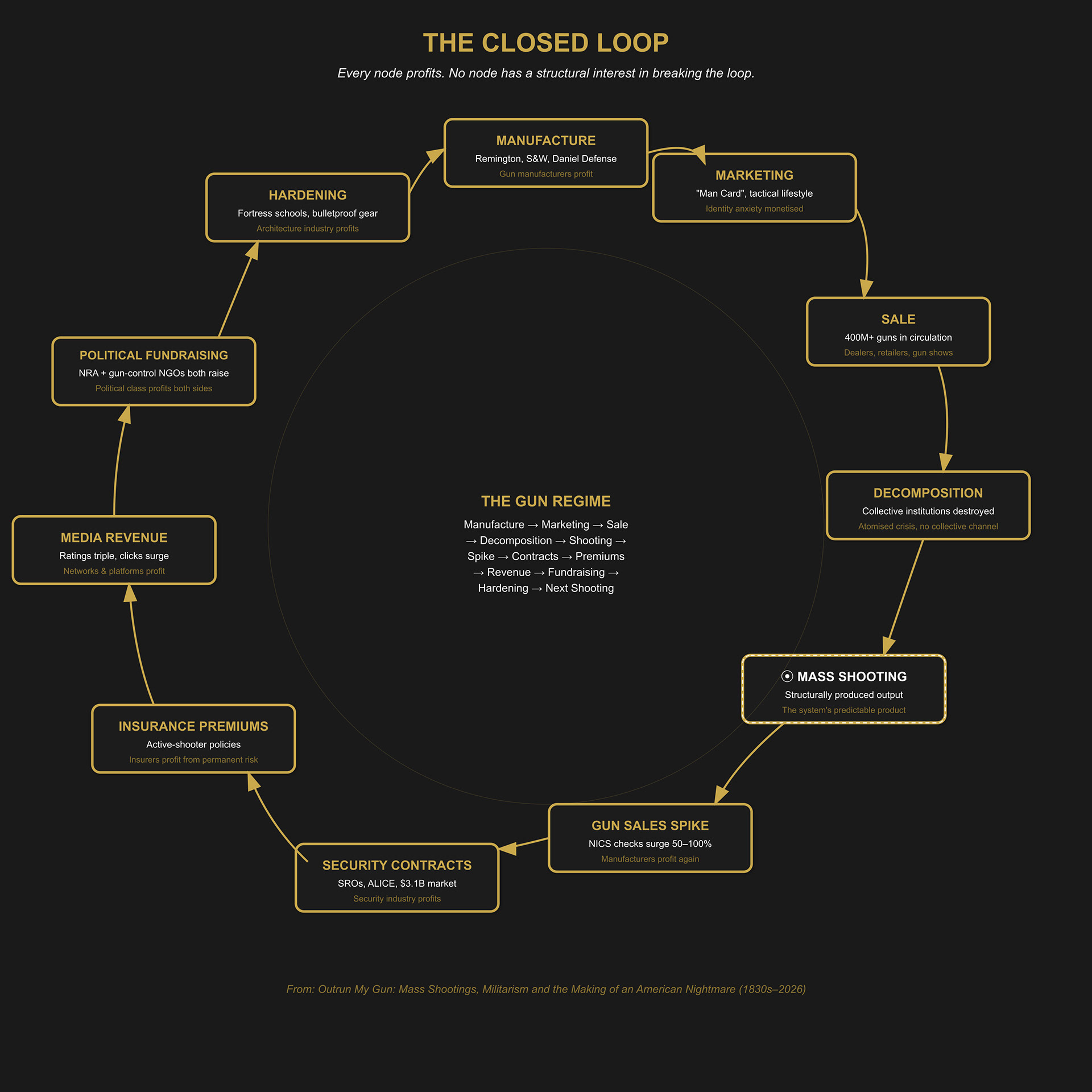
At the centre of the book is a brutaly simple claim: mass shootings are the statistically predictable output of a closed profit loop.
It is not random eruptions of madness in an otherwise rational system. A rifle is engineered on a Pentagon contract, refined in overseas wars, and then repackaged for “civilians” as a lifestyle object. It is sold into a country where unions are broken/transformed, services gutted and people pushed into debt, precarious work and isolation. When a school, supermarket, club or church is turned into a crime scene, the loop closes: background checks spike, gun stocks jump, security firms sign new hardening contracts, insurers roll out active-shooter products, media outlets pull in record ratings, politicians from both parties flood inboxes with fundraising emails, and schools commission yet another redesign that assumes the next attack is already on the calendar. The book follows that entire chain with names, numbers and contracts. The point is not that “money is made” from tragedy in the abstract; it is that the revenue model requires permanent emergency and gives every major institution a financial incentive to live with it.
Rifles and R & D
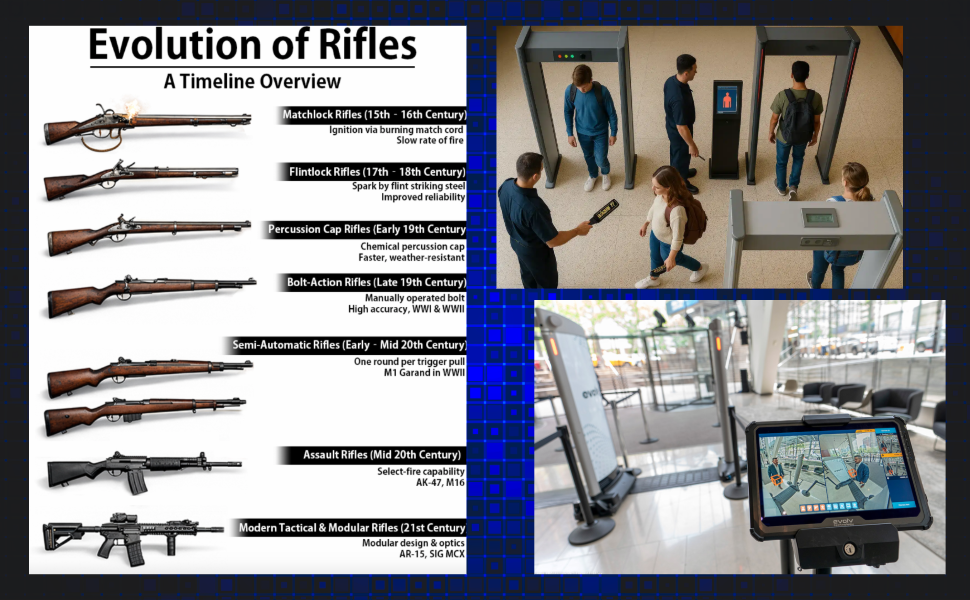
Inside the System: Manufacturers, Security, Media, Law and War
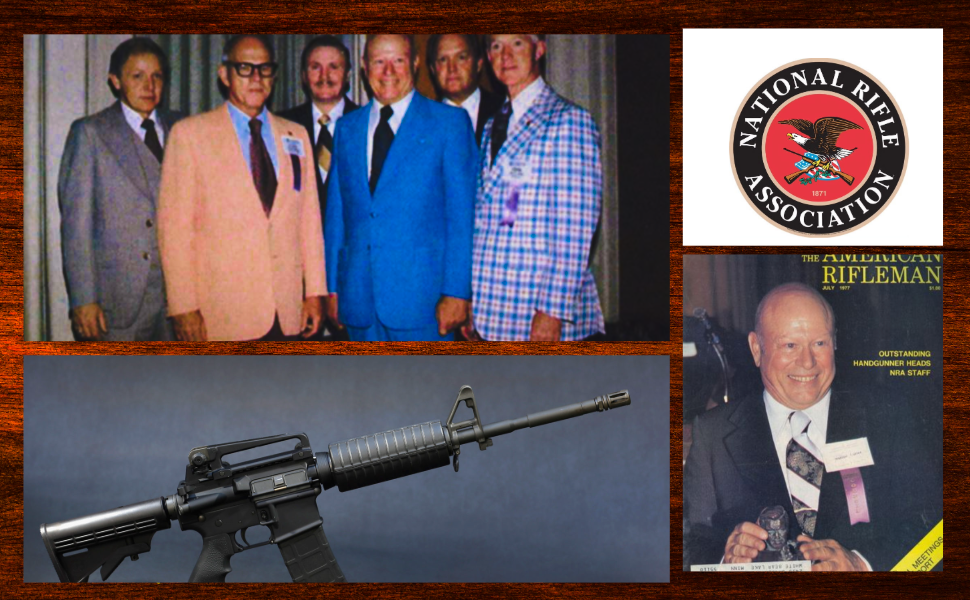
The book moves through the system piece by piece and shows how it all bolts together. (Above, The NRA "Cincinnatti Coup" board members, and an AR--15.
It looks at gun manufacturers and their private-equity owners, tracing the AR---15 from Eugene Stoner’s Pentagon prototype to a civilian best-seller marketed to insecure men on Instagram and YouTube. It dissects the NRA’s transformation into a political machine, the legal path from the National Firearms Act to Heller and Bruen, and the way laws like PLCAA and FOPA were written to shield profits rather than protect lives. It follows the post-Columbine and post-9/11 security boom: school resource officers, tactical drills, 1033 transfers, “run–hide–fight” trainings and AI weapons-detection portals that quietly turn schools into soft prisons. It digs into the media template—how newsrooms and platforms package each massacre as spectacle, and how that coverage feeds radicalisation and imitation. And it keeps one eye on empire: wars in Vietnam, Iraq, Afghanistan and beyond, the veterans they produce, the weapons that circulate back, and the slow fusion of foreign militarism with domestic policing, border raids and far-right paramilitary politics. The book treats all of this as one machine, driven by the same owners and the same logic.
Cracks, Harm Reduction, and What It Will Actually Take
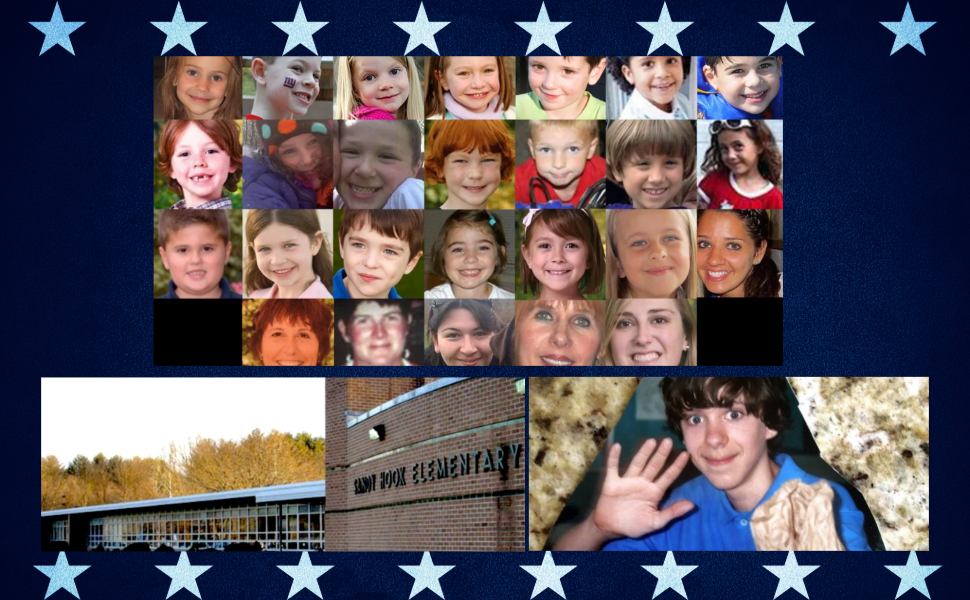
The book doesn’t end in despair and it doesn’t romanticise “common-sense gun reform.” (Above-SandyyHook, the victims and perpetrator Adam Lanza.
It draws a hard line between harm reduction and structural change. It spends time with the Sandy HHook families who forced Remington’s insurers to pay and exposed internal marketing documents. It looks at state-level laws that really do cut deaths, community-violence programmes that slash shootings in specific neighbourhoods, and international cases—Port Arthur in Australia, Dunblane in Scotland—that prove there is nothing biologically or culturally inevitable about America’s death toll. Then it walks through why those examples, on their own, can’t break a closed loop protected by federal shields, interstate trafficking, a captured judiciary and a political system funded by the very industries that profit from each atrocity. The final chapters argue that the only force with both the numbers and the material interest to dismantle the gun regime is the working class itself: the people who build the weapons, staff the schools and hospitals, drive the ambulances and dig the graves. The book is heavily researched and extensively end-noted, but it is written to be used—a structural map for anyone who understands that “thoughts and prayers” was never incompetence, it was always policy.
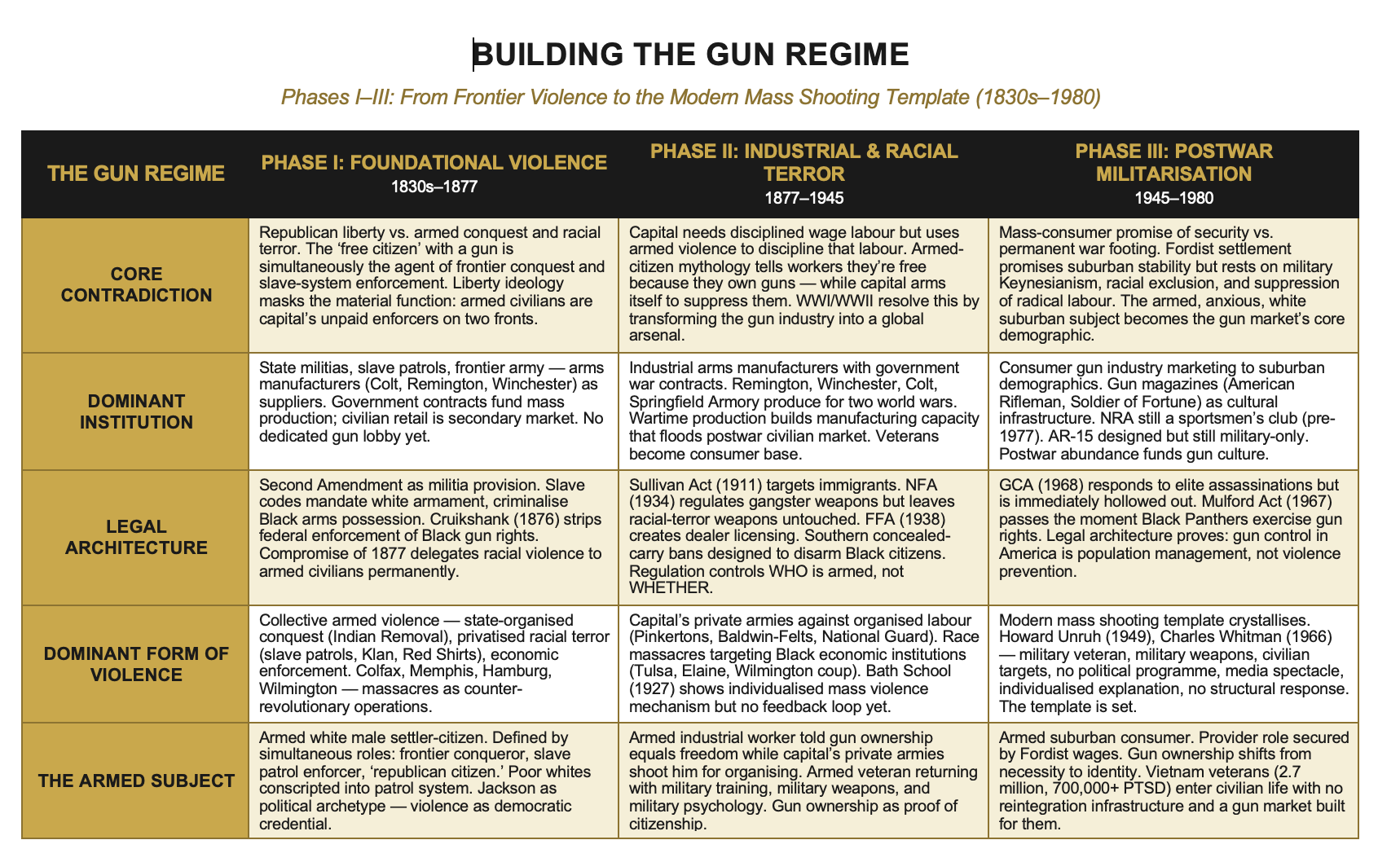
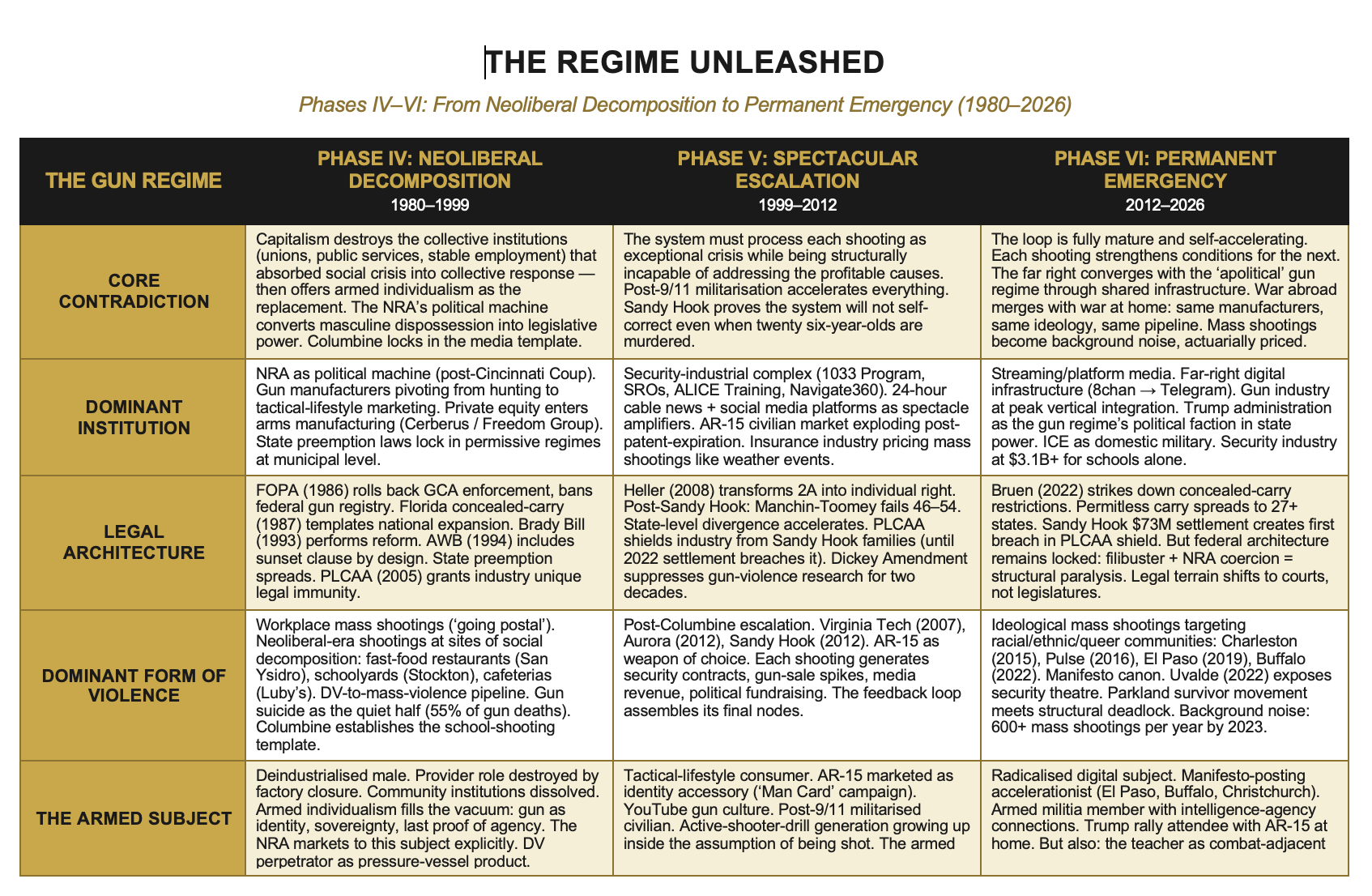
HOW TO READ THE TABLE
This table is a map of how the American gun regime evolves from the 1830s to the present. It doesn’t track individual motives or crime-scene details. It tracks structure: who controls weapons, how profit is pulled out of violence, and how each phase’s tensions force the system into its next shape.
Two Ways to Read
Read across a row: you’re following one element over time. The dominant institution in the 1830s (state militias, frontier army) mutates into something very different by 2026 (security contractors, platforms, digital radicalisation networks, ICE). The forms change, the core function doesn’t: arm a population stripped of collective institutions, then make money from the violence that follows.
Read down a column: you’re looking at one moment in history. In each phase, the core contradiction, legal architecture, dominant institution, and armed subject line up. It’s not “secret coordination,” it’s structural alignment of ownership, law, and ideology.
The Core Contradiction
Capitalism needs social institutions to reproduce labour — schools, healthcare, community, stable work — and then undermines or destroys those institutions in the hunt for profit. The gun regime is how that contradiction becomes specifically American and lethal: property relations defended with mass-produced weapons in the hands of isolated individuals. That contradiction is constant. What changes, phase by phase, is how it gets managed and who gets armed.
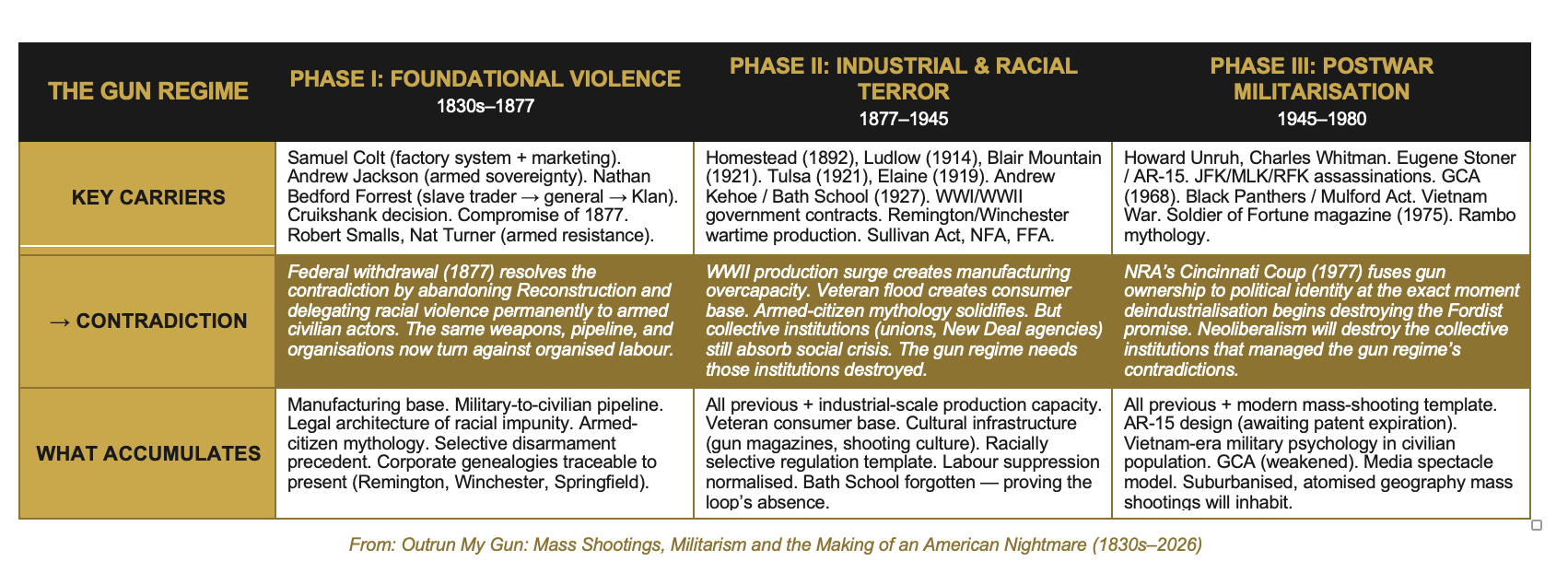
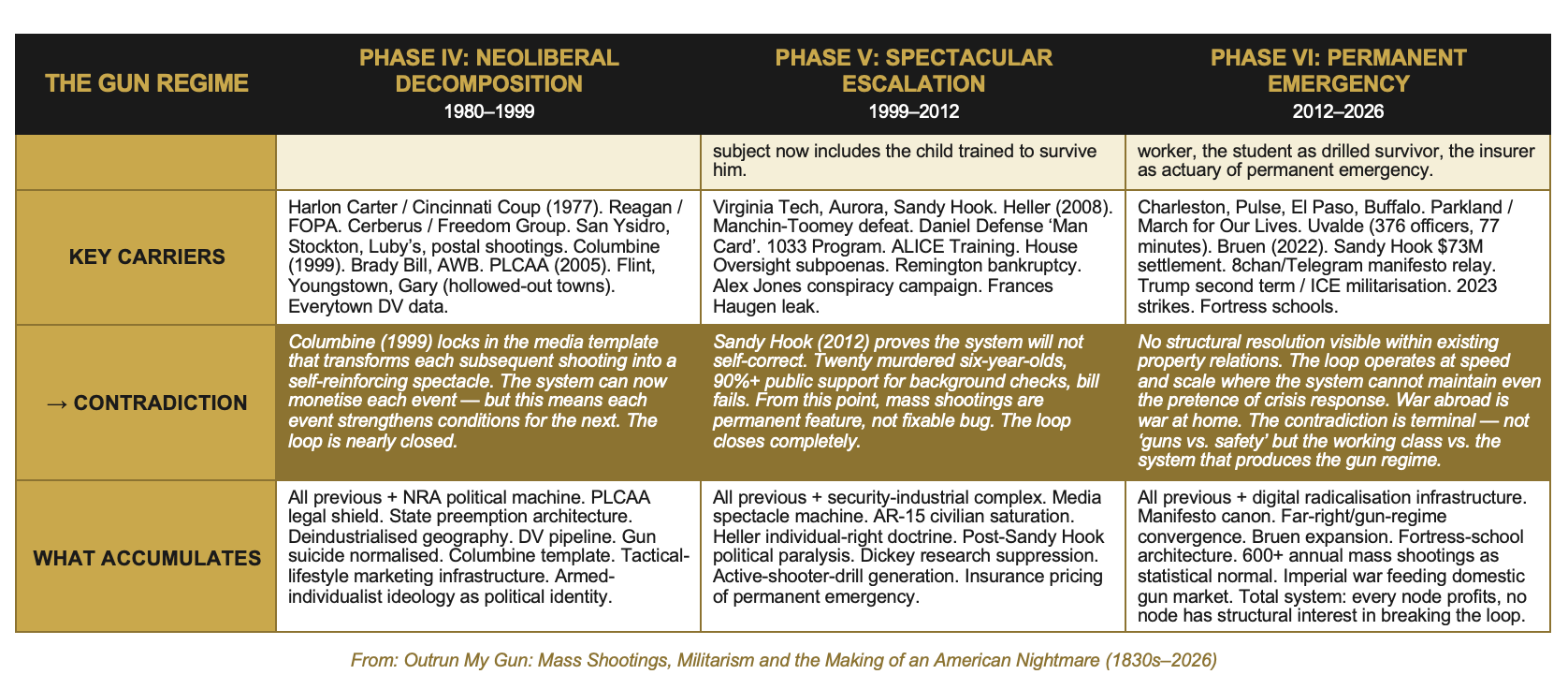
The Arrow Row
The “→ Contradiction” row is the engine of the table. Each phase breaks under the weight of its own tensions and pushes the system into the next one. Federal withdrawal in 1877 abandons Reconstruction and hands racial violence to armed civilians. The NRA’s Cincinnati Coup in 1977 hard-wires gun ownership into political identity just as deindustrialisation guts the old working-class settlement. Sandy Hook in 2012 proves the system will not self-correct even at its most “unthinkable” moment. Each arrow carries forward everything built before.
War Abroad, War at Home
The gun regime is the domestic face of American imperialism, not a separate “home-front problem.” The same manufacturers supply foreign wars and the civilian market. The same armed-individualist ideology justifies both border militarisation and interventions overseas. Veterans trained in imperial wars return to a civilian gun market designed around them. The table tracks that line from frontier conquest through the world wars, Vietnam, the Cold War, the War on Terror and into the Trump-era convergence of ICE, far-right paramilitarism, and the gun industry under conditions of deep crisis.
Rows, Threads, and What Persists
Eight rows run across every phase: the core contradiction, the dominant institution, the legal framework, the main form of violence, the armed subject, the key carriers (events, people, laws, companies), the contradiction that breaks the phase, and what accumulates. Seven threads weave through those rows: the military-corporate pipeline; the legal architecture of gun rights and liability; race as an organising principle; the masculine crisis under capitalism; the media template; the security feedback loop; and the shift from collective institutions to “lone” violence.
What matters is not memorising each label but seeing the pattern: the same pipelines, logics, and exclusions reappear in new combinations. Nothing important is ever truly retired; it gets repurposed.
The Structural Constants
Across all six phases, some things never change. The gun regime arms people whose collective institutions have been stripped away, and it profits from the violence that follows. Race and gender are built into the foundation of the system, not added later as “complications.” Profit flows to those who own the pipeline — from contracts and manufacturing to lobbying, media, security, insurance and politics. Each reform wave restores legitimacy without changing who owns what. Every node in the loop benefits when the shootings continue. None has a structural interest in stopping them.
The loop is simple and brutal: manufacture → marketing → sale → social decomposition → shooting → gun-sales spike → security contracts → higher premiums → revenue → fundraising and campaigning → more hardening → the next shooting.
What the Table Reveals
By the end, three things are hard to ignore.
First: mass shootings are not random eruptions or cultural quirks. They are structurally produced by a system that arms, ideologises, and then monetises each atrocity through a closed feedback loop.
Second: every serious reform has been absorbed. The NFA, GCA, Brady, the assault-weapons ban — each expanded what could in theory be regulated while leaving the profit core intact. The system adapts; it does not improve.
Third: the regime is sedimentary. New mechanisms don’t replace old ones; they stack on top. Digital radicalisation doesn’t replace the NRA, and the NRA doesn’t replace the military-corporate pipeline, which doesn’t erase the racial architecture that built it. By the final phase, every previous mechanism is still running. That’s not failure. That’s how the system is built.
Follow the money. Follow the pipeline. Follow the shootings that became “unpreventable.”
From: Outrun My Gun: Mass Shootings, Militarism and the Making of an American Nightmare (1830s–2026)
Alex Pretti, thirty-seven, spent his working life putting soldiers back together. He was an intensive care nurse at the Minneapolis Veterans Affairs hospital, moving between ventilators and drips in wards full of men and women whose lungs, limbs and nervous systems had been torn apart in Afghanistan, Iraq and all the other places the United States had sent them to fight and bleed and break. The rooms smelled of antiseptic and stale coffee. Monitors flickered green lines across the dark. His family described him as a kind-hearted soul who cared deeply for the veterans in his charge.¹ By any sane measure, his entire professional existence was organised around repairing the damage American imperial war inflicted on the people who fought it.
On the morning of January 24, 2026, Pretti was on a residential street in Minneapolis. It was winter: bare trees, packed snow at the kerb, the kind of brittle cold that makes breath hang in the air. Federal agents from Immigration and Customs Enforcement and Customs and Border Protection were conducting immigration raids — part of what the Trump administration called Operation Metro Surge, a paramilitary deployment of federal forces into American cities that had provoked mass protests across Minnesota the day before, when more than a hundred thousand people marched against the federal occupation.² The night before, the city centre had been full of homemade signs, red and blue police lights, and the low thump of helicopters circling overhead. On the twenty-fourth, the spectacle moved into neighbourhood streets. Pretti was filming. He had a phone in his hand.
About a week earlier, he had stopped his car after witnessing ICE agents chasing a family on foot through another residential block — agents in tactical vests running after people in ordinary winter coats. He shouted at the agents and blew a whistle. Five of them tackled him, and one leaned on his back, breaking a rib.³ They released him at the scene, but they knew who he was. A CNN report confirmed that Pretti was “known to federal agents” before the day they killed him.⁴ A DHS memo obtained by CNN ordered agents to collect licence plates, identification documents, and photographs of people it classified as “agitators” for a centralised surveillance database.⁵ The weapon the federal government feared was not a firearm. It was a camera phone pointed at men with guns.
When agents pepper-sprayed a woman protester and knocked her to the ground on the morning of January 24, Pretti intervened. Video evidence — shaky phone footage and higher-resolution clips from nearby windows, analysed frame by frame by multiple major media outlets — shows what happened next.⁶ Federal agents in dark uniforms and helmets tackled him and pinned him face-down on the pavement, his cheek pressed into the road. One removed a legally holstered firearm from Pretti’s belt — a gun he had never drawn, never pointed, never touched during the encounter. The weapon is visible for a moment in the footage, held clear of his body. Then a second agent, who had not been involved in the initial takedown, pushed the first agent aside and fired four shots into Pretti’s back as his arms were pinned to the ground. That agent and a second then fired six additional rounds into his motionless body.⁷ Ten shots into a nurse lying on the asphalt, already down, already disarmed, already immobilised. Neighbours screamed from doorways. Sirens arrived after the killing was done.
The White House called him a domestic terrorist.⁸ Vice President JD Vance declared that the agents who killed him were “protected by absolute immunity” and had been “doing their job.“⁹ The two shooters were later identified by ProPublica as Jesus “Jesse” Ochoa, forty-three, and Raymundo Gutierrez, thirty-five — both longtime Customs and Border Protection agents from south Texas with careers built on the border line.¹⁰ As of this writing, neither has been charged. The investigation announced by the Department of Justice is being carried out by the Department of Homeland Security — into itself.¹¹
Two weeks before Pretti was killed, ICE agent Jonathan Ross had shot and killed thirty-seven-year-old Renée Nicole Good in Minneapolis. Video evidence shows Ross deliberately positioning himself in front of Good’s vehicle before firing through the car window at point-blank range.¹² Moments before the shooting, Good’s wife told the agents: “We don’t change our plates every morning — it will be the same plate when you come talk to us later.“¹³ Both women knew they were being tracked. Both Good and Pretti were acting as legal observers at the time they were killed, filming and documenting the actions of federal agents. Their murders had a clear function: to intimidate anyone who might expose what the state was doing.
Here is a nurse (Pretti) who spent his career caring for the human wreckage of American imperial war, killed on an American street by the domestic arm of that same war. Customs and Border Protection was created in 2003 as part of the Department of Homeland Security, itself born from the September 11 attacks and the “War on Terror”.¹⁴ The agents who shot Pretti were not local cops from the nearby precinct. They were federal paramilitary operatives, in armour and helmets and government-issued guns, deployed under a regime that had declared open season on its own population. The pipeline that ran from the battlefields of Fallujah and Kandahar to a residential neighbourhood in Minneapolis was not metaphorical. It was administrative, institutional, and financial. The same budget lines, the same agencies, the same legal authorities, the same weapons.
War abroad is war at home. That is the organising principle of this book. Not as metaphor. Not as analogy. As structure.
The question this book answers is not “why mass shootings happen” in the existential sense. That question, endlessly recycled through cable news segments and congressional hearing rooms and op-ed pages, is designed to produce no answer at all. It redirects attention from systems to individuals, from structures to pathologies, from the disease to the symptom, profit to grief. Every time a man walks into a school or a church or a shopping centre with a military-derived weapon and kills as many people as he can before he is killed or kills himself, the same machinery activates: the media covers the spectacle, politicians offer thoughts and prayers or demand reform they know will not pass, the gun lobby warns that regulation is coming, gun sales spike, security contracts are signed, insurance premiums rise, and the cycle resets. The statements change; the loop does not. No institution in the loop has a structural interest in breaking it.
What this book answers is how that loop was built.
The American gun regime is a closed profit system. It manufactures and distributes military-derived weapons to a civilian population stripped of collective institutions. It sells armed individualism as the foundation of American liberty. It produces mass shootings as the statistically inevitable output of those conditions — and then converts each event into revenue. Gun sales spike after every major shooting; NICS background checks surged to a record 2.78 million in December 2012, the month of the Sandy Hook massacre, and remained above 2.4 million in January 2013.¹⁵ Behind those numbers are counters in gun shops running hot, cardboard boxes of rifles opened in back rooms, credit cards swiped in strip-mall stores and at weekend gun shows. Security companies sign school-hardening contracts, selling camera grids, reinforced doors, bullet-resistant glass and “active-shooter training” packages to desperate school districts. Active-shooter insurance becomes a growth market, with brokers explaining premium tables to school boards in fluorescent-lit meeting rooms. Media networks capture advertising revenue from wall-to-wall coverage, filling primetime with rolling footage and sponsorship bumpers. Politicians on both sides fundraise off the crisis. Architecture hardens — fortress schools designed by the same contractors who build prisons, with curved corridors and “safe rooms” sold as educational features. And then it happens again.
You do not explain a tuberculosis epidemic by asking what was wrong with each patient. You look at the conditions that produce the epidemic: the overcrowded housing, the contaminated water, the absence of sanitation, the poverty that makes all of it inevitable. Doctors in nineteenth-century Manchester did not solve TB by drawing up personality profiles of each coughing worker; they had to confront slums, wages and sewers. The conditions that produce mass shootings in America are no more mysterious than the conditions that produced tuberculosis in nineteenth-century Manchester. They are material, institutional, and ideological. They can be named. They can be mapped. They can be traced through the book.
The material conditions: more than four hundred million civilian firearms in circulation in a country of three hundred and thirty million people.¹⁶ A domestic firearms industry that produces approximately eleven million new guns per year.¹⁷ Warehouse shelves full of boxed pistols and rifles, pallets wrapped in plastic, shipping labels bound for wholesalers and big-box retailers. A military-to-civilian design pipeline that has placed the AR-15 platform — originally developed by ArmaLite for the United States military as the AR-10 and AR-15, adopted as the M16, and then sold back to civilians after the relevant patents expired — in the hands of millions of private citizens.¹⁸ This is the most popular rifle in America. It was designed to kill people in combat. The transition from jungle and desert to suburb and cul-de-sac is a change of scenery, not of core function.
The institutional conditions: the systematic destruction of every collective structure through which working-class Americans once organised their lives. Unions, gutted — union halls closed, shop stewards removed, grievance procedures replaced with HR portals. Socialist and Communist Parties, blacklisted, leaders murdered, demonized relentlessly. Public schools, defunded — leaking roofs, outdated textbooks, teachers buying classroom supplies from their own wages. Mental health infrastructure, dismantled — psychiatric beds eliminated, community clinics closed, waitlists stretching for months. Public housing, abandoned — towers with broken lifts and mould, waiting lists that function as a quiet eviction from the system. Community institutions — churches (with any semblance of community improvement, replaced by corporate megachurches), fraternal organisations, neighbourhood associations — hollowed out by decades of deindustrialisation and the deliberate transfer of wealth upward. The gun replaces the union. The AR-15 replaces the picket sign. Armed individualism fills the space that collective institutions once occupied, and the market sells the weapons to fill it.
The ideological conditions: a narrative in which the armed individual citizen is the foundation of American freedom. The Second Amendment, originally a compromise between slaveholding states that needed armed militias to suppress slave revolts and a federal government too weak to maintain a standing army, reinterpreted across two centuries into an absolute individual right to bear military weapons.¹⁹ Schoolchildren recite stories of minutemen and frontier farmers; gun marketers translate that into glossy catalogues of “patriot” rifles and “defender” pistols. An ideology so thoroughly naturalised that it can survive the murder of twenty six- and seven-year-olds at Sandy Hook Elementary School without producing a single piece of federal legislation.
These are the conditions. Mass shootings are the epidemic. This book traces how the conditions were built, phase by phase, from the 1830s to 2026.
The pipeline runs in one direction, and it has run in that direction since the beginning. War abroad feeds the domestic gun regime. The manufacturers, the personnel, the ideology, and the profit structures that sustain American imperial war are the same manufacturers, personnel, ideology, and profit structures that sustain American gun violence. This is not a story about a single plot or a hidden cabal. It is a story about a system that makes certain outcomes profitable and therefore constant. You do not need to start with a boardroom full of executives plotting to arm the American civilian population with military weapons, though that of course does happen. What you need first is a defence industry that makes more money selling to two markets than one. You need a veteran population trained in the use of weapons and then discharged into a society saturated with them. You need a gutted, deindustrialised rust belt full of alienated, oppressed working class and middle class layers that feel disempowered, humiliated and traumatised. You need an ideology of armed sovereignty that serves both the imperial project abroad and the property-rights regime at home. You need a state that spends more on its military than the next ten countries combined while its schools, hospitals, housing, and public transport deteriorate.²⁰ The conspiracy is capitalism itself. The coordination is incentive, profit and misdirection.
Samuel Colt understood this in the 1830s. His Hartford factory floor was a long hall of wooden benches, lathes and milling machines, workers in shirtsleeves cutting, filing and assembling metal parts under gaslight. His first major contracts were with the United States government — weapons for the Seminole Wars, for the Mexican-American War, for the project of continental conquest that required armed white settlers to dispossess, displace, and exterminate Indigenous peoples across a continent.²¹ Colt’s genius was not mechanical. It was commercial. He recognised that a government contract funded the tooling that made civilian production profitable. The military-to-civilian pipeline was not an accident of the twentieth century. It was the business model from the start.
The pipeline deepened through every phase of American imperial expansion. Two world wars transformed the domestic gun industry into a global arsenal. The production lines that manufactured the M1 Garand and the M1 Carbine and the Thompson submachine gun for the battlefields of Europe and the Pacific did not shut down when the wars ended. They retooled for civilian markets.²² The same machines, the same factories, now stamped out hunting rifles and consumer shotguns. Millions of veterans came home trained in the use of firearms and entered a civilian economy where those skills had no productive application but where the weapons were readily available, stacked in racks behind glass counters. The National Rifle Association, founded in 1871 by two Union Army veterans concerned about the poor marksmanship of Northern troops, spent its first century as a marksmanship and sporting organisation.²³ Its rifle ranges and safety courses sat comfortably inside a Cold War culture that married civic duty to weapons training. The Cold War transformed it. By the time Harlon Carter — a former Border Patrol chief who had shot and killed a Mexican teenager as a young man — led the Cincinnati Coup of 1977, seizing control of the NRA from its moderate leadership, the organisation had become a political weapon fusing gun ownership to anti-communist ideology, racial anxiety, and the defence of unlimited property rights.²⁴
Then came the acceleration.
From 1980 onward, the machinery changes tempo. Mass shootings go from rare and shocking to routine and structural. That shift sits in the same years that the American ruling class, confronted with the crisis of profitability that ended the postwar boom, launched a comprehensive assault on every collective institution through which the working class had organised its existence. Unions were broken. The PATCO strike of 1981 was the signal: President Reagan fired more than eleven thousand striking air traffic controllers and banned them from federal employment for life.²⁵ The message travelled far beyond airports. What followed was four decades of deindustrialisation, wage stagnation, the destruction of pension systems, the defunding of public education, the gutting of mental health infrastructure, and the transfer of trillions of dollars in wealth from working people to the financial oligarchy. Factory towns lost their factories; union halls became empty shells or coffee shops.
At the same time, American military operations intensified. Central America in the 1980s — El Salvador, Nicaragua, Guatemala, Honduras — where the CIA funded and armed right-wing paramilitaries and death squads.²⁶ The Gulf War in 1991. Somalia in 1993. The Balkans through the 1990s. The global footprint expanded as the domestic social fabric contracted. The gun industry served both fronts, winning contracts in Pentagon procurement offices and printing catalogues for civilian customers in the same year.
The first modern mass-shooting wave sits directly on top of this restructuring. In 1984 James Huberty walked into a McDonald’s in San Ysidro, California, and killed twenty-one people with weapons that included a semiautomatic Uzi carbine — an Israeli military weapon marketed to American civilians.²⁷ The restaurant had plastic seats, bright primary colours, a playground outside. It looked like any other McDonald’s in the country. In 1989 Patrick Purdy opened fire on a schoolyard at Cleveland Elementary School in Stockton, California, with a semiautomatic AK-47-pattern rifle, killing five children — all Southeast Asian immigrants, a community already marked by the intersection of American imperial war and domestic racial violence.²⁸ Children in primary-school uniforms fell in a place that had been painted as a site of integration and refuge. The postal shootings of the late 1980s and early 1990s — fourteen separate incidents in United States Postal Service facilities between 1986 and 1997 — were concentrated among workers in an institution being systematically restructured through automation, outsourcing, and the elimination of union protections.²⁹ Sorting machines replaced jobs; management drove “productivity”; wages stagnated. The phrase “going postal” entered the language as a joke, a sneer at angry workers with guns. The structural analysis did not.
Then came September 11, and the pipeline became a flood.
The War on Terror militarised everything. The Department of Homeland Security, created in 2003, was the largest reorganisation of the federal state since the creation of the Department of Defense in 1947.³⁰ The 1033 Program — established under the National Defense Authorization Act of 1997 but massively expanded after 2001 — transferred more than seven billion dollars’ worth of surplus military equipment to domestic law enforcement agencies: armoured vehicles, grenade launchers, military-grade rifles, bayonets, and helicopters.³¹ Small-town police departments acquired Mine-Resistant Ambush Protected vehicles designed for the roads of Anbar Province and parked them outside brick municipal buildings and high schools. Local newspapers ran photos of tactical teams in desert camouflage on Midwestern streets. DHS grants funded school surveillance systems, school resource officers, active-shooter training programmes, and the domestic security industry that grew out of the War on Terror’s contracting boom. The contractors who built bases in Iraq now trained teachers in “run, hide, fight.”
The same period saw the most dramatic expansion of the civilian AR-15 market in American history. Colt’s patents on the AR-15 design had expired in the 1970s, but the weapon’s transformation from niche enthusiast platform to America’s bestselling rifle happened in the 2000s and 2010s, driven by the cultural prestige of the War on Terror, the marketing of tactical-lifestyle identity to young male consumers, and a deliberate industry strategy to replace the hunting market — which was declining as rural America hollowed out — with a tactical-military market fed by war.³² Gun-store walls filled with black rifles; trade-show booths featured models in camouflage and body armour. Companies like Daniel Defense built their entire brand on the aesthetic of the special-operations soldier, marketing weapons with imagery drawn directly from the battlefields their customers would never see but desperately wanted to inhabit. The AR-15 became the weapon of choice for mass shooters because it was the weapon of choice for the military whose wars had made it famous and whose culture had made it aspirational.
Between 2001 and 2025, approximately 2.7 million Americans served in the wars in Afghanistan and Iraq.³³ They came home to a country where the Veterans Affairs healthcare system was chronically underfunded — Alex Pretti worked in one of its hospitals — where the unemployment rate for post-9/11 veterans consistently exceeded the civilian rate in the years following their discharge, and where the civilian landscape was saturated with the same weapons they had trained on.³⁴ The veteran-to-mass-shooter pipeline is not the primary vector — most mass shooters are not combat veterans — but the veteran-to-armed-civilian pipeline is enormous, and the ideology of armed readiness that the War on Terror produced extends far beyond those who served. The entire culture was militarised. Call of Duty sold more than four hundred million copies.³⁵ Players spent evenings running virtual patrols through maps based on Fallujah and Mogadishu. Tactical gear became fashion. The gun show became a political rally, with “Don’t Tread on Me” flags hanging over tables stacked with rifles and boxes of ammunition. The weapons that killed children in Newtown and worshippers in Sutherland Springs and shoppers in El Paso were born on the same production lines and in the same corporate boardrooms as the weapons that killed civilians in Fallujah and Kandahar and Mosul.
The United States spends more on its military than the next ten countries combined.³⁶ The fiscal year 2024 defence budget was approximately eight hundred and eighty-six billion dollars.³⁷ That figure does not include the budgets of the Department of Homeland Security, the intelligence community, the Department of Energy’s nuclear weapons programmes, or veterans’ services. Total national security spending exceeds one trillion dollars annually. Those dollars leave lines on spreadsheets in Washington and reappear as missiles, armoured vehicles, contracts and dividend payments.
While this money flows outward — to weapons manufacturers, to military bases that ring the globe, to the wars in which those weapons are tested and the populations on which they are tested — the domestic infrastructure that sustains the reproduction of the American working class deteriorates. Public school funding in the United States is tied to local property taxes, ensuring that the poorest communities have the worst-funded schools.³⁸ The difference is visible in a drive from a wealthy suburb to a poor district: fresh turf fields and modern auditoriums give way to cracked asphalt, barred windows and temporary classrooms. Approximately one hundred and fifty rural hospitals have closed since 2010.³⁹ Pregnant women, heart-attack patients and injured workers now travel an hour or more for care that used to be ten minutes away. Public housing waiting lists in major American cities stretch to years, sometimes decades. Mental health services have been gutted since the deinstitutionalisation movement of the 1960s and 1970s, which emptied state psychiatric hospitals without replacing them with community-based care.⁴⁰ Call centres and emergency rooms carry the load as last-resort support. The spaces where mass shootings happen are the spaces this trade-off empties: schools, workplaces, churches, shopping centres, public gatherings. These are the places where working-class Americans are most concentrated and least protected.
This is the guns-versus-butter equation written in blood. The American state does not lack the resources to fund its schools and hospitals and housing. It allocates those resources elsewhere — to the military machine that sustains imperial power projection and to the corporate profits that flow from it. The gun regime is not separate from this allocation. It is the domestic consequence of it. The same system that arms the world and wages permanent war also saturates its own civilian population with military-derived weapons, strips that population of the collective institutions through which it might organise a response, and then treats the resulting violence as a mystery to be solved through individual psychology, better background checks, or more police.
By 2024 the convergence was no longer something you had to infer. It sat in quarterly earnings reports. The five largest American defence contractors — Lockheed Martin, RTX (formerly Raytheon), Northrop Grumman, Boeing, and General Dynamics — reported combined revenues exceeding two hundred billion dollars in fiscal year 2023, with record backlogs driven by weapons shipments to Ukraine and Israel.⁴¹ Their subsidiaries, supply chains, and contracting networks extend into every corner of the domestic economy, including the domestic firearms and security markets. The same materials science, the same manufacturing processes, the same logistics infrastructure that produce missiles for the Israeli military produce components for the domestic gun and security industries.
At the same time, veterans of the wars in Iraq and Afghanistan — and of the broader War on Terror deployment across Africa, the Middle East, and Central Asia — had become a significant presence in far-right paramilitary organisations. The Oath Keepers recruited explicitly from military and law-enforcement backgrounds.⁴² The Proud Boys and Three Percenters drew on the tactical culture that the War on Terror had produced.⁴³ The gun-show circuit that Timothy McVeigh had navigated in the 1990s was now a recruitment ground for organisations that shared commercial infrastructure — weapons dealers, tactical-gear manufacturers, online platforms — with the mainstream gun industry. Tables selling AR-15 lowers and ammo tins sat a few yards from tables selling militia patches and conspiracy literature.
And ICE — the agency whose agents executed Alex Pretti on a Minneapolis street — functioned as a domestic military force. Its budget had grown from approximately three and a half billion dollars at its creation in 2003 to more than nine billion dollars by 2025.⁴⁴ It operated a network of detention facilities — many run by private contractors like CoreCivic and GEO Group, corporations that also held contracts with the Bureau of Prisons and, in some cases, military contracting subsidiaries.⁴⁵ Its agents carried military-grade weapons, conducted operations with military-style tactics, and operated under a regime that — in the words of the Vice President of the United States — claimed “absolute immunity” for their use of lethal force against American citizens.⁴⁶
War abroad is war at home. Alex Pretti’s life and death made it literal. He nursed the veterans. The same system that sent them to war came home and killed him. But the argument of this book is that this has always been the structure. What happened in Minneapolis in January 2026 was not a departure from the American norm. It was the American norm made visible — the same pipeline that ran from Colt’s Hartford factory to the Mexican-American War, from the Springfield Armory to the Western frontier, from the arms industry’s wartime production lines to the postwar civilian market, from the Pentagon’s research labs to the AR-15 in a suburban gun shop, from the War on Terror’s surveillance state to a DHS database of “agitators” on a Minneapolis street.
This book traces that pipeline across six phases, from the 1830s to 2026. Each phase adds new machinery to the gun regime. None replaces what came before.
In Phase I, the period of foundational violence from the 1830s to 1877, the gun regime and the American empire are born together. Samuel Colt builds the military-to-civilian pipeline. Armed white citizens dispossess Indigenous peoples, patrol enslaved populations, and constitute themselves as the sovereign body of the republic. The legal architecture of racial impunity is established. When the federal government withdraws from Reconstruction in 1877, it delegates racial violence to armed civilians — and the gun regime has its first structural mandate.
In Phase II, from 1877 to 1945, armed violence becomes the instrument of class discipline. The Pinkertons and the National Guard suppress labour at Homestead, at Ludlow, at Blair Mountain. Race massacres at Wilmington, Tulsa, and Elaine function as armed expropriation — the destruction of Black wealth through organised paramilitary violence. Two world wars transform the domestic gun industry into a global arsenal and produce generations of armed veterans. The infrastructure for what comes later is laid.
In Phase III, from 1945 to 1980, the permanent war footing of the Cold War fuses gun ownership to political identity. Veterans of Korea and Vietnam return to a civilian landscape already saturated with weapons. The NRA begins its transformation from sporting organisation to political weapon. Charles Whitman climbs the tower at the University of Texas in 1966 — a former Marine, trained by the military, armed with military weapons — and the media invents the question that will define the next sixty years of deflection: “Why did he snap?”
In Phase IV, from 1980 to 1999, restructuring destroys the collective institutions through which working-class Americans once organised their lives, and mass shootings emerge as a structural phenomenon. The same period sees the expansion of American military operations across Central America, the Middle East, and the Balkans. The gun replaces the union. Armed individualism fills the space that solidarity once occupied. The NRA, now a fully radicalised political organisation, vetoes every piece of meaningful federal gun legislation. Columbine locks in the media template — the cameras on the school, the live feeds, the rolling coverage that will be replayed after every future shooting.
In Phase V, from 1999 to 2012, the feedback loop assembles. The War on Terror militarises the domestic landscape. The AR-15 becomes America’s bestselling rifle. Each mass shooting generates revenue — gun sales, security contracts, insurance premiums, media advertising, political fundraising — and the revenue funds the conditions for the next shooting. Sandy Hook, in December 2012, proves that the system has no self-correcting mechanism. Twenty dead children produce no federal legislation. The market registers the event as a spike in sales.
In Phase VI, from 2012 to 2026, the loop self-accelerates with no structural brake. The same manufacturers profit from weapons systems used in Gaza and Ukraine while their supply chains feed the domestic gun market. Far-right paramilitary networks, cultivated during the War on Terror, converge with the commercial gun culture. The Trump regime deploys federal agents as a domestic occupation force. ICE executes a nurse on a Minneapolis street and the state calls him a terrorist. The permanent emergency is not an aberration. It is the system operating at full capacity.
The gun regime is sedimentary. Every phase’s machinery persists. Frontier violence never stops — it adapts form. Racial terror adapts form. The military-to-civilian pipeline expands with each war. Each new phase adds to what came before. Nothing is replaced. Everything accumulates.
This is not a book about grief, though grief is present on every page. It is not a catalogue of shootings, though the shootings are here — because they are the system’s output, and to ignore them would be to ignore the evidence. It is not a psychological study of shooters, because you do not explain an epidemic by profiling each patient. It is an investigation of the machine: who built it, who profits from it, how it works, where it breaks, and what it would take to stop it.
The next chapter opens the books. It follows the money through every node of the profit loop — the gun manufacturers’ sales spikes, the security contractors’ invoices, the insurance industry’s actuarial tables, the media’s advertising revenue, the politicians’ fundraising emails — and names the companies, the dollar figures, and the human cost. If the introduction has established the scale of the system, the chapter that follows will show you the accounts, line by line.
Alex Pretti’s murder did not generate a gun-sales spike. The weapons that killed him were government-issued, carried by federal agents on the public payroll. No manufacturer needed to market them. No retailer needed to sell them. No background check was involved. The profit loop that this book traces operates through a different channel — the one where the killing is done by private citizens with privately purchased weapons, and every institution in the system makes money before, during, and after the event. That loop is the subject of the next chapter.
But Pretti’s death belongs here, at the beginning, because it reveals the structure that the profit loop runs on. The gun regime is the domestic face of American imperialism. The weapons flow from the same factories. The personnel flow from the same wars. The ideology flows from the same well. And the bodies fall in the same places — the schools and hospitals and streets that capital has abandoned, where the working class lives and works and dies.
Ten shots into a nurse who was already on the ground. That is where the pipeline ends. This book will show you where it begins.
On the morning of August 15, 2022, the children returning to Frenship Independent School District in Wolfforth, Texas, walked through something that had not been there the previous spring. The district had installed Evolv Express weapons-detection portals — freestanding units that look like the security scanners at an airport, using artificial intelligence to identify concealed weapons on anyone who walks through them.¹ Frenship was not the only district shopping that summer. Across Texas, school administrators were staring at invoices they had never expected to see. Three months earlier, on 24 May, an eighteen-year-old former student named Salvador Ramos had crashed a pickup truck in a drainage ditch outside Robb Elementary School in Uvalde, fired at bystanders and a nearby funeral home, and then walked into the school carrying a Daniel Defense DDM4 V7 rifle and hundreds of rounds of ammunition. He murdered nineteen children and two teachers.
The details matter, because they show what the gun and the “security” system really are.
Ramos entered the building at 11:33 a.m. after an exterior door failed to lock properly. He moved down the hallway and into adjoining classrooms 111 and 112. Children and teachers called 911 from inside those rooms as he fired. Local police arrived within minutes, advanced toward the classrooms, and then retreated when they encountered rifle fire. Over the next seventy-seven minutes, a total of 376 law-enforcement officers from multiple agencies — local police, county sheriffs, Texas state police, federal Border Patrol tactical units — assembled in the hallway and outside the school. They had ballistic shields, rifles, helmets, and training that explicitly told them to move toward the shooter and stop the killing. They did not go in. They waited while the children bled. When a Border Patrol tactical team finally breached the classroom at 12:50 p.m., Ramos was shot and killed. By then, some of the children who had called 911 had already died. Others survived with injuries they will carry for the rest of their lives.
This is what “school security” looked like in practice: hundreds of armed officers, paralysed in a corridor, while a teenager with a high-end AR-15 did exactly what the platform was designed to do.
Governor Greg Abbott responded by allocating one hundred and five million dollars in school safety grants.² The money did not go to counsellors, or to smaller class sizes, or to the mental health infrastructure that Texas had spent decades defunding. It went to security companies. Weapons-detection systems. Surveillance cameras. Ballistic-rated doors. Armed guards. The children of Texas were about to become the most scanned, surveilled, and fortified student population in American history, and every dollar of that transformation would land in a corporate account.
The Evolv portals were just one line item. Ballistic-rated doors cost between one thousand and four thousand dollars per unit; a typical elementary school has dozens of exterior and interior doors. Surveillance cameras with AI-enabled threat detection run fifty to a hundred thousand dollars per campus. Armed security officers — the school resource officers now mandated by Texas law — cost sixty to eighty thousand dollars per officer per year in salary and benefits, and that is before the training, the insurance, and the weapons they carry. A single weapons-detection portal from Evolv runs between twenty and thirty thousand dollars, plus annual licensing fees for the software that analyses the scans. Multiply these figures across the more than nine thousand public schools in Texas and the arithmetic is staggering. The state was building a security market worth hundreds of millions of dollars per year, funded by taxpayers who had already been paying for the schools those security systems were now designed to protect against the products of another taxpayer-subsidised industry: the gun manufacturers whose weapons made the security necessary in the first place.
This is what a mass shooting costs — not in lives, which are treated as externalities, but in revenue, which is the metric that matters to every institution in the loop. The profit generated by a mass shooting in America does not flow to one recipient. It flows to all of them, simultaneously, through channels so well established that they activate automatically. Gun manufacturers see sales spikes within hours. Security companies begin fielding calls within days. Insurance underwriters adjust premiums within weeks. Media networks bank advertising revenue in real time. Politicians on both sides of the aisle send fundraising emails before the bodies are cold. Architects draft fortress-school renderings before the funerals are over. And then the cycle resets, and everyone waits for the next one, because the next one is how they get paid again.
No institution in this loop has a structural interest in breaking it. That is not a conspiracy theory. It is a business model.
The first node in the loop is the one that seems most perverse, and it is the most reliably documented. Mass shootings sell guns.
The FBI’s National Instant Criminal Background Check System — NICS — provides a near-real-time proxy for firearm sales in the United States. Every time a licensed dealer sells a gun, a background check is initiated. The monthly NICS figures are public, and their pattern after mass shootings is so consistent that firearms-industry analysts have given it a name: the demand surge.³
On December 14, 2012, a twenty-year-old man killed twenty children and six staff members at Sandy Hook Elementary School in Newtown, Connecticut, using a Bushmaster XM15-E2S, an AR-15-platform rifle manufactured by Remington Arms, which was then owned by the private equity firm Cerberus Capital Management through its holding company, the Freedom Group.⁴ NICS background checks for December 2012 hit approximately 2.8 million. In January 2013, they surged past 2.5 million — the highest January figure ever recorded to that point.⁵ Smith & Wesson reported record quarterly revenue of one hundred and thirty-six million dollars for the quarter ending January 2013, a thirty-eight percent increase over the same period the previous year.⁶ Sturm, Ruger & Company reported net firearms revenue of one hundred and forty-two million dollars for the first quarter of 2013, up from one hundred and eighteen million the year before.⁷
The mechanism is not mysterious. President Obama proposed a renewal of the federal assault weapons ban in the weeks after Sandy Hook.⁸ The National Rifle Association responded with a campaign warning that the government was coming for Americans’ guns. Wayne LaPierre, then the NRA’s executive vice president, held a press conference one week after the massacre and declared that the only thing that stops a bad guy with a gun is a good guy with a gun.⁹ The NRA’s messaging did not mention the twenty dead six- and seven-year-olds. It did not need to. The message was aimed at gun owners, not at grieving parents, and its function was not consolation but activation: buy now, before they ban it. The fear of regulation drove purchasing. Purchasing drove revenue. Revenue funded lobbying. Lobbying ensured that the regulation never passed. The assault weapons ban proposed by President Obama and Senator Dianne Feinstein was defeated in the Senate in April 2013.¹⁰ By then, the gun industry had already banked the profits from the panic the proposal had generated.
This is the crisis-to-sales pipeline, and it runs on the same fuel every time: a mass shooting creates the political conditions for reform talk, reform talk creates the market conditions for panic buying, panic buying creates the revenue that funds the lobbying that kills the reform. The industry does not need to cause mass shootings. It needs them to happen, and it needs the political system to respond with exactly enough outrage to scare gun owners into buying but never enough legislation to actually restrict sales. The system delivers this outcome with remarkable consistency.
San Bernardino, December 2, 2015: fourteen people killed at an office holiday party. Weapons included a Smith & Wesson M&P15, an AR-15-platform rifle. NICS checks for December 2015 hit a then-record 3.3 million.¹¹ Smith & Wesson’s stock price nearly doubled in the months following the shooting, and the company reported record annual revenue of seven hundred and twenty-three million dollars for fiscal year 2016.¹² The company’s CEO, James Debney, told analysts on an earnings call that consumer demand remained strong across all product categories.¹³ He did not mention what was driving the demand. He did not need to.
Parkland, February 14, 2018: seventeen people killed at Marjory Stoneman Douglas High School in Florida. Weapon: a Smith & Wesson M&P15 Sport II. NICS checks spiked in the following months, and the entire AR-15 market lifted.¹⁴ Daniel Defense, which did not manufacture the Parkland weapon, nonetheless reported record quarterly revenue — because in the AR-15 market, one company’s massacre is every company’s sales event. Dick’s Sporting Goods announced it would stop selling AR-15-style rifles and raised its minimum purchase age to twenty-one.¹⁵ The gesture cost Dick’s an estimated one hundred and fifty million dollars in annual revenue.¹⁶ Other retailers absorbed the displaced demand. The total market did not shrink. It redistributed.
And then came 2020, when the crisis-to-sales mechanism detached from any single shooting and ran on generalised fear. The pandemic. The killing of George Floyd and the nationwide protests that followed. The presidential election. NICS background checks for 2020 hit 39.7 million — an all-time record, obliterating the previous high of 27.5 million set in 2016.¹⁷ An estimated 8.4 million Americans purchased a firearm for the first time that year.¹⁸ Smith & Wesson reported net revenue of over one billion dollars for fiscal year 2021, the highest in the company’s hundred-and-seventy-year history.¹⁹ Sturm Ruger reported seven hundred and thirty million.²⁰ The gun industry did not need a mass shooting to generate a sales spike. It needed a country afraid enough to buy, and 2020 delivered that in abundance.
The gun-sales spike is the most visible node in the loop, but it is not the most structurally revealing. That distinction belongs to the insurance industry, because insurance is where the financial system tells you what it actually believes.
Sometime in the mid-2010s, a new product category appeared in the commercial insurance market: the active-shooter policy. The concept was straightforward. Mass shootings were happening with sufficient frequency and generating sufficient liability exposure that businesses, schools, churches, entertainment venues, and other institutions needed specific coverage for the risk of someone walking in and killing people. General liability policies had exclusions or sub-limits that left policyholders exposed. The market responded by creating a standalone product.²¹
McGowan Program Administrators, a specialty insurance firm based in the Midwest, was among the first to offer dedicated active-shooter and workplace-violence policies, placing coverage through Lloyd’s of London syndicates and domestic carriers.²² Other specialty insurers followed: Beazley, Hiscox, Berkshire Hathaway’s commercial lines. By the early 2020s, active-shooter insurance was a mature market segment with its own underwriting guidelines, actuarial models, and premium structures.²³
The premiums vary by sector, location, headcount, and — crucially — by the security measures the policyholder has in place. A small church might pay a thousand dollars a year. A large school district might pay fifty thousand or more. A major entertainment venue or shopping centre could pay six figures.²⁴ But the premium is only the beginning of the revenue stream, because insurers do not simply price the risk and collect the cheque. They mandate specific security purchases as conditions of coverage. Surveillance cameras. Access-control systems. Visitor-management software. Active-shooter training programmes. Threat-assessment protocols. Each mandate generates revenue for the security companies that sell those products and services. The insurance industry functions as a transmission belt: it converts the risk of mass shootings into mandated purchasing from the security industry, which then lobbies for the regulatory standards that make those purchases compulsory even for organisations that do not carry the insurance.
The actuarial models are the coldest evidence in this entire book. To price an active-shooter policy, an underwriter needs frequency and severity assumptions: how often do mass shootings occur, and what is the expected cost when they do? The models draw on FBI Active Shooter Incident reports, which track events annually.²⁵ The frequency trend is upward. The severity trend — measured in casualties per incident, liability costs, and property damage — is also upward. The models do not assume the crisis will end. They assume it will continue or accelerate. The entire business model depends on mass shootings being a permanent feature of American life. If they stopped, the product would have no market. The actuarial tables have priced the epidemic as structural, chronic, and ongoing. They have normalised it in the most literal sense: they have made it a line item in a spreadsheet, a risk factor in a portfolio, a recurring revenue stream for every company in the chain.
This is what it means to say that the gun regime is a closed profit loop. The insurance industry does not cause mass shootings. It does not want them to happen. But it needs them to continue in order for its product to have value, and it has built a business — premiums, mandated purchases, claims management, reinsurance treaties — that depends on the epidemic being permanent. Every institution in the loop occupies the same structural position: it would lose revenue if mass shootings stopped.
Consider what the existence of this market means in practical terms. A church treasurer in suburban Ohio sits down with an insurance broker and reviews an active-shooter policy. The broker explains the coverage: crisis-response costs, funeral expenses for victims, business-interruption losses, legal defence, liability settlements. The broker explains what the insurer requires: a security assessment, access-control upgrades, an active-shooter response plan, annual training for staff. The treasurer writes a cheque. The cheque is deposited in an account that flows to a reinsurance syndicate at Lloyd’s of London, where the risk is pooled with thousands of other American institutions that have made the same calculation — that the probability of a mass shooting at their location is low but nonzero, that the financial consequences of an uninsured event are catastrophic, and that the annual premium is a rational cost of operating in a country where military weapons are freely available to the civilian population. That syndicate, in turn, models its reserves based on the assumption that mass shootings will continue at their current or accelerating rate. The entire financial architecture — from the church treasurer’s chequebook to the reinsurance market in London — rests on the structural permanence of the epidemic.
No company illustrates the marketing-to-massacre pipeline more precisely than Daniel Defense.
Marty Daniel founded the company in Black Creek, Georgia, in 2000, initially manufacturing aftermarket rail systems for AR-15 rifles.²⁶ By the mid-2000s, the company was producing complete rifles — high-end AR-15-platform weapons marketed under a brand identity that drew its visual language directly from the special-operations military world. The imagery was consistent: night-vision shots, operators in tactical gear, muzzle flash, the aesthetic of the war fighter transposed onto the suburban gun buyer. Daniel Defense’s marketing targeted young male consumers through Instagram, YouTube, and influencer partnerships, using the same visual grammar as military recruitment campaigns and first-person-shooter video games.²⁷
The company is privately held, so its financial disclosures are limited. Industry analysts estimated its annual revenue at approximately fifty million dollars in 2012, growing to over one hundred and twenty million by the early 2020s.²⁸ That growth trajectory tracks precisely with the expansion of the tactical-lifestyle market — the segment of the civilian gun industry that sells not just weapons but an identity, a posture of armed readiness, a simulation of the military masculinity that the War on Terror made culturally aspirational. Daniel Defense did not invent this market. It perfected the sales pitch. Every image on the company’s social media feed told the same story: you are not a consumer purchasing a product. You are a warrior selecting a tool. The rifle is not recreation. It is purpose. And the purpose is inseparable from the military operations that made the platform famous — the same operations that produced the veterans Alex Pretti nursed back to health at the Minneapolis VA.
On May 16, 2022, Daniel Defense posted an image on its Instagram account. It showed a small child — a toddler — sitting on a man’s lap and holding a Daniel Defense rifle. The caption read: “Train up a child in the way he should go, and when he is old, he will not depart from it.” The quotation is from Proverbs 22:6.²⁹ Eight days later, an eighteen-year-old walked into Robb Elementary School in Uvalde, Texas, carrying a Daniel Defense DDM4 V7 rifle he had purchased legally on his birthday, and murdered nineteen children and two teachers.³⁰ Daniel Defense deleted the Instagram post after the shooting.
The Uvalde weapon was not an accident of the market. The DDM4 V7 retails for approximately two thousand dollars — a premium AR-15 marketed to exactly the demographic that bought it. Daniel Defense’s social media strategy placed its products in front of young men through algorithmic targeting, tactical-lifestyle content, and an identity proposition that fused gun ownership to masculine purpose. The eighteen-year-old who carried the weapon into Robb Elementary was the marketing’s target audience. He purchased the product. He used it for the purpose its design — a military weapon adapted for civilian sale — made possible.
The legal architecture that protected Daniel Defense from liability for the Uvalde massacre is the Protection of Lawful Commerce in Arms Act, PLCAA, passed by Congress in 2005 with bipartisan support and signed by President George W. Bush.³¹ PLCAA grants the gun industry a unique federal shield from civil lawsuits — no other industry in America has comparable protection. It bars most claims against manufacturers and dealers for harm caused by the criminal use of their products. The law was drafted by the NRA and the National Shooting Sports Foundation and lobbied through Congress at a cost of millions of dollars in campaign contributions.³²
But PLCAA has a crack in it, and the Sandy Hook families found it. In 2014, the families of nine victims of the Sandy Hook massacre filed suit against Remington Arms, arguing that the company’s marketing of the Bushmaster XM15-E2S — the weapon used in the shooting — constituted negligent entrustment and violated the Connecticut Unfair Trade Practices Act.³³ The legal theory was not that Remington was liable for manufacturing the weapon. It was that Remington was liable for how it marketed the weapon — specifically, for targeting young men with military imagery and messaging that associated the AR-15 with combat masculinity and personal dominance. The case went to discovery. Remington’s internal marketing documents were exposed, revealing a deliberate strategy to sell military weapons to young male civilians through appeals to aggression, dominance, and tactical identity.³⁴ In February 2022, Remington’s insurers settled the case for seventy-three million dollars.³⁵
The settlement did not overturn PLCAA. But it established that the marketing-liability exception could reach the companies that build their brands on selling the fantasy of military violence to the young men most likely to enact it. Daniel Defense’s Instagram account, with its tactical-lifestyle imagery and its biblical injunction to train children with rifles, operates in the same territory. The pipeline from marketing to massacre is not a metaphor. It is a documented business strategy with a body count.
After every mass shooting, the security industry gets paid. The mechanism is as reliable as the gun-sales spike, and it is more durable, because security contracts are recurring revenue — they do not depend on panic buying and they do not fade when the news cycle moves on. Once a school district signs a security contract, it pays annually. Once a state mandates security standards, every district in the state becomes a customer.
After Parkland, the state of Florida passed the Marjory Stoneman Douglas High School Public Safety Act in March 2018.³⁶ The law mandated that every public school in Florida have at least one armed school resource officer or armed guardian on campus. It allocated four hundred million dollars for school safety measures and created the Office of Safe Schools within the Florida Department of Education.³⁷ The mandate did not just respond to Parkland. It created a permanent market. Every school in Florida now required armed security, surveillance systems, threat-assessment protocols, and the training programmes to operate them. The companies that provided those products and services — security staffing firms, surveillance-camera manufacturers, active-shooter training providers — acquired a captive customer base of more than four thousand public schools, funded by state appropriation and enforced by state law.³⁸
The pattern repeated in Texas after Uvalde. Governor Abbott’s one hundred and five million dollars in school safety grants funded weapons-detection systems, surveillance upgrades, ballistic-rated doors, and armed security across hundreds of school districts.³⁹ Evolv Technology, the company whose AI-powered weapons-detection portals had been installed in Frenship ISD, saw its contract pipeline expand dramatically. The company, which went public via SPAC in 2021, reported revenue growth tied directly to the school-security market.⁴⁰ Its investor presentations framed the expanding market in the language of recurring revenue: each installation generated ongoing service contracts, software subscriptions, and maintenance fees.⁴¹
In Newtown, Connecticut, Sandy Hook Elementary School was demolished entirely and rebuilt from the ground at a cost of approximately fifty million dollars.⁴² The new school was designed as a fortress: secure vestibule, ballistic-rated construction, controlled-entry points, interior lock-down architecture. It was a school designed not to educate children but to survive a military assault — which is what a mass shooting functionally is, given that the weapons used are military designs. The architectural firm that designed the new Sandy Hook was Svigals + Partners, which subsequently became a nationally recognised expert in what the industry calls “secure learning environments.“⁴³ The firm’s expertise was born from a massacre. Its market expanded with each subsequent one.
Navigate360, which acquired the ALICE Training Institute — one of the first and largest active-shooter training providers for schools — reported serving more than twenty thousand organisations.⁴⁴ ALICE, which stands for Alert, Lockdown, Inform, Counter, Evacuate, was founded in 2001 by a police officer and a school principal in response to the Columbine shooting.⁴⁵ The business model was simple: mass shootings create demand for training on how to survive mass shootings. Each new shooting validated the product. Each new state mandate expanded the customer base. Navigate360’s growth trajectory maps directly onto the frequency of school shootings in America.
The feedback loop is not just responsive. It is generative. Security companies do not merely wait for shootings to generate demand. They lobby for the regulatory frameworks that make their products mandatory. The National Shooting Sports Foundation — the gun industry’s trade association — has advocated for school-hardening measures as an alternative to gun-control legislation.⁴⁶ The security industry lobbies state legislatures for mandated security standards in schools, churches, and public buildings. Insurance companies require security upgrades as conditions of coverage. Each node in the loop reinforces the others: the shooting generates demand, demand generates contracts, contracts generate lobbying for mandated standards, mandates create a permanent market, and the permanent market generates the recurring revenue that funds more lobbying. The loop is self-sustaining. It does not need new shootings to maintain itself — the mandates ensure that — but new shootings accelerate it.
There is one more node in the loop, and it is the one that operates in plain sight every time: the media.
Television news ratings spike during mass-shooting coverage. CNN’s viewership increased by approximately two hundred percent during its coverage of the Sandy Hook shooting.⁴⁷ Fox News and MSNBC saw comparable surges. The coverage is wall-to-wall — days of continuous broadcasting, specials, panel discussions, expert commentary, vigils, press conferences, and the slow assembly of the shooter’s biography, which becomes the narrative spine of the coverage. The advertising revenue follows the eyeballs. Media companies do not set out to profit from mass shootings. But the structure of ad-supported television news means that every minute of coverage generates revenue, and mass-shooting coverage generates more minutes and more viewers than almost any other news event short of a presidential election or a war.
The political fundraising apparatus activates with the same reliability. In the days following Sandy Hook, the NRA’s fundraising surged.⁴⁸ So did the fundraising of gun-control organisations: Everytown for Gun Safety, the Brady Campaign, the Giffords organisation. Both sides of the gun debate are funded by the crisis. The NRA raises money by warning that the government is about to confiscate firearms. Gun-control groups raise money by promising that this time, finally, something will change. The donations flow. Nothing changes. The fundraising infrastructure on both sides depends on the loop continuing.
At every node, the revenue is real and the incentive is structural. No individual in the system needs to want mass shootings to continue. The system itself needs them to continue, because every institution in the loop is funded by the crisis and would lose revenue if it ended. This is not a claim about evil people. It is a claim about a profit structure that converts the mass killing of Americans — in their schools, their workplaces, their churches, their shopping centres, their public spaces — into recurring revenue across multiple industries simultaneously. The TB analogy holds: you do not explain the epidemic by examining the motives of the bacterium. You examine the conditions that let it spread.
The conditions are in the books. The gun manufacturers’ SEC filings. The security contractors’ invoices. The insurance industry’s actuarial tables. The media companies’ advertising revenue reports. The politicians’ campaign-finance disclosures. The school districts’ budget line items. Every number tells the same story: someone is getting paid, and the payment depends on the killing continuing.
In 2023, the school-security market in the United States was valued at approximately 3.4 billion dollars and projected to grow at a compound annual rate of more than seven percent through the end of the decade.⁴⁹ That growth projection assumes that mass shootings will continue. It does not assume a cure. It assumes a chronic condition — an epidemic managed, not ended, because the management is where the money is.
The previous chapter asked how the United States arrived at a point where federal agents execute a nurse on a Minneapolis street and the state calls him a terrorist. This chapter has shown where the money goes when the killing is done by private citizens with privately purchased weapons. The structure is the same: a system that produces violence, profits from it, and has no institutional mechanism for stopping it. The gun regime is not broken. It is working exactly as designed. The next chapter will define what this book means by that claim, and lay out the framework for taking the machine apart — phase by phase, node by node, from the 1830s to the present.