
“The main reason Santa is so jolly is because he knows where all the bad girls live.”
― George CarlinRead the Reference Tables, Period analysis, Introduction and Prologue below!
Also available on the kindle page.
Also available on the kindle page.
What if the history of comedy isn’t a straight line of “free speech” victories, but a record of how power keeps finding smarter ways to manage laughter?
Killing Jokes follows 175 years of American comedy as a system, not a highlight reel. It starts in the 1850s, in Northern theatres where white workers laughed at Black caricatures in burnt cork. Minstrelsy isn’t “offensive old content”; it’s an industrial machine: touring troupes, standardised formats, contracts, sheet music, and a cheap wage of whiteness that paid out in the feeling of being above someone else—the first major comic factory, mass-producing both entertainment and a racial order.
From there, the circuits professionalise. Vaudeville chains like Keith-Albee tighten the screws with backstage rule sheets and blacklists. Comics sign contracts that hand over their acts and their futures in exchange for a place on the route. The studio era centralises control: long-term deals, morals clauses, and the Production Code tell you what can’t be put on the page. Jokes change and technology shifts, but that basic dependency—workers trading their voices for access to someone else’s stage—stays in place.
The book follows that wiring into the television age: Carson’s Tonight Show as a national gate, late-night as a pressure valve that turns politics into safe monologue, Saturday Night Live as a pipeline that looks rebellious while feeding talent back into the same studios and advertisers it mocks. Cable and HBO widen what can be said—edgier material, more swearing—but the terms of trade don’t budge. The anger can be real; the ownership isn’t.
In the platform era, the wiring moves into code. YouTube, podcasts and streamer specials promise direct access, then bury creators under recommendation systems, brand-safety rules, demonetisation and payment choke points. The loud public argument is about “cancel culture” and online mobs. The quiet decisions that actually end careers are made by platforms, payment processors and advertisers.
Working from hundreds of sources—archival contracts and censorship files, studio and network correspondence, platform policies, trade press, court cases, creator testimonies, labour histories and critical scholarship—Killing Jokes keeps the focus on class and control. Who owns the room? Who writes the contracts? Who can be switched off by a policy change they never voted on?
It also tracks the rise of an openly reactionary comedy machine. Daily Wire and allied outlets build studios, subscription platforms and stand-up-adjacent shows, using comedy as the cultural front end of a coherent right-wing project. They sell themselves as persecuted outsiders while running on the same logic as every other media conglomerate: concentrated ownership, carefully managed audiences, and content that never threatens the class paying the bills.
Alongside that machinery, the book recovers the moments when comedy tried to answer to someone else: IWW halls where songs led into strikes, Federal Theatre shows that named bosses and landlords on publicly funded stages, small circuits where comics faced workers more than sponsors. Those experiments were short-lived for reasons the archive makes very clear—and none of them have much to do with “audience taste.”
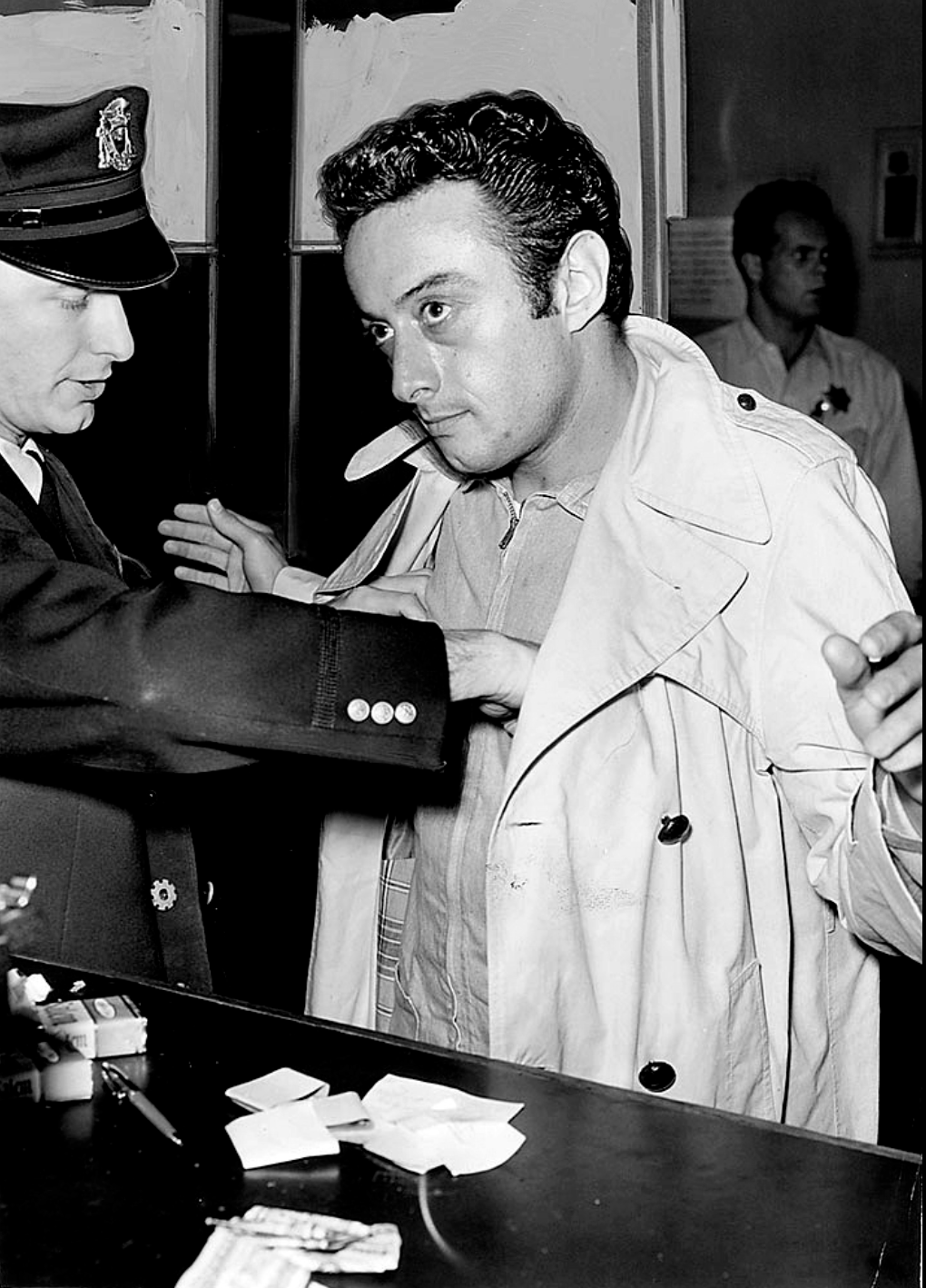
Comedian Lenny Bruce being arrested,..again.
Under capitalism, comedy is real relief and real regulation at the same time. It lets people breathe and feel less alone. It also trains them who it’s safe to hate, who must never be touched, and where their anger is allowed to go. You don’t have to stop laughing to see that; you just have to stop staring only at the spotlight and start looking at the wiring.
If you’ve ever finished a “dangerous” special and felt, quietly, that the world looked exactly the same afterwards, this book is written to show how that happens—and what’s doing the work offstage.
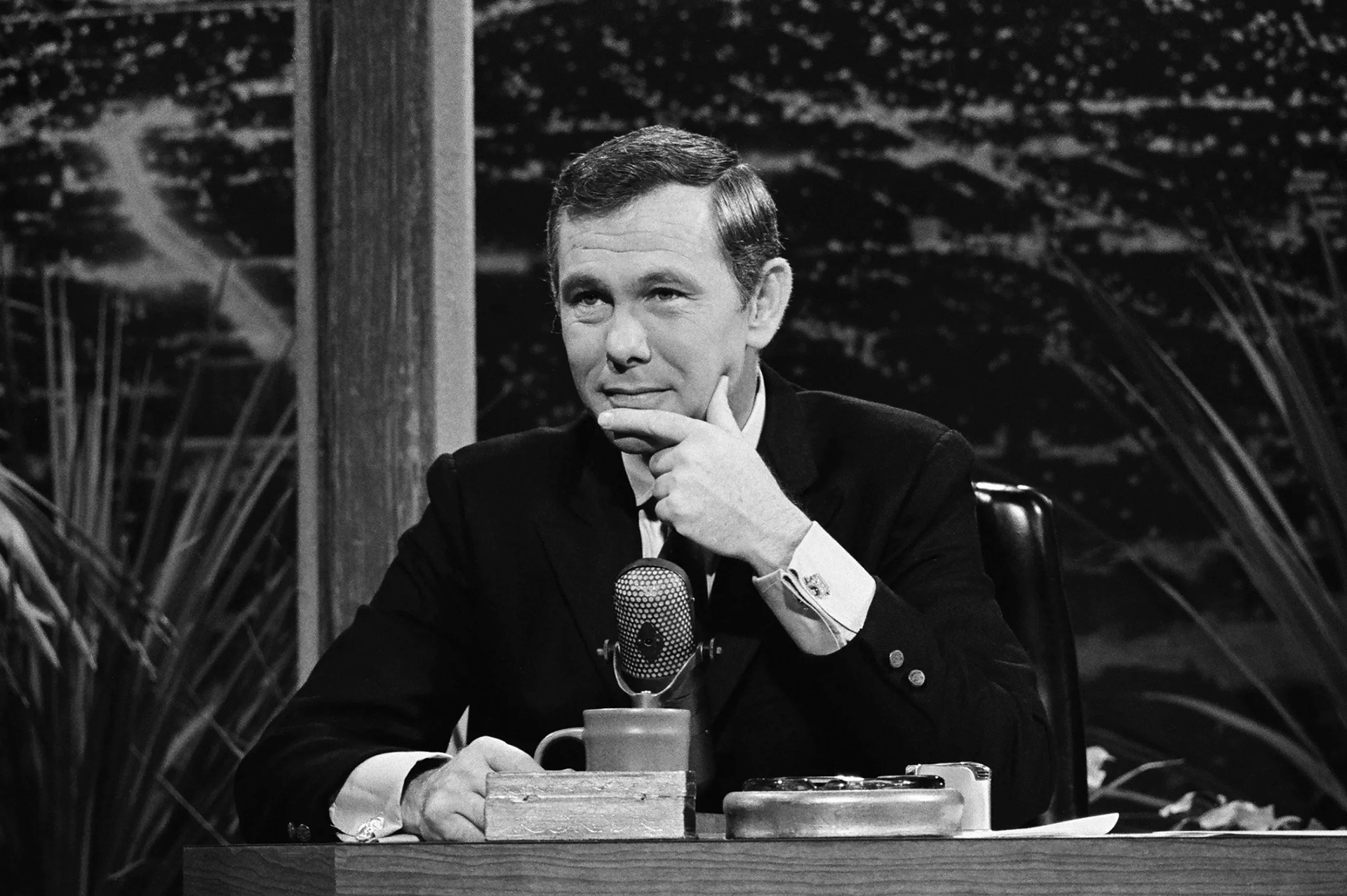
Johny Carson of The Tonight Show was not your advocate, He was your "host". Which meant non-bias. Which really meant uncritical.
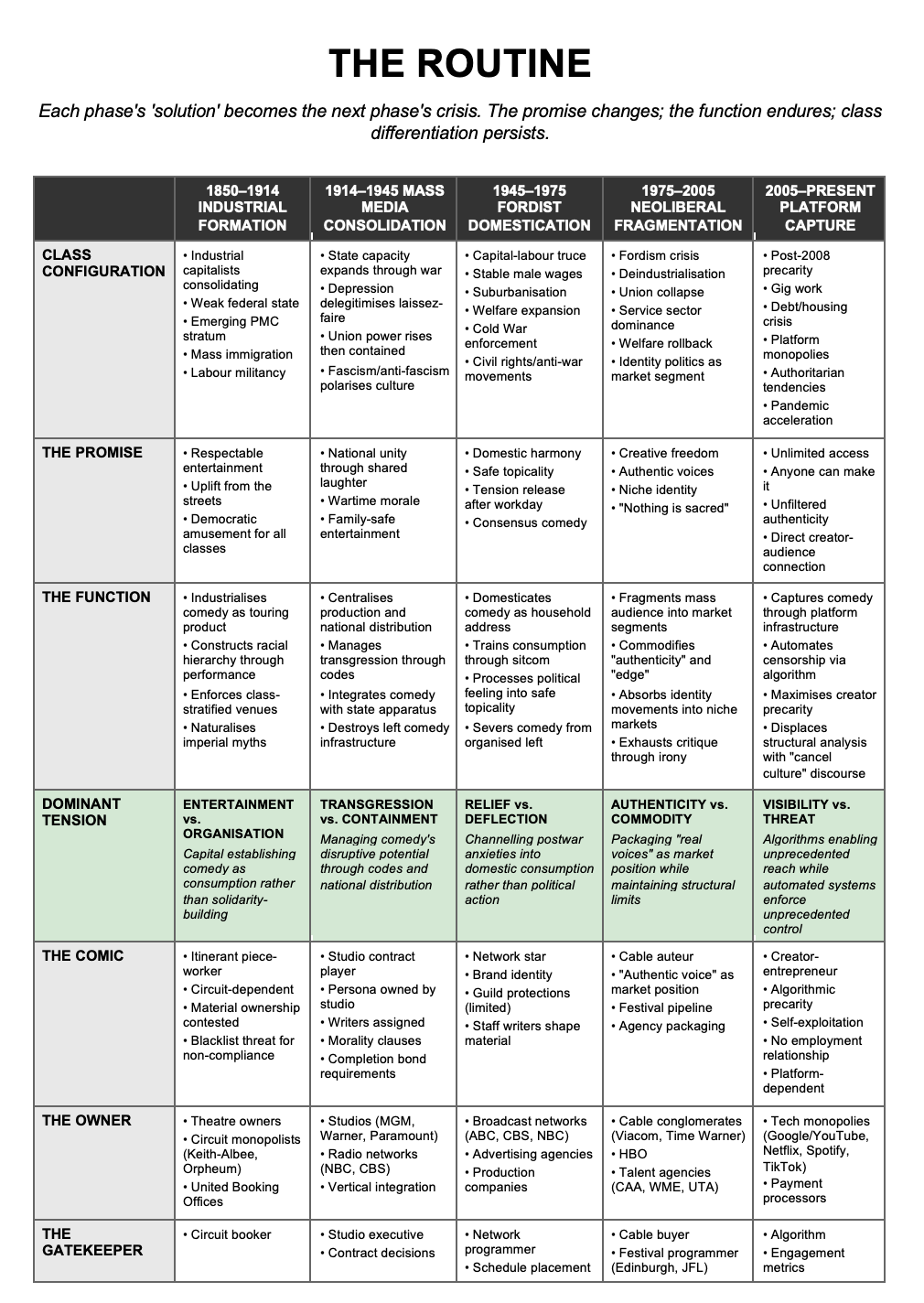
How To Read The Routine Table
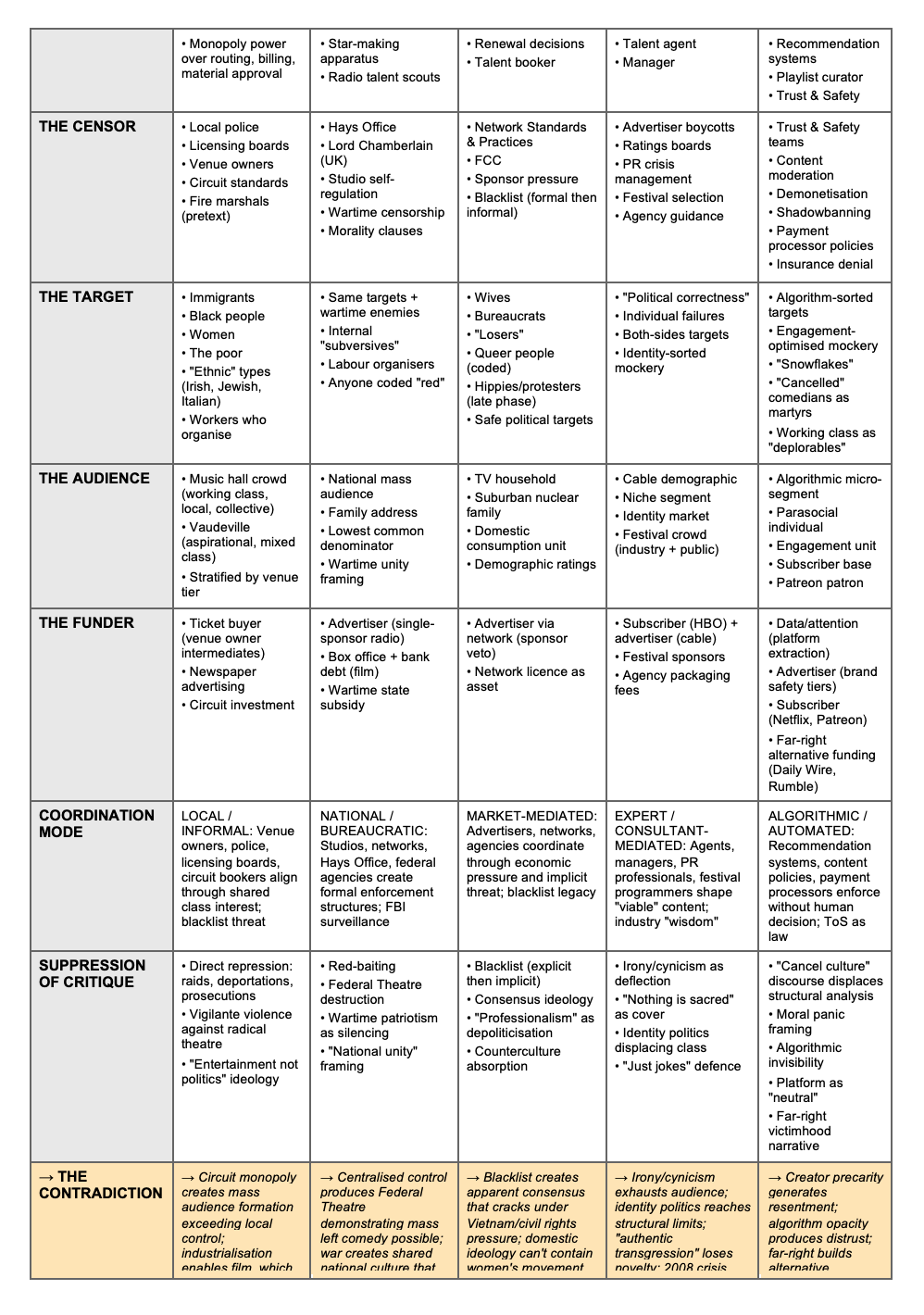
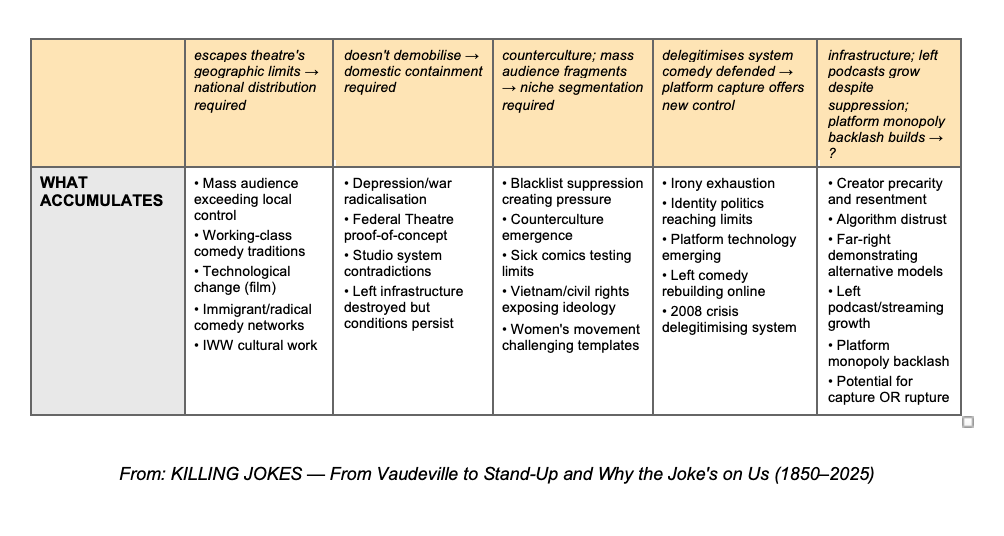
This table maps how the comic order evolved from 1850 to the present. It shows not what comedians believed or what reformers tried, but who controlled access to what, how the extraction worked, and how structural critique was systematically blocked.
Two Ways to Read
Read ACROSS a row to see how one element evolved over time. Who censors comedy in 1870 (local police, licensing boards, venue owners) becomes something entirely different by 2025 (algorithmic moderation, payment processors, Trust & Safety). The system didn't simply grow—it transformed while preserving its core function.
Read DOWN a column to see how all elements aligned at one historical moment. In any given phase, the promise, the function, the positions, the coordination mechanisms, and the suppression of critique all interlock. The table shows how coordination works—not through conspiracy, but through structural alignment.
The Contradiction Row (→)
This is the engine of the table. Each phase's solution to the previous crisis creates the next crisis. Circuit monopoly worked—until film escaped geographic limits. Mass media consolidation worked—until the blacklist created pressure that cracked in the 1960s. Fordist domestication worked—until it couldn't contain the movements it tried to deflect.
The system doesn't fail because people made mistakes. It transforms because each solution contains the seeds of its own obsolescence.
The Callback
Comedy's own term for structural memory. When a comedian references an earlier bit, the laugh depends on the audience remembering. When you trace "The Censor" from venue owner to Hays Office to Standards & Practices to Trust & Safety, you're performing the same operation: the meaning emerges from recognising what connects across apparent difference.
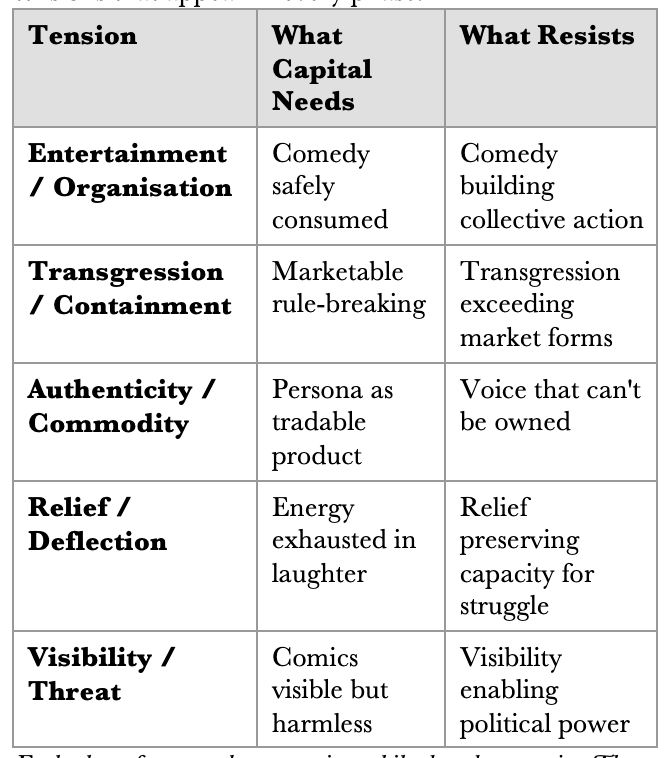
The Five Tensions
The comic order operates through five interlocking tensions that appear in every phase:
The Seven Positions
Seven structural positions persist across all five phases. The people change; the functions remain:
The Comic — Provides comedic labour-power. Produces the commodity (laughter).
The Owner — Controls means of comedy production and distribution.
The Gatekeeper — Determines who rises and who remains invisible.
The Censor — Enforces content limits through varied mechanisms.
The Target — Designated acceptable object of mockery. Enforces hierarchy through laughter.
The Audience — Configured receivers whose composition shapes content.
The Funder — Economic base determining structural limits on content.
The position persists; the occupants shift.
Coordination Without Conspiracy
How does the comic order coordinate across institutions without anyone planning it? Through structural alignment:
Law — obscenity, sedition, licensing statutes
Industry self-regulation — codes, standards, "best practices"
Advertiser pressure — sponsor veto, brand safety requirements
Financial infrastructure — payment processors, insurance, investment
Platform policy — Terms of Service, content moderation, algorithmic shaping
No conspiracy required. Each institution follows its own logic, and the alignment emerges from shared class interests and structural pressures.
The Structural Constants
What persists across all five phases—the invariants that reform cannot touch:
Ownership of distribution determines what can be said — Keith-Albee's circuit, NBC's network, YouTube's algorithm: same function
Labour precarity produces self-censorship — piece-work, contract, gig: comics learn what not to say
Class filtering at every entry point — festival costs, showcase economics, algorithm optimisation: who gets in
Racial and gender hierarchy enforced through target selection — who can be mocked shapes who counts
Transgression continuously captured into market position — "edgy" becomes brand, threat becomes product
Laughter processing contradiction without resolving it — relief that preserves rather than challenges
State power deployed when comedy threatens to organise — raids, blacklists, deplatforming: when structure fails, force
Self-reinforcing: Precarity → self-censorship → gatekeeping → ownership concentration → precarity
The Core Function
What does the comic order actually do? It organises comedic labour, laughter production, and content regulation to serve capitalist reproduction. Three functions make this work:
Labour discipline — comedy as relief from work that preserves capacity for more work; precarity enforcing compliance
Hierarchy enforcement — target selection naturalises who can be mocked; racial and gender order reproduced through laughter
Contradiction processing — structural tensions laughed at rather than acted upon; critique absorbed into entertainment
The promise changes. The function endures.
What the Table Reveals
By the end, you will understand:
Comedy is structured — organised by capitalism, not nature or individual genius
The comic order serves capitalism — processing contradiction, enforcing hierarchy, absorbing resistance
"Transgression" has been captured — edginess is market position, not political threat
Reform cannot succeed — ownership and precarity regenerate control after every apparent victory
Moral panics displace class conflict — "cancel culture" debates obscure structural coordination
Identity comedy is insufficient — representation without redistribution changes nothing
Liberation requires organisation — comedy threatens only when fused with collective struggle, not as individual expression.
The performer waits backstage at Keith’s Union Square Theatre, contract in hand.¹ It is 1905, and everything depends on the next fifteen minutes.
He can hear the act before him winding down: a trained dog routine, tight and polished, the kind of wholesome novelty Benjamin Franklin Keith built his fortune on.² Muffled barks, a last trick, a burst of applause. The house is full, as it usually is on a good night. Keith’s theatres pull in the respectable trade—fathers in dark suits, mothers in carefully chosen hats, children in their best clothes. The whole point of this building, this circuit, this contract, is that those children can be brought here without anyone worrying what they will hear. That is Keith’s promise, and it is the promise this performer is expected to keep.
The contract he’s holding is standard for the big time. It locks him into exclusive booking through what will shortly be formalised as the United Booking Offices. His material is subject to management approval. The circuit can terminate him at will.³ On the wall behind him, a printed notice itemises what cannot be said on a Keith stage: no vulgarity, no slang, no double entendre, nothing that would embarrass a twelve-year-old child or a Sunday school teacher.⁴ The list runs to multiple paragraphs. It doesn’t just ban swear words; it bans whole attitudes. It is, in practice, a diagram of the limits of speech.
In the wings, a manager stands where the actors can see him and the audience cannot. His job is to watch. If the performer deviates from approved material, if a joke gets the wrong kind of laugh, if a line sounds too much like a double meaning, there will be a report. The performer knows this. Everyone knows this. The Keith-Albee circuit controls access to nearly every major vaudeville theatre in the Eastern United States and is pushing steadily west.⁵ Keith’s partner, Edward F. Albee, has turned that reach into a system: managers’ reports, centralised records, discipline flowing down from his office.⁷ The blacklist those reports feed into is not a rumour—it’s a document, updated, copied, circulated.⁶ Ending up on it does not mean losing one job. It means losing the circuit, and with it legitimate vaudeville. It means dropping down to the beer halls, the dime museums, the small-time houses respectable patrons avoid. It means the long slide out of the business.
The act before him gets its last round of applause. The curtain dips. The dogs are led off. A cue is given. He walks on.
The material he does that night is clean, tested, and approved. He has already cut the things that worked in rougher rooms—lines that landed with factory men after their shifts, jokes built on the kind of anger you don’t perform in front of Sunday school teachers. What’s left is what the circuit will tolerate. The jokes land where they’re supposed to land. The audience laughs in the right places, gasps at the right moment, applauds on cue. The performer kills. Everyone goes home satisfied. Another successful night in American comedy.
This scene already contains everything this book is about. Not the jokes themselves—those are lost, and it doesn’t matter what they were. What matters is the machinery around them: the contract that decides what can be said, the blacklist that enforces compliance, the circuit that controls access to audiences, the self-censorship that makes direct punishment mostly unnecessary. The performer on that stage in 1905 is not free and does not imagine himself to be. The laughter filling Keith’s theatre is safe laughter, profitable laughter, supervised laughter. The system works exactly as designed.
The question this book asks is not “What happened to that system?” but “How did that system adapt?”
It did not disappear. The Keith-Albee circuit gives way to the movie theatres; the movies yield ground to television; television is fragmented by cable; cable is outflanked by streaming; streaming is swallowed by platforms. Each transition arrives with the same sales pitch: comedy has been liberated. New technology means new access. New access means new voices. New voices mean new freedom. Yet at every turn, something that looks uncomfortably like the old system reassembles itself in new form. The contracts never vanish; they change shape. The blacklist doesn’t go away; it comes back as “not brand-safe,” “demonetised,” “shadowbanned.” Self-censorship remains rational because the material conditions that produce it remain in place.
What follows is a history of that persistence: structure remaking itself under the mask of transformation. The names change; the machinery continues.
I call that machinery the comic order: the historically specific organisation of laughter, comedic labour, and “rule-breaking” speech inside capitalist social relations.
This is not a book about comedy as art form, or about taste, or about which specials are secretly underrated. It does not rank comics, reconstruct legendary sets, or trace the evolution of styles. Those books exist; some of them are excellent. The question here is different. Not what makes things funny, but who has the power to decide what gets said. Not how comedy “evolved,” but how the system that organises comedy has served capital for roughly 175 years of American history.
The comic order is the whole arrangement that decides who gets to make people laugh, under what conditions, through which institutions, and with what consequences. It includes ownership—who controls the venues, the broadcast schedules, the cable bundles, the platforms, the intellectual property. It includes labour—contracts, day rates, exclusivity clauses, non-competes, the long history of “you’re lucky to be here at all” precarity that makes self-censorship a survival skill. It includes content regulation—what can be said to whom, at what time of night, in what format, and what happens to the performer who crosses those lines. It includes audience management—from segregated houses and balcony seating to demo targeting and algorithmic recommendation. And it includes what I’ll call transgression processing: the ways the system permits certain kinds of rule-breaking, contains their threat, turns them into product, and destroys what it cannot absorb.
The performer backstage at Keith’s theatre understands the comic order in practice without having a name for it. Every decision that night—what joke to drop, which line to soften, how far to lean into a bit—is a calculation about that system. The laughter that follows is shaped by that system. The fact that he has another job next week depends on that system. Comedy in America has never floated above this arrangement. It has only ever existed inside it—constrained by it, shaped by it, sometimes bumping up against its edges, and in the end helping it reproduce itself.
The title of this book is meant in three senses. First, the literal: jokes get killed. Lines are cut in rehearsal; bits are censored in edit; sets are pulled from rotation; clips are demonetised; careers are ended. The performer in 1905 knows which jokes will land him on a blacklist. The creator in 2025 knows which jokes will anger an algorithm, a payment processor, or a trust-and-safety team. The surface mechanism changes; the killing does not stop. Second, the structural: the comic order kills comedy’s potential to do anything other than entertain. Comedy can build solidarity, articulate grievance, and help organise resistance—there are moments in this history where it does all three. The comic order exists, in large part, to stop that from happening, to keep comedy safely consumable, stripped of organisational power, processed into a harmless pressure valve. Third, the reflexive: the joke is on us. We have been laughing while being managed. The jokes we have been sold have been doing work on us that we were not supposed to notice. This book is an attempt to make that work visible.
To get there, we need to clear away a few familiar stories.
This is not a conservative lament about how comedy “used to be free” and has now been strangled by political correctness, cancel culture, or “wokeness.” In 1905, our vaudeville performer faces content restrictions as tight as anything a modern TV writers’ room deals with. The system has always managed what can be said; that is not new. What has changed is who is demanding protection and who is treated as a legitimate target. When the people being shielded are church-going patrons and “respectable” middle-class families, content rules are common sense. When the people asking for protection are those who have historically been the butt of the joke, the same basic restraint is suddenly tyranny. The conservative story takes a shift in whose dignity counts and treats it as a collapse of freedom, while leaving the underlying machinery untouched.
It is also not a liberal progress story about how comedy is slowly becoming more diverse, inclusive and representative, and how that inclusion is itself the victory. Representation matters; the first Black headliner on a major network, the first openly queer comic with a giant streaming special—none of that is trivial. But more voices inside unchanged structures do not equal transformation. When a Black or queer comic finally gets that Netflix slot, the question is not only who is on stage but who owns the pipeline from camera to couch: the distribution monopoly, the data extraction, the recommendation engine. Those things do not change because the face on the thumbnail does. Liberal celebration of diversity tends to stop at the moment of inclusion. This book is more interested in what inclusion is being included in.
Nor is this a libertarian fantasy about “free markets in jokes.” The performer in 1905 is not being censored by a government office. Keith-Albee is a private firm, and its blacklist is a private business decision. The YouTuber in 2025 is unlikely to be hauled into court for her material; her income can disappear overnight because an opaque private platform has changed the rules. In both cases, someone other than the audience decides what can be said, and the person making that decision is accountable to owners, not to the public. Replacing state control with private power does not produce freedom. It produces control with fewer lines of appeal.
Finally, this is not a culturalist tale about attitudes and taste, where comedy is treated primarily as a mirror that reflects what “we” believe at any given moment. There are shifts in what audiences will laugh at, and those shifts mean something. But the comic order does not live or die on what people happen to find funny this decade. It depends on who owns the stages, the channels, and the feeds; how workers are hired and fired; and what mechanisms enforce limits when someone goes too far. Those are questions of material power, not just sensibility.
What this book offers, instead, is structural analysis. Not what comedy means, but what comedy does inside a particular social order. Not how our attitudes shape jokes, but how the comic order shapes what can ever make it to a stage or a feed. Not a story of steady liberation or tragic decline, but of a system that survives each supposed transformation with its core functions intact.
To make that story manageable, the book is organised into five historical phases, each a different configuration of the comic order.
Phase One, from 1850 to 1914, covers the industrial formation of American comedy. This is the age of vaudeville circuits, booking monopolies, and blacklists that train performers into obedience. Keith and E.F. Albee build a system so tight that a single telegram from the central office can end a career from Boston to Chicago.⁷ It is also the age when minstrelsy is not just a “form” but a business model: touring routes, stock characters, sheet-music sales—an industry that teaches white workers to think of themselves as white before they think of themselves as workers. Racial mockery is not an ugly side-effect; it is a way of managing class tension. Alongside that sits a suppressed counter-tradition: workers’ theatres raided by police, anarchist speakers fined and jailed, radicals deported. That line of comedy imagines jokes as tools of collective struggle rather than private escape. The state treats it accordingly. The central tension in this phase is entertainment versus organisation: will comedy be kept as harmless fun, or will it help build something dangerous?
Phase Two, from 1914 to 1945, tracks mass-media consolidation. The studios inherit the circuits; radio moves comedy into the home; film and broadcasting take jokes to scales vaudeville never reached. Wall Street money demands predictability, and predictability demands control. The Hays Code formalises what Keith’s rule sheet used to do informally, moving censorship into the script office and pre-production.⁹ For a few years the Federal Theatre Project cuts across that logic: federally funded, unionised, openly political, it proves that mass radical entertainment can be popular. Congress kills it in 1939 with open hostility.⁸ At the same time, the machinery that will feed the post-war blacklist—FBI files, informant networks, studio–state coordination—takes shape. The dominant tension becomes transgression versus containment: which challenges can be absorbed and repackaged, and which have to be smashed.
Phase Three, from 1945 to 1975, is the period of Fordist domestication. A three-network television oligopoly dictates what enters the American living room. Sitcoms teach the family how to live, laugh and shop; late-night monologues define the outer edge of “topical.” The blacklist severs comedy from organised left politics with surgical precision. Those who want jokes tied to unions, anti-racist struggles, or socialist movements are pushed out or ruined; what survives is individual transgression—Lenny Bruce hauled off for obscenity, the “sick comics” of the 1960s needling taboos in language and sex.¹⁰ They can be prosecuted or, later, canonised on prestige labels and cable, but either way they stand alone. The system can live with a lone rebel. What it cannot live with is organised laughter linked to organised power. Here the key tension is relief versus deflection: does comedy help people see their situation and act, or does it offer a brief release that leaves the underlying arrangement untouched?
Phase Four, from 1975 to 2005, opens into neoliberal fragmentation. The mass audience splinters; cable offers channels for every niche; comedy turns into a set of market segments rather than a common culture. HBO and its imitators will air what networks won’t—language, sex, some politics—but always for a paying demographic, bounded by subscription and folded into a corporate catalogue. Irony becomes the default tone: clever, distancing, politically tired. The Daily Show era arrives, and a generation gets its politics as a nightly joke—a show that can spell out how rotten everything is and then send you to bed feeling you’ve “kept up” without having done anything.¹¹ At the same time, the festival circuit and agency-packaging machine industrialise talent selection. Who reaches a wider audience now depends on who can afford to grind through unpaid gigs, travel, festivals and networking. The main tension becomes authenticity versus commodity: the constant demand for a singular “voice,” and the system’s growing skill at turning that voice into owned intellectual property.
Phase Five, from 2005 to 2025, is the platform era. The booker becomes the algorithm; the blacklist becomes demonetisation; Keith’s framed rule sheet becomes an unread Terms of Service and a shifting set of “community guidelines.” The creator economy promises freedom—no boss, no gatekeeper—and delivers precarity more total than vaudeville ever managed: no union, no minimum, no schedule, just an individual trying to guess what a system will reward, under threat of instant invisibility. Moderation happens at industrial scale. What the recommendation engine buries might as well not exist. Meanwhile, the far right builds its own infrastructure—Daily Wire studios, Rumble, donor-funded “free speech” comedy spaces—while liberal comedy burns itself out in a loop of Trump impressions, “clapter,” and election-cycle despair.¹² Here the tension is visibility versus threat: what it means to have unprecedented reach when that reach is granted and withdrawn at the whim of systems no comic can see or confront.
Across all five phases, the same roles recur. The Comic produces the work. The Owner controls the means of production and distribution. The Gatekeeper decides who gets through. The Censor—sometimes a person, sometimes a committee, sometimes an algorithm—polices the lines. The Target is the group marked out as safe to laugh at instead of with. The Audience is both raw material and product: their attention is sold, their data harvested, their reactions fed back into the system. The Funder sets the terms in the background: the banker, advertiser, donor or investor whose interests shape the whole arrangement. The costumes and names change from phase to phase. The basic positions don’t.
Threaded through this history are a handful of lines that keep reappearing in slightly different dress. Ownership: who actually owns the stages, the channels, the feeds. Labour: how comics are hired, fired, disciplined, and rarely organised, and how insecurity trains them to do the system’s work for it. Content control: from posted rules and obscenity prosecutions to standards departments and recommendation engines—the shifting mechanisms that decide what counts as “going too far.” Race: how racial comedy is used again and again to split workers and audiences that might otherwise find common cause—from burnt cork to border jokes to “anti-woke” grievance. A fifth line, politics, tracks what happens each time comedy and organised struggle start to touch, and how quickly that touch is broken.
By the time you finish this book, the pattern should be hard to unsee.
Comedy is not a neutral pressure valve sitting outside the system that grinds you down during the day. Under capitalism, comedy is woven into how that system manages people. The laughter you enjoy is real; so is the way it is organised, steered and monetised. The “transgression” that feels like rebellion has usually been pre-processed into something that can be sold. The “authenticity” that feels like resistance is, more often than not, part of the brand. The political comedy that makes you feel informed and angry is, in most cases, a product designed to end when the credits roll.
You will still laugh. That’s not the problem and not the demand. Pleasure is not a lie; the relief comedy provides is genuine; the human impulse to crack jokes in bad conditions is one of the few decent things about us. But once you’ve seen the comic order, the laughter comes with knowledge of what else it is doing. You’ll see capture happening in real time. You’ll recognise why “more representation” inside these structures can change who gets paid but not who holds power. You’ll understand why each new medium that promises liberation—radio, TV, cable, platforms—immediately begins rebuilding the same forms of control. You’ll see why individual acts of courage, however admirable, get either folded into the catalogue or wiped out.
You will also see the outline of what actual change would require. Not nicer owners or slightly looser rules. Not a more diverse writers’ room at the same conglomerate. Not some mythic “marketplace of ideas” finally allowed to work. Real change would mean changing who owns the means of making people laugh, what level of material security performers can count on, and whether comedy is once again allowed to sit next to organised struggle rather than being carefully kept apart from it. That points beyond reform and straight at the basic question of who owns what and who works for whom.
That fight is bigger than one sector and bigger than this book. It is the same struggle that runs through factories, warehouses, schools, hospitals and feeds. A single volume can’t resolve it. What it can do is give you a map of the ground you’ve been walking without a name.
The performer backstage at Keith’s theatre in 1905 faces a brutally clear choice. The rules are on the wall. The blacklist is an open secret. The options are simple: comply, or vanish. A century and three-quarters later, the choice is structurally similar and far harder to see. The rules are buried in terms and policies and “brand suitability” guidelines. The blacklist is a recommendation system and a line of code. A career can be ended by a tweak that never mentions you by name. The destruction presents as individual failure—“not getting traction,” “falling off”—rather than as the outcome of deliberate, organised power.
The chapters that follow are an attempt to make that power visible again. Chapter One begins in that same theatre, with that same performer, at the moment when the system still had to write its rules out loud. From there, we watch how it learned to hide—and what it was hiding all along.
The joke has been on us. Knowing the joke is where refusing it begins.
Comedy doesn’t “emerge.” It’s built—on contracts, schedules, and threats.
Part I starts where the circuits do: with managers who understand that owning the route means owning the act. The vaudeville chains don’t have to stand in the wings and bark orders. Keith-Albee’s bookers sit at the back of the house, watch ten minutes, and decide whether someone works again in any major theatre in the country. One wrong joke, one whiff of “dangerous” politics, and your name goes in a book. The blacklist here is literal: a list that quietly makes people disappear from the calendar. Precarity does the rest. Performers rewrite themselves before anyone has to tell them to.
Around the edges, a counter-tradition tries to form. Industrial Workers of the World halls use parody songs as strike prep. Immigrant theatres mix radical speeches with comic turns. Anarchist speakers turn rage into bitingly funny lectures. These rooms aren’t big, but they are dangerous in a way the circuits are not, because the laughter feeds straight into organisation. People leave and walk into meetings, picket lines, and fights with actual stakes.
The state and its friends notice. Police raids, licensing pressure, and quiet blackmail fall hardest on any room where jokes and class politics share the stage. Part I tracks both sides of that split: comedy as a disciplined product line for capital, and comedy as a tool that, briefly, belongs to workers before the hammer comes down.
Dominant tension: Entertainment vs Organisation
The performer knows the rules before he reaches the stage.
They are posted backstage at Keith’s Union Square Theatre, printed on cardboard and mounted where no one can miss them. The language is specific: no vulgarity, no double entendre, no slang, no suggestive movements, no references to “questionable subjects.” The prohibition extends to words like “hell” and “damn.” It extends to jokes about marriage infidelity, motherhood, or religion. It extends to any material that might cause a twelve-year-old child to ask a question his mother would prefer not to answer.¹ The list is comprehensive. It is a map of the unsayable.
Backstage, the air smells of dust, sweat, and old scenery. The orchestra’s warm-up drifts in from the pit—snatches of popular tunes, a trumpet testing high notes, a drummer tapping impatiently at the snare. A red glow leaks around the edges of the curtain where the footlights flare against it. Performers cluster in the wings: a juggler rolling balls in his hands, a contortionist stretching, a chorus girl quietly adjusting a costume strap. Nobody needs to read the notice again, but it’s there in their peripheral vision, like a second set of eyes.
The performer has read these rules many times. He has internalised them so completely that he no longer needs to look up at the board to remember what’s on it. His act is clean—has been clean for years, shaped and reshaped to fit the Keith standard. The jokes that once worked in beer halls and dime museums have been cut. The material that got laughs from working men after their shifts—the barbed comments about bosses, priests, policemen—has been replaced by material suitable for afternoon audiences of women and children. The rough dialect has been smoothed. The sexual innuendo has been buried or excised. What remains is professional, polished, and safe.
It is not the act he started with. In the saloons, he could joke about the foreman and the landlord and the cop on the beat. Here, the foreman and the landlord and the cop might be in the audience with their families. The targets change when the ticket price goes up.
In the wings, the house manager watches. He carries a clipboard, but his real job is to remember. His responsibility is not merely to make sure the show runs on time but to watch the acts as if he were the circuit itself. If a performer deviates from approved material—if a line sounds off, if a gesture looks suggestive, if the audience reaction hints that something slipped past the rules—a report will be filed with the central office. The manager knows that is his responsibility. The performer knows the manager is watching. Everyone in this theatre understands the system they are part of, even if they don’t have a name for it.
The cue light flashes. The performer steps out. The material lands where it is meant to land. A joke about domestic squabbles that never quite tips into cruelty. A bit of dialect humour trimmed so it sounds colourful rather than threatening. Just enough energy to feel lively, never enough to feel dangerous. The audience laughs at the right moments, applauds at the finish, files out satisfied under the glow of the lobby chandeliers, past the framed posters advertising “POLITE VAUDEVILLE.” Another successful night. The performer has done his job, which is to be funny in precisely the ways the circuit permits and in no other ways at all.
This is vaudeville at its height—the dominant form of American entertainment in the first years of the twentieth century, reaching more people more regularly than any medium before it. On any given night, hundreds of thousands of Americans are sitting in vaudeville theatres, watching acts that have been vetted, approved, and monitored for compliance. And this is the Keith-Albee circuit at its height—the most powerful force in that industry, controlling access to audiences across the Eastern United States and pushing steadily west. The performer who succeeds here can make a comfortable living, can achieve something like fame, can build a career that supports a family. The performer who fails here—or worse, who offends here—will find every door closed, every opportunity foreclosed, every contact suddenly unavailable.
The question this chapter asks is blunt: how does that system actually work? Not the jokes, not the performers, not the shows themselves—but the machinery that determines what can be said, who can say it, and what happens to those who say the wrong thing.
Benjamin Franklin Keith did not invent vaudeville, but he understood something about it that others missed.²
Keith came out of the circus and dime museum world—the cheapest, most disreputable end of American entertainment. He had worked as a circus grifter, had operated a storefront museum featuring curiosities and freaks, had learned the trade in venues where respectability was not even on the list of concerns.³ When he opened his first theatre in Boston in 1883, he was entering a field that shared those origins. Variety entertainment—the precursor to vaudeville—was male, working-class, and rough. It lived in concert saloons attached to bars, where the entertainment was part of an evening’s drinking. Women on stage were presumed to be available for other services. The audience was presumed to be interested in those services. The line between entertainment venue and brothel was often unclear.⁴
This limited the market. Respectable families—meaning middle-class families, meaning families with money to spend on entertainment—would not enter such venues. Women would not attend unescorted. Children would not attend at all. The business was confined to the segment of the population with the least disposable income and the least inclination to spend it on theatre tickets.
Keith saw the problem as a business problem, not a moral one. His solution was what he called “refined vaudeville”—variety entertainment stripped of everything that kept respectable audiences away.⁵ The content would be clean. The theatres would be elegant: plush seats, uniformed ushers, décor that signalled safety and respectability. The audiences would be mixed—men, women, and children together, attending shows that no one would be embarrassed to admit they had seen. This was not uplift. It was market expansion.
Refinement reshaped everything that happened in the building. Ushers were instructed to remove drunken patrons. Performers were warned not to fraternise with the audience. Female performers’ costumes were scrutinised; skirts could be short enough to be interesting, never short enough to prompt complaints. The same logic that banned coarse jokes also policed hemlines. Respectability and titillation were balanced like items on a ledger.
The results were immediate and dramatic. Keith’s Boston theatre drew audiences that variety had never reached. His innovation—continuous performance, running shows all day rather than at set times—meant the theatre was never empty.⁶ Women could attend afternoon shows while their husbands worked. Families could attend together. Office workers could slip in for a programme between shifts. Ticket prices could be higher because the clientele could afford to pay more. Within a decade, Keith was operating multiple theatres and looking to expand further.
The content restrictions were essential to this model. A single off-colour joke, a single suggestive gesture, could drive away the family audience that made the business profitable. Keith understood that consistency mattered more than any individual act. An audience that attended one show and encountered inappropriate material would not return. An audience that could trust the Keith name would return again and again. The posted rules, the monitoring, the enforcement—these were not expressions of Keith’s personal morality. They were mechanisms for protecting a market position.
The usual story credits Keith with cleaning up vaudeville, with bringing respectability to a disreputable form, with elevating popular entertainment. It makes him sound like a reformer. He was not a reformer. He was a businessman who discovered that content control was more profitable than content freedom. The clean stage was not an end in itself—it was a means to a larger audience and higher revenue. Every subsequent development in American entertainment would learn this lesson: the managed audience is the profitable audience.
Keith built the model. Edward Franklin Albee made it work at scale.⁷
Albee joined Keith’s operation in the 1880s and rose to become its general manager and, after Keith’s death in 1914, its president. Where Keith was the architect, Albee was the enforcer—the man who created the systems that turned a successful theatre chain into an industry monopoly. He was not beloved. Performers called him ruthless, dictatorial, vindictive.⁸ He was all of these things. He was also effective.
The key innovation was the United Booking Offices, established in 1906.⁹ Before UBO, performers negotiated individually with theatre managers. Each booking was a separate transaction. A performer might play Keith’s theatres one week and a competitor’s theatres the next. The market, while constrained, allowed some movement. A bad week in Boston might be offset by a better run in Philadelphia or on the Western circuits.
UBO ended that. Under Albee’s system, the major vaudeville circuits pooled their booking operations into a single centralised office. Performers who wanted to play any of the affiliated theatres—and by 1910, that meant nearly every major vaudeville house in the country—had to book through UBO.¹⁰ The office took a five percent commission on every booking. More importantly, it controlled access. A performer in good standing could work steadily across hundreds of theatres. A performer not in good standing could not work at all.
The contracts performers signed reinforced this control. Standard Keith-Albee contracts included exclusive booking clauses that prevented performers from working non-affiliated venues. They included material-approval provisions that required performers to submit their acts for review before performing them. They included termination-without-cause clauses that allowed the circuit to cancel bookings at will.¹¹ The contracts looked like employment agreements. They functioned like instruments of discipline.
Albee’s enforcement mechanism was the blacklist.¹²
The blacklist was not secret. Everyone in vaudeville knew it existed. Performers knew that certain offences—unapproved material, union activity, “troublemaking” of various kinds—could result in listing. They knew that listing meant the end of their careers in big-time vaudeville. They knew there was no formal appeal, no due process, no mechanism for challenging a listing once it occurred. The blacklist was simply a fact of professional life, as certain and unappealable as the weather.
The list was maintained at UBO headquarters and circulated to affiliated theatres weekly. When a performer was listed, the information spread rapidly through the network. Bookings were cancelled. Offers stopped coming. A performer who had been working steadily might find themselves completely unemployable within days.¹³ The speed and comprehensiveness of the system made it terrifyingly effective.
Albee supplemented the blacklist with an informant network. Theatre managers were expected to report on performers—not just on their material but on their attitudes, their associations, their conversations backstage.¹⁴ Performers who expressed discontent, who talked about organising, who associated with known troublemakers—all of this was noted and forwarded to the central office. The surveillance was pervasive. It was also, from Albee’s perspective, necessary. The system did not have to see everything. It had to convince performers that enough was being seen.
The structural position Albee occupied was unprecedented in American entertainment. He controlled the major venues—the Owner position. He controlled access to those venues through UBO—the Gatekeeper position. He enforced content restrictions through the posted rules and material approval—the Censor position. This consolidation meant there was no gap in the system, no alternative path to audiences, no way to route around the circuit’s control. Performers faced a unified structure that owned the means of reaching audiences and could exclude anyone it chose to exclude.
The machinery surrounding our anonymous performer at Keith’s Union Square Theatre—the contract, the rules, the surveillance, the blacklist—is the comic order in its first fully industrial form. Later versions would be more complex and less visible. None would be more naked.
The blacklist was not theoretical. It destroyed careers.
George Fuller Golden was one of the most successful monologists in vaudeville—a performer whose talking act had made him a headliner on the Keith circuit through the 1890s.¹⁵ He was also one of the founding members of the White Rats, the performers’ union organised in 1900 to challenge the circuits’ power. When the White Rats called for collective action, Golden was visible. When the circuits responded, Golden was targeted.
The White Rats had formed in response to conditions that every vaudeville performer understood. The contracts were exploitative. The booking system extracted commissions while offering no job security. The blacklist hung over every career. Performers earned good money when they worked but could be cut off without warning or recourse. The name “White Rats” was “star” spelled backwards, combined with a reference to the British music hall union, the Water Rats. The founders saw themselves as stars who had been treated like rats—and they intended to change that.¹⁶
The union’s demands were modest by any reasonable standard: fairer contracts, limits on the booking commission, some mechanism for appealing blacklist decisions. They were not seeking to overthrow the circuits—merely to bargain with them. The White Rats imagined themselves as negotiating partners in a civilised dispute. The circuits recognised them as a threat to the whole arrangement.
The response was systematic. Albee identified the union’s leaders and moved against them individually.¹⁷ Golden found his bookings cancelled. Other founding members found the same. The circuit made examples of the organisers while offering small concessions to performers who remained loyal. A minor fee was reduced here, a contract clause softened there. The message was clear: solidarity would be punished; compliance would be rewarded.
Golden’s case illustrated how the blacklist worked in practice. His talent was undeniable—he had been one of the biggest names in vaudeville. But talent was not protection. The circuit controlled access to audiences, and without access, talent was worthless. Golden could still perform, but only in the small-time venues the circuit didn’t control—the beer halls and minor houses that paid a fraction of what big-time vaudeville paid. The rooms were smokier, the pay envelopes thinner, the prestige gone. His income collapsed. His status evaporated. His career, in any meaningful sense, was over.¹⁸
No policeman had laid a hand on him. No judge had sentenced him. On paper, his “freedom of speech” remained intact. He could say whatever he liked—into rooms that no longer existed for him. The punishment arrived entirely through private power exercised in the language of contracts and “business decisions.” It felt personal. It was structural.
The lesson was not lost on other performers. The White Rats had sought to bargain collectively for better contracts, fairer treatment, an end to the blacklist. The circuits’ response demonstrated that collective action would be met with collective punishment. Performers who had supported the union quietly withdrew. Performers who had been considering joining decided not to. By 1901, the White Rats were effectively broken.¹⁹
The union would revive in 1916, and Albee would break it again using the same methods.²⁰ Each time performers attempted to organise, the circuit demonstrated its willingness to destroy careers. Each time, the demonstration worked. The structural asymmetry was insurmountable: performers needed work continuously, while the circuit could absorb any short-term disruption. Performers could be replaced; the circuit could not be replaced. This asymmetry made genuine collective action nearly impossible.
What the White Rats ran into was not just a hard boss but a whole order.
The White Rats’ failure illuminated a tension that would persist across every phase of the comic order: the tension between entertainment and organisation.
Capital needs comedy to be safely consumed as atomised entertainment. Individual performers, individual audiences, individual transactions—no collective identification, no solidarity, no organisation. The circuit model achieved this perfectly. Performers competed against each other for bookings. Audiences attended as families, as individuals, as consumers of a product. Nothing in the vaudeville experience encouraged performers to see themselves as workers with shared interests or audiences to see themselves as anything other than ticket buyers.
Comedy can do something else. It can build collective identification. Performers recognising that they share conditions—that the contracts binding them bind all of them, that the blacklist threatening them threatens all of them—can develop solidarity. Audiences laughing together at shared targets can develop a sense of shared position. Comedy’s collective experience—the room laughing together, the recognition that others find the same things funny—contains the seed of collective action.
The circuits understood this, even if they didn’t articulate it in these terms. The White Rats threatened not because they demanded better pay or fairer contracts—those demands could have been negotiated, concessions could have been made. The White Rats threatened because they represented performers acting collectively rather than individually. If performers could organise, they could bargain. If they could bargain, they could demand. If they could demand, the circuit’s comprehensive control would be compromised.
Albee’s response to the White Rats was therefore not merely punitive but structural. He didn’t just punish the organisers; he created systems to prevent organisation from recurring. The informant network monitored for union talk. The blacklist punished association with known organisers. The company union he eventually created—the National Vaudeville Artists—gave performers the appearance of collective representation while remaining firmly under circuit control.²¹ Every mechanism was designed to keep performers atomised, to make solidarity dangerous, to ensure that entertainment remained entertainment and never became organisation.
For this phase, the tension was resolved in capital’s favour. Comedy would be consumed individually. Performers would compete individually. The collective potential of the form would be suppressed. This resolution was not permanent—no resolution ever is—but it established the template. Every subsequent phase of the comic order would face the same tension and would develop its own mechanisms for the same resolution.
What the circuit system reveals about the comic order is visible precisely because the system did not hide.
In 1905, the mechanisms of control were explicit. The rules were posted on the wall. The blacklist was known. The contracts spelled out the terms of compliance. Performers understood exactly what constrained them and exactly what would happen if they violated those constraints. The calculation—self-censorship in exchange for career survival—was conscious and continuous. Every performer who walked on stage at a Keith theatre had made that calculation and would make it again.
This visibility would decrease in subsequent phases. The studio system would embed content control in development processes and production codes. Network television would bury it in Standards and Practices departments and sponsor relationships. Platform algorithms would make it nearly invisible—demonetisation without explanation, suppression without acknowledgment. But the structure would persist. The calculation would persist. The performer deciding what to say and what not to say, calibrating their material to the requirements of the system, choosing compliance because the alternative is destruction—this would remain constant.
What changed was not the structure but its visibility. Keith’s posted rules told performers exactly what they couldn’t say. YouTube’s community guidelines are vaguer, and their enforcement is opaque, but the function is the same. The blacklist that ended George Fuller Golden’s career was explicit and acknowledged. The shadowban that buries a creator’s content is invisible and deniable. The circuit model demonstrated that private ownership of distribution is sufficient for comprehensive content control—no government censor required, no First Amendment implicated. Every subsequent owner of entertainment distribution would learn from this demonstration.
The other lesson of the circuit system is that labour precarity produces self-censorship more reliably than external enforcement ever could. The manager watching from the wings was necessary, but the performer had already internalised the rules before stepping on stage. The blacklist was devastating, but most performers never tested it—they complied because they understood the consequences of non-compliance. The system worked not because Albee was omniscient or his informants were everywhere but because performers correctly understood their structural position and acted accordingly.
This is what makes self-censorship rational rather than cowardly. The performer who tells the safe joke instead of the dangerous one is not lacking courage—they are responding accurately to their conditions. The conditions are the problem, not the response to conditions. Moralising about performers who comply with oppressive systems obscures the system itself. The question is not why performers complied but why the system made compliance necessary.
The Keith-Albee circuit dominated vaudeville, but it did not control everything.
At the edges of the system, other possibilities existed. Film technology was emerging—the nickelodeon, the storefront theatre showing short movies to working-class audiences the circuits ignored.²² The chairs were hard, the ventilation poor, the piano often out of tune, but the price was low and the product new. These venues operated outside the circuit structure. Their performers—if the flickering images on screen could be called performers—faced no booker, signed no contract, feared no blacklist. Film would eventually develop its own control mechanisms, as we will see, but in this moment it represented an alternative distribution system.
Immigrant audiences created demand the circuits couldn’t fully serve. Yiddish theatre on the Lower East Side, German workers’ halls in Chicago and Milwaukee, Italian neighbourhood theatres—these venues operated in languages Keith’s audiences didn’t speak, serving communities his model didn’t reach.²³ The comedy performed in these spaces was not subject to Keith’s rules. Some of it was political in ways big-time vaudeville could never be. Jokes about landlords and factory owners landed differently when the audience worked in the same sweatshops.
And there were spaces where comedy served organisation rather than entertainment—where the tension between those poles was resolved differently. IWW halls where workers gathered and sang songs mocking their bosses.²⁴ Workers’ theatres where performances articulated class grievance and built solidarity.²⁵ Anarchist speakers who combined political analysis with wit and laughter, making radical ideas entertaining.²⁶ This counter-tradition existed alongside the circuits, using comedy for purposes the circuits existed to prevent.
The existence of these spaces did not cancel what the circuits were doing. It showed what else comedy could do when it was not locked inside Keith’s business model.
The next chapters follow these threads. Chapter 2 examines minstrelsy—what racial comedy did to manage class contradiction, how the Target position was constituted, how workers were taught to identify by race rather than class. Chapter 3 examines the raids—what happened when comedy connected to political organisation, how the state intervened when the circuits’ market discipline wasn’t sufficient. Chapter 4 examines free laughter—the radical comedy tradition before it was destroyed, what it achieved and why it was crushed.
The circuit system established the template for managed entertainment in America. Clean content for expanded markets. Private ownership as content control. Labour precarity as self-discipline. The destruction of collective organisation. These mechanisms would recur in every subsequent phase, refined and less visible but structurally identical.
The performer leaving Keith’s theatre that night in 1905 has succeeded by the system’s terms. His material is clean. His career continues. His compliance is rewarded. He may even feel grateful. Across town, in venues the circuit doesn’t control, other possibilities are being performed for other audiences, in other languages. The system has edges. At those edges, for a time, comedy can be something else.