
Olivers Crossing
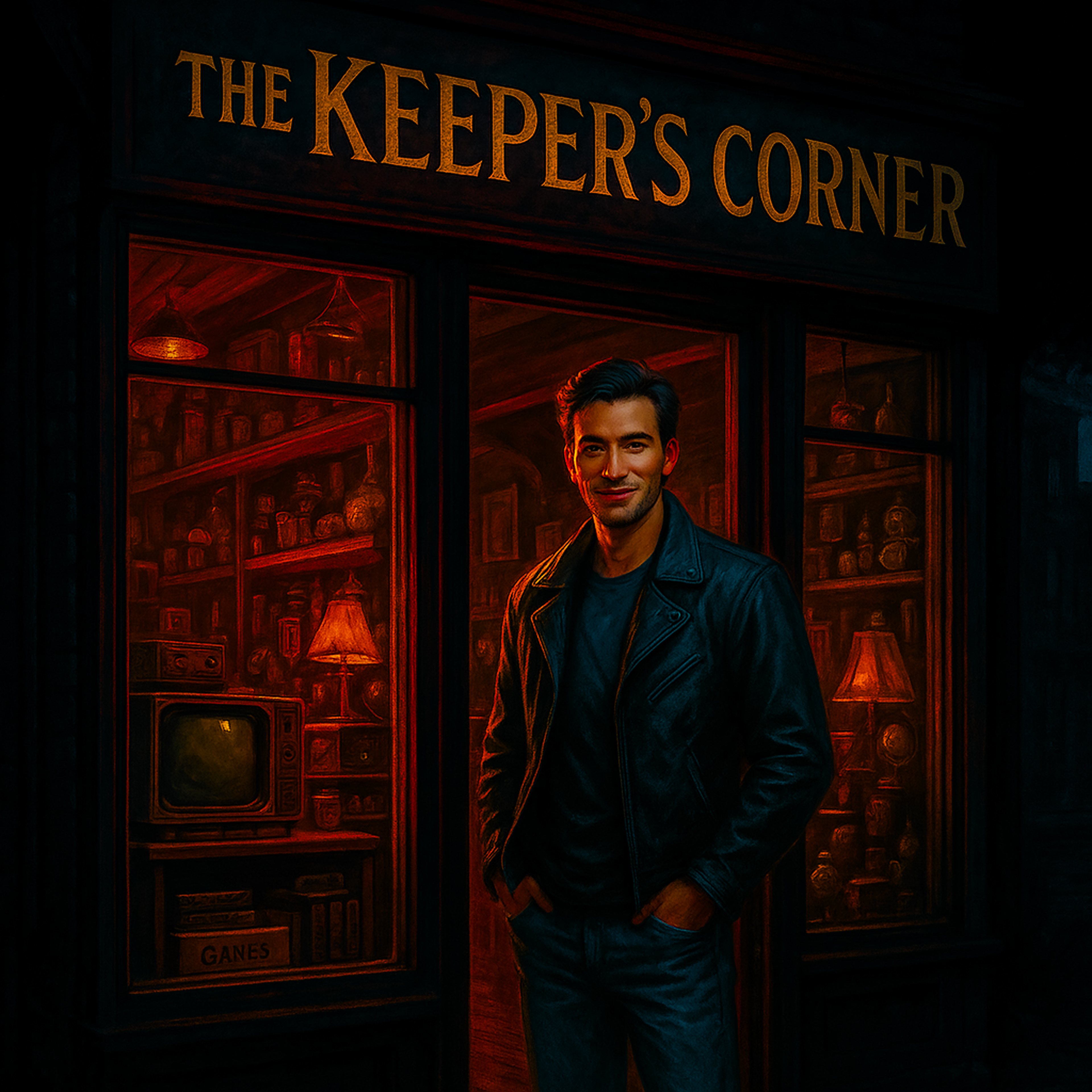
When charismatic Ally opens The Keeper's Corner overnight in Vallejo, California, he offers exactly what each desperate family needs most. But in a town where staying costs more than leaving, every miracle has a price.
Twelve-year-old Oliver Reeves knows something is wrong the moment the shop appears. While adults throughout the community suddenly find their problems solved, Oliver and other children begin to see the disturbing patterns beneath these apparent blessings.
As Vallejo's residents grow closer than ever before, the children discover they may be the only ones who remember what normal felt like. But Oliver's resistance carries devastating personal stakes.
In the tradition of Ray Bradbury's Something Wicked This Way Comes and Stephen King's Needful Things, Oliver's Crossing blends supernatural horror with sharp social commentary, asking whether authentic human connection can resist the seductive pull of solutions that promise everything while demanding the unthinkable.
Some doors should never be opened.
A brother's keeper story for our time, where the future itself hangs in the balance.
Read the first two chapters below (also included on the Kindle preview).
October arrived in Vallejo like a strange relative you’d forgotten, wind tasting of rust and distant fires, carrying promises wonderful until you remembered why family dinners stopped mentioning them.
Oliver Reeves, twelve years old and weary of it, pedalled his Huffy down Georgia Street, knowing five minutes late meant lunch money converted into someone else’s Snickers.
The bike chain clicked with the same mechanical persistence as his father's typing—that sound that had become morning's soundtrack when words mattered more than conversation, when keystrokes felt like prayers offered to algorithms that rarely answered.
The morning light held October's particular cruelty—golden but stretched thin, like the last of the honey spread across too much toast, never quite sweet enough to cover what lay underneath. It fell across storefronts abandoned since Mare Island Naval Shipyard closed, taking eight thousand pay checks with it and leaving behind windows that reflected Oliver's passage like accusations. Each empty storefront marked another family's calculation that staying cost more than leaving, another small business that had discovered algorithms didn't need what human hands had spent decades learning to provide.
Oliver's father would be at work by now, if coding from the kitchen table counted as work, which Oliver suspected it didn't—not the way work used to mean something you could depend on. Neil Reeves moved mechanically between laptop and bathroom, maintaining a machine only he heard breaking down. Each keystroke a plea, convincing Silicon Valley his twenty years counted more than college graduates working for equity over salary.
His mother had started leaving Post-it notes on the coffee maker like small flags of surrender: "Remember to eat!" and "Team meeting at 2!" and, lately, "Dr. Morrison at 4:30 ❤️"—as if heart emojis could soften appointments that cost three hundred dollars to learn that hope wasn't covered by insurance.
The fertility clinic squatted on Vallejo’s edge like a pastel-painted factory for the desperately wanting, all soft blues and hopeful yellows that couldn’t disguise its function as the place middle-class couples went when their bodies had started negotiating separate terms with their intentions.
Oliver had googled "IVF" on the library computer, then immediately cleared the history, feeling like he'd stumbled into his parents' bedroom at the wrong moment. Some knowledge came with its own shame—not for what it revealed, but for the stealing of it, the way children learned to carry adult pain in spaces too small for its accommodation.
The Huffy's tires whispered against asphalt still holding summer's heat, creating rhythm that matched his heartbeat when he wasn't thinking about it, falling out of sync when he was. Georgia Street stretched ahead like a catalogue of exhausted finances—check-cashing spots replacing banks, beauty supply stores bearing signs in languages weighted by distant places, taco trucks appearing before dawn and vanishing after midnight, aluminium angels ministering to third-shift hunger.
He coasted past the old Woolworth's, its soap-scummed windows holding fragments of his reflection just long enough for the morning light to decide what deserved preservation. The building exhaled the particular emptiness of spaces that remembered purpose, cash registers that dreamed of transactions in currencies that no longer meant what they used to mean.
The space next to it had been empty since before Oliver's memory started keeping reliable records. Except this morning, it wasn't.
The Keeper’s Corner revealed itself through hand-painted letters shifting from burgundy to black depending on the light, as if morning couldn’t decide which colour suited truth best.
The window display stopped Oliver's pedaling like a hand closing around his bike chain—not because the objects were remarkable, but because they sat in their spaces with the patience of things that had been waiting for someone specific to notice them.
A baseball mitt worn smooth by hands that had shaped it into perfect accommodation. Comic books with covers faded in the exact pattern that came from being read by flashlight under blankets during thunderstorms. A Nintendo system still factory-sealed but somehow looking older than it should, as if it had been waiting decades for someone to recognize its value.
Each item rested in shadow that moved independent of the morning light, darkness that felt purposeful rather than accidental, as if each object had brought its own history and refused illumination from anything that didn't understand its significance.
A hand-lettered sign read: "Memory is the only paradise from which we cannot be expelled—but some try to return anyway."
Oliver straddled his bike, New Balance sneakers flat on asphalt radiating heat through rubber soles worn thin by a summer of pedaling to places that cost nothing to visit. The shop hadn't been there yesterday. He knew this with the certainty of someone who had memorized every crack in sidewalks, every faded advertisement painted on brick walls, every detail that comprised the geography of daily navigation when walking was cheaper than driving and driving required gas money that went to groceries instead.
"Weird."
Harmony Fuller's voice carried no surprise, as if weird was weather she'd learned to expect. She stood beside him in designer jeans that managed to look effortlessly casual through what Oliver was beginning to suspect required considerable effort, her carefully disheveled sweater suggesting someone who understood that appearing uninterested demanded more skill than appearing interested. Her honey-colored hair caught morning light with mathematical precision, each strand positioned to create the illusion of accident while achieving effects that felt anything but random.
Oliver noticed something new in the October air—the way that strand tucked behind her ear made his stomach perform gymnastics that had nothing to do with the generic cereal he'd eaten because name brands cost forty cents more per box, and everything to do with growing awareness that some people could change the temperature of space just by occupying it.
"It wasn't here yesterday," Oliver said, his voice catching on words that felt heavier than they should.
"Obviously." Harmony tucked that strand behind her ear with the precision of someone disarming a bomb, and Oliver found himself watching the gesture like it contained instructions for something important he hadn't learned yet but desperately needed to understand. "The question is whether it belongs here now, or if we're seeing something that's always been here but was waiting for the right eyes to notice it."
Before Oliver could parse that particularly Harmony-like observation—the kind that sounded simple until you tried to figure out what it actually meant— The shop door opened with a sigh, like a building finally exhaling after holding its breath too long.
The man who emerged looked like every photograph of young teachers from the 1970s that mothers kept in boxes and pretended not to remember. Handsome in the way that made you trust him before you'd decided whether you should, wearing clothes that suggested he understood exactly how to make authority feel like friendship. His smile reached his eyes and went beyond them, touching something older that watched from behind his pupils with the patience of someone who had seen centuries of twelve-year-olds and found them all worthy of protection.
"Morning, citizens," he said, his voice carrying warmth that made Oliver think of expensive whiskey, though he wouldn't understand that comparison for years yet. "Just getting the place shipshape. I'm Ally."
He extended a hand neither child shook—not from rudeness, but from caution recognizing significance without understanding its price
Something in Harmony's stillness told Oliver she was cataloguing details the way she did when her father brought home clients from the defence contracting base, gathering information that might prove important when patterns emerged that adults didn't want children to see.
Oliver found himself oddly aware of her presence, as if she was broadcasting on a frequency his nervous system had suddenly learned to receive.
"We're gonna be late for school," Harmony said in her dreamy voice, the one adults mistook for dimness but which Oliver was beginning to suspect camouflaged something more like advanced reconnaissance. The same voice that made his chest feel tight in ways that had nothing to do with October air and everything to do with the growing recognition that some people could make ordinary mornings feel insufficient.
"Are you?" Ally's smile seemed to generate its own light source, warming air that carried the metallic tang of a town built around industries that had decided they didn't need American workers anymore. "Seems to me you have exactly the time you need. Always do, in places like Vallejo. Time moves different when you're not watching clocks that other people set for you."
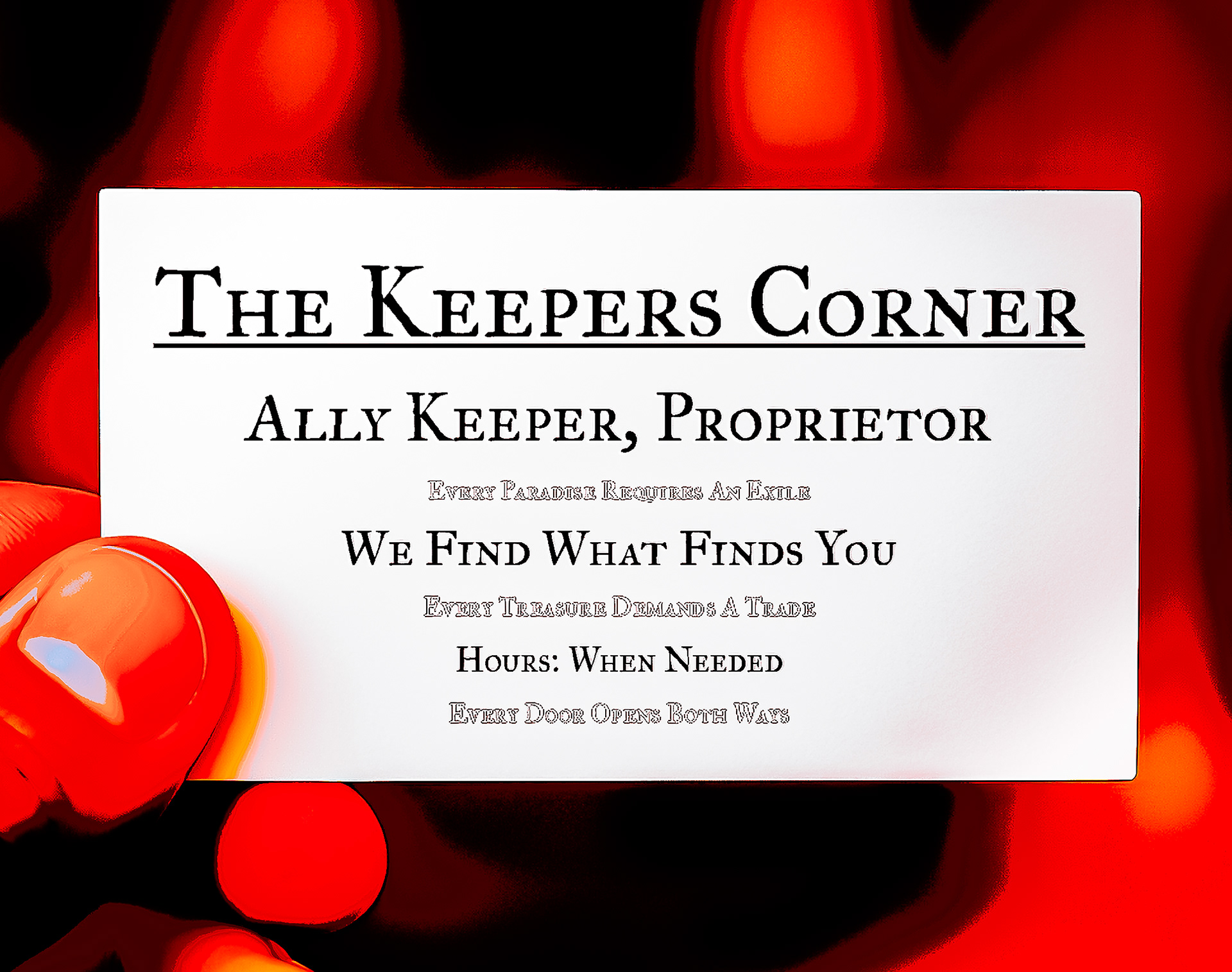
He produced a business card from nowhere visible, the motion too smooth to track, like magic performed by someone who'd forgotten it was supposed to look difficult. "Tell your folks The Keeper's Corner is open for business. First item free for founding families. We specialize in finding what finds you."
The card in Oliver's hand felt warm like it had been sitting in afternoon sunlight that belonged to houses he'd never visited, heat that felt like memory rather than temperature. When Harmony leaned close to examine it—close enough that Oliver could smell something like vanilla and the particular freshness that came from shampoo that cost more than his family's weekly grocery budget—the warmth changed quality, becoming chaotic rather than controlled, as if the card couldn't decide which frequency to broadcast when she was near.
The text seemed to rearrange itself when he wasn't looking directly, business hours shifting like children who couldn't sit still:
THE KEEPER’S CORNER
Ally Keeper, Proprietor
"We Find What Finds You"
Hours: When Needed
"Founding families?" Harmony asked, her voice carrying the particular tone she used when asking questions that sounded innocent but consistently revealed information people didn't realize they were sharing.
Ally's smile widened by precisely the right degree—not enough to seem eager, too much to seem indifferent. "The ones who'll matter when the story gets complicated. You'll recognize them when you see them. They're usually the ones who think stories happen to other people."
A bell Oliver couldn't locate rang eight-fifteen, the sound carrying across morning air that tasted of exhaust from cars people drove until the payments were worth more than the vehicles. School in fifteen minutes, where being late meant detention that cost an hour of after-school job hunting that might help his parents with the grocery money.
Harmony tugged his sleeve with uncharacteristic directness, and the touch sent electricity through Oliver that made the business card pulse in response—differently, like two instruments trying to find harmony instead of unison.
"Nice meeting you," she said to Ally, already pulling Oliver away with determined efficiency that suggested she understood some conversations needed endings before they found natural conclusions.
"Likewise, Ms. Fuller. Mr. Reeves." He touched his forehead in a salute that belonged to no military Oliver knew. "Remember—the door's always open. Even when it's closed. Especially then."
They didn't speak for two blocks, Oliver's bike clicking between them like a metal heartbeat keeping time with thoughts too complex for twelve-year-old vocabulary. The business card radiated warmth that seemed to respond to his proximity to Harmony, growing warmer when she walked closer, cooling when she drifted away, as if measuring distances that had nothing to do with footsteps and everything to do with feelings he was still learning to name.
Finally, Harmony said, "He knew our names."
"Yeah."
"We never told him our names."
"Yeah."
"That should bother us more than it does, shouldn't it?"
Oliver thought about his parents checking phones with the desperate frequency of people waiting for news that might change everything or nothing, checking for messages from Dr. Morrison about test results that would translate hope into numbers or numbers into bills they couldn't afford to pay. But he also thought about how Harmony's presence made the business card fluctuate between temperatures, like it couldn't decide which response served its purpose when she was near enough to interfere with whatever it was designed to detect.
"Maybe we're just getting used to things being different than they're supposed to be," he said.
Harmony made a sound that might have been agreement or might have been the wind catching in her throat. They reached the corner where their paths divided—she toward developments where military money built Mediterranean dreams with three-car garages, he toward the middle-income maze where tech workers convinced themselves the commute to San Francisco wasn't slowly killing them one traffic jam at a time.
"Oliver?" She paused, one foot already pointing toward her different life. "That quote in the window. Jean Paul Richter. German Romantic writer. My mom has it needlepointed in the downstairs bathroom."
"Okay?"
"She bought it at an estate sale last year. From a house where the family just... left. Everything still in place, like they'd stepped out for milk and never came back. Dinner still on the table. TV still playing. Like they'd been erased from their own lives."
The morning air suddenly felt heavier, like breathing through wet cotton. But Oliver also noticed how Harmony's eyes—had they always been that particular shade of green, like sea glass that had spent decades learning to catch light?—held concern that seemed specifically calibrated for his welfare.
"The house was on your street," she added, her voice carrying information like a gift she wasn't sure he wanted to receive. "Three doors down from yours."
Then she was gone, designer backpack bouncing with each step, moving away like someone who'd delivered a message and trusted the recipient to decode its significance. Oliver stood alone with his bike and the business card that felt too warm when he thought about green eyes and too cool when he thought about houses where families disappeared between dinner and dessert.
Above him, October clouds moved across the sun in patterns that looked almost like letters, spelling words in a language that predated vocabulary, creating shadows that fell across Georgia Street like punctuation marks in sentences only the morning could read.
Behind him, The Keeper's Corner settled into its space between the abandoned and the merely forgotten, patient as a spider that had learned webs brought exactly what they were designed to bring, nothing more and nothing less.
The card in his pocket grew warmer when he thought about how Harmony said his name like it mattered. Cooler when he thought about empty houses where families stepped out of their own stories. Warmer again when he remembered the way she looked at him like he might be someone worth protecting.
School bells called across Vallejo like dinner bells, like church bells, like the bells that rang in dreams just before the dreamer decided whether to wake up or sleep a little longer to see what happened next.
Oliver pedalled toward education, toward routine, toward the comfortable fiction of ordinary Tuesday morning in a town that had learned to make do with less than it used to need. But something had shifted in the morning light, in the weight of the air, in the space between what was empty and what was full. And something had shifted in him too—awareness that had nothing to do with mysterious shops and everything to do with the way certain people could change the frequency you used to receive the world.
He was twelve years old and tired of being twelve, but maybe beginning to understand why thirteen might be worth the wait.
He was old enough to know that some doors, once noticed, rearranged everything around them.
Old enough to recognize that some people, once seen clearly, changed how you measured the distance between yourself and the rest of the world.
The Keeper's Corner waited behind him, patient as October, patient as memory, patient as the paradise we build from what we've lost and the paradise we hope to find before we lose that too.
But ahead of him, school waited where Harmony would be in first period English, making the business card fluctuate like a compass trying to find magnetic north in a world where the poles had shifted overnight and nobody had updated the maps to show where home was supposed to be anymore.
That afternoon, Oliver came home to the sound of his mother laughing at nothing, and somehow that was worse than if she'd been crying.
Not nothing exactly—Vivian Reeves stood in the kitchen with her laptop balanced on counter space between unpaid bills and grocery coupons she'd printed but would forget to use, giggling at a YouTube video about meal prep where a woman had somehow managed to set a sweet potato on fire. But Oliver knew the difference between his mother's laugh and the sound she made to fill spaces that had grown too quiet, the way people whistle past graveyards—not from joy, but because silence gives darkness too much room to grow.
This was the filling kind, bright and sharp as Halloween candy wrappers, crackling with the particular energy that came from trying to find joy in circumstances that weren't offering any up voluntarily.
"How was school?" she asked without looking up, chopping carrots with the precision of someone who believed proper technique could restore order to breathless kitchens
"Fine." Oliver dropped his backpack by stairs that led to bedrooms they'd furnished with credit cards that carried interest rates designed to make furniture feel like long-term relationships. The business card from The Keeper's Corner radiated heat through his jeans pocket like a small engine running on fuel he couldn't identify, its warmth cycling in patterns that seemed to respond to thoughts he couldn't control…strange, alive, impatient.
He'd transferred it between notebooks twice during math class, trying to find a location where he couldn't feel its pulse, but it had developed opinions about where it wanted to rest. During English, when Harmony had read aloud from To Kill a Mockingbird—her voice giving Scout Finch's words a precision that made other students actually listen—the card had cooled noticeably, as if her voice carried frequencies that interfered with whatever signal Ally had tuned it to receive.
"Just fine?" The knife paused mid-chop. Vivian Reeves possessed radar for her son's emotional weather, though lately that radar seemed calibrated to frequencies Oliver wasn't broadcasting on, picking up static from conversations he wasn't having while missing signals he thought were unmistakable.
"We're starting local history. Did you know Mare Island used to build nuclear submarines?” Oliver offered, because sometimes the best way to redirect parental attention was information that couldn't be analyzed for hidden emotional content.
"Mmm." Back to chopping, each slice creating small thunder that echoed off walls painted the colour of butter that had lost its optimism. "Your father's in his office. Conference call with Singapore. Or maybe Shanghai. One of those places where it's tomorrow."
His father's office was what they called the spare bedroom now, though the wallpaper border still showed faded sailboats from when the room had been waiting to become a nursery painted in colours that wouldn't commit to pink or blue but promised to welcome whatever arrived. The sailboats had been chosen for their neutrality and their suggestion of voyages to places where possibilities hadn't been narrowed down to appointment schedules and insurance co-pays that made hope feel like a luxury purchase.
Oliver climbed stairs that creaked with the particular complaints of houses built when lumber was cheaper and builders assumed families would stay put long enough to make mortgage payments feel like investments rather than rent paid to banks that had learned to make profit from other people's dreams of stability.
Through the cracked door, he could see Neil Reeves wasn't on any call. He sat staring at his monitor like someone trying to decode messages written in languages he'd once known but had forgotten through disuse, hand poised over the mouse like someone about to click on something they couldn't take back.
The screen displayed an email with too much white space, the kind companies sent when they were trying to make rejection sound like career guidance: "We regret to inform you that your recent application has been filled by a candidate whose qualifications more closely match our current needs..." Oliver could read the corporate language even upside down, having developed the skill that came from living with adults who received too many emails that began with "We regret" and ended with "We encourage you to apply for future opportunities" that never seemed to arrive.
His father clicked the window closed and opened a spreadsheet full of numbers that probably meant something to someone, somewhere, but looked like mathematics designed to make hope feel optional. His shoulders held the defeated curve of a question mark nobody wanted to answer, the posture of someone who'd spent two decades building expertise that algorithms had decided wasn't worth translating into contemporary relevance.
Oliver backed away, sock feet silent on carpet that still carried new-house smell despite three years of mortgage payments that left less each month for things like replacing the cereal with name brands or fixing the dishwasher that had started making sounds like it was digesting something it shouldn't have eaten.
Outside, Mr. Antonelli watered his lawn in October drought with the mechanical persistence of someone who'd forgotten that grass needed water everywhere, not just in the narrow strip he'd been soaking for the past fifteen minutes. The spray caught afternoon light like broken promises, creating small rainbows that lasted just long enough to seem significant before disappearing into earth that couldn't absorb any more good intentions.
The Nguyen kids sat on their front steps arranged by height like Russian dolls, not playing, just sitting and watching something only they could see. Their bikes lay abandoned in the driveway, wheels spinning occasionally when touched by breezes that seemed to affect nothing else, creating slow rotations that caught sunlight and held it just long enough to hypnotize anyone who looked too closely.
In his room, Oliver sat at the desk his parents had assembled from IKEA instructions that had required two trips back to the store and one argument about whether the holes were pre-drilled correctly. The business card felt warm against his palm, radiating heat that had nothing to do with room temperature and everything to do with purposes he couldn't name.
In afternoon light that fell through windows facing west toward San Francisco Bay, it looked almost ordinary, even inviting—cream-colored cardstock with elegant lettering looking almost child-like in its innocence-
THE KEEPER’S CORNER
Ally Keeper, Proprietor
"We Find What Finds You"
Hours: When Needed
But when he tilted it toward the window, words appeared in the margins like messages written in ink that only revealed itself under specific conditions, letters that seemed to rearrange themselves when he wasn't looking directly:
Every paradise requires an exile
Every treasure demands a trade
Every door opens both ways
The warmth spread through his fingers with heat that felt like sunlight stored in stones and released slowly, not unpleasant exactly but carrying implications he couldn't name. It felt like fever that made you feel powerful instead of sick, like energy borrowed from sources that expected repayment in currencies you hadn't learned to recognize yet.
He thought about throwing it away, then thought about his father's defeated shoulders, his mother's brittle laughter filling spaces that had grown too quiet, the sailboat wallpaper waiting for passengers who might never board. Three doors down, Harmony had said. That's where the Miller family had stepped out of their own story and never returned.
From his window, Oliver could see 4247 Meadowbrook Lane with uncomfortable clarity. Same split-level design as all the others, same drought-resistant landscaping that suggested surrender to conditions beyond individual control, same pretence of suburban normalcy that felt more like performance than authentic life. But something about it sat wrong in the afternoon light, like a photograph where one person's face had been carefully removed and the space filled with something that almost matched but didn't quite convince anyone who looked closely.
He'd never seen anyone enter or exit, never witnessed the small dramas that made houses feel inhabited rather than merely maintained. The lawn stayed mysteriously kempt—not perfect, but presentable enough to avoid citations. Mail disappeared from the box at appropriate intervals. Newspapers never accumulated into evidence of absence. As if the house was breathing but not living, maintaining itself through biological functions that didn't require consciousness.
"Oliver!" His mother's voice carried up the stairs with forced brightness that couldn't quite mask the underlying frequency of someone fleeing circumstances that had become too small to contain what they were trying to accomplish. "Running to Kaiser. Back in an hour!"
The front door closed with the definitive sound of someone escaping their own life for sixty minutes of sitting in waiting rooms that smelled like disinfectant and deferred dreams, where magazines from previous decades offered advice about problems that seemed quaint compared to current anxieties. Oliver heard his father's office door open, footsteps in the hallway that moved with careful precision, bathroom door closing with the soft click of privacy claimed for rituals too personal to be overheard.
The shower started with pressure that suggested someone standing under water not for cleanliness but for the white noise it provided, coverage for sounds that pride couldn't afford to let escape into hallways where twelve-year-old sons might hear them.
Even from his room, even with water running at full pressure, Oliver could detect what lived in the spaces between sounds—not crying exactly, but the negative space where crying would go, silence that had its own weight and occupied more room than sound ever could.
He pocketed the card and headed downstairs, moving through rooms that felt like they were holding secrets in every corner, stories that had been edited down to what families could afford to acknowledge when speaking aloud cost more than staying quiet.
The afternoon had gone gray while he wasn't watching, October light fading with the resigned exhaustion of someone who'd worked hard all day and had little to show for the effort except the knowledge that tomorrow would require the same expenditure of energy for equally uncertain returns.
The street stretched empty except for a single figure at the far end—someone in a Vallejo Redhawks letterman jacket moving with the easy grace that came from never doubting that bodies were designed to cooperate with intentions, that futures were supposed to unfold like red carpets rolled out by invisible hands.
Even from this distance, Oliver recognized Hunter Reese—no relation despite the name similarity that had caused confusion since kindergarten, when teachers assumed they were brothers and seated them alphabetically side by side. Hunter represented what Oliver's father called "that kind of kid," which meant the kind whose advantages accumulated like compound interest, whose mistakes became learning experiences while other people's learning experiences became permanent records.
He made varsity as a sophomore, dated seniors without apology, threw parties when his parents travelled to wine country for weekends that lasted just long enough to maintain plausible deniability about what happened in houses left unsupervised. The kind whose future stretched ahead like a highway with no speed limits and no tolls, assuming he didn't crash before reaching whatever destination everyone expected him to claim.
As Oliver watched, Hunter froze mid-step, body locked like a paused broadcast, the image held too long on a single frame.
His head tilted slowly, like a radio antenna picking up some distant and deliberate commands threaded through static, rewriting his next move before he even knew he’d received them.
Then he turned—not toward his house with its three-car garage and Mediterranean pretensions, not toward school where his name was already being engraved on trophies he hadn't won yet, but toward downtown, toward Georgia Street, toward the commercial district where check-cashing places and discount groceries served people whose economic lives happened in the margins between traditional banking hours.
Toward The Keeper's Corner.
Hunter moved differently now, each step deliberate as sleepwalking but purposeful as prayer, the letterman jacket suddenly looking like costume rather than identity. As he passed the Antonelli house, Mr. Antonelli stopped watering his lawn and watched Hunter's procession with the intensity of someone trying to remember a dream that had felt crucial upon waking but was dissolving into fragments that couldn't be assembled into meaning.
Oliver found himself following, keeping a block between them, his bike abandoned in the garage like evidence of a childhood he'd temporarily outgrown. The business card grew warmer with each step toward downtown, as if approving of the direction while measuring the distance to whatever magnetic force was drawing Hunter toward objects that had been waiting patiently for someone with his specific combination of gifts and vulnerabilities.
Hunter never looked back, never acknowledged the other pedestrians who stopped their errands to watch his procession with expressions suggesting recognition without understanding. They looked like people seeing words written in languages they'd once known but had forgotten through disuse, faces showing the particular confusion that came from almost remembering something important but not quite being able to retrieve it from storage.
Dr. Kim stepped out of his dental practice still wearing his white coat and latex gloves, as if he'd abandoned a patient mid-procedure to observe something that couldn't wait for appropriate stopping points. Mrs. Rodriguez left her grocery cart in the parking lot, engine still running, keys in her hand but attention focused entirely on Hunter's approach to whatever destination was calling him forward.
The owner of the Filipino market—Mr. Santos, Oliver remembered now, whose daughter Maria was in seventh grade—stood in his doorway holding a pricing gun like he'd forgotten what it was designed to accomplish, his usual efficiency replaced by the particular stillness that came from recognizing something significant happening without understanding what significance meant.
All of them watched Hunter with the same expression Oliver had seen on his father's face when staring at rejection emails—recognition mixed with helplessness, understanding that something important was occurring but lacking vocabulary to name it or authority to intervene.
The Keeper's Corner sat between its neighbours like punctuation in a sentence that had been waiting for the right pause, its windows glowing with light that belonged to autumn afternoons in memories that felt more authentic than most things that had actually happened. Hunter approached the door and stood swaying slightly, one hand raised toward the brass handle but not quite making contact, as if the final inch contained obstacles he hadn't learned to navigate yet.
"Interesting afternoon for a walk."
Oliver spun around, sneakers squeaking against sidewalk still warm from accumulated heat. Ally stood behind him as if he'd materialized from afternoon shadows, wearing clothes that created the same impression of someone who understood exactly how authority should dress when it wanted to be mistaken for friendship. His smile carried the patience of someone who'd learned to wait for exactly the right moment and had developed confidence that such moments always arrived eventually.
"I was just—" Oliver started, then stopped, because explaining felt like confessing to crimes he hadn't realized he was committing.
"Following our friend Hunter? Natural impulse. Humans are social creatures designed to notice when someone breaks pattern." Ally moved past Oliver with confidence that suggested he'd mapped this terrain extensively, keys appearing in his hand with the same smooth motion that had produced the business card that morning. "Though the question becomes whether he broke the pattern, or the pattern broke him. These distinctions can be harder to make than people assume."
He unlocked the shop door, and Hunter's raised hand finally made contact, pushing it open as if he'd been waiting for permission that had finally been granted. The quarterback disappeared inside without acknowledging either of them, moving like someone guided by instructions that didn't require conscious participation.
"Shouldn't you—" Oliver gestured toward the shop, toward whatever was happening inside that required Hunter's presence more than his understanding.
"Stop him? He's a customer, and we're open." Ally leaned against the doorframe; posture relaxed with the practiced ease of someone who never acted without intent.
"Besides, he's not here for me. He's here for what's already his, what's been waiting for someone with his particular needs. Amazing how we can lose things we haven't found yet."
Through the window, Oliver could see Hunter standing in the shop's center like someone awaiting instructions, surrounded by objects that seemed to lean toward him with botanical attention. A football helmet that looked crafted in the 1940s but somehow appeared newer than equipment manufactured yesterday. A trophy that flickered between brass and gold depending on viewing angle, as if it couldn't decide which metal would impress whoever was meant to claim it. A letterman jacket identical to Hunter's except older, newer, impossibly both simultaneously.
But Oliver noticed other objects too, arranged according to organizational principles more complex than alphabetical or chronological order. A nurse's textbook from the 1980s that pulsed with attention when Mrs. Rodriguez's gaze passed over it. Dental tools that gleamed with brightness suggesting they were responding to Dr. Kim's professional expertise. A cash register humming almost inaudibly, creating harmonics calibrated to Mr. Santos's frequency of attention.
Each object waited with the patience of experienced fishermen who'd learned exactly what bait worked on specific species, displaying themselves not randomly but according to elaborate matching systems that paired need with solution, vulnerability with remedy, emptiness with the precise shape required to fill it.
"His grandfather played for Vallejo High," Ally said conversationally. "1962. Full ride to Cal, then Vietnam. Never made it back to see what his athletic ability might have accomplished in peacetime. His father played too—1988. Blew out his knee senior year, spent forty years selling insurance to people who needed protection from the kinds of accidents that had already happened to him."
Ally's voice carried information like gifts Oliver wasn't sure he wanted to receive. "And now Hunter. Star quarterback. College scouts circling like venture capitalists who smell the next big investment. So much potential balanced on the edge of so many ways to lose it all. Three generations of athletic promise, two generations of dreams that got edited down to what reality would actually support."
"What are you doing to him?"
Ally's smile widened by exactly the right degree. "Nothing he doesn't want. That's the beauty of it, Oliver. I don't make anyone do anything they haven't already decided to do. I just provide alternatives to the stories they're stuck in, options they didn't know existed, ways to sidestep patterns that seem inevitable until someone points out that inevitability is often just failure of imagination."
Inside the shop, Hunter reached for the helmet with the deliberate motion of someone sleepwalking toward something they'd been dreaming about without realizing it. The moment his fingers made contact, Oliver felt air pressure change like the instant before lightning strikes, atmosphere reorganizing itself around electricity it was about to conduct. The business card flared from warm to uncomfortably hot, then went cold as winter metal—except for a spot near his heart that stayed warm, the place where he'd felt that flutter when Harmony had tucked her hair behind her ear.
"You should head home," Ally said with gentle authority that disguised instruction as suggestion. "Your mother will be back from Kaiser soon. She'll have that particular expression she wears after appointments with Dr. Morrison—the look that comes from translating hope into medical terminology and discovering some words change meaning when professionals use them. She'll need to see you're safe, even if she's forgotten what safety looks like when so much depends on factors beyond anyone's control."
Oliver wanted to argue, wanted to demand explanations for things that seemed designed to resist explanation, wanted to grab Hunter and pull him away from whatever transaction was being completed. Instead, he found himself backing away from The Keeper's Corner, October afternoon suddenly feeling fragile as tissue paper, as if wrong breath might tear holes that couldn't be repaired.
"Oh, and Oliver?" Ally called, his voice carrying easily across distance that had somehow opened between them. "That house you're curious about. Three doors down? The Millers lived there. Lovely family. Two kids, a dog, all the standard accessories rendered in suburban specifications. They found exactly what they were looking for. Sometimes that's the most dangerous thing that can happen to people who haven't learned to be careful about what they wish for."
Behind Ally, through the shop window, Oliver could see more neighbours gathering like iron filings drawn to magnets they couldn't see but couldn't resist. Dr. Kim was removing his gloves with ceremonial precision. Mr. Santos had set down his pricing gun and was walking toward the shop with determined stride, as if he'd suddenly remembered an urgent appointment he'd forgotten he'd made.
All of them moved toward The Keeper's Corner with the same sleepwalker's purpose Hunter had demonstrated, drawn by whatever magnetic force operated through objects that waited inside for people with their specific configurations of professional expertise and personal vulnerability.
Oliver ran—not walked, not hurried, but ran with panic that emerged from understanding something without being able to name it, breathless urgency that came from recognizing danger that couldn't be explained to adults who'd stopped believing children could perceive threats that escaped sophisticated analysis.
Behind him, The Keeper's Corner hummed with quiet satisfaction of machinery working exactly as designed, processing customers according to specifications calibrated across centuries of practice, creating transactions that felt like choices while serving purposes that transcended individual decision-making.
The business card cycled between ice-cold and fever-hot, as if it couldn't decide whether to warn him about what he was leaving behind or what he was running toward. But that warm spot near his heart remained constant—small rebellion against whatever frequency was broadcasting from the shop, reminder that some responses couldn't be programmed, predicted, or purchased, no matter how sophisticated the system attempting to catalogue human vulnerability.
Some doors, once opened, changed everything about the neighbourhoods that surrounded them.
Some afternoons revealed that the familiar could become strange without warning, that ordinary people could disappear into stories they hadn't known they were part of, that safety was more fragile than anyone wanted to admit and more precious than anyone had taught him to recognize.
And some patterns, once established, expanded to include everyone who'd been waiting without knowing what they were waiting for, drawing them toward transactions that felt like choices but served purposes that remained carefully hidden behind the pleasant facade of getting exactly what you thought you wanted.
Friday night meant lights bright enough to make you believe in futures that probably weren't coming, flooding McCarthy Field with the kind of harsh white glare that could turn seventeen-year-old boys into heroes until Saturday morning reminded everyone that heroes still had to fill out job applications like everybody else.
Oliver sat between his parents in bleachers that smelled like decades of spilled Coke and teenage dreams, watching his mother check her phone for the third time in five minutes. She was doing that thing where she pretended to be interested in the game while really waiting for Dr. Morrison to call with test results that might change everything or nothing.
His father had brought his laptop, claiming he needed to catch up on work, but Oliver could see the reflection of his email inbox in his glasses—mostly messages that started with "We regret to inform you" and ended with "We encourage you to apply for future opportunities" that never seemed to come.
Around them, families who'd scraped together fifteen dollars for tickets tried to make Friday night feel like celebration instead of another reminder of what they couldn't afford to do without thinking twice. The Hendersons were sharing one bag of popcorn between four people. Mrs. Garcia had brought a thermos of coffee instead of buying the three-dollar stadium stuff.
The business card in Oliver's pocket felt warm but not hot, like it was paying attention but not alarmed. Three rows down, Harmony sat with her parents, her dad's military posture making everyone around him sit up straighter without realizing it. When she turned to scan the crowd, her eyes found Oliver's, and she gave him a small wave that made the card flutter with heat as his stomach flipped over.
"Hunter looks good tonight," his mother said, tracking number 17 as he warmed up with throws that spiralled perfect as DNA helixes. "His mother must be so proud."
She said it without meaning anything by it, but Oliver heard the part she didn't say—other people's kids arriving on schedule, other people's genetics cooperating with their plans, other people's futures spreading out like highways with no tolls.
"That's weird," said a voice beside him.
A Black girl about his age had appeared in the empty space next to them. She wore an oversized Redhawks t-shirt and Nikes that had logged serious miles, studying Hunter with the focused attention of someone who understood bodies in motion the way other people understood math problems.
"What's weird?" Oliver asked.
"You're Oliver, right? From Mrs. Patterson's class? I'm Erin Washington." She didn't wait for him to answer. "Watch Hunter's left foot when he drops back to pass. See that little hitch? Like he's protecting something that isn't even hurt yet."
Oliver looked closer. She was right. Hunter Reese, who moved through school hallways like he owned them, was hesitating between steps, like his brain was getting interference from somewhere.
Around the stadium, Oliver noticed other adults in spots that seemed random but felt organized. Dr. Kim sat two sections over, still wearing his white coat from the dental office. Mrs. Rodriguez stood by the concession stand, holding a coffee cup she never drank from. They weren't watching the game so much as waiting for something.
"You play?" Oliver asked Erin.
She made that sound twelve-year-olds make when adults ask stupid questions. "You see any girls on that field? District says they're 'exploring options' but that just means waiting for someone else to pay for what they're supposed to provide anyway." She shrugged. "But I run. I'm fast. Faster than most of these guys, including Hunter. Used to beat him in every race back in fifth grade."
"What changed?"
"He got equipment and coaching. I got told I was getting too old to race against boys." She said it matter-of-fact, like weather. "But I still know what good movement looks like. And that"—she pointed at Hunter—"isn't it."
The crowd stood for the national anthem with the kind of coordination you only see at small-town games, everyone knowing their part without being told. Oliver stood between his parents, the business card cycling through temperatures that seemed to match Harmony's location in his peripheral vision—warmer when she was directly in his line of sight, cooler when she looked away.
On the field, Hunter stood with his helmet under his arm, swaying slightly in air that carried no breeze but seemed to move around him anyway.
The game started normal enough. Vallejo received, ran their usual plays, made their usual mistakes. But Oliver kept watching Hunter during the quiet moments, noticing how he touched his helmet like he was making sure it was still there, still his.
"Your dad's Neil Reeves, right?" Erin had positioned herself to watch both the field and Oliver's family. "My cousin works IT at Kaiser. Says the whole tech industry's getting rough for anybody over forty."
"He's between projects," Oliver said, using the family phrase that made unemployment sound like choice instead of circumstance.
"Yeah, my dad's been 'between projects' since Mare Island closed." Erin's voice carried no judgment. "Seems like a lot of dads are between projects these days."
Her way of saying it made Oliver's chest feel less tight. Like maybe his family wasn't broken, just caught in something bigger that was breaking lots of families.
Second quarter, the Redhawks drove within scoring distance. Hunter took the field for what the announcer called "a crucial drive," his voice crackling through speakers that needed replacing about as much as everything else in Vallejo needed replacing.
The play was simple—handoff to the running back, keep the drive alive, give the crowd something to cheer about that might make them forget about shipyard jobs that weren't coming back and mortgage payments that kept getting harder to make.
Instead, Hunter took the snap, turned toward the running back, and just stopped.
Not frozen exactly. More like he’d been paused—caught between muscle memory and something whispering no. The running back crashed into him with the momentum of expectation meeting sudden absence. The ball popped loose with that particular sound leather makes when everything goes wrong.
Bodies piled on. When they unpiled, Hunter didn't get up right away.
The crowd went quiet the way crowds do when someone's future breaks in real time. Oliver's mother grabbed his father's hand without thinking, that unconscious reach for stability when the world demonstrates how easily things can change.
Erin stood on her bench for a better view. "That wasn't right," she said. "That pause. I've seen plenty of hits, plenty of injuries. That was something else."
Oliver was watching the adults scattered through the bleachers. Dr. Kim had pulled something from his pocket—a small wooden box that he was showing to Mrs. Rodriguez, who nodded like she'd been expecting it. Mrs. Williams, who taught third grade, was smiling. Not mean, but satisfied, like watching a plan work out exactly right.
Hunter was moving now, sitting up with the trainers, but his eyes looked like he was seeing something that wasn't there. Or maybe something that was there but belonged to a different time, a different field.
"Probably concussion protocol," Oliver's dad said, finally closing his laptop. "These things happen."
But Oliver was thinking about Hunter in The Keeper's Corner, reaching for that old helmet, the way the air had changed when he touched it.
"I need some air," Oliver said.
"Game's not over," his mother protested.
"I know. Just need to walk around."
He made his way down the bleachers, past families trying to turn disaster into something manageable, something that happened to other people. At the concession stand, October air tasted like fryer oil and diesel exhaust from the visiting team's bus.
Erin appeared beside him, buying a Coke with bills that had been folded and refolded so many times they felt like fabric.
"That wasn't no concussion," she said.
"No?"
"I've seen concussions. That was something else. Like when my grandmother had her stroke—the world stopped making sense but only to her, and she had to keep pretending it did."
Around them, adults moved with purposes that seemed urgent but unclear, like people who'd suddenly remembered appointments they'd forgotten they'd made.
"You want to know something?" Erin continued. "I was faster than Hunter in fifth grade. Beat him in every race at field day. Then suddenly he's the golden boy getting recruited while I'm just the girl who used to be fast."
"You're still fast," Oliver said.
This seemed to catch her off guard, as if no one had noticed before. She looked out toward the field for a moment, as if it had made the comment, as if it had challenged her to respond. "Fast doesn't matter if nobody's measuring it." She said quietly, half to herself. “But maybe that changes now…maybe whatever happened to golden boy opens doors for the rest of us." She crushed the empty can like punctuation. The business card flared hot, like it was responding to something in her words Oliver couldn't identify.
"There's this shop," he started, then stopped.
Erin studied him with athlete's eyes that read body language like game film. "Downtown? The place that feels like it's watching you back?" She nodded. "Yeah, I noticed it. Made me think of my great-grandmother's stories about crossroads, places where deals get made that nobody remembers agreeing to."
Behind them, Harmony approached with that strategic grace that came from watching her parents navigate military social situations where every conversation had multiple purposes.
"Oliver? Everything okay?" Her concern seemed real, which made the business card spike to uncomfortable heat that had nothing to do with shops or detection and everything to do with twelve-year-old biochemistry encountering feelings that didn't have names yet.
"Hunter got hurt," he managed.
"I saw. Really scary." She moved closer, and the business card went haywire—hot, cold, hot again, like it couldn't process whatever frequency she was broadcasting.
"My dad says these things happen in contact sports. Says the human body's more fragile than we admit but more resilient than we discover." Her voice carried doubt, like official explanations weren't covering observable data.
Erin watched this interaction with obvious interest, recognizing chemistry the way she recognized athletic ability—capability that existed whether anyone was keeping official score or not.
"You should probably get back to your parents," Harmony said, but her tone suggested she was following social protocols rather than expressing actual preference.
"Yeah," Oliver agreed, but didn't move.
They stood in harsh concession stand lights, caught in that particular twelve-year-old awkwardness that came from discovering other people could generate feelings that had no relationship to logic or prior experience.
"See you Monday?" Harmony asked.
"Yeah. Monday."
She smiled—specifically for him, he thought—then did that thing where she tucked hair behind her ear with precision that made Oliver wonder if she knew what it did to his nervous system.
Then she walked back toward her parents, creating distance that felt temporary rather than permanent.
"Well," Erin said with a grin. "That was interesting."
"What was interesting?"
"Nothing," she said, grinning wider. "Just interesting how some people can make everything else seem less important just by standing there."
The crowd noise swelled as someone scored something that mattered to someone. Oliver rejoined his parents, who asked no questions because they'd each been equally absent—his mother calculating hope against medical evidence, his father pretending work emails were more compelling than community events.
In the parking lot afterward, an ambulance idled near the gym with lights off but engine running, just in case. Hunter had already been taken to Kaiser for observation of conditions that didn't quite match standard concussion symptoms but couldn't be called anything else without more tests that cost money and raised questions.
Walking toward their car, Oliver noticed the adults from the stands moving through the parking lot with coordination that seemed unconscious but purposeful. Dr. Kim was showing his wooden box to Mrs. Rodriguez. Mrs. Williams stood by her car without getting in, just smiling with that same satisfied expression she'd worn when Hunter's injury had unfolded exactly like she'd expected it to.
Mr. Chen approached the group, pulling folded paper from his pocket that he handled like it was important, valuable, something he'd been waiting to share with the right people at the right time.
"Probably just concerned parents," Oliver's mother said, following his gaze.
"Probably," Oliver agreed, though several of the adults had no kids on the team, no obvious reason to be conducting what looked like business in a high school parking lot at ten o'clock on Friday night.
The business card pulsed once, definitive as punctuation at the end of a sentence everyone had been reading but nobody wanted to finish.
Some doors opened whether you walked through them or not, changing everything about the neighbourhoods around them. Some patterns, once started, expanded to include everyone who'd been waiting without knowing what they were waiting for.
And some Friday nights in towns that had learned to make do with less became the nights everything changed, especially when the changes looked like nothing more than athletic injuries and adult conversations and community coordination that felt completely normal until you noticed that normal had started meaning something different than it used to mean.
The Keeper's Corner waited downtown, patient as October, patient as hunger that had learned to look like opportunity, patient as processes that had learned to feel like improvement instead of what they actually were.
But first, adults had to finish becoming what they'd been moving toward all along—transformation that felt like professional development instead of something else entirely, community leadership instead of coordination, democratic participation instead of preparation for decisions that would serve purposes nobody had agreed to support but everyone would end up choosing anyway.
The equation was balancing itself through variables that included athletic performance and economic anxiety and family security and medical intervention, all arranged so that what came next would feel like community choice instead of systematic elimination, resource optimization instead of something that had other names, names that belonged to different times and different places and different stories that weren't supposed to be happening in Vallejo, California, on Friday nights when all anyone wanted was for their kids to score touchdowns and their mortgages to get easier and their hope to cost less than it seemed to require.
In Oliver's pocket, the business card kept time with a heartbeat that might have been his, might have been Hunter's, might have been the whole community's learning to beat in rhythm with something that had been broadcasting since before anyone knew they were listening.