
Read the Introduction, Prologue and chapter one below!
Also available on the kindle page.
Also available on the kindle page.
“I’ll show you acting.”
— Nicolas Cage, age fifteen, to his uncle Francis Ford Coppola,
in the back seat of a car in Beverly Hills, late 1970s
NICOLAS CAGE IS THE WRONG QUESTION: The Bunny, The Box, and the High Price of Too Much is the first full-length, fully cited biography of Nicolas Cage that actually follows his whole life and career, film by film, across forty years.
It starts in Long Beach and Beverly Hills: August Coppola’s classrooms, Joy Vogelsang’s illness, Francis Ford Coppola’s shadow, access without security. From there it tracks the early explosions in the 1980s – Valley Girl, Birdy, Raising Arizona, Vampire’s Kiss – as a run of controlled experiments in performance rather than a string of curiosities. Accents, bodies, timing, voice, all pushed until something new appears on screen.
The book then follows the better known stretch through the 1990s and early 2000s: Leaving Las Vegas, The Rock, Con Air, Face/Off, Bringing Out the Dead, Adaptation, National Treasure. It looks at how those films turned “Nicolas Cage” into a high-priced asset, how the contracts and commissions were structured, how the mid-budget star vehicle began to vanish under his feet, and why the person doing the work never ended up with lasting protection.
Collapse is laid out in detail. Tax liens, bad advice, castles and properties that behave more like debt containers than trophies, the shift into VOD thrillers financed through foreign pre-sales where his name functions as collateral. The tabloid years in New Orleans, the meme boom that strips two decades of craft down to reaction clips, the way that constant circulation reshapes what he is allowed to do next.
This is built from the record: hundreds of interviews, profiles, box office reports, legal filings, trade pieces and critical essays, pulled together into one narrative and fully referenced. The filmography is treated as evidence, not decoration. Birdy, Raising Arizona, Vampire’s Kiss, Leaving Las Vegas, Face/Off, Bringing Out the Dead, Adaptation, Bad Lieutenant, Joe, Mandy, Pig, The Unbearable Weight of Massive Talent, Dream Scenario, Longlegs, Butcher’s Crossing, Renfield, Arcadian, The Surfer and more are read closely for what they show about his technique and for what they reveal about the structures around him.
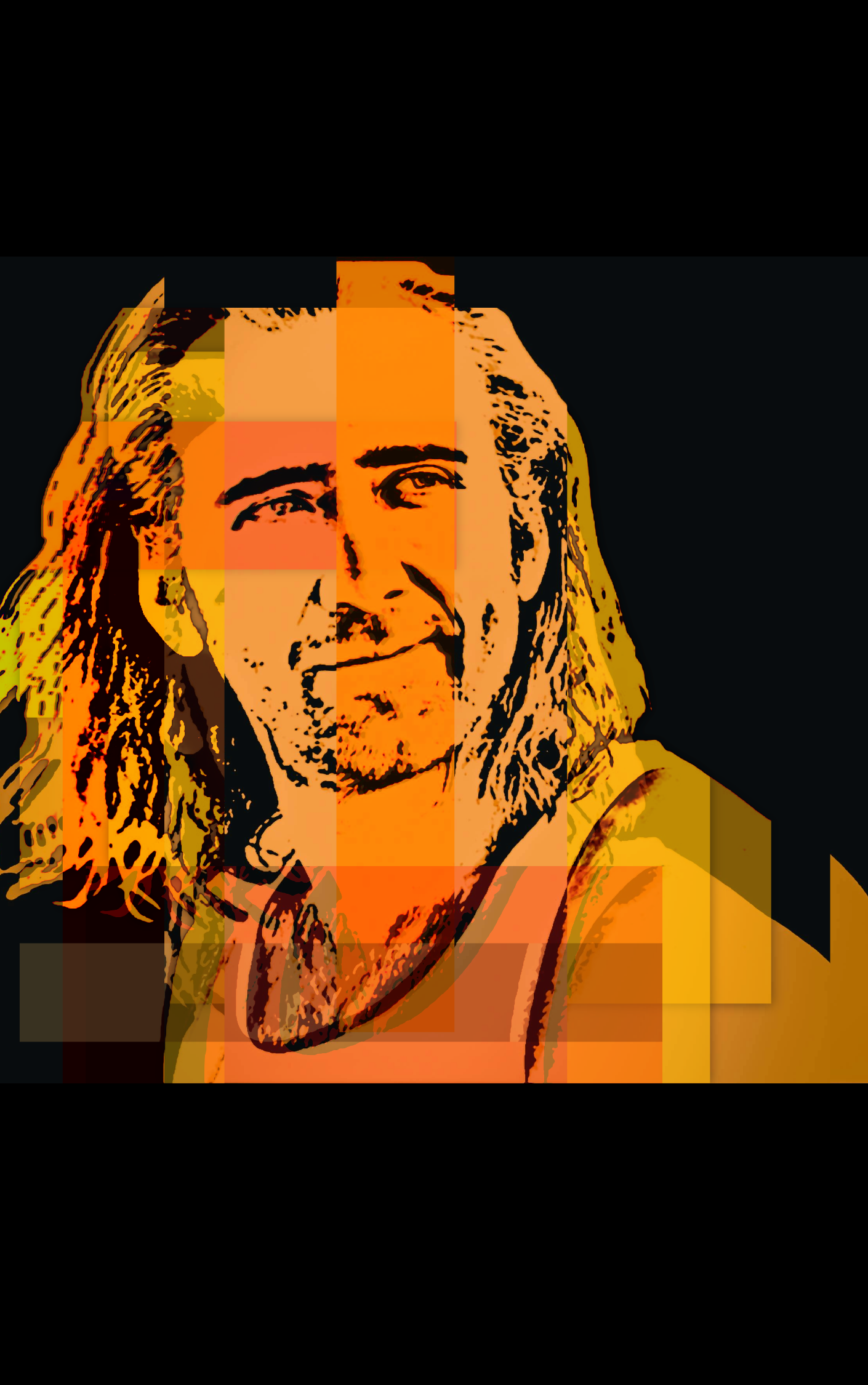
Birdy appears as the first full statement of what he’s willing to do with his body for a role; Leaving Las Vegas as the moment that discipline briefly lines up with awards, leverage and a price tag that changes his life. Pig proves that the quieter end of his range was always there, waiting for material that could hold it. Longlegs shows that audiences will still turn out in force when someone builds a film around his instincts instead of treating him as a meme.
By the end, Nicolas Cage appears as both artist and worker: someone who kept building strange, committed performances while the industry around him turned that commitment into a financial instrument, ran it into the ground, then found new ways to profit when he started to climb back out. The result is a biography that doubles as an x-ray of modern Hollywood: how stars are made, spent, written off, and sometimes, against the odds, taken seriously again.
This book keeps returning to a single image: a Bulgarian soundstage in 2016. One more compressed shoot, one more skeletal crew, one more script read on the plane over. Nicolas Cage walks onto set at fifty-two, doing the same physical preparation he did for Birdy thirty-two years earlier: the work on movement, the immersion, the private rituals that tighten a performance until it sits right in his body. It’s the same discipline that helped win him an Academy Award and turn him into one of the highest-paid actors in Hollywood.
What has changed is everything wrapped around that discipline.
Birdy was chosen; this work is mandated. Birdy was art-house ambition under Alan Parker, shot on film with prizes in mind more than profit. This is a thriller built for the post-theatrical economy, financed through foreign pre-sales that needed his name contractually locked in before a frame existed. His face secured the budget. His future labour collateralised the loan. The work inside him is the same; the ownership conditions around him are not.
Twenty years earlier, holding his Oscar for Leaving Las Vegas, Cage looked out at an industry that had never paid him for that performance and said, almost in disbelief: “Oh, boy. $3.5 million budget, some 16mm film stock thrown in, and I’m holding one of these.”¹ What he didn’t say—and what only surfaced decades later, when director Mike Figgis finally talked about it—was that his promised $100,000 fee never arrived. Lumiere Pictures claimed the film “never went into profit” and kept both his and Figgis’s pay, despite a worldwide gross of roughly $50 million on a $4 million budget.² He won Hollywood’s highest honour and wasn’t paid.
Within a year he was earning $20 million per film. The Rock, Con Air, Face/Off: the blockbuster trifecta that turned critical validation into raw pricing power. Between 1996 and 2011, trade coverage and industry estimates put his acting income at over $150 million in salaries alone, with $20 million cheques for Gone in 60 Seconds, Windtalkers and National Treasure.³ At the peak he owned fifteen homes across multiple countries: an English castle, the famously haunted LaLaurie mansion in New Orleans, a private island in the Bahamas. He collected rare comics, vintage cars, shrunken heads, a dinosaur skull. The lifestyle rose to meet the best-year income and quietly assumed the best year would be the baseline.
Then the architecture buckled. By 2009 he owed the IRS more than $6 million in back taxes. He sued his business manager for $20 million, accusing him of negligence and fraud. Properties were foreclosed, auctioned, unloaded at losses that compounded the damage. The tabloids had their feast: Crazy Cage, the man who bought castles and couldn’t pay his bills. The memes followed. His face circulated endlessly—reaction GIFs, YouTube supercuts, “Not the bees” on infinite loop—generating engagement for platforms he didn’t own and advertising revenue he never saw.
And still he worked. Multiple films every year. Four released in 2016, five in 2017, six in 2019. The same preparation, the same discipline, now poured into projects that would arrive on streaming menus and bargain-bin DVD racks. The capacity hadn’t gone anywhere—anyone who watched Mandy or Pig could see that—but the obligations had changed. “I developed this mantra,” he told The Hollywood Reporter in 2022. “I never had a career, I only have work.” Asked what happens if he stops, he didn’t reach for mystique or mythology: “I’m a better man when I’m working because I don’t want to be that guy that’s sitting by a pool getting bombed on mai tais and Dom Perignon.”⁴ The work continued not despite the crisis but because of it.
That soundstage in Bulgaria is the right frame, not as a symbol of failure but as an x-ray. It shows the question clearly. How did $20 million leverage turn into this? What, exactly, did forty years of labour buy for the man doing it—and what did it buy for everyone else?
The title of this book is both answer and accusation: Nicolas Cage is the wrong question.
The question people usually ask—“What happened to Nicolas Cage?”—starts from the assumption that the answer is inside his head. It hunts for an inner flaw: psychology, character, “bad choices,” eccentric impulses. If we can just understand why he bought those castles, why he spent that money, why he said yes to that string of VOD thrillers, then the trajectory becomes a morality tale about personal excess and poor judgment. The industry gets to walk away unexamined.
That framing is extremely useful—for the industry. If Cage is simply crazy, or undisciplined, or addicted to chaos, then his career tells us nothing about how Hollywood actually works. The commission structures, financing mechanisms and format crashes that shaped his options become invisible. The machine disappears behind personality. We’re invited to tut over one man’s spectacular dysfunction instead of asking how a system built on “back end” fantasy and percentage deals treats the people whose faces it sells.
The better question is blunt: What does Nicolas Cage’s career reveal about the system?
If you start there, he stops being a riddle to solve and becomes evidence. The work becomes a diagnostic record. The path—from Oscar winner to $20 million star to tabloid punchline to VOD workhorse to late-career reclamation—throws light on structures that usually stay off-screen: agency commissions, pre-sales financing, the way platforms strip value out of visibility, the way “eccentricity” becomes the story instead of the economics that exploited it. Gossip is background. The machinery is the subject.
He doesn’t vanish in that shift. He’s there in every chapter: the choices, the performances, the labour that runs underneath all of it. The point is that he’s present inside conditions he didn’t design: the tax code, the agency contracts, the pre-sales spreadsheets, the streaming catalogue. The same system that elevated him to $20 million and merchandised his face on posters took his leverage and turned it into exposure. The same discipline that built Leaving Las Vegas kept him turning up on Bulgarian soundstages three decades later. Both things are true. The frame decides which truth looks like the explanation.
The thesis of this book is simple on purpose: star careers are debt instruments.
That is not a metaphor or a flourish; it is the literal financial arrangement. His face was collateral for foreign pre-sales. The mid-budget financing model that built much of his later career works like this: before a film is shot, overseas distributors buy territorial rights on the basis of attachments. A star’s name on the poster is the guarantee. “Nicolas Cage” in the sales brochure means pre-sales that cover most of the budget before day one. His name underwrites the loan. His future labour is pledged against present financing. He receives an upfront fee, but that fee comes out of debt his image helped secure.
The same image then goes back into circulation as free content. YouTube compilations of his “wildest moments” rack up millions of views and ad impressions. Reaction GIFs and looping clips drive engagement on social platforms that treat him as raw material. “Nicolas Cage Losing His Shit” becomes a miniature content economy. None of that revenue lands with him. There is no licensing fee for a meme. The image that once guaranteed eight-figure cheques is repurposed as zero-cost bait.
Even the people ostensibly on his side were plugged into a system that pays out on motion, not outcome. Agents on ten per cent, managers on five, lawyers, accountants, business managers, art dealers: everybody gets their piece off the gross when the deal is signed, not off the net years later when the tax bill arrives. When the leverage was high, they participated in the high. When the fall came, their money was already safe. The advisory apparatus makes its living on transactions, not on whether the architecture is stable.
None of this is a metaphor for how stardom feels. It’s how the money actually moves. Leaving Las Vegas generates roughly $50 million on a $4 million budget and the people who made it still don’t see the promised fees.² Within a year the same actor commands $20 million a picture. By 2009, the IRS is a creditor, the houses are liabilities and the only exit route that doesn’t involve bankruptcy court is work—whatever work the market will offer him. The star system that creates value at the top converts it into extraction on the way through.
The standard stories we use to explain him all face the same direction, and it’s away from that machinery.
“Crazy” is the tabloid favourite. It’s convenient, memorable and lazy. It stuffs everything—property spree, collections, marriages, VOD era—into a diagnosis: unstable man implodes under the weight of his own chaos. That’s reassuring because it suggests nothing structural is at stake. If he’s crazy, the wider system is fine.
The record doesn’t line up with that fantasy. The same “crazy” person has maintained a brutal level of professional discipline for four decades. He turns up, learns the lines, hits the marks. “I need about two months for the libretto of the screenplay to sink into my instruments so that I can not have to think about dialogue,” he told Rolling Stone in 2022.⁵ That isn’t chaos; that’s craft. The intensity that looks unhinged on screen is built on routine underneath. The preparation is consistent whether the script is Pig or Left Behind. What changes is what that preparation is being used to service.
“Eccentric genius” is the flattering mirror. In that version he becomes a misunderstood saint, a pure artist whose extremes were too much for a conservative industry and a cowardly audience. It swaps insult for praise but keeps the frame: the story lives in his essence and their response. The business arrangements vanish. Hagiography is still individualising; it still leaves the economics untouched.
Meme appreciation pretends to be critical but functions as collaboration. The ironic celebration of his most extreme performances—sharing “Not the bees” or freak-out compilations as “so bad it’s good”—feeds the same circulation engines that exploited him in the first place. Writing 2,000 clever words about the meme without asking who owns the platform and who gets paid is another way of dodging the main question.
Gossip does similar work with more detail. The marriages, the purchases, the oddities become the plot. If the story is “he married X” and “he bought Y” and “he lived in Z,” then the story is about his tastes. The structure that made the castles possible and the collapse inevitable drops into the background. The reader is invited to feel informed about him rather than informed about the machine.
This book takes a different line. It treats his life and work seriously, but it doesn’t pretend it can climb into his head. Interviews are performances. Quotes are moves in a game: attempts to manage an image, process a moment, plant a story. We can use them as evidence of what was said and how he wanted to be seen; we can’t treat them as transparent streams from the unconscious. Where filings and financial records exist—IRS liens, court documents, foreclosure notices—they anchor the story. Where the sources are weaker—tabloids, partial recollections, anonymously sourced rumours—they’re used with caution or not at all. The point is not to flatten him into a case study or to defend him against criticism. It’s to show how a particular life ran through the wiring of a particular system.
He did make decisions. He signed contracts. He authorised purchases. He said yes when he could have said no. Agency doesn’t vanish just because structures matter. But agency operates on a floor somebody else built. Commission structures rewarded high-velocity spending. The mid-budget collapse shrank the range of projects available to an ageing star. Advisors had their own incentives. All of that sits around the choices and shapes them. The goal here isn’t to excuse him or to condemn him. It’s to stop pretending that outcomes like his can be read off personality alone.
To make sense of that outcome, the book tracks a simple sequence: Capacity → Leverage → Debt → Servitude → Recovery.
This is not “rise and fall.” It’s not tragedy in the classical sense (he had it all and arrogance destroyed him), and it’s not an inspirational arc (he was tested and came back stronger). It’s a progression with a missing step where something else should have been—and what’s missing, at the point where it breaks, is autonomy.
Capacity comes first. The early films—Birdy, Raising Arizona, Vampire’s Kiss, Wild at Heart—make it obvious that he can do things other actors either can’t or won’t: punish his body, lean into grotesquerie, fuse sincerity and absurdity, push past tasteful limits while staying rigorous about the work underneath. The industry sees that capacity before it knows what to do with it.
Leverage is when that capacity hits the market. The Oscar for Leaving Las Vegas validates what the performances have already shown; the success of The Rock, Con Air and Face/Off converts it into price. Suddenly there’s a $20 million quote, backend participation, a sense that you can build an opening weekend around one name. This is peak negotiating power. It feels like the moment when a star can finally dictate terms.
In the success story we like to tell, leverage turns into protection. Bigger quotes become producer credits, ownership stakes, refusal power. Keanu Reeves is a clean example of that path: same 1990s star-vehicle ecosystem, similar peak earning power, but he uses that leverage to build 87Eleven, stack producer slots and turn down Speed 2. Labour becomes autonomy.
Cage’s sequence breaks there. Instead of converting leverage into a safety net, he converts it into exposure. Properties multiply. Collections grow. Fixed costs stack up on the assumption that the peak is normal. Commission percentages skim off every deal. On paper the portfolio looks like wealth; in practice it’s a finely tuned dependence on continued $20 million years. The expected “autonomy” slot gets filled by debt.
Debt then reshapes what work even means. When the IRS liens and the Levin lawsuit take that fragile architecture public, he doesn’t negotiate a graceful partial retreat. He works. The volume era—four to six films a year, often financed by foreign pre-sales and destined for streaming—is not a mysterious artistic collapse. It’s debt servicing. The same capacity that once bought him leverage is now pledged to creditors.
Recovery is the late phase, not in the sense that everything is fixed, but in the sense that some control returns. Mandy (2018) shows that in the right hands the extremity still burns. Pig (2021) proves the other side, the stillness people pretended didn’t exist. In the restaurant confrontation where everyone expects him to explode, he refuses to. Restraint becomes the twist. The Unbearable Weight of Massive Talent (2022) is an attempt to seize the meme by playing “Nicolas Cage” as a role. Dream Scenario (2023) literalises the trap: a man consumed by an image that won’t leave other people’s heads. These projects don’t lift him out of the system, but they do mark a shift from compulsory volume to selective work.
The Keanu comparison, held lightly, shows how much is structure and how much is personal. Same era, same star apparatus, same broad set of opportunities. Both men are disciplined workers. Both went through a mid-budget collapse. One converted leverage into a stunt team, a company and a veto. The other converted leverage into houses, objects and fixed costs. That isn’t about moral worth. It’s about how different configurations of advice, risk tolerance and institutional support produce different outcomes under the same rules.
To tell that story cleanly, the book breaks his career into seven phases, each with its own underlying mechanism:
Formation (1964–1982) — inheritance without safety: Coppola access, no Coppola money. A professor father, a film-legend uncle, a family name that opens doors but doesn’t pay rent.
Emergence (1983–1994) — declaration: the change from Coppola to Cage, the fights to be seen as more than a nephew, the performances that crystallise his signature in Vampire’s Kiss. Capacity is declared; it hasn’t yet been cashed out.
Leverage Peak (1995–2000) — capital: Leaving Las Vegas, the action trifecta, the $20 million years. Capacity becomes price. The lifestyle floor creeps up to meet it.
Prestige Consolidation (2001–2006) — diversification: Adaptation, Matchstick Men, National Treasure, Lord of War, Ghost Rider. On the surface, a balanced portfolio of franchise, prestige and passion projects. Underneath, the trap under construction.
Crisis Exposure (2007–2012) — collateral: the liens, the lawsuit, the foreclosures, the headlines. The numbers that were always there become public record. His name, once shorthand for box-office insurance, shows up in court documents as an asset in dispute.
Volume Servitude (2013–2020) — obligation: the VOD grind, four to six films a year on aggressively tight schedules. The same preparation poured into projects whose real function is to keep income flowing.
Selective Recovery (2021–present) — reclamation: Mandy, Pig, Massive Talent, Dream Scenario. Fewer projects, more control, a critical narrative that shifts from “what happened?” to “he never actually went away.”
A final section steps back from the timeline and treats two things as exhibits: the money—how the architecture was built, who profited along the way, how the collapse worked—and the work—what the performances prove at every stage about capacity, method and the difference between material and actor.
By the time you reach the end of that path, “What happened to Nicolas Cage?” has stopped being a real question. The answer is straightforward: the system that paid him, packaged him and promoted him happened. Commission percentages and pre-sales spreadsheets happened. The collapse of the mid-budget theatrical market happened. A meme economy that knows how to monetise visibility and has no interest in sharing did its job. None of it required conspiracy; all of it required a man whose face could be turned into collateral.
The evidence is sitting there. It’s in the films that mark out his range and his discipline. It’s in the filings that document the crisis. It’s in the way the work kept going when the leverage was gone. “I’m not the kind of guy that’s going to file for bankruptcy,” he told The Hollywood Reporter. “Whatever happened to me in 2009, I made the decision to work my way out of it.”⁶ The same discipline that held his body together on Leaving Las Vegas is the discipline that keeps him showing up to sets most people will never think about twice.
This is what forty years of work looks like when the system around it behaves exactly as it was built to behave.
The soundstage sits on the outskirts of Sofia, Bulgaria, in an industrial zone at the foot of Vitosha Mountain where the old communist infrastructure has been repurposed for cheaper uses. Nu Boyana Film Studios: thirty hectares of production facilities, ten soundstages, standing sets that can double for ancient Rome or modern New York, and daily rates that undercut Los Angeles by seventy per cent.
The place has a past. It opened in 1962 as Boyana Film, the state-owned studio that produced most of Bulgaria’s cinema under the regime—propaganda, socialist realist dramas, the occasional prestige export for Moscow. After the state collapsed, the studio decayed for a decade. In 2005, Nu Image and Millennium Films, one of Hollywood’s longest-running independents, bought the lot and renamed it. Since then, The Expendables franchise has shot here. Conan the Barbarian. The Black Dahlia. Rambo: Last Blood. London Has Fallen. The backlot includes a replica Roman colosseum, a Middle Eastern street, a facsimile of St Paul’s, and a standing New York City set with brownstones and fire escapes.
None of that is in use in November 2016. The production on Stage 4 is smaller than the action franchises that put Nu Boyana on the map—a thriller with a budget somewhere around four million dollars, an eighteen-day shooting schedule and a distribution plan that skips cinemas entirely. This is a different kind of American film, the kind that fills streaming catalogues and VOD menus. Its existence rests on a financing model built on foreign pre-sales and tax incentives rather than theatrical gross.
The building is cavernous and cold. Concrete floor, exposed steel, industrial lighting rigs that date back to the mid-2000s renovation. Outside, in the thin November light, a skeleton crew smokes near the catering truck—Bulgarian technicians hired through the studio’s service department, a handful of American department heads flown in with the production, a few local actors in supporting roles. Inside, grips adjust a dolly track while the director of photography talks with the gaffer about a setup. The operation is lean: maybe forty people in total, a fraction of what The Expendables needed. No star trailers; the leads are using converted storage rooms down a concrete corridor as dressing rooms.
This is Nicolas Cage’s fifth film of the year.
He walks onto the set at seven in the morning, an hour before his first call. Fifty-two years old now. Grey in the stubble. He carries a hotel coffee and a sheaf of papers—the script, marked in his handwriting, the margins full of notes about character, intention, the interior logic of the man he’ll inhabit for the next eighteen days.
In three weeks, three of his films will be released within days of one another: Army of One, a Larry Charles comedy about a man who flies to Pakistan to hunt Osama bin Laden; Dog Eat Dog, a brutal crime thriller reuniting him with Paul Schrader and Willem Dafoe; and USS Indianapolis: Men of Courage, a World War II disaster drama in which he plays Captain Charles McVay. He has already appeared this year in The Trust, a small heist film with Elijah Wood, and Snowden, Oliver Stone’s NSA whistleblower drama.
Five films, five different corners of the market. “I can’t think of three more diverse characters that I could play,” he told Esquire that November about Army of One, Dog Eat Dog and USS Indianapolis. “And I hope that the fact that they’re all coming out in the same month will highlight the fact that I’m trying to continue to challenge myself and stay productive and growing as an actor. I still see myself very much as a student of film acting and I’m always looking for something to learn.”¹
That’s the public line. The work underneath it is less polite.
In the makeshift dressing room—a converted storage space with a folding table, a mirror ringed with bulbs and a rack of wardrobe—he prepares.
The routine hasn’t changed in thirty years. He’s described parts of it in interviews, though most interviewers don’t know what to do with what he’s telling them. He calls his approach “Nouveau Shamanic,” a phrase that sounds like self-parody until you watch him unpack it: the actor as channel for extreme states, the performance as ritual rather than polite imitation. He lists his influences—German Expressionism, the distorted physicality of The Cabinet of Dr Caligari and Nosferatu; Kabuki theatre, with its stylised movement and formalised emotion; silent cinema, where the face and body have to carry meaning without dialogue. “I love art, I love music,” he’s said. “I can listen to Stockhausen and a very experimental, avant-garde approach, and I can listen to Beethoven and have a more classical, traditional approach. Why not be able to do that with film performance?”²
There’s the voice work. He speaks the dialogue aloud in the small room, testing registers, shaping the character’s rhythm. This man is broken—a criminal, someone who’s made decisions that cost him everything that mattered. Cage shifts his posture as he talks; something changes in his spine, in the set of his shoulders. The way he holds his mouth adjusts. He has spoken about approaching voice like a musician: timbre, pitch, rhythm, the particular quality of breath that colours each line.
There’s the movement work. He paces the cramped space, looking for the gait. Does this man move quickly or slowly? Does he lead with his chest or his chin? How does he put weight on his feet? Physical transformation has been there from the beginning—not just the famous extremes, but the small choices that make one body distinct from another.
And there’s the interior work, the part that doesn’t photograph directly but informs everything that does. Who is this man alone? What memory bites hardest? What does he want that he’ll never admit? “I try to keep my characters raising more questions than giving answers,” he’s said. “I don’t want to leave too much on the table. I want you to have your connection and your secret understanding of the character.”³
He does some version of this for every role. Has done it for every role since Birdy, since Vampire’s Kiss, since the Oscar. The preparation is the same whether the film will premiere at Sundance or appear, unannounced, on a streaming service. The discipline is the discipline. The work is the work.
When the first assistant director knocks on the door at eight, Cage is ready.
The film itself is a heist-gone-wrong thriller. Its budget was stitched together almost entirely through international pre-sales—territory by territory, market by market, long before a frame was shot. A sales agent took a package to foreign buyers: script, director, and a star attachment.
Nicolas Cage.
His name is what makes the numbers balance. The attachment guarantees that the film will sell in Germany, Japan, South America and the smaller European territories where his face still carries recognition. Buyers in those markets don’t care that he hasn’t had a domestic blockbuster in years; they care that “Nicolas Cage” on a poster moves units and justifies a higher licence fee than an unknown lead. His quote on a film like this is a fraction of what it was in 1997, when he pocketed twenty million dollars for Con Air. It’s still enough to make the financing model work. The pre-sales cover most of the budget; Bulgarian tax incentives and below-the-line savings handle the rest.
This is how the VOD economy runs. A producer secures a recognisable star, uses that star’s name to pre-sell foreign rights, shoots in a low-cost jurisdiction on a compressed schedule with a small crew, and delivers a finished project to platforms that always need fresh tiles. The star gets paid; the crew gets paid; the film disappears into the endless scroll. No festival circuit, no awards campaign, no box-office narrative. Just content—manufactured, shipped, forgotten, replaced.
The director—a competent journeyman who’s worked with him before—knows not to crowd him. “You give him the space,” he will say later. “You set up the shot, you call action, and you let him do what he does.” What Cage does, even in a film like this, is commit. Total commitment. As if the material deserves it. As if every character is owed the same depth of preparation.
The Bulgarian crew notices. They always do. The camera operator has worked with dozens of American faces flown through Sofia for quick shoots—names that secure financing, faces that sell foreign rights, bodies that need to be on set for the business model to function. He’s seen the ones who coast, who arrive unrehearsed, hit the marks, say the lines and disappear. Cage is not like that. Cage behaves as if this film matters. The crew doesn’t know his financial situation, doesn’t know about IRS liens or lawsuits or foreclosures. What they see is a worker who takes the job seriously.
In 1984, a young Nicolas Cage lost fifteen pounds for a role. He was twenty years old, still using his birth name in some auditions, hungry in a way that had nothing to do with diet.
The film was Birdy, directed by Alan Parker, adapted from William Wharton’s novel about two Philadelphia boys whose friendship is warped by Vietnam. Parker had already made Midnight Express, Fame and Pink Floyd: The Wall. He had a reputation for intensity—for pushing actors, for making films that left marks. Cage played Al Columbato, a working-class kid who returns from the war with his face shattered by an explosion, his jaw reconstructed with steel, his features hidden for much of the film beneath surgical bandages.
Matthew Modine got the title role. He had auditioned for Al, but Parker saw an “introverted honest quality” that suited the silent, damaged Birdy. Cage took Al instead: the loud one, the charismatic one, the friend who has to carry the film’s emotional weight through monologue and memory while Modine crouches naked in a hospital room, refusing to talk.
“I was terrified of the role of Al,” Cage told the New York Times that year, “because it was like nothing I’d ever done before, and I didn’t know how to get to the places the role was asking me to go emotionally.”⁴
So he went further than the brief. He dropped fifteen pounds because a man with a shattered jaw wouldn’t eat properly. The weight loss would show in his face, in the way his clothes hung, in the hollowed look of a body that has been through something. He slept with his head wrapped in bandages for weeks before shooting, producing the acne and ingrown hairs that would make his skin look genuinely damaged when they came off. And he had two teeth pulled.
They were baby teeth, teeth that would have needed extraction eventually. He timed the procedure to the shoot, turning a mundane dental job into a piece of method. “They were baby teeth,” he explained later. “So I took advantage of it and had them out. I thought it would add an interesting dimension to the role.”⁵
That’s what “preparation” looked like at twenty. Total commitment. The willingness to hurt yourself for the work. The assumption that the role demands everything and that “everything” is the only acceptable response.
Parker was impressed, even if he rolled his eyes in public. The film required Modine to hold the title role through silence and physical contortion—bird-like, naked, psychologically broken. Cage had to be the engine: loud enough to fill the space, vulnerable enough to make the friendship believable, damaged enough to show what the war had done to both of them. The performance announced him—not as a movie star yet, but as an actor who would go further than expected.
Birdy opened in limited release in December 1984. It flopped at the American box office, grossing only $1.4 million against a $12 million budget. TriStar cancelled the planned wide release. But Cannes loved it; the film won the Grand Prix, the festival’s second-highest prize. Roger Ebert gave it four stars. The National Board of Review put it in the year’s top ten. Nicolas Cage, twenty years old, had demonstrated what he was capable of.
Thirty-two years later, in Sofia, in a converted factory at the foot of Vitosha, Nicolas Cage prepares for a thriller no one will remember.
The same discipline. The same commitment. The same attention to voice, movement and interior logic. He still acts as if the work matters, because to him it does. The context has degenerated: this isn’t Alan Parker, this isn’t a Cannes hopeful, this isn’t the opening move in a career that could go anywhere. The preparation has not.
“I’m not in competition with anybody but myself,” he has said in some version for decades. “My goal is to beat my last performance.”⁶
In 1984, Birdy was an investment. A young actor betting his body on a role that might establish him, that might prove capacity, that might turn access into a career. The risk was artistic: would the performance land? Would the film play? Even with the commercial flop, the gamble paid off—Cannes, critics, a reputation for commitment that would define him.
In 2016, this work is not investment. It is obligation.
The films keep coming—five this year, six next year, and so on—because they have to. The properties, the tax problems, the compound effect of commissions and bad advice turned past leverage into current pressure. The model that attached itself to his face needs volume.
His face sells foreign territories. His name secures production loans. His labour services an architecture that became public in 2009, when liens, lawsuits and foreclosures surfaced what had been quietly building for years. The prep is the same; the stakes are different. The same actor, the same method, the same commitment—deployed now into scripts that don’t deserve him, for money that goes to service debt, inside a structure that extracts value from his name without giving him much back in position.
From a distance, the volume looks like decline: too many films, too little money, too many streaming tiles, not enough “event.” Up close, it’s something else entirely. The capacity is still there. The discipline is still there. The man who pulled his teeth for Birdy and ate a live cockroach in Vampire’s Kiss and destroyed himself in Leaving Las Vegas is still on set before call time, still doing the work. The people who work with him see it. The directors who know what he can do see it. Anyone who watches the performances instead of the loglines sees it.
What has changed is who the work belongs to.
How did he get here?
That’s what this soundstage forces you to confront. Twenty years earlier, he was one of the highest-paid actors in the industry. The Rock, Con Air, Face/Off: peak leverage, peak market power, the twenty-million-dollar quote that put him alongside Schwarzenegger and Stallone as someone who could open a film on name alone. The Oscar for Leaving Las Vegas validated the capacity; the blockbusters monetised it. Everything from Valley Girl through Birdy and Vampire’s Kiss had compounded into what looked like real strength.
Then the floor gave way—not in his ability, but in his position. Leverage turned into exposure. Choice turned into obligation. The face that once commanded a premium became a piece of collateral in financing plans for films no one would remember.
The lazy question is “What went wrong?”—lazy because it assumes the answer lives in him: psychology, flaw, addiction, hubris. The industry loves that question. “He’s crazy,” the profiles say. “He made bad decisions.” “He squandered it.” Those explanations shove everything structural into the background, reassure everyone that this is a one-off, a freak event, a man who did it to himself.
The question this book cares about is what this trajectory reveals. What does it show about how the star system actually works? About how fast leverage can collapse into debt? About what happens when you build exposure without protection?
The soundstage is the result, not the cause. To understand how he ends up here—why identical preparation produces such different outcomes at different moments—you have to pull back. You have to go back to Long Beach in 1964, to a professor’s son born into a dynasty that offered cultural capital without a safety net. You have to look at the uncle whose career proved that maximum artistic achievement could live right next to maximum financial disaster; that you could make The Godfather and still end up vulnerable. You have to watch the boy who would change his name but never entirely escape it, absorbing a model of artistic ambition and money chaos before he made a single choice of his own.
Formation. Dynasty. A kid who hasn’t yet pulled his teeth for a role, who hasn’t yet learned that total commitment can build a career and cannot, on its own, protect one.
The soundstage in Sofia will still be there when we come back to it. Nicolas Cage will still be preparing. The discipline will still be intact. The context will still be hostile.
First, how he got there.
Capacity as inheritance.
Before there was a “Cage performance,” before the memes, before the tax bills and the VOD years and the late-career reclamation, there was a family problem.
Nicolas Kim Coppola is born in 1964 into one of the few genuine dynasties in American film. Francis Ford Coppola is the uncle who made The Godfather and Apocalypse Now. August Coppola is the father, a literature professor who loves art but doesn’t run studios. Joy Vogelsang is the mother, a dancer whose mental health breaks under the strain. The doors to the industry exist before the kid can walk. The comparisons arrive before he can act.
What he doesn’t inherit is safety. August’s salary pays bills, not legacies. Joy is in and out of hospital. The family shifts from Long Beach apartments to Beverly Hills classrooms—a life built on cultural capital without financial security, access without a cushion. He grows up close enough to see how the business works, far enough away that nothing is guaranteed if he falls.
Francis teaches a very specific lesson in public. Maximum artistic ambition can live alongside maximum financial disaster. He builds Zoetrope and almost loses it. He makes masterpieces and then faces bankruptcy courts. Success and ruin are both on the table. The nephew watches this play out as normal.
Changing the surname from Coppola to Cage is an attempt to step out of that shadow, to be judged on what his own body can do, not on who his uncle is. But the early wiring is already laid down. Formation is where he learns the basic pattern he’ll repeat for forty years: doors that open, models that encourage risk, no real structural protection underneath.
Long Beach, California. January 1964. A professor’s household in a middle-class neighbourhood, not the estate in Napa, not the San Francisco compound, not the mansions that will later appear in glossy “Coppola clan” profiles. This is a different Coppola address—smaller, less insulated, a satellite orbiting the bright centre of a family that is only just starting to become a dynasty.
August Floyd Coppola teaches comparative literature at California State University, Long Beach. His wife, Joy Vogelsang, is a modern dancer and choreographer. They already have two sons: Marc, born in 1958, and Christopher, born in 1962. On January 7, their third son arrives. They name him Nicolas Kim Coppola.
He’s born in the shadow of something that hasn’t quite taken shape yet.
August’s younger brother Francis has just finished principal photography on a low-budget horror film called Dementia 13 for Roger Corman. It’s not nothing, but it’s not yet myth. In four years he’ll win an Oscar for co-writing Patton. In eight, he’ll release The Godfather and move into the small category of people whose work permanently rearranges an art form. The family name is about to harden into a kind of currency in Hollywood, and Nicolas will spend his entire working life dealing with what that currency buys and what it doesn’t.
In January 1964, though, Francis Ford Coppola isn’t “Francis Ford Coppola.” He’s a hustling young filmmaker trying to get out from under studio notes. August is a young academic trying to build a department. The Coppola family is not yet a dynasty; it’s a network of ambitious Italian-Americans—Carmine the musician, Italia the lyricist, their children scattering into film, theatre, literature—on the verge of something none of them can fully see.
Nicolas arrives into that moment of becoming. The household he enters is artistic, intense, unstable, and wired with contradictions that will shape everything that follows.
August Coppola was not a film producer. That simple fact underwrites the entire childhood.
He was an academic—brilliant, theatrical, more interested in ideas than in deals. He earned a philosophy degree from UCLA, a master’s in English from Hofstra, and a doctorate in comparative literature from Occidental College in 1960. By the time Nicolas was born, August was teaching at Cal State Long Beach, a young lecturer in a young institution that had only just made the jump from teachers’ college to state university.
On paper, he looked like a certain kind of mid-century success story: first-generation child of immigrants who climbs through education, ends up with a PhD and a faculty job. In practice, his version of “professor” didn’t look like the stereotype at all.
He helped found the comparative literature department at CSULB with colleagues Thomas Hubble and Peter Carr, pushing for a curriculum that treated “world literature” as more than a polite elective: Latin American writers alongside the Russians, Chinese poetry in the same conversation as the French modernists.¹ He launched Genre: An International Journal of Literature and the Arts in 1967 and served as its editor. He won the first Distinguished Teaching Award in the department’s history.
But even the institutional summary undersells how odd he was willing to be.
He designed the Tactile Dome at San Francisco’s Exploratorium—a lightless maze visitors navigate entirely through touch. You crawl and feel your way through padded tunnels, rubber spikes, slick plastic, netting, rough wood. No vision. The point is to rewire how you process the world. The dome opened in 1971 and it’s still operating: an August Coppola brainwave turned into infrastructure.²
He co-founded the AudioVision Workshop in 1972, experimenting with audio descriptions of films and theatre for blind and visually impaired audiences. He helped make the now-standard idea of audio description into something you could actually do. He wrote a romantic novel, The Intimacy, in 1978. He hosted events where, instead of a standard “ground-breaking,” he staged a “sky-breaking” and told everyone to look up: “The idea is to look up, rather than down—look up to the sky, the clouds, teach young people to dream.”³
The obituaries after his death in 2009 are all variations on the same theme: August thought education should alter consciousness. He wanted teaching to feel like discovery, not discipline. Colleagues describe him as “flamboyant,” “eccentric,” “larger than life.” Students remember having their heads cracked open—in a good way.
This is the intellectual weather Nicolas grows up in. Not Hollywood lunches. Not back-lot politics. A house full of books and records, a father who drags his sons to see Fellini at the art-house instead of Disney at the multiplex, and a belief that art is meant to change the way you perceive the world.
“He was one of the most remarkable characters anybody’s going to meet,” Cage told Playboy in 1996. “When I was a kid, the other kids were seeing Disney, and he was showing us movies like Fellini’s Juliet of the Spirits. This was before video, so he would take us to the art-house cinemas.”⁴
The line that sticks is even simpler: “It’s all right to get an F. You learn from your mistakes. That’s something for an educator to say.”⁵
August supplies cultural capital in bulk—films, books, permission to get things wrong as long as you’re reaching for something. What he can’t supply is the other kind of capital. A state-university professor’s wage in 1960s California pays the mortgage and feeds three boys; it does not buy a studio lot or a Napa estate. The Coppola name will open certain doors, but August Coppola cannot fund what walks through them.
That gap—between a family name that screams “film royalty” and a bank balance that says “salaried academic”—is the first version of the problem.
Joy Vogelsang brings another set of forces into the house entirely.
She’s a modern dancer and choreographer, German-American, born in 1935. She and August marry in 1960 and have three sons in six years. By the time the youngest arrives, something in her has already started to break.
Nicolas is six when his mother is first institutionalised. Schizophrenia. Severe depression. The labels shift across time and different accounts, but the reality is constant: long hospitalisations, returns, relapses, electroshock treatments. The rhythms of childhood are punctuated by disappearances.
“She was plagued with mental illness for most of my childhood,” Cage told Playboy. “She was institutionalized for years and went through shock treatments. She would go into these states that lasted for years. She went through these episodes of poetry—I don’t know what else to call it. She would say the most amazing things, beautiful but scary.”⁶
That phrase—“episodes of poetry”—isn’t casual. The kid who hears his mother speak in language that’s both beautiful and terrifying learns early that intensity and damage can coexist. He learns that altered states don’t look like neat case studies; they look like a person you love saying things that don’t line up with the ordinary world.
“Sometimes she would go into a Rip Van Winkle mode and forget everything that had happened,” he remembered. “That her father had died or that I had become an actor.”⁷
Christopher Coppola talks about her differently. In a Facebook post after her death in 2021, he called her “a very hard life with mental health issues” and then immediately pivoted to what she gave him: a sense that affection was “a good thing,” that touch and care were not weaknesses. “In all of that painful emotional chaos she still managed to teach me something super important.”⁸
Cage stays analytical when he describes it. “Even when things got really bizarre, I was able to detach and look at it with a scientific curiosity,” he said in the same Playboy interview. He rejected the neat trauma causality when asked if her illness explained his nightmares: “Maybe, yet I always felt protected. She never wanted to hurt anybody.”⁹
The one thing he’s never hedged is her influence on his work. “She was the driving force in my creativity,” he told the magazine.¹⁰ And elsewhere: “Children of schizophrenics tend to become overachievers and become this super-vigilant, overachiever type of personality.”¹¹
This is not a stable Hollywood childhood. It’s a middle-class house stressed to breaking: a father teaching full-time and trying to hold things together, three boys watching their mother vanish into institutions and reappear altered, and a constant, low-level awareness that the world can tilt without warning.
There’s a lazy version of the story where Joy just “explains” Nicolas Cage: the weirdness, the extreme performances, the interest in altered states. It’s neat, and it’s wrong. She was a person enduring serious illness for decades, not raw material for later behaviour. What you can say without turning her into a metaphor is that the house was not safe in the way Hollywood nostalgia likes to imagine. The environment taught him vigilance, detachment, and a high tolerance for strangeness.
In 1976, the marriage breaks. August and Joy divorce. Nicolas is twelve.
The details stay mostly off the record. The pressure of Joy’s illness, the demands of August’s career, the strain of raising three boys inside that instability—all of that is easy to infer and impossible to reconstruct precisely. What’s documented is the arrangement that follows: the sons live primarily with August. Joy remains in their lives, turning up at milestones—his Oscar night, his Hollywood Walk of Fame ceremony, the handprint in front of Grauman’s—but the daily pattern of teenage life is shaped by the professor’s house.
The divorce doesn’t create the instability; it formalises it. It confirms what was already the case: there is no big, calm, money-insulated “Coppola home” for Nicolas to retreat to. There is a parent who believes deeply in art and education, a parent who is ill, a broken marriage, and three boys who are not being raised on studio money.
The name says one thing; the lived conditions say another.
Hovering over all of this, mostly in the distance, is Francis.
He’s not in the kitchen at dinnertime. He’s not doing school pick-ups. But his presence saturates the stories, the visits, the way everyone else in the family is described. When Nicolas is eight, The Godfather comes out and becomes an event. When he’s ten, The Conversation and The Godfather Part II hit the same year and Francis walks around with a pair of Oscars under his arm. When he’s fifteen, Apocalypse Now finally limps out of the jungle and onto screens, and the director becomes something more than “successful.” He becomes legend.
The legend has two halves.
There’s the triumph story: American Zoetrope in San Francisco as a rebel studio for directors; The Godfather reinventing the gangster film and turning Paramount’s great fear (“too Italian, too dark”) into a gold mine; The Godfather Part II and The Conversation in the same year; the Palme d’Or for Apocalypse Now. Francis racks up five Oscars. He’s mentioned alongside Scorsese, Spielberg, Lucas as one of the people who rewired the medium.
And there’s the catastrophe story running right alongside it.
Before The Godfather, Zoetrope is already in trouble. Warner Bros. hates THX 1138, cancels their development deal, and demands its money back. Zoetrope owes hundreds of thousands of dollars. The Godfather rescues Francis, but he immediately ploughs the winnings into new bets: ambitious films, expensive properties, the dream of a director-run studio.¹²
Apocalypse Now almost kills him. The Philippines shoot blows up: typhoons destroy sets, war breaks out nearby, Martin Sheen has a heart attack, Brando turns up overweight and unprepared. Francis mortgages his home, borrows against future income, and gambles his personal wealth on finishing the film. Eleanor Coppola’s documentary Hearts of Darkness shows him mid-spiral, terrified he’s making “a disaster” that will ruin him.¹³
“I’m always in money trouble,” he tells Time in 1981.¹⁴
The pattern doesn’t stop. One from the Heart (1982) is a gigantic, neon-lit musical experiment that costs around $26 million and earns less than one at the box office. Zoetrope collapses. Francis files for Chapter 11 bankruptcy protection more than once. The Hollywood General Studio lot he buys in 1979 is gone by 1984. “Bankruptcy is a funny thing,” he says later. “It’s not something that just happens once. It is like an earthquake, it has aftershocks.”¹⁵
That’s the model sitting there in plain view for Nicolas as he grows up: artistic risk at maximum, financial exposure at maximum, triumph and ruin braided together so tightly you can’t pull them apart. The lesson isn’t “don’t risk”; the lesson is that this is what risk looks like when you go all in.
He visits the San Francisco operation. He sees the Zoetrope offices, the edit bays, the soundstages, the wine country property. He sees the toys success can buy and, without necessarily realising it, the fragility underneath: one film away from foreclosure. The uncle everyone talks about as a genius is simultaneously the uncle who is always in negotiations with banks.
Francis later says of August, “He did very well in school and received many awards for writing and other things, and he was like the star of the family and I did most of what I did to imitate him.”¹⁶ That’s its own twist: the “successful” brother imitating the “academic” brother, the hierarchy in public prestige running the other way to the one inside the family.
Nicolas grows up in August’s small Long Beach house, formed by August’s books and obsessions, but the wider world only knows one Coppola name. Francis is proof that you can win every artistic prize and still be one bad quarter away from disaster. That combination—maximum creativity, chronic exposure—will echo, hard, later.
The dynasty surrounds the professor’s house without ever quite absorbing it.
His grandparents, Carmine and Italia, set the tone. Carmine is a flautist and composer who plays with the NBC Symphony under Toscanini and eventually wins his own Oscar for scoring The Godfather Part II and Apocalypse Now. Italia writes lyrics and appears in The Godfather Part III. Their children—August, Francis, Talia—grow up in a house where art is labour, not hobby.
Talia Shire, Nicolas’s aunt, rides her own trajectory: Connie Corleone in The Godfather, Adrian in Rocky, Academy Award nominations for both. She marries producer Jack Schwartzman and has sons who’ll become actors and musicians. That branch of the tree plugs directly into another set of industry circuits.
Family gatherings are thick with actors, musicians, directors, producers. Stories about shoots and scores and studio fights are normal table talk. For a kid like Nicolas, film stops being something that happens in faraway buildings and becomes simply what adults around you do for work. The idea that you might also do it one day feels ordinary.
At the same time, the professor’s house in Long Beach sits at a clear distance from the visible glamour. No swimming pool interviews. No lifestyle spreads. There’s no studio expense account smoothing over the chaos of his mother’s illness. The dynasty’s cultural weight doesn’t show up as a blank cheque.
That “inside but not quite inside” position will repeat. He has the surname that makes casting directors raise an eyebrow. He doesn’t have Francis’s money, or Talia’s residuals, or Carmine’s composer fees. He’s invited into rooms but he’s not of those rooms. He learns early to move like someone who belongs while always knowing his footing is different.
Geography makes the class position even more concrete.
He’s born in Long Beach: port city, oil refineries on the horizon, a mix of working-class and middle-class neighbourhoods, far enough from Hollywood that you have to drive in. At some point in his teens, the family’s circumstances shift enough that he ends up at Beverly Hills High School—the public school that might as well be a specialised institution for entertainment-industry offspring.
Beverly Hills High sits on twenty acres with an active oil well under the athletic fields. The student body in the late 1970s is a catalogue of “somebody’s kid”: producers’ children, lawyers’ children, actors’ children. Alumni lists include Albert Brooks, Richard Dreyfuss, Carrie Fisher, and a whole run of people whose names will be on credits for decades.
Nicolas is there with the name, but he’s still a professor’s son. He’s close enough to see what sheeny, fully funded privilege looks like but goes home to a different reality: a father marking papers, a mother in and out of institutions, money that has to be watched.
That tension—Coppola in the attendance roll, not Coppola in the driveway—matters. He learns how to talk to the kids who treat Cannes and Aspen like normal holidays as well as to the kids whose parents are colleagues of August at the university. He starts to build the code-switching that will let him move between working on a Corman-level production and sitting across from a studio head.
Around fifteen, he takes a summer class at the American Conservatory Theater in San Francisco. The story he’s repeated is simple: that was it. Something clicked. Watching James Dean in East of Eden and Rebel Without a Cause had already lit the fuse; ACT gave him a path. He starts doing monologues at family gatherings, throwing himself around in living rooms, trying to hit the same level of volcanic intensity Dean found in a single close-up.
By seventeen, he’s out. He drops out of Beverly Hills High to go after acting full-time.¹⁷ There’s no fallback position. No vineyard to manage if it doesn’t work out, no seat waiting in an office at Zoetrope. If the jobs don’t materialise, he doesn’t fall back into a rich family’s safety net; he falls into the ordinary Californian scramble for rent.
That decision—high risk, no obvious cushion—isn’t random. It’s what you do if you’ve grown up in a house where art is treated as serious work, watched an uncle bet everything on films, and lived in a city where middle-class stability doesn’t feel like security anyway.
By 1979, the conditions are set.
Nicolas is fifteen. His mother has been in and out of institutions for most of his remembered life. His parents’ marriage has broken; his father is raising three boys on an academic salary and a set of ideas about art that encourage risk more than caution. His uncle has just brought Apocalypse Now back alive and, in the process, demonstrated that “Coppola genius” comes with “Coppola exposure” baked in. The family name opens doors; the immediate household cannot insulate anyone from what’s on the other side.
He’s had a front-row seat to three overlapping realities:
A parent who treats art as a way of expanding perception and is willing to build strange, tactile machines to prove it.
A parent whose mind has turned against her in ways that make ordinary life fragile and who still manages to write “episodes of poetry” through the illness.
An extended family where you can win every possible artistic prize and still deal with foreclosure notices.
That mix produces exactly the kind of person he will become: someone who treats performance as transformation, who has a high tolerance for the strange, and who is not instinctively cautious about financial risk because the main models he’s seen of “playing it safe” weren’t safe at all.
The capacity hasn’t surfaced yet. That belongs to the next phase, Emergence: Valley Girl, Birdy, Raising Arizona, Vampire’s Kiss—the run where “Nicolas Cage” stops being a family footnote and starts meaning something specific onscreen. The through-line this book cares about—Capacity → Leverage → Debt → Servitude → Recovery—hasn’t started either. We’re still in the pre-history, mapping the floor he’s going to be walking on when the real acceleration begins.
The problem isn’t the name by itself. It’s the configuration: access without insulation; cultural capital without financial capital; a family script that treats total commitment as normal and financial catastrophe as a kind of weather pattern you live through.
He sees that up close long before he pulls his first tooth for a role. He watches Francis bet everything and sometimes lose, watches August turn teaching into a sensory experiment, watches Joy’s mind fracture and reform around images and phrases that don’t obey ordinary logic. He learns quickly that intensity is survivable, that risk is part of the job, that being “too much” is not the worst thing that can happen to you.
The name change is coming. Nicolas Coppola will become Nicolas Cage, a calculated move to step out of Francis’s shadow while privately still dealing with every structure that shadow represents. Emergence will be about what he does with that declaration: how he proves his own capacity, how he builds leverage, how he starts to accumulate the capital that will eventually be converted into something else.
For now, Chapter 1 does one job: it locks in the starting conditions. A professor’s son with a filmmaker’s surname. A house where art and instability live side by side. A dynasty that demonstrates both the power and the cost of radical creative ambition. Access to rooms he doesn’t quite belong in and no safety net if he falls.
The Coppola problem isn’t that he’s born into privilege; it’s that he’s born into a system where the family name guarantees attention but not protection. The doors open. The floor is optional.
He’ll spend the next forty years showing what that looks like in practice.