
Read the Reference Tables, Period analysis, and Prologue below!
Also available on the kindle page.
Also available on the kindle page.
Psyche Inc: The Hidden History of How Psychology Rebuilt the Modern Mind (1800–2025) is a long, angry history of how “mental health” became an industry, a management tool and a quiet police force for a collapsing social order.
Psyche Inc tells the story psychology doesn’t want told.
It starts in the nineteenth-century asylum and workhouse, where industrial capitalism first had to decide what to do with people who couldn’t—or wouldn’t—fit the new regime. From there it follows psychology as it threads itself through the modern world: the laboratory, the school, the wartime testing centre, the VA clinic, the welfare office, the HR department, the prison, the app, the feed. Each site looks different; the underlying function doesn’t.
Across five periods, the book tracks how a loose collection of moral reformers, alienists and lab tinkerers turns into a global infrastructure that can classify, test, medicate, monitor and “support” millions of people at once. The journey runs from early asylums and reaction-time experiments to IQ testing, shell shock clinics, Cold War behaviourism, MK-programs, DSM-driven diagnosis, pharmaceutical empires, workplace wellness programmes and phone-based therapy apps that never quite log off.
At each step, the pattern repeats. Techniques tried first on the poor, the colonised, prisoners, patients and conscripts reappear as “best practice” in education, therapy, advertising, security and platform design. The same knowledge base that treats trauma also designs interrogation regimes. The profession that talks about “wellbeing” helps employers cut costs and discipline staff. The science that claims objectivity keeps lining up with the grant, the contract and the billing code.
The book sits on the boundary between history, political critique and investigative reporting. It moves from case studies—one clinic, one programme, one scandal—to the larger architecture they expose: how testing regimes feed conscription and hiring; how welfare psychology turns structural brutality into “non-compliance”; how risk scores, diagnostic categories and “early intervention” pipelines keep folding more of life into systems that bill by the hour or the click.
Built on thousands of sources and more than fifty pages of tightly documented endnotes, Psyche Inc pulls scattered scandals and specialist research into a single, gripping narrative. It doesn’t lean on conspiracy to make its case; it shows, step by step, how psychology’s role as a management tool follows from the basic demands of profit, empire and control. The same techniques appear wherever those demands intensify—on plantations, in colonies, in prisons, in schools, in HR handbooks and in “engagement” dashboards.
The book is written for people who’ve lived inside this machinery as much as for people who study it: patients, workers, students, clinicians, organisers, and anyone who has sat across from a professional and felt that something deeper was going on than “care.” It assumes no specialist background, but it refuses to pretend the system is neutral. The tone is clear, narrative and accessible, but the line is unapologetically materialist.
By the end, the neat line between “good psychology” and “bad psychology” doesn’t hold. There is only what the system requires—and what it would take to build something beyond it. Therapies, diagnoses and manuals are not treated as uniquely evil or uniquely redeeming; they’re treated as tools that have done exactly what their funding streams and institutional backers needed them to do.
This isn’t a self-help book and it isn’t a polite professional history. It’s a ruthless, accessible history of how the modern mind was rebuilt to suit the needs of power—and what that means for anyone who’s ever been diagnosed, medicated, assessed, counselled or simply told to be more “resilient.” It’s also a map of where pressure can be applied: fault lines where workers, patients and students are already pushing back against a system that keeps calling itself “care” while doing the work of control.
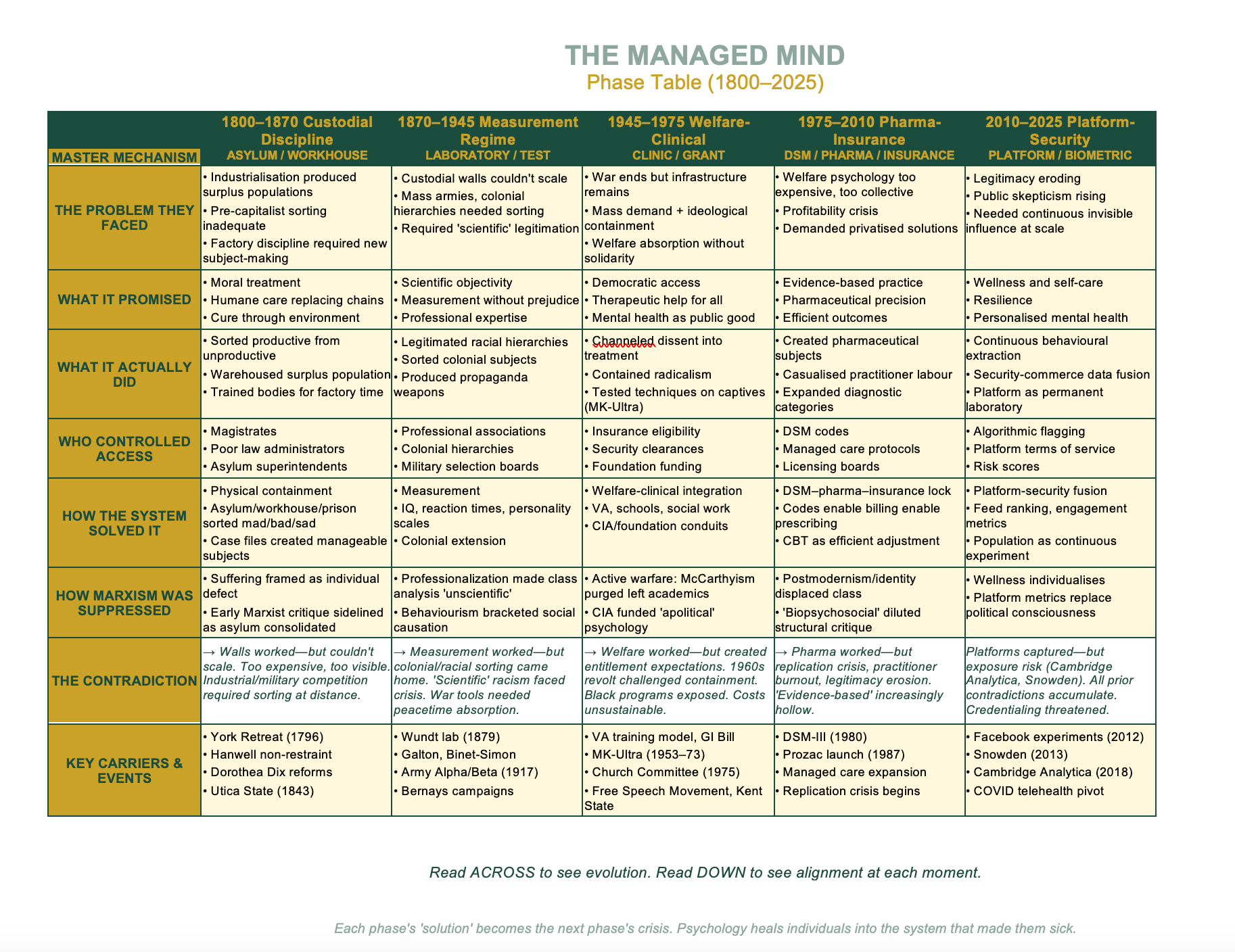
HOW TO READ THE MANAGED MIND TABLE
This table maps how modern psychology evolved from 1800 to 2025. It shows not what clinicians believed or what researchers discovered, but who controlled access to what, how the money flowed, and how class analysis was systematically suppressed.
Two Ways to Read
Read ACROSS a row to see how one element evolved over time. What controlled access in 1800 (magistrates, asylum superintendents, social origin) became something entirely different by 2025 (algorithmic flagging, platform terms of service, risk scores). The system didn't simply grow—it transformed while preserving its core function.
Read DOWN a column to see how all interests aligned at one historical moment. In any given phase, the institution's promises, its actual functions, its gatekeeping mechanisms, and its suppression of class analysis all interlocked. The table shows how coordination worked—not just what individuals wanted.
The Contradiction Row (→)
This is the engine of the table. Each phase's solution to the previous crisis creates the next crisis. Asylum walls worked—until industrial scale demanded sorting at distance. Measurement worked—until colonial techniques came home and started to stink. Welfare absorption worked—until the 1960s revolt and costs became unsustainable. The DSM–pharma–insurance lock worked—until replication crisis and legitimacy erosion exposed the hollow core.
The system doesn't fail because people made mistakes. It transforms because each solution contains the seeds of its own obsolescence.
Master Mechanisms
Each phase has one coordination mechanism that dominates all others. Asylum/workhouse (1800–1870) controlled who got confined. Laboratory/test (1870–1945) controlled who got classified. Clinic/grant (1945–1975) controlled who got treated and what got researched. DSM/pharma/insurance (1975–2010) controlled what got diagnosed, prescribed, and reimbursed. Platform/biometric (2010–2025) now controls the infrastructure psychology no longer owns. The previous mechanism doesn't vanish—it becomes subordinate to the new master.
The Suppression Thread
Row 6 tracks how Marxist analysis was suppressed in each period—not through a single conspiracy, but through evolving mechanisms. Individualisation framed suffering as defect. Professionalisation made class analysis 'unscientific.' McCarthyism and CIA funding were organised warfare. Postmodernism and identity theory displaced class. Wellness became late-stage firmware. The suppression didn't require coordination—the structure produced it.
The Core Function
What does psychology actually do? It heals individuals into the system that made them sick. Three functions make this work: classification (sorting populations for institutions), legitimation (producing ideology that naturalises adjustment), and extraction (generating data, billing codes, and behavioural predictions for capital and state). The promise changes. The function endures.
Follow the money. Follow the coordination. Follow the suppression.
This book argues that modern psychology is a distributed system for producing, classifying, and managing human subjects for capital and state while claiming to heal and understand them.
That sounds abstract. It isn’t. That sentence is a map of how this thing actually works.
Distributed: Psychology is not a single institution with a director’s office and a master plan. It lives in clinics, HR departments, school counsellors’ offices, welfare agencies, prisons, military bases, advertising agencies, think tanks, research labs, wellness apps and content moderation teams. These sites don’t have to share a manifesto. They are stitched together by funding streams, diagnostic manuals, billing codes, licensing regimes, performance targets, and software platforms. The result is coordinated behaviour without the need for a single command centre. You don’t need one world-brain plotting in secret when a thousand smaller deals, contracts, and “partnerships” line up in the same direction. Conspiracies exist inside that field; the point is that the structure generates alignment whether or not anyone plots on paper.
System: Psychology is not just “ideas about people” or a pile of findings and therapies. It is an organised arrangement of roles, institutions, techniques and concepts that performs specific functions. Some parts genuinely clash with others. Some people inside it try to resist what it does. The system still runs. Individual intentions are noise on top of a machine that reliably produces certain kinds of subjects.
Producing: Psychology does not simply uncover timeless “mental illnesses” that were sitting there waiting to be named. It manufactures the categories that make experience legible to institutions. The anxious worker becomes a “case of burnout.” The exhausted single mother becomes “depressed” or “non-compliant.” The teenager reacting to police harassment becomes “conduct disordered.” Once those labels exist, they become real in their consequences: tied to treatment, employment, eligibility, surveillance, and risk scores. The person changes because the category exists, and the institution only sees the category.
Classifying: From the first IQ tests through to DSM diagnoses, corporate personality inventories, actuarial risk tools, and platform “trust” scores, psychology supplies sorting devices. Who gets hired, promoted, sectioned, medicated, surveilled, or locked up is increasingly filtered through instruments that present themselves as neutral and scientific. A tick in the right box opens doors. A red flag closes them. You do not meet power directly; you meet it as a score.
Managing: Psychology’s everyday function is to translate structural problems into individual stories that can be treated. The worker collapsing under impossible hours and stagnant pay is told they have burnout and needs resilience training. The soldier shattered by occupation duty is told they have PTSD and needs to learn to cope. The student in an underfunded school is given a diagnosis and a coping plan instead of smaller classes and a meal. The system keeps producing the damage; psychology is funded to mop the floor and write reports about the puddles.
For capital and state: Psychology answers to whoever pays the bills. That is not a moral failure; it is a description. Research funded by pharmaceutical companies ends up answering questions that matter to pharmaceutical companies. Research funded by militaries answers questions that matter to militaries. Platform-funded research optimises engagement, retention, and “safety” for platforms. The shape of what counts as knowledge, and what gets forgotten, follows the money.
While claiming to heal and understand: The claim is not pure propaganda. A therapist sitting with a suicidal client is doing real work. A researcher mapping how trauma affects memory is doing real work. The point is not that nobody is helped or nothing is learned. The point is that the helping and the understanding sit inside a system that primarily manages bodies and minds for other ends. The individual experience of care happens within an institutional logic that never asked the patient what the system itself should be.
This book traces how that system was built, how it actually operates, and why you cannot simply reform it into something else without changing the conditions that make it necessary.
WHY MARXIST ANALYSIS
This is not one perspective among many. It is the only frame that lets us see psychology as a system rather than a self-contained “discipline.”
Psychology cannot analyse itself. Its tools, concepts, and default stories were all developed inside the same institutions we need to examine. Asking psychology to critique psychology is like asking a corporate HR department to write the history of class struggle in its own company.
Take the replication crisis. Internal critique has correctly identified a stack of methodological rot: p-hacking, tiny samples, publication bias, “questionable research practices.” It has proposed internal fixes: pre-registration, larger samples, open data, registered reports. These are genuine technical improvements. They also leave the central questions untouched: Why were people pushed to produce exciting but fragile findings in the first place? Why does a career in psychology still depend on novelty and volume over depth and truth? Who set the reward structure that made bad science adaptive? Whose interests were served by filling journals with sensational claims that didn’t replicate?¹
Those are not “methods” questions. They are questions about political economy, class, institutions, and power. Internal critique, working with the discipline’s existing categories, cannot follow them all the way down. Doing that would mean admitting that the discipline sits inside a larger system with its own needs and priorities.
Marxist analysis starts from the mode of production of knowledge. It asks: Who funds this? Who does the labour? Who controls the institutions? Who benefits when this line of research flourishes and that one dies of neglect? Who is exposed to harm when an industry captures a concept or a diagnosis? It looks at how knowledge is made, not as a pure search for truth occasionally corrupted by “bias,” but as work done under particular historical and economic conditions.
Applied to psychology, that lens makes visible what internal critique keeps blurring out:
Psychology emerged to solve ruling-class problems. Factories needed disciplined workers who would show up on time and tolerate the line. Colonial states needed categories for managing subject populations and deciding who was “fit” to rule and who was “primitive.” Armies needed ways to sort mass conscript forces and patch up the ones who broke. Welfare regimes needed gatekeeping tools for deciding who was “deserving” of support. At every point, psychology was invited in to manage people for institutions, not to emancipate them.²
Psychology’s core maneuver is individualisation. Structural violence—exploitation, precarity, racism, carceral punishment—produces predictable forms of distress. Psychology turns that distress into individual pathology and offers individual treatment plans. A system that would be politically intolerable when named as class rule or racial hierarchy is re-described as a landscape of personal struggles with “mental health.”
Psychology’s knowledge is captured. Not as a rare scandal when a dodgy drug trial gets exposed, but as the everyday condition of work. Pharma pays for trials and gets drug-friendly literatures. Military agencies pay for interrogation and resilience research and get techniques they can use. Platforms pay for behaviour studies and get better ways to hold attention. The data and analysis are often technically real; the project itself is aligned with whoever keeps the lights on.
So “Marxist analysis” here is not branding. It’s the minimum toolset. Without external structural critique, the discipline can only polish its own mirror and complain about smudges.
WHAT THIS BOOK DOES
This book follows the money.
Each chapter keeps asking the dullest, most revealing question in political economy: who paid for this? Who built this clinic, this lab, this programme, this diagnostic manual, this app? What did they get in return? Defence funding for testing and propaganda during the World Wars did not just “support science”; it created a permanent military–psychological complex that outlived the wars and found new problems to solve. Pharma money in the late twentieth century did not simply “support research”; it re-wired diagnosis around drug markets and billing codes. Platform funding did not just sponsor “behavioural insights”; it built infrastructure for permanent low-level experimentation on entire populations.³
This book follows the labour.
Psychology is not just journals and clinics; it is workers trying to survive in bad conditions. Therapists drowning under forty-plus clients and endless note-taking requirements. School psychologists forced to ration time across hundreds of kids. Early-career researchers chained to soft money, chasing grants and citations while departments quietly redirect their work toward whatever attracts funding. Their exhaustion and corner-cutting are not character flaws; they are built into the way the work is organised. If you want to understand what psychology does, you have to look at the jobs, not just the theories.
This book follows the test populations.
The “knowledge” of psychology has been built disproportionately on people who could not really say no: asylum inmates, prisoners, conscript soldiers, children in institutions, colonised populations, welfare recipients whose benefits depended on compliance, psychiatric patients, and now platform users who never read the experiment clause in the terms of service. The grand claims about “human nature” rest heavily on data gathered from people under constraint. Following those populations through the archive tells you whose lives were considered disposable, and whose comfort the science was designed to protect.⁴
And this book ends with structural conclusions.
The problems it identifies are not bugs to be patched by better training, slightly improved ethics codes, or more diverse hiring. They are functions: the whole thing is built to channel suffering into management instead of into politics. Reforms can smooth some of the sharpest edges; they cannot change who the system ultimately serves. The conclusion is simple and unpopular: psychology under capitalism does not get “fixed.” It gets superseded when the conditions that require it change.
WHAT THIS BOOK REFUSES
This book does not offer a menu of reforms, recommendations, or best-practice toolkits. It spends hundreds of pages showing why the structure produces what it produces. It does not pretend that a new code of conduct will overturn that.
This book does not “balance” critique with a list of positives to avoid offending the discipline. Psychology has institutional defenders, PR operations, professional bodies, and a century of self-congratulation. It does not need another polite chapter pointing out its “contributions.” The focus here is function, not feelings: what the system does in practice, not how kindly it thinks of itself.
This book does not blame individual practitioners. Therapists, counsellors, caseworkers, and researchers are often doing their best with the tools and constraints they’ve been handed. The point is that their structural position was built long before they arrived, and their personal kindness cannot cancel the function of that position. Telling a burnt-out therapist “you are the problem” is just another displacement.
This book does not claim neutrality. The analysis is explicitly Marxist and openly partisan: on the side of those who are classified, adjusted, and managed, against the system that does the managing. Its aim is to make the structure visible enough that collective action against it becomes thinkable.
THE PRIMARY CONTRADICTION
Psychology’s central contradiction is structural: it must function as management and control while presenting itself as a healing science.
This is not a simple mismatch between intentions and outcomes, or “good science” occasionally misused. Management is not a side effect. The whole system is built so that care and control are fused in the same techniques, the same offices, often the same person.⁵
Psychology exists because ruling classes needed a way to manage populations that did not always look like outright repression. Beating people into line is expensive, unreliable, and politically dangerous. Far better to offer services, diagnoses, and treatment plans that smooth behaviour and preserve the existing order while appearing as help. Psychology must generate real trust and real relief for some people—it has to, or it wouldn’t work at all—but that trust is then used to stabilise the conditions producing the distress.
You cannot resolve that contradiction inside capitalism. Each historical reorganisation of the field—new therapies, new diagnostic manuals, new community programmes, new apps—creates a new configuration of the same basic tension. Asylums promised moral treatment and delivered custody. Welfare-era clinics promised support and delivered gatekeeping. Modern therapy culture promises liberation through self-knowledge and delivers self-managed adjustment to the market. Platforms promise wellness and peer support while harvesting behavioural data. The contradiction shifts costume; it does not disappear.
THE SEVEN SUBSIDIARY CONTRADICTIONS
Seven recurring contradictions express that central tension in concrete domains:
Individualisation / Structure. Suffering generated by work, debt, racism, gendered violence, poverty and war is reframed as personal malfunction. You are anxious, disordered, maladjusted. You must be treated, coached, medicated. The social causes remain untouched, and the diagnostic label follows you.
Healing / Control. The same skills that build trust in therapy—rapport, empathic listening, knowledge of defence mechanisms—are used in interrogations, undercover work, corporate “culture change,” and coercive settings. Behaviour modification techniques migrate easily between clinics, schools, prisons and platforms. The badge on the door changes; the methods don’t.
Knowledge / Ideology. Psychology produces real findings about perception, memory, trauma, cognition. Those findings are then selectively assembled into ideological stories that justify the status quo: poor people make “bad choices,” unemployment is about “mindset,” strike waves are “emotional contagion.” The scientific content and the political use cannot be peeled apart cleanly.
Liberation / Adjustment. Therapeutic culture teaches people to talk about boundaries, needs, triggers and growth. That can be genuinely useful. It can also turn into an endless project of self-adjustment to unlivable conditions: you work on yourself so you can tolerate what you should be fighting.
Care / Carcerality. The border between the caring professions and the carceral system is porous. Psychologists design solitary-confinement regimes and parole assessments; prison mental-health units use the same diagnostic tools as community clinics. A “treatment plan” can be the price of release. The difference between care and punishment is often an administrative category, not a lived experience.
Science / Industry Capture. Psychology markets itself as science while operating in conditions that reliably distort inquiry: corporate funding, publish-or-perish pressure, metrics that reward novelty over accuracy. The replication crisis showed how easily whole literatures can be built on sand and how long they can stand before anyone checks them. The problem is not a few bad actors; it is selection pressure for whatever sells.
Evidence / Experimented-On Populations. Claims about universality sit on top of research disproportionately done on WEIRD (Western, educated, industrialised, rich, democratic) students, captive populations, and people who were never told what they were really part of. Ethics committees now exist to manage this, but they arrived after a century of damage and still operate inside the same funding logic. The evidence is not neutral; it has a history.
Each chapter shows how these contradictions play out in specific institutions and time periods.
THE FIVE PHASES
Psychology’s development tracks capitalism’s development through five broad phases: not clean boxes, but dominant configurations.
Phase I: Custodial Discipline (1800–1870). Asylums, workhouses, and prisons arise to manage the fallout of industrialisation and enclosure. The “alienist” and the early prison doctor appear as quasi-experts on deviance. Psychology exists as embryonic observation and categorisation inside physical custody. The master mechanism is confinement.
Phase II: Measurement Regime (1870–1945). Laboratories, psychometrics, and eugenics. Wundt’s timing devices, Galton’s measurements, Binet’s tests, the Army Alpha and Beta batteries. Psychology becomes a technology for sorting bodies and minds for schools, factories, colonial service and mass armies. The master mechanism is classification.
Phase III: Welfare-State Integration (1945–1975). Clinical psychology, guidance counselling, community mental health centres, school psychology. Psychology is woven into social-democratic and New Deal-style welfare systems as both service and filter. The master mechanism is access: psychology decides who gets help, who is “disable enough,” who is “too disturbed,” and who must be sent back to work.
Phase IV: Pharma–Insurance Complex (1975–2010). DSM-III and after, blockbuster drugs, managed care, “cost-effective” treatment. Diagnostic categories are rebuilt to match billing and trial requirements. Short-term manualised therapies and medication become standard. The master mechanism is diagnosis tied directly to reimbursement and drug markets.
Phase V: Platform–Security Fusion (2010–present). Behavioural tracking, A/B testing, nudging, predictive policing, risk scoring, wellness platforms. Psychological expertise dissolves into the background of algorithmic governance and data-driven management. The master mechanism is continuous monitoring and micro-adjustment: everyone lives inside an experiment.⁶
Each phase tries to resolve the crises generated by the previous one. Each builds new contradictions while carrying the old ones forward. By the time we arrive at the present, the weight of those accumulated contradictions is visible everywhere from burnt-out clinicians to over-policed neighbourhoods to platform-induced mental health spikes.
THE FIVE ARCHETYPES
Across all these phases, five structural positions keep reappearing with different uniforms:
Patient / Client. The person being classified, treated, or adjusted. Asylum inmate, schoolchild, worker in an EAP programme, user of a mental health app, “at-risk” youth on a risk register. They are the ones to whom things are done.
Practitioner. The person authorised to deploy the tools. Alienist, psychiatrist, psychologist, counsellor, caseworker, coach. They are stuck between institutional metrics and human suffering, forced to reconcile “service delivery” with the reality in front of them.
Researcher. The person producing knowledge. Laboratory founder, survey researcher, behaviourist, cognitive psychologist, UX researcher, data scientist. They are pulled toward questions and methods that get funded and rewarded, whatever their personal politics.
Manager / Commissioner. The person or entity deciding what psychology is for in a given setting. Asylum superintendent, military medical corps, HR director, pharma executive, insurance gatekeeper, platform “trust and safety” lead. They never have to see patients; they decide what counts as success.
Subject of Control. The person who cannot refuse. Prisoner, conscript, asylum inmate, institutionalised child, detainee, black-site prisoner, flagged user. Sometimes they overlap with “patient.” Sometimes all pretence of care is dropped and only control remains.⁷
One of the book’s jobs is to keep all five positions on the page at once so that nobody can pretend psychology is just “what happens in therapy.”
WHY THIS BOOK, WHY NOW
Psychology is visibly cracking.
The replication crisis has already shredded much of the discipline’s public claim to be straightforwardly scientific. Flagship findings evaporated when tested. Whole areas of research turned out to be more sensitive to graduate student enthusiasm and clever p-hacking than to the world.
Outside the journals, people are starting to recoil from the language itself. “Therapy-speak” circulates as a way of mocking hollow corporate emails, influencer content, and interpersonal evasions. Diagnostic inflation and pop-trauma discourse generate both real relief and understandable backlash.
Inside the system, practitioners are burning out or leaving. They are expected to absorb endless streams of distress generated by work, housing, racism, war, climate crisis, and social breakdown, while working inside institutions that cannot change any of those conditions. The contradiction between what they are told they do and what they can actually deliver is becoming impossible to ignore.⁸
The same contradictions that were once hidden in specialist journals and backroom contracts are now surfacing in public: the fusion of care and surveillance, the dependence on pharma, the policing of “risk,” the capture of behavioural science by platforms and security agencies. The legitimacy story is fraying.
That is exactly when you need a structural account. Not a feel-good defense of “mental health awareness,” and not a cynical “nothing works” shrug, but a clear diagram of what this machine is, how it came to be, and what it would take to move beyond it.
HOW TO READ THIS BOOK
The book moves roughly chronologically through the five phases, but each part is also a different angle on the same machine.
Part I (Chapters 1–3) follows the emergence: asylums, laboratories, and war. Psychology is born as a way of looking at deviance, then trained as a way of measuring and sorting, then weaponised in total war.
Part II (Chapters 4–6) follows expansion and challenge: welfare-state integration, black programmes, and revolt from below. Psychology is pulled into social-democratic projects and, in the shadows, into torture and interrogation, while anti-psychiatry and radical movements try to break its grip.
Part III (Chapters 7–9) covers neoliberal capture: the pharma–insurance nexus, the workplace, and the prison. Diagnosis becomes currency, “treatment” becomes a cost centre, and psychological tools are normalised inside carceral systems.
Part IV (Chapters 10–12) covers the platform era: social media, security fusion, and the wellness boom. Behavioural data, nudging, and self-help meet in an environment where everyone is always on the record.
Part V (Chapters 13–14 and the Epilogue) looks at what all of this does to practitioners, the discipline’s claim to authority, and the question of supersession: what it would mean for psychology, in its current form, to end.
Each chapter uses the same method: concrete scenes and documents, tracing coordination mechanisms, showing where the money flows, tracking the five archetypes, and making the underlying contradictions explicit. The style stays the same; the time and setting change.
The last chapters do not predict the future. They describe the structure and lay out the options. Whether psychology limps along as a shrinking part of the welfare market, dissolves further into platform governance and pharma pipelines, or is displaced by movements that do not need it—that is a political question.
WHAT READERS SHOULD ABANDON
Abandon the idea that psychology is primarily about helping people. Help happens. It is not the main function of the system.
Abandon the belief that psychology’s worst failures are deviations from its “true” purpose. They are expressions of its purpose under current conditions. The replication crisis, torture research, racist testing regimes, platform manipulation: these are not freak accidents. They are what happens when the field does exactly what it is paid to do.
Abandon the hope that a better version of psychology can be built on the same foundations with nicer policies and more diverse hires. Reforms may protect some people and buy time for others; they will not change the basic relationship between the discipline, capital, and the state.
Abandon the expectation that this story ends with a list of professional recommendations. It ends with a structural verdict. What happens next is not a matter for committees of experts but for politics in the full sense: organised struggle over how we live.
The book begins.
She sits through the mandatory wellness webinar on her second monitor while doom-scrolling on her phone. The presenter—a woman with the practiced warmth of someone paid to seem caring—is explaining the importance of “psychological safety” in the workplace. The slides use a lot of teal. There’s a stock photo of diverse coworkers laughing around a laptop, which bears no resemblance to anything that has ever happened at her company.
Her name is—it doesn’t matter what her name is. She could be anyone. She could be you.
The HR dashboard tracks her cursor movement, logging it as “engagement.“¹ She doesn’t know this. She knows her performance review is in six weeks and that her manager has been making comments about her “energy levels.” She knows her student debt autopays on the fifteenth. She knows the antidepressant she’s been taking for three years costs $40 after insurance, which sounds manageable until you remember she’ll be taking it forever, or until her insurance changes, or until the manufacturer decides to raise the price, whichever comes first.
Her rent went up by $90 last year. Her salary didn’t.
Her phone buzzes. The therapy app she downloaded last month—the one with the cartoon elephant—wants to check in on her mood. It noticed she’d been scrolling late last night. It has suggestions. The app was recommended by her insurance company, which gets a discount on her premiums if she logs her feelings regularly. The data goes somewhere.³ She accepted the terms of service without reading them, like everyone does, like the terms are designed to ensure everyone does.
The webinar presenter is now discussing “resilience strategies.” The word resilience appears on screen in a font that probably costs money. Resilience, the presenter explains, is the ability to bounce back from adversity. The presentation does not mention who creates the adversity. It does not ask why bouncing back is her responsibility. It offers breathing exercises.
She is being cared for. She is being managed. She cannot tell the difference.
Five systems are operating on her right now, in this moment, as she half-watches the webinar and half-scrolls and fully dissociates. She doesn’t experience them as systems. She experiences them as her life—as choices she made, as struggles she faces, as feelings she has. The systems are invisible to her in the same way water is invisible to fish. They are simply the medium she moves through.
But the systems are not natural. They were built. They have histories. They serve interests. And if you know where to look, you can see them converging on her like coordinates on a target.
The oldest layer is custodial. It’s the residue of the first phase of modern mind management: the asylums and workhouses of the early nineteenth century that sorted the mad from the bad from the merely poor. The physical walls are mostly gone now—most of them, not all—but the function persists. She is being watched. Her movements are tracked, her attention monitored, her productivity measured. The surveillance is softer than a locked ward, but it is no less total. The asylum kept ledgers; her employer keeps dashboards. The information serves the same purpose: to know where she is, what she’s doing, whether she’s compliant. The technology changed. The logic didn’t.
The second layer is measurement. This is the laboratory and testing phase, born in the late nineteenth century when psychology decided it wanted to be a science and built instruments to prove it. Stopwatches for reaction times. Questionnaires for attitudes. Tests for intelligence—or what the tests decided to call intelligence, which happened to correlate remarkably well with being white, wealthy, and educated. She encountered this layer before she was hired, when she took the “personality assessment” that would determine her “culture fit.“⁴ The assessment was developed by a company that licenses it to Fortune 500 firms. It has no particular scientific validity. It makes a lot of money. She scored well enough to get the job, which means she scored well enough to be sorted into this particular box. The box has fluorescent lights and a wellness webinar.
The third layer is clinical integration. This is the welfare-state phase, built after the Second World War, when psychology wove itself into schools, hospitals, social services, the VA. Psychology learned to present itself as care while acting as a gatekeeper. She touched this layer when she used her Employee Assistance Program—the three free sessions her company provides.² The counselor was kind. The counselor asked about her childhood, her relationships, her coping strategies. The counselor did not ask about her rent, her debt, her sixty-hour weeks, or the fact that her company laid off 12 percent of her department last quarter while posting record profits. The intake form had a space for her diagnosis. It did not have a space for “capitalism.” The sessions ran out. She was encouraged to continue with an outside provider. Her insurance covers 60 percent after deductible.
The fourth layer is pharmaceutical. This is the cognitive–pharma–insurance complex that locked into place in the 1980s, when the DSM-III created the categories, the insurance companies created the billing codes, and the drug companies created the markets.⁵ She takes a selective serotonin reuptake inhibitor. It helps, sort of. It makes the edges less sharp. It was prescribed after a fifteen-minute appointment in which she described her symptoms and a doctor matched them to a code—296.32, Major Depressive Disorder, moderate, recurrent—which unlocked a prescription, which unlocked a revenue stream that flows from her insurance company to her pharmacy to the pharmaceutical manufacturer to its shareholders. The drug was tested on people who looked nothing like her, in conditions nothing like her life, for a duration much shorter than the years she’s been taking it. The trials were funded by the company that sells the drug. The results were published in journals that depend on pharmaceutical advertising.⁶ This isn’t a malfunction. It’s how the system runs when everything is working as intended.
The fifth layer is the newest and the hardest to see. This is the platform–security fusion: the layer in her hand right now, glowing. The therapy app that tracks her mood and sells the data to someone. The algorithm that decides what she sees when she scrolls, optimised for engagement, which turns out to mean optimised for anxiety, outrage, and the particular kind of despair that keeps you scrolling.⁷ The content moderation system that shapes what distress looks like when you search for it—what’s allowed, what’s flagged, what’s quietly suppressed.
Last month, she watched a video of a protest twice. Now her “recommended for you” sidebar is full of articles about “online radicalisation” and “warning signs in the workplace.” Somewhere, on a server she will never see, a risk score ticks up by a decimal place because she didn’t click away fast enough.
In this layer she isn’t a patient. She isn’t even really a user. She is a data point. She is a pattern of behaviours that can be predicted, nudged, and monetised. The platform doesn’t care if she’s happy. It cares if she’s engaged. These are not the same thing. The platform has learned that unhappiness is extremely engaging.
The five layers don’t announce themselves. They don’t appear as separate forces. They converge on her as a single experience: the experience of being tired, being stressed, being worried about money, being told to breathe deeply and visualise success. She thinks she has a mental health problem. She does have a mental health problem—in the sense that her mental health is poor and this is a problem. But the problem is not a malfunction in her brain. The problem is that she lives in a system that produces suffering and then sells her the management of that suffering at a markup.
A message pops up in the muted group chat with her friends: Drinks Friday?. She stares at it, feels the exhaustion in her teeth, and pretends she didn’t see it.
The wellness webinar is ending. The presenter thanks everyone for their attention and reminds them that taking care of their mental health is “an investment in themselves.” There’s a feedback survey. She clicks the rating that will end the survey fastest and closes the tab.
She is not unusual. She is not even unlucky. She is what the system produces.
This book is about that system.
It argues that modern psychology is a distributed machinery for converting structural violence into individual diagnosis. It protects the social order from critique by relocating the source of suffering from exploitative conditions to defective minds. It generates real knowledge—partial truths about trauma, cognition, development, behaviour, the brain—that becomes weaponised by whoever funds its production. And it cannot be fundamentally different within capitalism, because its function is producing subjects who adjust themselves to conditions that should not be adjusted to.
The worker in the webinar doesn’t need resilience. She needs shorter hours, cancelled debt, a society that doesn’t require her exhaustion as fuel. Instead she gets a diagnosis, an app, and a prescription—tools that help her survive conditions the system will not change.
This is not to say psychology is “all bad,” or that psychologists are villains, or that therapy never helps anyone. There is real insight here, and real care. Practitioners help people survive. That help matters. But it happens inside a structure whose job is not to end suffering, only to keep it within acceptable limits. Ending it would require transforming the conditions that produce it. The therapist who helps you cope with your job is not going to help you overthrow your boss. That’s not what therapy is for. That’s not what the insurance company is paying for.
What follows is a history of how this machinery was built.
It begins in the early nineteenth century, in the asylums and workhouses where industrial capitalism first confronted the problem of what to do with people who couldn’t or wouldn’t work. It moves through the laboratories of the late nineteenth century, where psychology invented itself as a science and immediately began sorting populations for the state. It traces the world wars, which transformed psychology from a marginal academic enterprise into essential military infrastructure—and the Cold War, which brought that infrastructure home and buried parts of it in classified programs we are still learning about.
It examines the welfare state that absorbed psychology after 1945, weaving it into schools and clinics and social services—and the revolt of the 1960s and ’70s, when some psychologists and many patients began asking whose interests the system actually served. It tracks the counterrevolution: the rise of the DSM-III, the pharmaceutical capture of diagnosis, the insurance-driven restructuring that turned therapy into a billable-hour commodity. It follows psychology into the workplace, where it learned to call union-busting “culture” and overwork “engagement.” It follows psychology into the prison, where “rehabilitation” became another word for management. It follows psychology onto the platforms, where the laboratory became the population and the experiment never ends, and into the security services that learned to treat whole categories of people as pre-problems to be scored, flagged, and managed.
Along the way, it asks some uncomfortable questions. Who funded the research? Who got tested on? Whose inability to refuse constituted the evidence base? How did the same techniques come to serve therapy and torture, counselling and interrogation, healing and control? Why did a profession supposedly dedicated to human flourishing spend so much of its history serving militaries, corporations, and carceral states? Why does it keep doing so?
The answers are not flattering. They are also not secret. Most of what this book describes is documented—in court records and congressional testimony, in declassified files and litigation discovery, in the discipline’s own journals and proceedings. The evidence exists. It is simply not assembled in one place, not connected to each other, not narrated in a way that makes the system visible.
This book assembles it. It connects it. It makes the system visible.
By the end, you will see what the worker in the wellness webinar cannot see: the five layers converging on her, the history behind each one, the interests they serve, the contradictions that hold them together and threaten to tear them apart. You will see how your own distress has been named, categorised, and monetised. You will see the trap.
What you do with that knowledge is not a question this book can answer. It is not a reform proposal. It does not end with ten things you can do to fix psychology. The conditions that produce psychological suffering—wage labour, class hierarchy, carceral state, platform capture—will not be fixed by better therapy or kinder therapists or apps with nicer elephants. They will be transformed, or they will continue.
Psychology under capitalism ends when capitalism ends.
That is not a slogan. It is a structural observation. And everything that follows is the evidence for it.
The webinar is over. She has twelve minutes before her next meeting. She scrolls.
The app wants to know how she’s feeling. She taps “okay.” It’s not a lie, exactly. She is okay, in the sense that she is surviving, in the sense that she is still here, in the sense that the system is working exactly as designed.
The screen glows in her hand. The oldest layers hum beneath the newest. The ledger became the stopwatch became the clipboard became the prescription pad became this—this small bright rectangle that knows her better than she knows herself, that watches her watching it, that converts her attention into money and her distress into data.
She is being cared for. She is being managed.
She cannot tell the difference.
The system doesn’t need to know the difference. It only needs her to keep going.