
“Fashion is what you adopt when you don’t know who you are.”
— Quentin Crisp
Read the Reference Tables, Period analysis, Chapter One below!
Also available on the kindle page.
Also available on the kindle page.
Fashion likes to pose as only harmless fun: self-expression, creativity, “the joy of dressing up.” Rags, Racks and Runways treats that story as one-sided at best, and starts digging.
Across more than seven hundred years, it follows clothing as a system of power. It begins in the guild halls of medieval Europe, where wardens stamped seals into cloth and decided who was allowed to weave, who was allowed to sell, and what counted as “proper” dress.
From there it moves into the mills and factories of the industrial revolution—twelve-hour days, locked fire doors, child workers bent to machine time—where cotton grown by enslaved people on American plantations fed looms in Lancashire, and “free labour” in the North sat on top of chains in the South.
From guild to factory to department store: control slides from workshop to shop floor. Rags, Racks and Runways traces how nineteenth- and twentieth-century retailers turned clothing into spectacle and desire, building palaces of glass and light where the new middle class learned to be customers. The racks in Macy’s and Selfridges didn’t just offer choice; they quietly narrowed it, deciding which bodies were welcome, which trends mattered, which makers lived or died based on a single order.
Then comes the age of advertising and synthetics. Images start doing what overseers once did. Nylon and polyester arrive, fibers that can be engineered to last or fail on schedule. Wardrobe churn stops being an accident and becomes a business strategy. Magazines, billboards and TV spots learn to do one job extremely well: convince you that who you are, in the clothes you already own, is not enough.
By the late twentieth century, the logo is the real factory. Nike, Gap and luxury houses in Paris and Milan shed their machines and keep the profit. Production is pushed into Bangladesh, Vietnam, Honduras; risk and liability fall down the chain onto workers with no leverage and no spotlight. Sweatshops collapse in Dhaka, workers burn behind barred windows, and the brand response is always the same: shock, sorrow, a promise to “do better,” a new wave of audits and certifications that leave the basic structure untouched.
The final turn is the platform era: Amazon, Zara, Shein, TikTok, Instagram. Algorithms now decide what exists. Data replaces the buyer’s eye; influencer hauls replace print campaigns. Styles are generated, tested and killed in days. Shein pushes thousands of new items a day into feeds designed to trigger one feeling: whatever you have is wrong.
A $5 dress made by an invisible worker on the other side of the world appears in your hand forty-eight hours later, worn once, returned or donated, and then quietly destroyed or shipped in a bale to a market in Accra or a dump in Chile’s Atacama Desert—where mountains of clothing are now literally visible from space.
All the way through, race is not an add-on, but a spine. Slave-grown cotton, Black and brown garment workers in New York and Los Angeles, today’s offshore factories in the Global South, Black creativity strip-mined for “streetwear” trends, Black shoppers followed, stopped and handcuffed for “shopping while Black” in luxury stores. The same populations whose labour and style keep the system running are the ones treated as suspect when they walk through the door.
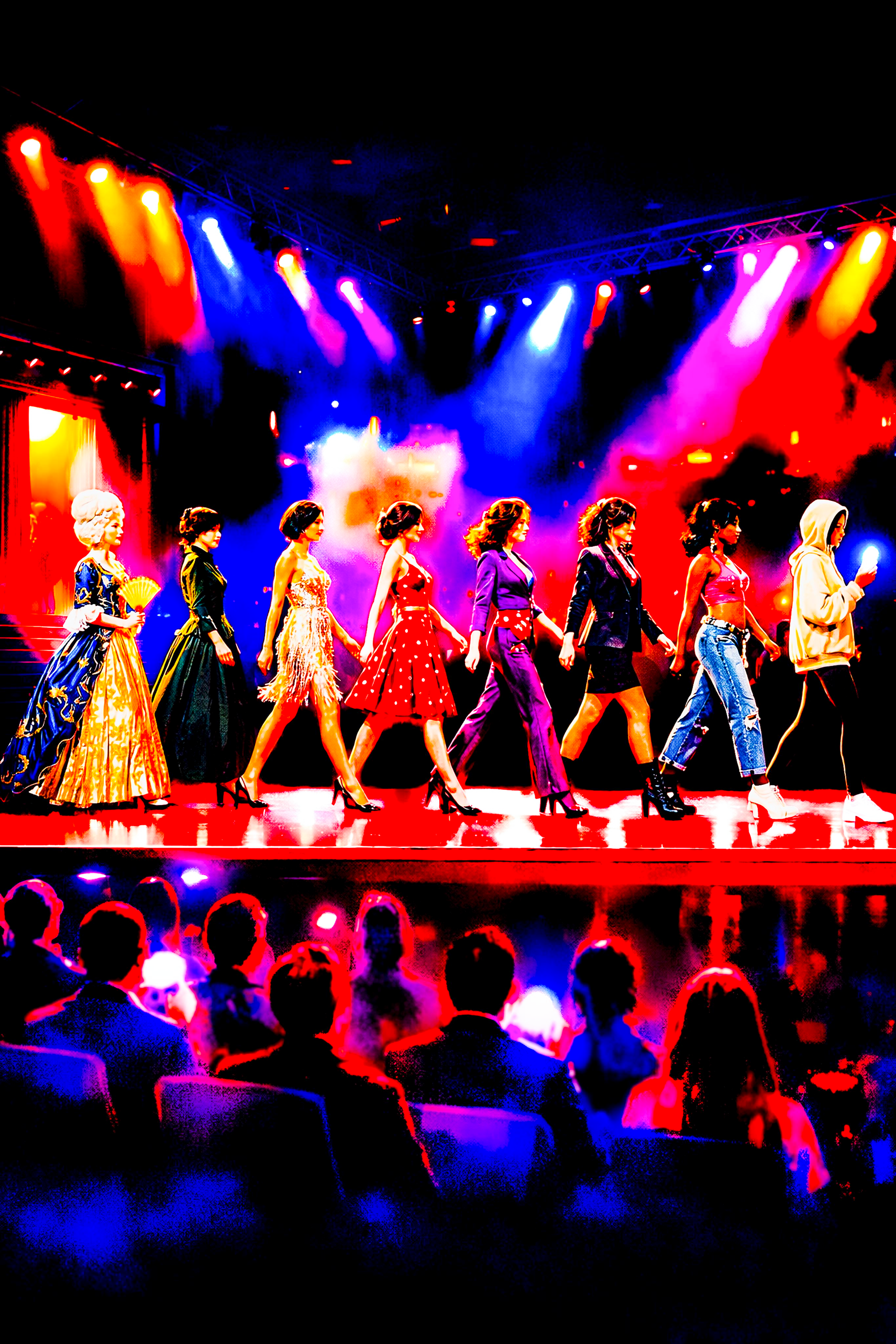
Rags, Racks and Runways is a deeply researched, muckraking excavation of how fashion actually works: who decides what gets made, where it’s made, who is allowed to wear it and at what cost. It shows a world where control has moved from guild wardens’ seals to factory whistles, from department-store buyers to ad men, from brand managers to recommendation engines—but the underlying job hasn’t changed. Someone has to keep you buying clothes you don’t need, year after year. Someone has to keep you just insecure enough that the next dress, the next sneaker, the next haul might finally make you feel like you measure up.
The result is a clear, angry anatomy of a system that wraps itself around the planet and calls that grip “style”: plantations and ports, mills and malls, sweatshops and server farms, police stations and platform feeds, closets and clothing dumps stitched into a single circuit. After reading it, getting dressed in the morning will feel different—not because you suddenly “hate fashion,” but because you finally know who’s holding the rack, and why they need you to keep reaching for it.
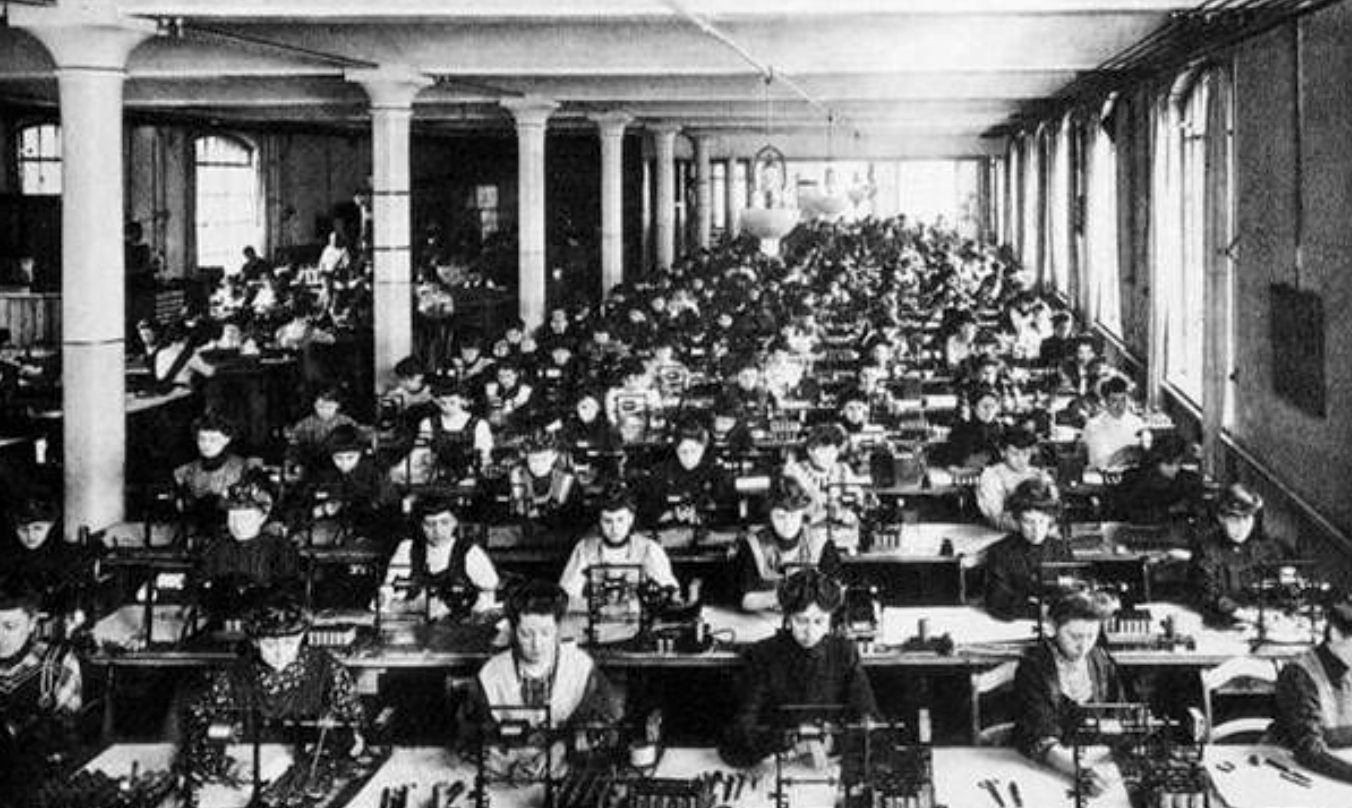
Above- an English Sweatshop circa 1880
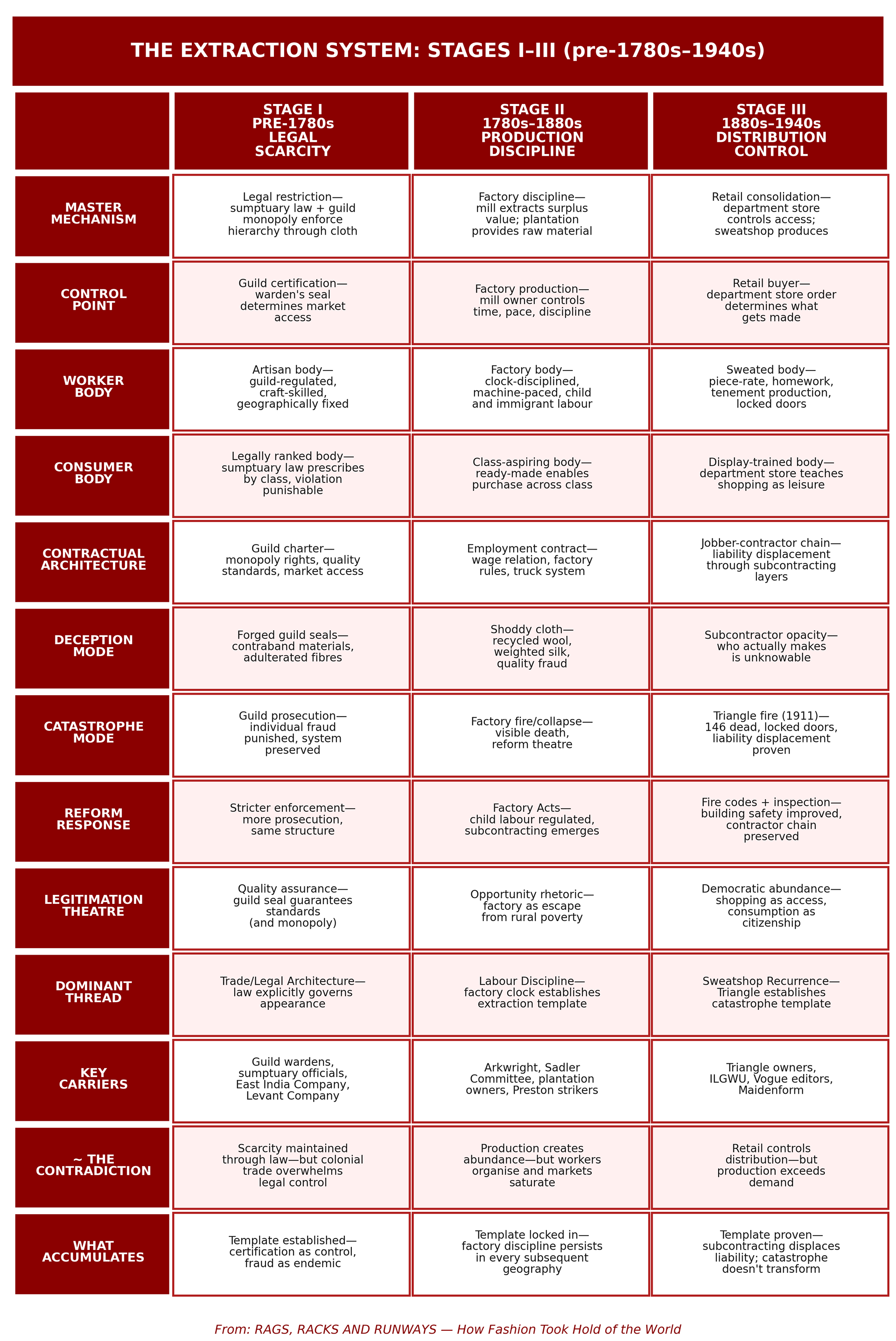
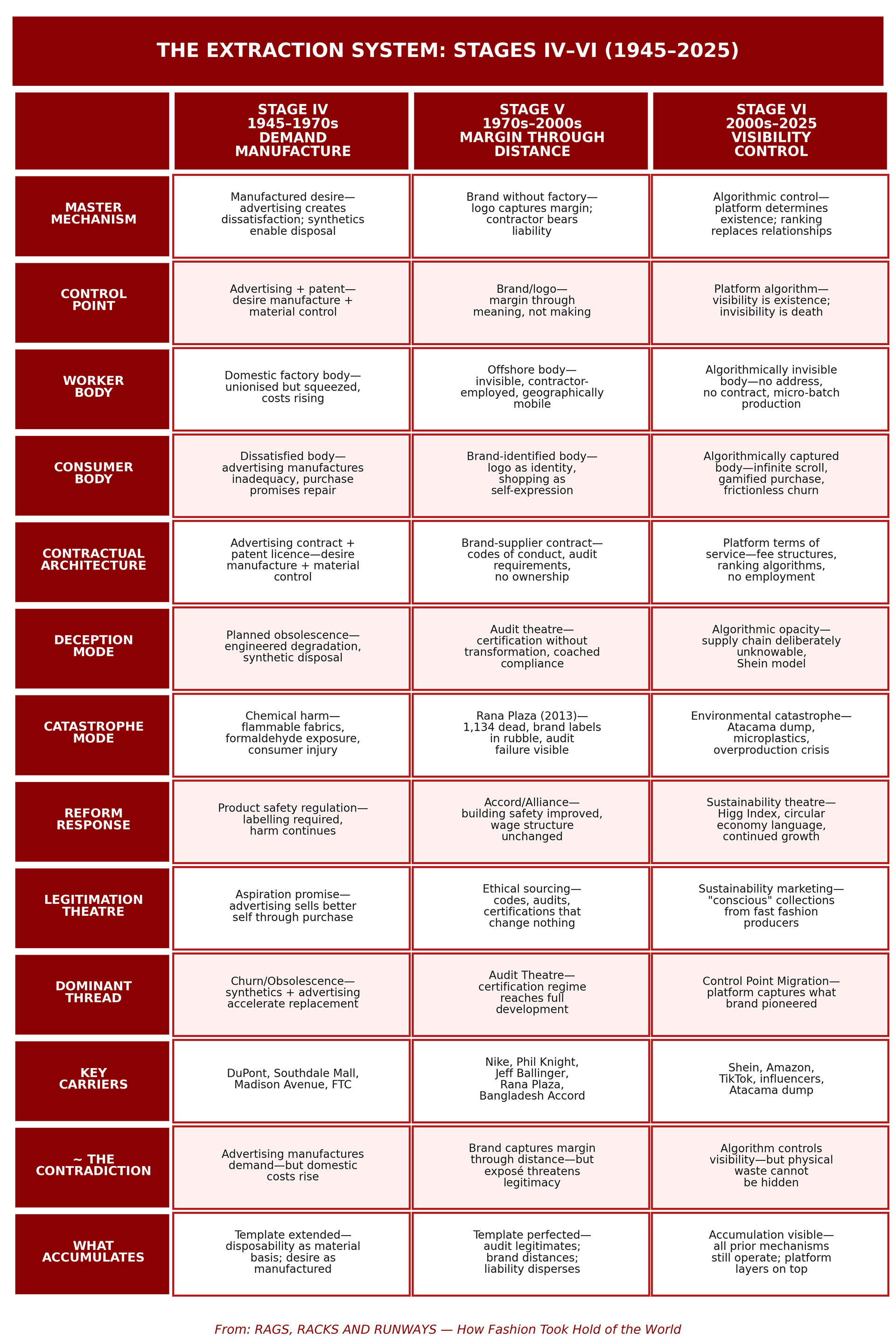
HOW TO READ THE TABLE
This table is the X-ray of the book. It doesn’t track hemlines or “iconic looks”; it tracks power. It shows how fashion moves from guild monopoly to algorithmic capture, and how the same job gets done in different costumes: control extraction, hide responsibility, absorb resistance.
You can read it two ways.
Across a row, you see how one element mutates over time. The 1800 worker is a clock-ruled factory operative; by 2025 they’re an invisible supplier squeezed by an app. The system doesn’t simply “grow” – it keeps its core function and changes shape around it.
Down a column, you see how everything locks together in one era. Worker body, consumer body, contracts, and legitimation all line up so the machine runs smoothly. No mastermind needed. Structure does the coordinating.
Underneath is one simple contradiction: clothes are a need, but capital needs churn. The system has to give you something to wear and keep you buying more than you need. Every “solution” to that problem becomes the next crisis: guild laws collapse under trade, factories trigger organising, retail drowns in overproduction, advertising hits cost limits, brands get exposed, platforms run straight into planetary boundaries.
The table builds that story out using four repeating blocks:
Control & Contract – who owns what, who signs what, who’s legally on the hook.
Production & Body – what the worker’s body has to endure to keep output flowing.
Consumption & Desire – how your appearance anxiety is created and steered.
Legitimation & Absorption – how the system justifies itself, and how it turns critique into fuel.
Inside those blocks, one thing really matters: the control point. Whoever holds it coordinates the whole circuit while pushing liability downward.
Guild wardens’ seals control market access.
Mill owners control time and discipline.
Buyers’ orders decide what exists.
Ad men and patents control desire and material.
Brands capture margin without owning factories.
Platforms and algorithms decide who is visible at all.
The details change – guild hall, mill, department store, ad agency, brand office, server farm – but the constants don’t. Workers are always paid less than the value they produce. Liability always slides down the chain until it hits bodies and the environment. Reform restores legitimacy more than it changes structure. Race and gender aren’t extras; they’re how labour, desire and punishment are organised. And now, environmental limits are starting to do what movements alone couldn’t: put a physical ceiling on “infinite” growth.
The table is there to make that visible at a glance. Follow the control point. Follow where responsibility actually lands. Follow where the waste ends up. Once you see those three lines, the whole fashion system stops looking like “style” and starts looking like what it is: a single, global machine for turning cloth, bodies and images into churn.
Rags, Racks and Runways
Before fashion, there was law. Before taste told you what you “shouldn’t” wear, statutes told you what you simply couldn’t. Sumptuary laws made class visible in fabric: nobles wrapped in ermine, merchants barred from silk, anyone aspiring above their station fined for dressing like the wrong kind of person. The guild warden’s seal decided what could be sold; the guild monopoly decided who was allowed to make it.
This was the first control point: certification. Whoever controlled the seal controlled the market. Quality control and market control were the same mechanism, stamped into the same piece of lead. The seal said, “this cloth is sound,” and silently added, “and nobody outside this club is allowed to compete.” It worked as long as volumes stayed manageable and Europe hadn’t yet been flooded with cotton, silk and dye from colonised worlds the guilds couldn’t fully see or regulate.
Part I tracks the contradiction’s first form: scarcity enforced openly through law. Once that open governance starts to fail—once colonial trade delivers more material than the guilds can process, once bourgeois wealth looks for ways around the rules, once enforcement becomes more expensive than the fines it brings in—the explicit bans soften into unwritten codes. “You cannot wear that” turns into “you wouldn’t want to wear that.” The discipline doesn’t vanish. It just changes costume and moves off the statute book into the culture.
Savar, Bangladesh. April 24, 2013. 8:57 in the morning.
The day before, cracks had appeared in Rana Plaza—an eight-story commercial building housing five garment factories, a bank branch, and several shops. The fissures ran visibly through the concrete, wide enough to see, alarming enough that an engineer was called. He inspected and declared the building unsafe for occupancy. His warning went out on local TV. The bank on the lower floors evacuated its staff immediately. The shops closed their doors.
The garment factory managers on the upper floors made a different calculation. They ordered their workers inside.
The workers—mostly young women, some as young as fourteen—entered a building that had been officially condemned the day before. One texted her sister that she was scared and went in anyway. They entered because their managers told them to. They entered because their wages, already barely enough to survive on, would be docked if they refused. They entered because in Bangladesh’s garment sector, refusing an order means losing your job, and losing your job means losing everything. They entered because they had no choice that was actually a choice.
At 8:57 AM, the building collapsed. Eight stories pancaked in seconds—concrete floors slamming down onto concrete floors, sewing machines tumbling through the wreckage, bodies crushed and buried and trapped. The rescue operation would continue for seventeen days. Workers were pulled from the rubble alive after more than a hundred hours. Many more were pulled out dead.
Final count: 1,134 dead. Over 2,500 injured. The deadliest garment factory disaster in history.
In the rubble, among the bodies and the shattered concrete and the twisted remains of sewing machines, rescuers found something else. Labels. Primark. Benetton. Mango. The Children’s Place. Brands from department stores and shopping malls in London and New York and Sydney—tags that would be sewn into clothes and sold to consumers who would never know the name Rana Plaza, never know the names of the women who made their clothes, never see the connection between the garment in their closet and the bodies in the wreckage.
For a moment, the distance collapsed. The tag that says “Made in Bangladesh” acquired a specific address, a specific building, a specific body count.
Call it a tragedy and you miss what actually happened. Tragedy implies fate, bad luck, the unavoidable. Rana Plaza was none of these. The cracks were visible. The warning was issued. The workers entered anyway—not because they didn’t understand the danger but because the system required them to enter. Their managers faced shipping deadlines. The brands those managers supplied faced inventory schedules. The consumers those brands served expected the clothes to arrive on time and on budget. At every point in the chain, someone else’s convenience outweighed the workers’ lives.
Their death was not an accident. It was an outcome. The only real uncertainty was when a building like this would fall, not whether it would. The predictable result of a system designed to make exactly this calculation: that their lives cost more to protect than their deaths cost to replace.
This book explains how that building got built. Not the concrete and rebar—the system. How fashion became a global machine for converting clothing from human need into endless churn. How the workers who make the clothes became invisible to the people who wear them. How the suffering that the system produces came to seem natural, inevitable, someone else’s problem. How we got here.
The core claim is simple enough to put in one line: fashion is a system that converts clothing from need into churn.
That conversion needs three operations running at once, feeding into each other.
The first is artificial obsolescence—trend manufacture. Physically, clothing lasts. Cotton holds up for years. Wool can be repaired almost indefinitely. Even cheap synthetics keep doing their basic job—covering the body, providing warmth—long after you’ve forgotten when you bought them. A good coat can last a decade. A T-shirt can survive hundreds of washes.
This durability is a problem for capital. Durable goods don’t generate continuous revenue. If your coat lasts ten years, that’s one coat sale per decade. If your wardrobe meets your needs and those needs remain stable, you stop buying. The market saturates. Growth stops.
So the coat has to become unwearable before it wears out. Not physically—the coat still works, still keeps you warm, still fits. Socially. Last season. Out of style. The cut is wrong. The colour is dated. You can still wear it, technically. You just can’t be seen wearing it.
That is trend manufacture. The fashion magazine declaring this season’s colours. The runway show announcing new silhouettes. The influencer unboxing this week’s haul and making last week’s haul look tired. The “going-out top” that feels embarrassing after two nights out, not because the seams have failed but because the feed has moved on. The garment hasn’t stopped functioning. Its meaning has.
The gap between physical durability and social perishability isn’t a glitch. It’s the engine. Every garment that could be worn but won’t be worn is a future sale.
The second operation is appearance discipline—using clothing to enforce social hierarchy. Clothing is compulsory. You cannot participate in public life without it. Try entering an office, a school, a restaurant, a courthouse without the “right” dress. Employment requires a “professional wardrobe.” Schools enforce dress codes. Social situations demand conformity to rules no one wrote down but everyone polices.
Clothes become a way of sorting and ranking bodies. What you wear marks you: your class, your taste, your belonging. The rules present themselves as neutral—“dress appropriately,” “look professional,” “age-appropriate attire”—but they carry very specific codes. “Professional” means one thing on a man in a suit and another on a woman at reception. “Appropriate” hair reads differently on Black curls and straight blonde. “Neat” nails look different if you clean houses for a living versus signing the contracts.
If you show up in the “wrong” clothes, the failure is presented as yours. You didn’t try hard enough; you didn’t take pride in yourself; you didn’t “invest” in the right pieces. The fix is always another purchase. You’re not just buying a dress, you’re buying the chance not to be read as poor, sloppy, out of place. If you work front-of-house in a shop or a café, you learn quickly that “looking right” is part of the job—you pay for the clothes, the employer gets the benefit.
The third operation is labour exploitation that never disappears, only moves. Someone makes the clothes. That obvious fact is the one the system works hardest to blur. The label says “Made in Bangladesh” but not “Made by a twenty-two-year-old woman earning less than seventy dollars a month, working fourteen-hour shifts in a building with cracks in the walls.” The distance between where clothes are bought and where clothes are made—geographic, economic, racial—becomes a moral buffer. You don’t see the seamstress. You see the swoosh.
That distance is built. The global supply chain that moves production to wherever labour is cheapest; the subcontracting arrangements that stack three or four intermediaries between the brand and the worker; the audit systems that certify factories as “ethical” without touching the fundamentals—all of it works to keep exploitation out of frame. When it lurches into view anyway, as it did at Rana Plaza, the response is automatic: deny, blame the contractor, announce reforms, wait out the outrage.
The exploitation doesn’t stop. It just relocates. When workers in one country organise and win small gains, production moves to another. The sweatshop form—piece rates, long hours, unsafe buildings, wages held under subsistence—shows up in 1890s New York, 1970s South Korea, 1990s Indonesia, 2000s Bangladesh, 2020s Ethiopia. New York to Hong Kong to Shenzhen to Dhaka to Addis Ababa. New faces, same shape.
Put together, these three operations give you a system. Trend manufacture creates demand for continuous replacement. Appearance discipline makes that demand feel like personal need, even personal failure. Labour exploitation keeps prices low enough for mass consumption while extracting maximum value from workers. On top of that, there’s the story the system tells about itself: fashion as glamour, art, creativity; shopping as self-expression; endless “choice” as freedom. Always the promise that the next purchase will finally be enough.
It can’t be. The system only works if it isn’t.
The gap between who you are and who you might become if you just bought the right thing has to stay open. That gap is the engine. The promise is the fuel. Your purchase is your participation.
To understand how this works historically, you have to name the contradiction at the centre of it. Not the things a better HR policy or a sharper audit might fix, but the structural antagonism the industry keeps circling around without ever resolving.
Greed, “bad actors” and market failures make convenient villains, but they don’t explain why the same harms keep recurring in different times and places. The suffering the fashion system produces isn’t a glitch in an otherwise benign setup. It’s what the setup is built to deliver.
The contradiction is between use-value and exchange-value.
Clothing has use-value. It keeps you warm. It protects your skin from sun and wind and rough surfaces. It lets you enter spaces you’d otherwise be thrown out of or arrested in. These are needs, not luxuries. The use-value of clothing is real and relatively stable. A coat that keeps you warm this winter will keep you warm next winter. The need it meets doesn’t care about seasons.
Exchange-value is something else. It’s what the garment can be sold for—not what it does, but what it will fetch. And exchange-value only shows up in motion. Goods have to move, be bought and sold, change hands. A coat sitting in your closet has use-value—it’s still warm—but generates no exchange-value. No transaction, no profit. For capital, a garment sitting in a closet is dead. Only a garment heading to the till is alive.
So you get a built-in clash. Use-value points toward durability: one good coat lasting ten years. Exchange-value points toward churn: ten flimsy coats lasting one year each. Use-value is satisfied by enough. Exchange-value can’t afford enough. It has to keep pulling you back to the rack.
That doesn’t just live in spreadsheets. It runs straight through people. You stand in front of a wardrobe full of clothes that fit and function and still feel, somehow, that you have nothing to wear. Everything is fine on your body and wrong in your head. That feeling is what it looks like from the inside when use-value and exchange-value collide.
Within capitalism, there’s no way to get rid of that clash. Capital only realises itself by turning use-values into exchange-values, taking needs and running them through markets. With clothing, that means turning the basic need to cover and protect your body into a permanent shortage—never enough outfits, never the right thing to wear, never quite up to date. The coat that works has to be made to stop working, not in fabric but in meaning. Trend cycles, influencer feeds, micro-seasons: all of them are devices for wrecking use-value in the name of exchange-value.
The book follows six historical arrangements of that contradiction—six ways of managing it, working around it, profiting from it. Guild monopolies and sumptuary laws enforce scarcity from above, telling people what they can wear. Factory production and plantation agriculture flood the market with cheap cloth. Department stores and malls turn shopping into a pastime. Advertising and synthetics manufacture demand and disposability. Brands separate from factories and live off logos. Platforms and algorithms decide which garments exist at all in the marketplace and which disappear into page five of the search results.
Each arrangement works for a time, then runs into its own limits. Guild monopoly can’t cope with colonial trade and bourgeois wealth. Factory production creates a surplus it can’t sell. Retail consolidation can channel demand but not generate it. Advertising saturates attention. Brands hit scandal and exposure. Platforms keep selling into a world drowning in waste. At each limit point, the structure re-hooks itself somewhere else.
From afar, this can be sold as progress: more choice, more styles, safer conditions, better materials, a more “ethical” industry. Look closer and it’s mostly reconfiguration—the same force field rearranging itself, moving the point of control, finding new ways to justify old harms. The exploitation of workers, the destruction of use-value, the discipline of appearance don’t ease off over time. They shift shape to suit new circumstances.
That’s why reforms keep dissolving. Every reform takes aim at symptoms and leaves the underlying arithmetic alone. Tighten safety rules in one country? Production relocates to another. Switch to “sustainable” fabrics? Overall volume climbs and the “green” garment still ends up in landfill. Launch an ethical brand? It becomes a niche product inside a market whose fundamentals are untouched. As long as clothing is organised around exchange-value—the need for churn—the contradiction holds.
The workers at Rana Plaza died inside that contradiction. Their lives were cheap because their labour had to be cheap—cheap enough for exchange-value to clear the bar of profit. The building stood the way it did because safety cost more than the risk of collapse. That isn’t a matter of this or that manager’s personal morality. It’s the logic they were operating inside.
Over two and a half centuries, that logic has worn six different outfits. Think of them less as rungs on a ladder and more as stages in a theatre: different sets, same play.
The first can be called Legal Scarcity. Before the 1780s, clothing hierarchy was enforced from above. Sumptuary laws dictated who could wear what—silk and certain colours for nobles, humbler fabrics for commoners. Guilds controlled production, stamping their seals on cloth, regulating who could weave and sell in a given city. Scarcity was created by decree: not because there wasn’t enough cloth, but because access to certain cloth was restricted. People could be fined or punished for wearing the wrong fabric in the wrong place. The key point of control was certification. The guild’s stamp didn’t just promise quality; it policed competition.
The second is Production Discipline. From the 1780s to the 1880s, factory production and plantation agriculture turned clothing from craft to industrial commodity. Cotton gins and power looms, Lancashire mills and Mississippi plantations, the factory clock and the overseer’s whip. The industrial revolution in textiles rested on slavery: the cotton entering the mills was picked by enslaved Black workers. “Free labour” in the mills was financed by unfree labour in the fields. This era set the pattern for discipline that still governs garment work: clock time, piece rates, child labour, locked exits, bodies broken down into costs. Control sat in the mill. Whoever owned the machines controlled the flow.
The third is Distribution Control. From the 1880s to the 1940s, retail took over. Department stores like Macy’s, Selfridges and Marshall Field centralised buying power. A handful of buyers in offices above the shop floor could make or break entire lines, setting terms for manufacturers. Shopping was recast as leisure; Saturdays became days for browsing, not just provisioning. At the same time, the sweatshop reached its modern form. Subcontracting chains moved liability away from those department stores and onto a stack of manufacturers and undercapitalised contractors, while immigrant women in tenements sewed until their eyesight failed. Triangle Shirtwaist burned in 1911—146 workers dead behind locked doors. There were inquiries, new fire codes, promises of change. The contractor system that made Triangle possible survived the reforms designed to fix it. Control now rested with retailers: those who controlled access to the shop floor controlled the market.
The fourth is Demand Manufacture. From 1945 into the 1970s, the problem flipped. Factories could produce more clothes than people were naturally inclined or financially able to buy. The solution was to manufacture desire. Television advertising turned dissatisfaction into a planned product line. Synthetic fibres—nylon, polyester, Lycra—made it technically and financially possible to treat garments as disposable. Suburbanisation and the rise of the enclosed mall gathered consumption into climate-controlled spaces designed for buying and for little else. Car, mall and revolving credit together turned weekends into shopping trips. Control moved to the business of wanting: those who shaped demand could steer production.
The fifth is Margin Through Distance. From the 1970s to the early 2000s, brands stepped away from the factory floor. Nike showed how to own almost no production facilities, contract everything out and capture value through marketing and logo ownership. Container shipping made it easy to chase the lowest labour costs across oceans; trade agreements made it legal and profitable. Distance in space created distance in conscience. Workers in South Korea, then Indonesia, then China, then Vietnam and Bangladesh stitched for global brands whose ads never showed a single factory floor. When scandals broke, companies reached for new instruments: codes of conduct, compliance programs, social audits. These didn’t so much transform conditions as provide paperwork to wave around. Control now sat with the brand. Owning the logo meant owning the margin, even if someone else owned the building.
The sixth is Visibility Control. From the 2000s onwards, platforms and algorithms became the gatekeepers. Amazon, Shein, Instagram, TikTok: systems that decide which products appear on your first page and which sink into obscurity. Ranking systems that no one outside the company can properly see or understand. Trend manufacture sped up from seasons to weeks to a continuous stream. Shein alone adds thousands of new items daily. Supply chains became opaque on purpose: not only do consumers not know who made their clothes, in some cases the brands claim they don’t either. At the far end, the consequences pile up: clothing mountains in the Atacama Desert, textile waste flooding markets and drains in Accra, microplastics from synthetic fabrics in every ocean. Control now rests with whoever runs the feed. What isn’t ranked, doesn’t exist.
Six stages, one contradiction: the basic clash between what clothes are for and what capital needs them to do. Each stage is a fresh arrangement of that clash, a new way of keeping the churn going. The point of control moves—from guilds to factories to department stores to ad agencies to brand headquarters to platform back-end teams—but the underlying extraction doesn’t let up.
Go back to those labels in the rubble.
They’re not just brand names. They’re little handles on a much longer history.
You can trace them backwards to guild seals in sixteenth-century Lyon, where wardens stamped cloth to certify it, to keep out rivals and “frauds,” to decide who could sell what in which market. When colonial trade and bourgeois wealth eventually overwhelmed that system, the seals lost their grip—but certification as such didn’t vanish. It reappears in paperwork: the modern audit certificate that “passed” Rana Plaza’s factories two months before the collapse is a direct descendant, still conferring legitimacy, still failing at the one thing people assume it guarantees.
They reach back to cotton bales on Liverpool docks in 1840, tagged and traded as pure commodity. The fibres inside were picked by enslaved Black workers in American fields, turned into export statistics and bolt cloth in Manchester. The journey from plantation to mill swapped one form of bondage for another—whip for clock, overseer for foreman—but the basic logic remained: extract as much work as possible for as little as possible and treat the people doing it as an input, not an end.
They run through the locked doors at Triangle Shirtwaist in 1911, when young immigrant women found the exits barred so bosses could prevent theft and unauthorised breaks. A dropped match, a floor of shirtwaists, no way out. The fire trials and factory investigations that followed produced better fire codes and outraged copy, and left intact the subcontracting structure that made it rational to save on proper exits in the first place. The same calculation—save money now, hope the building holds—would resurface in Savar a century later.
They wind past DuPont’s World’s Fair pavilion in 1939—“Better Things for Better Living Through Chemistry”—and the debut of nylon stockings as a miracle of modern life. Synthetic fibres made it possible to treat garments as short-term consumables. A polyester blend that gives way after five washes isn’t an unfortunate accident; it’s part of the business model.
They pass through Jeff Ballinger’s early-1990s reporting on Nike’s Indonesian plants, with workers paid a few cents an hour and punished for organising. Nike’s PR response—deny, blame the contractor, announce a code, join a multi-stakeholder initiative, talk about progress—became the template for every major brand facing a labour scandal after that. The story around Rana Plaza followed almost exactly the same beats.
And they arrive in the present, inside apps and feeds. In Shein’s catalogue, where thousands of new products go live every day without a transparent supplier list. In Amazon’s seller dashboards, where ranking algorithms and fee structures quietly reshape what gets made and how. The garments that survive their short lives end up in the Atacama Desert, in piles visible from satellites, or in the Kantamanto Market in Accra, where imported cast-offs flood markets, clog drains and bury local production. The desert heap and the flooded gutter are not side-effects; they’re where the system’s excess ends up when it’s done parading on the feed.
One system. Six stages. Guild stamp, cotton bale, factory fire, nylon stocking, swoosh, infinite scroll. Different scenes, same through-line. The contradiction between use-value and exchange-value runs through all of them, changing costumes as it moves. The point of control slides from guild to factory to retailer to advertiser to brand to platform. The extraction stays put. The people doing the sewing change—different countries, different languages, different names—but their position in the structure doesn’t: their labour is what gets captured; their safety is expendable.
By the end of this book, the act of opening your closet won’t feel neutral. You’ll see more than hangers and folded piles. You’ll see the guild seal sitting inside the “quality” label. The plantation sitting under the cotton, with Black workers whipped to keep Manchester in shirts. The locked fire exit tucked into the “Made in Bangladesh” tag. The DuPont patent stitched through the polyester. The Nike-style PR script curled inside the “ethically sourced” swing tag. The algorithm sitting behind the impulse that made you want this particular jacket, and the waste mountain at the end of its life.
This isn’t going to turn into a shopping guide. There’s no circular-approved list at the back that lets you consume your way out of the arrangement. No individual set of choices can reroute a system designed at this scale. The point here is different: to drag into the light what that system depends on you not seeing—the bodies behind the labels, the deaths behind the trends, the waste and damage folded into the ordinary business of getting dressed.
Once you’ve seen the connections—between the garment in your hand and the building that collapsed, between the price tag and the wage, between the trend and the body count—they’re hard to unsee.
What you do with that is a political question, not a wardrobe one. The question this book sticks to is narrower and colder: What exactly is fashion, understood as an industry and a structure? What is this thing that turns human need into churn, that disciplines bodies through what they wear, that keeps its labour cheap by moving it and hiding it?
By the time you reach the last page, you’ll be able to answer that. And the next time you open your closet, you’ll be looking at more than clothes.
The garment got hold of the world.
It still has hold of you.