
Read the Reference Table, Period analysis, Introduction and Chapter One below!
Also available on the kindle page.
Also available on the kindle page.
Love Me Love Me: The Romance Racket and the Drug of Desire (1850–2025) follows the biggest genre in commercial fiction from Victorian lending libraries to Harlequin factories, Christian imprints, KU grind-cycles and BookTok towers. It treats romance not as a joke or a “guilty pleasure,” but as one of capitalism’s key ways of managing desire.
The pattern is clear: real damage from work, debt, unpaid care, war, policing and loneliness is stripped of politics, turned into a private wound, and repackaged as the promise that one exceptional relationship will fix everything if you just keep turning the pages.
The story starts in the 1850s with governess novels, three-volume sensations and Mudie’s Circulating Library, read against coverture law, surplus women and the basic maths of who could afford to read.
It moves through magazine serials in Ladies’ Home Journal and Good Housekeeping tuned to circulation figures, ad revenue and wartime propaganda; through the rise of Mills & Boon and Harlequin as an industrial system of lines, guidelines, flat advances and release schedules; through the 1960s–70s gothic and bodice-ripper wave where Victoria Holt, Phyllis Whitney, Kathleen Woodiwiss and Rosemary Rogers juggle second-wave feminism, tranquiliser bottles and “forced seduction”; and into category cycles of tycoons and sheikhs in the era of deindustrialisation and union collapse, romantic suspense and military series built on the post-9/11 security state, and Christian romance worlds tied to evangelical publishing and complementarian gender politics.
This is not a book that hovers above the field. It goes into the novels themselves—Jane Eyre, Agnes Grey, Lady Audley’s Secret, New Woman fiction, Holt’s governess gothics, The Flame and the Flower, Sweet Savage Love, Harlequin Presents billionaires, Nora Roberts’ small-town empires, SEAL and “troubleshooter” series, Christian bestsellers like Redeeming Love and the O’Malley books, and contemporary KU-era titles where trauma language and “nervous systems” are written into the love story. Scene by scene, it asks what counts as desire, what counts as violence, who is allowed to want, and what the happy ending has to erase for the book to land.
Love Me Love Me keeps pulling back to the scaffolding: wages and lending rules, subscription prices and circulation, author payment bands and contract terms, postwar wage settlements and GI Bill housing, deindustrialisation and welfare “reform,” mass incarceration, the build-out of Christian retail, KU per-page payouts and author precarity.
All of it sits on the wider terrain of rent, medical and student debt and insecure work that shapes who reaches for romance now and what they need it to do. The focus stays on the people inside this—governesses, housewives, clerks, line writers, KU midlisters, readers in cramped rentals stacking paperbacks because therapy is out of reach. The book doesn’t blame them for the fantasies. It blames the order that injures people and then uses romance to channel and soothe desire instead of changing anything.

Underneath the narrative, it’s a fully documented autopsy: over 600 pages of main text with about 80 pages of endnotes, built from historical data, publishing histories, classic romance criticism, work on magazines and advertising, feminist and social histories of women’s labour, Marxist analysis of capitalism, and contemporary work on KU, Kindle, BookTok and author income.
There hasn’t been a full-length, fully cited history that treats mass-market romance as infrastructure on this scale. Love Me Love Me reads like a story, hits like a polemic, and names how the romance racket works—and how, under capitalism, desire gets organised, disciplined and sold back.
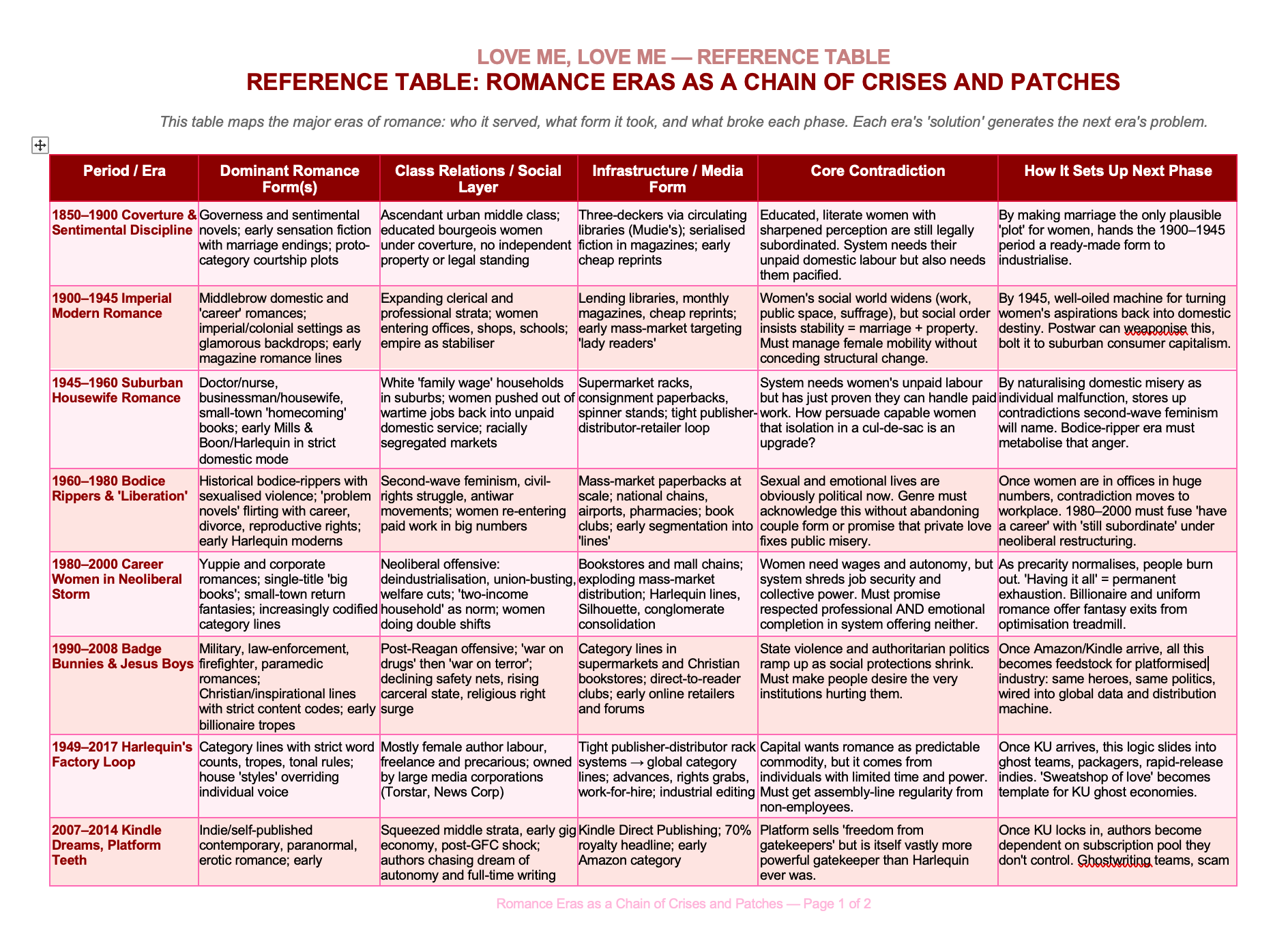
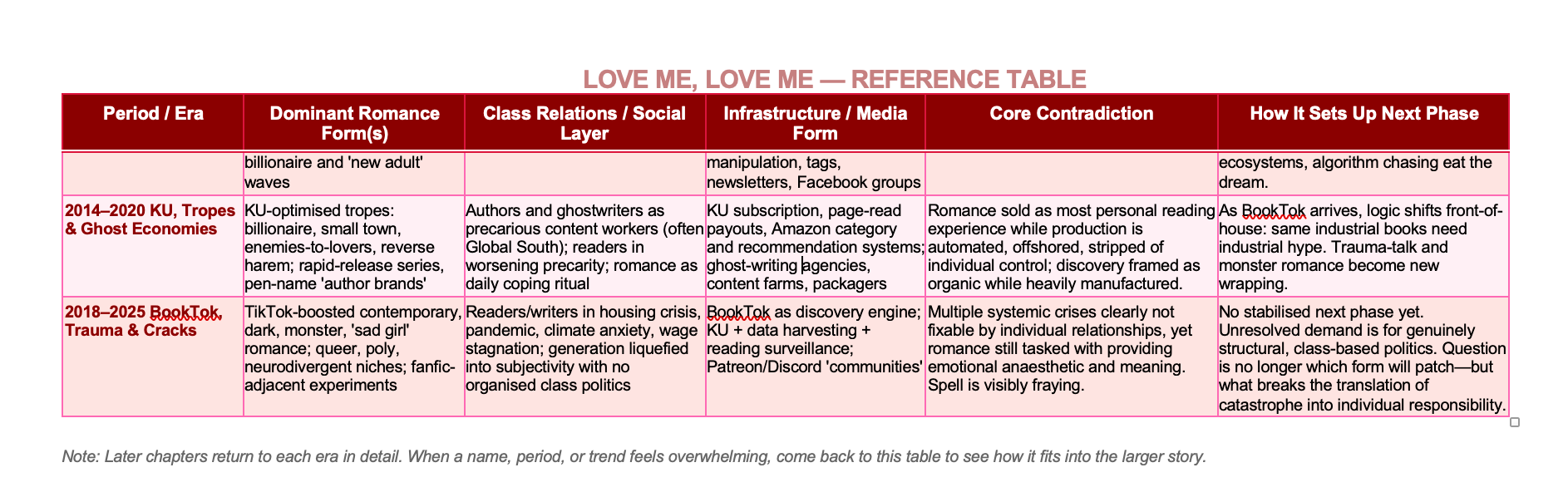
This reference table is a structural map of the book. Each row lines up a period of capitalism with the dominant romance form it produced, the class layer it spoke for, the media infrastructure that carried it, the core contradiction it had to manage, and the way its “solution” set up the next crisis. It isn’t a full history—just a spine. When the chapters zoom in on particular authors, tropes, or platforms, you can flip back here to see where they sit in the larger loop: crisis → patch →
Sarah checks her Kindle Unlimited dashboard at 6:47 AM, coffee cooling beside her laptop. The numbers tick over in real time: 2,847 pages read overnight across her five books in the program. At roughly $0.004 per page, that’s $11.39 while she slept.¹ Not a fortune. Not nothing. Rent money if the month is good and the algorithm doesn’t turn on her.
Another manuscript is due Friday—her sixth book this year—with three more contracted before December. The schedule isn’t ambition, it’s survival. Authors who publish quarterly slide off the also-bought carousel. Monthly releases keep you barely visible. Weekly releases, if you can manage them without collapsing, might get you featured.
She opens her work-in-progress: Claimed by the Ruthless CFO, book four in the Manhattan Titans series. The outline is already tuned to the platform:
• forced proximity by chapter two
• first kiss by chapter five
• the big fracture around 70%
• an epilogue with a ring, a baby, or both
She’s “writing to market,” which in practice means writing to data—reverse-engineering what Amazon’s recommendation system rewards. The billionaire hero. The virgin or near-virgin heroine. The “spicy” scenes BookTok expects: explicit enough to circulate in breathless reaction videos, tame enough to dodge content warnings that bury discoverability. Her last book got 4.2 stars and 847 reviews in two months. Respectable numbers. Not breakout. Just enough that the landlord doesn’t care what Kindle Unlimited is.
This is what romance looks like in 2025.
Right In Front
Romance in this moment is industrial content production tuned to platform metrics. This is not the first version of itself; it’s the latest mutation. The genre has moved from publisher-controlled formula (roughly 1850–1945), to postwar category industrialisation (1946–2010), to its current stage: algorithm-driven content bound to a handful of digital monopolies.
Authors burn out on production schedules that would have been unthinkable even fifteen years ago. Readers tear through books at speeds industry people politely call “binge reading,” though the behaviour looks much closer to compulsion. Kindle Unlimited—$11.99 a month for “all you can read”—turns books into streaming content, authors into gig workers paid per page, and reading into a traceable, saleable pattern of behaviour.²
Amazon tracks everything it can: reading speed and completion rates, skipped chapters and reread scenes, search terms, wish lists, one-click impulse buys. Every gesture feeds a recommendation system that decides which books appear on home screens and which simply stop existing for all practical purposes.
The scale is hard to grasp. Romance generates over two billion dollars annually in the United States alone and, by most estimates, makes up something like 40 percent of all genre fiction sales.³ In the subscription era, heavy romance readers routinely consume ten, twenty, even fifty books a month.
The platform makes that possible and then quietly demands it. Authors have to feed the algorithm; readers have to feed their own feeds. TikTok trends need new material. KU needs constant circulation. The whole setup has to keep moving or it seizes.
Sarah knows these rules because you don’t last long if you don’t. The algorithm favours particular tropes: billionaires and CEOs; age gaps; “why choose” reverse harems; bully and mafia romances; “dark” heroes whose behaviour would be criminal in any other context but is framed as protection here. BookTok—TikTok’s book subculture—pushes these trends through thirty-second videos that can turn an unknown author into a mid-list veteran’s replacement in a week.⁴
Books now need “BookTok appeal”: covers that film well, tropes that can be boiled down to three words in a caption, a “spice level” that can be ranked numerically. A story becomes a content bundle: aesthetic, trope list, reaction shot, affiliate link.
Underneath that churn, something else has shifted that doesn’t show up on the dashboard.
Sarah scrolls through her reader messages—mostly kind, some unsettling, almost all asking for the next book faster—and notices what she’s been trying not to think about. Her readers are not turning to romance because life is stable and pleasant. They are reading because life is structurally unbearable.
Housing costs that eat half their income. Medical bills that can wipe out a decade in one emergency. Student debt that never meaningfully shrinks. Climate disasters showing up in their news alerts. Pandemic trauma that no one has time or money to process because therapy is $150 a session if you’re lucky.⁵ The messages say things like:
“Your books are the only thing keeping me going.”
“I can’t afford therapy, so I read.”
“I just need somewhere to disappear for a few hours.”
Romance has become emotional infrastructure—the closest thing millions of people have to a predictable source of comfort inside a system that has stripped away most others. The class content is blunt if you decide to look at it. Working-class and precarious middle-class women are inhaling fantasies of billionaire rescue, alpha providers, protective cops and soldiers, small-town stability, and found families in renovated farmhouses at the exact historical moment when wages, unions, public housing, and social services have been gutted.
Romance is not just telling stories; it is teaching people where to aim their hope.
Three Kinds of Theft
This system pulls value out of three places at once: writers, readers, and social movements.
First: from writers.
Creative labour is turned into piecework under platform discipline. Kindle Unlimited’s exclusivity rule forces authors to choose between Amazon and everyone else; choosing “wide” distribution often means choosing commercial obscurity. Payment is per page read, at a rate Amazon sets unilaterally and reveals only after the fact.⁶ One change to the terms of service can cut an author’s income in half overnight.
Writers are not just competing with one another; many are competing with “author brands” that are in practice small factories—ghost teams and content farms using writers in the Philippines, India, Eastern Europe and elsewhere for $500–$2,000 per 50,000-word book. Those books then sell under Western pen names that can clear $30,000 or more a year.⁷ NDAs strip the actual workers of credit, rights, and any claim on future income. Rapid release becomes mandatory. Burnout is not a risk, it is built into the job description.
Second: from readers.
What looks like cheap comfort is also an enormous surveillance and marketing operation. Amazon isn’t just selling books and subscriptions; it’s harvesting behaviour. Page-read telemetry reveals engagement patterns. Highlights mark out emotional triggers. Rereads flag comfort passages. Abandonment points show when patience runs out. Cross-referenced with search history, wish lists, and broader shopping data, this becomes a psychological profile with commercial uses far beyond book recommendations.⁸
Reader money funds the subscription. Reader time produces the data. Reader emotional life becomes training material for recommendation systems and AI models, with no compensation and very little informed consent.
Third: from culture.
Every serious challenge from below—feminism, anti-racism, queer and trans liberation, disability activism, neurodivergent advocacy—is steadily converted into marketable “representation” that leaves the basic order intact.
Feminism becomes “strong heroines” who still end up folding themselves around a man’s needs by the final chapter. Anti-racist struggle gets reframed as diverse casting in stories that leave property and policing untouched. Queer liberation becomes gay and bi couples slotted into the same domestic closure and couple-worship as straight ones. Disability and neurodivergence become quirks or trauma backstories that can be soothed through love rather than fought for through healthcare, accessibility, and collective struggle.⁹
The system is highly flexible. It can plug almost any identity into its wiring as long as a few things never change: the couple is sacred, property remains private, wealth is aspirational rather than indictable, the state stays fundamentally legitimate, and the solution is always personal rather than political.
At full stretch, romance becomes a perfect little engine: every point of contact—writing, reading, marketing, “representation”—throws off profit and data while the people actually living the crisis are left with a sugar crash and the same unpayable bills.
The Core Contradiction
People do not flock to billionaire fantasies because they believe billionaires are benign. They flock to them because, under present conditions, a partner with that much money feels like the only imaginable route out of permanent insecurity.
Readers reach for trauma-heavy, “healing” romance because real healthcare is priced out of reach. They mainline “comfort reads” with cozy domestic settings even as their own rent is higher than their parents’ mortgage ever was, and home ownership has been pushed into the realm of science fiction for their generation. They inhale “protective cop” or “special forces” heroes in a world where actual police and soldiers are deployed against protests and communities with increasing brutality.
The basic contradiction is simple enough to put in one sentence: capitalism promises individual reward for effort but runs on class exploitation. Romance is the story that stops you getting to that sentence. It turns structural crisis into personal misfortune and then sells you a personal solution.
Instead of wages and social housing, you get a tech billionaire with a spare penthouse and a wounded heart. Instead of unionising, you get the boss who falls in love with his assistant and learns to respect her feelings. Instead of charging the state for its crimes, you get the cop who is different from the other cops. Instead of mass movements to win universal healthcare, you get one man who finally takes your pain seriously.
Across its history, this system has relied on three consistent moves:
1. Turn structural problems into private stories.
Economic crashes, mass unemployment, war, austerity, housing bubbles, epidemic disease—everything becomes raw material for another tale of individual salvation through love.
2. Offer fantasy when reality fails.
When the promises of “work hard and you’ll be safe” fall apart, the genre doesn’t admit that the promises were lies; it simply escalates the fantasy. The heroes get richer, darker, more powerful. The scenarios get more extreme. The distance from real life grows.
3. Swallow resistance movements whole.
Each time people begin to demand something beyond individual survival—feminist autonomy, Black liberation, queer and trans freedom, disability justice—the industry finds a way to package pieces of that language and aesthetic while keeping the underlying class, race and gender relations in place.
The platform era adds a fourth move: extract data from every breath of the process. Writing is partially automated and outsourced. Reading is monitored and modelled. Emotion itself becomes grist for the prediction mill. None of that overturns the basic pattern; it just makes the extraction more fine-grained and less visible.
How Long Has It Been Like This?
None of this started with Kindle Unlimited in 2014. The subscription model is just the current expression of a job romance has been doing for a very long time.
The modern romance industry takes shape around 1850, when industrial capitalism expanded women’s access to literacy and cheap print while the law still treated married women as extensions of their husbands. Under coverture, a married woman could not own property in her own name, sign contracts, or control her wages. Her legal existence was “suspended” and folded into her husband’s.¹⁰
By 1880, roughly 90 percent of women in England could read, up from just over half thirty years earlier. They could follow complex plots about inheritance, bankruptcy, and social mobility. They could recognise their own economic vulnerability in these stories. But the “respectable” conclusion for a middle-class woman was still marriage to a man with property—legal dependence presented as happy ending.
Sensation novels like Mary Elizabeth Braddon’s Lady Audley’s Secret, which sold over a million copies, turned those contradictions into mass entertainment: bigamy, madness, missing husbands, hidden debts. Circulating libraries like Mudie’s built business models around filtering which books reached middle-class women, enforcing moral boundaries that would harden into “genre expectations.”¹⁰ Publishers saw that literate women were an extremely profitable market. Authors responded, churning out stories that acknowledged fear and frustration while circling back to the same solution: a suitable husband who could absorb those fears under his legal authority.
You could call this the “literacy trap.” Industrial society gave women just enough education to imagine other lives, then used fiction to train that imagination back toward the existing order. The women weren’t dupes; they were working with the choices available. The publishers weren’t conspirators in a smoke-filled room; they were pursuing profit inside a legal and economic framework that assumed male control as normal.
From there, the pattern repeats in new forms:
• Early 20th century magazines tie romance to advertising and war. Women’s magazines run serialised love stories side by side with soap and appliance ads, helping to build the housewife-consumer while recruiting and then demobilising women workers in the First and Second World Wars.
• Post-1945 paperbacks fill supermarket racks with nurse, secretary and housewife romances that stabilise the suburban settlement: single wage, nuclear family, unpaid domestic labour sold as fulfilment.
• The upsurge of women’s liberation in the 1960s–70s collides with a boom in gothic and “bodice-ripper” historicals. Heroines may be more outspoken, sex more explicit, but the structure snaps back to marriage and male control in the last chapters.¹¹
• From the mid-1970s on, what is popularly labelled “neoliberalism” but is more accurately understood as a conscious offensive by the ruling class—smashing unions, deregulating finance, privatising services—tears up the old guarantees of a single income and a secure job. The genre responds by inflating the hero: CEOs, sheikhs, princes, billionaires. Harlequin and Mills & Boon perfect the category system. Janet Dailey writes ninety-plus novels in two decades. Wealth concentration becomes erotic spectacle instead of a political question.
• The “tough on crime” era and post-9/11 wars see an explosion of cop, FBI and military romances. Navy SEALs, detectives and federal agents step in as love interests just as police militarisation, mass incarceration and permanent war become the real face of the state. Christian romance grows alongside, feeding evangelical networks with stories that normalise submission, patriarchy and the “traditional family” while those same networks move ever deeper into right-wing politics.¹²
• The 2008 crash and the Kindle launch are sold as a revolution in which anyone can publish and thrive. For a brief period, some writers do. Amanda Hocking and a handful of others prove that self-publishing can generate serious money. Then Amazon locks in its position, rolls out KU, and slowly tightens the terms.¹³
• From 2019 onward, BookTok arrives, marketed as readers recommending books to one another “organically.” In practice, publishers pour money into TikTok campaigns, pay influencers for allegedly spontaneous posts, and chase the next viral dark-mafia-spice title.⁴ Ghostwriting operations expand to keep up with demand. Content mills turn out series for pen names that are more brand than person.¹⁴
Each stage looks, on the surface, like expansion and freedom: more voices, more subgenres, more heat, more “representation,” more control for authors, more choice for readers. Underneath, the work remains the same: redirect anger and fear away from the social order and back into private life, and harvest the resulting attention for profit.
Hitting the Limits
Right now, that work is running at maximum intensity just as its limits become hardest to hide.
The genre has never been more visible or more lucrative. Romance sections dominate bookstores. BookTok tables sit at the front of chains. KU is stacked with hundreds of thousands of titles. Representation has improved in obvious ways: more writers and characters of colour, more queer and trans stories, more neurodivergent and disabled protagonists, more explicit sex, more frank treatment of trauma.
At the same time, the actual conditions of life for the people reading these books are deteriorating. Wages lag behind inflation. Housing is increasingly unattainable. Health systems are collapsing. Climate disaster is not a metaphor, it’s the smoke outside. Under those conditions, it doesn’t matter how fast the machine spins; it cannot turn fantasy into insulin, or rent money, or safe drinking water.
That contradiction leaks into the reading experience itself. The more the promises of the social order break down, the more intense and outlandish the fantasies have to become to offer any relief. Billionaires accumulate cartoonish levels of wealth. Dark romances normalise behaviour that, in any other context, would be recognised as abuse. “Spice” escalates into a kind of arms race. Representation politics offers genuine moments of recognition, but within stories that still end with private salvation and property.
The machine still runs. It still provides real comfort for many people some of the time. That matters. The point is not to sneer at anybody for needing relief. The point is to look directly at how this relief is produced, who profits from it, and what it blocks from view.
What This Book Is Doing
This book treats romance not as a guilty pleasure or a punchline, but as part of the way capitalist society reproduces itself.
Across its three parts, it follows the genre from:
• industrial Britain’s “literacy trap” and sensation fiction,
• through postwar mass paperbacks and the factory system of Harlequin/Mills & Boon,
• through billionaire and uniform fantasies in an era of deindustrialisation, repression and war,
• into the present world of ghostwritten KU series, BookTok campaigns and data-mined reading.
The method is simple: material first. This is a muck-raking Marxist political economy of one of the most underexamined mass industries on earth. It is built on contracts, lawsuits, financial statements, policy documents, trade coverage, author testimonies and market data, not on academic fashion or coy sociology.
Part I looks at how the basic template is built from the mid-19th century to the Second World War: who owned the presses and libraries, what the law said about women and property, how war and reconstruction reshaped the marriage plot.
Part II moves through post-1945 boom and crisis—housewife and secretary romances, category lines, billionaire escalation, carceral and Christian romances, the rise of digital platforms and KU.
Part III stays with the present: subscription models, content mills, BookTok, data extraction, the “spice” race, trauma branding, and the limits of representation inside a system that cannot afford the changes people actually need.
Later chapters identify specific points of leverage: Amazon’s KU monopoly over ebooks, Harlequin’s historical exploitation of authors, Christian publishing’s integration into the far-right, BookTok’s fusion of “community” and covert advertising. Those become the basis for thinking about real-world fights: unionising, regulation, breaking up monopolies, building forms of cultural production that do not have to flatter capital to exist.
The aim is not to tell readers to stop reading romance. The aim is to make it impossible to see romance as “just entertainment” once you understand what work it is doing for this social order—and to open the space to imagine something beyond it.
Sarah drains the last of her cold coffee and looks back at Claimed by the Ruthless CFO. The draft isn’t going to write itself. The manuscript is due on Friday. The algorithm favours authors who never miss. Somewhere, another reader is leaving a review saying that Sarah’s books are the only thing making their night shift bearable.
The machine will keep running tomorrow and the next day and the next. It runs because people need what it offers and because everything else has been stripped away or sold back to them at a premium. But once you see how it’s put together—who builds it, who oils it, who it carries and who it crushes—you’re no longer trapped inside the story. You can start to think about dismantling the thing instead of just feeding it.
The historical story begins in 1850, with women who could read but were not allowed to own their own lives.
London, 1860. Upstairs from the soot and cart noise of New Oxford Street, the air in Mudie’s Select Library offices is thick with coal smoke, wet wool, and printer’s ink. Three men sit around a scarred table, boots stretched toward a grudging fire. Between them: a leaning tower of three-volume novels, each one a possible future for some author who needs the money.
A clerk opens the next parcel—new fiction from Chapman and Hall. The first reader has already done the dull work and now gives the summary in a flat voice: a married woman, an affair with an artist, a husband drawn as a petty tyrant, the wife treated too kindly for comfort. Charles Edward Mudie, at the head of the table, doesn’t need to hear the ending.
“Rejected. Unsuitable for family reading. Send the usual letter. Next.”
Another three-decker comes out of its paper, this one from Smith, Elder & Co. A governess, a brooding employer, a mad wife in the attic. The governess flees rather than become his mistress, wanders through poverty, inherits money, and only returns to him after a convenient fire kills the wife and levels the house.
Mudie listens, then nods once.
“Acceptable. Order fifty. The madwoman destroys herself, the governess waits, and they only marry once she’s respectable. Moral structure sound.”
The book is Jane Eyre, already a few years into its life. Mudie’s brief judgement—not the critics, not the “genius” talk in the papers—is what guarantees it will be in thousands of middle-class parlours.¹ Fifty copies on his shelves means steady borrowing, steady re-orders, the kind of circulation that keeps an author writing rather than going back to the classroom or the governess’ nursery. His yes or no is the difference between a career and a cautionary tale.
This is censorship without the bother of a law. No Home Office decree, no blue pencil from a state bureau—just one man’s sense of “family reading” standing in for God, Parliament, and the Bank of England. His preferences, and those of his subscribers, quietly harden into rules: adultery can appear only to be punished; wives may suffer but must not abandon; marriage must remain the finish line. Publishers learn to write toward those invisible requirements. Authors learn that certain endings pay and others do not.
Most Victorian readers never see this room or hear these conversations. They only see the polished side: rows of cloth-bound volumes in the lending library, a civilised fee, a novel brought home in a canvas bag. The filtering has already happened. What reaches their hands are love stories pre-screened to end in the right kind of marriage, with female autonomy trimmed down and folded back into dependence dressed up as destiny.
Romance does not simply “drift” into this shape because human beings naturally crave wedding bells. It is being steered. What happens in this smoky upstairs office is the first move in a much longer game: a commercial and ideological set-up that takes the wreckage of industrial capitalism and reorganises it as something soft, sentimental, and profitable.²
Factories, Servants, and Suspended Lives
Industrial capitalism didn’t just “modernise” women’s work—it tore the old household economy up by the roots and sold the pieces back for wages that could barely sustain life.
By the mid-nineteenth century, the textile mills of Britain were filled with hundreds of thousands of women, packed into the new industrial towns.³ Work that had once been done at home—spinning, weaving, and sewing—was dragged into the factories and ruled by the clock. Typical wages hovered between £15 and £25 a year.⁴ That meant a bed in shared lodgings, basic food, and no savings for sickness, unemployment, or old age. You could survive, but only just.
Domestic service was even larger. By 1851, about a million women in Britain worked as servants, making it the single biggest female occupation.⁵ Fourteen-hour days for room, board, and maybe £10–20 a year.⁶ The old household economy—where women’s work in spinning, preserving, brewing, and weaving had visible worth within the family—was gutted. Capital took those same tasks, sold them back as commodities, and paid women a fraction of the value they created.
Law locked this inequality in place. Sir William Blackstone’s Commentaries on the Laws of England, still the core legal text of the time, stated it baldly:
“By marriage, the husband and wife are one person in law: that is, the very being or legal existence of the woman is suspended during the marriage, or at least is incorporated and consolidated into that of the husband.”⁷
Under coverture, a married woman became feme covert—covered, in every sense, by her husband. Her property became his. Her wages became his. Any contract she signed was void without his consent. She could not sue or be sued in her own name. She had no independent claim to her children. You could point to her in a room; the law could not.
That produced a very specific knot of contradictions. Industrial capitalism opened up more paid work for women—factories, teaching, governessing, domestic labour—but marriage law ensured male authority wrapped itself around every escape route. A woman could earn wages, but if she married, she could not legally keep them. She could be educated, but if she married, she could not sign a lease. The Married Women’s Property Act of 1870 grudgingly allowed wives to keep their own earnings, but left most assets untouched.⁸ Only with the 1882 Act did married women gain full property rights in their own name.⁹ For most of the half-century in question, the rule was brutally simple: marriage turned an independent legal subject into a dependent legal shadow.
Meanwhile, literacy was rising fast. Sunday schools, evening schools, and local classrooms meant that by mid-century, the majority of working-class girls in industrial regions could read at least basic prose.¹⁰ Among the middle class, “accomplishment” education—piano, French, fine penmanship—encouraged reading as a badge of refinement. The result was a rapidly expanding audience of women who could read complex novels, think with them, and imagine lives beyond their current conditions—while the material order of society refused to let them.
That was the trap. Industrial capitalism created more literate women and fewer acceptable ways for them to live. Wage work existed, but only as drudgery. Marriage offered stability, but at the cost of legal extinction. The law treated you as an appendage; the factory treated you as replaceable.
Into that pressure gap stepped the marriage plot—not as a sentimental reflection of “love conquers all,” but as a cultural safety valve. It took the collision between literacy, labour, and legal non-existence and resolved it in fiction, where the heroine’s struggle could end not with rebellion, but with a wedding ring and a sigh of relief. It wasn’t a dream of freedom. It was a dream of being safely enclosed.
Love on Subscription
The three-volume novel—the “three-decker”—was never just an artistic quirk. It was a pricing trick.
By the 1840s, the standard price of 31 shillings and sixpence (about £1.57) had settled in.¹¹ For most households, buying one outright was a joke. A skilled artisan might bring home around £1–2 a week.¹² A clerk might earn £60–80 a year.¹³ Dropping more than a week’s wages—or a visible slice of annual income—on a single novel made no sense unless you were very comfortable indeed.
The subscription, on the other hand, made perfect sense. Mudie’s Select Library charged one guinea (£1.05) a year for the right to borrow one volume at a time, with higher fees if you wanted more volumes or lived out of town.¹⁴ It was the perfect middle-class signal: frugal yet refined. You didn’t recklessly buy novels; you had a subscription to a “Select Library,” which promised to filter out anything too lurid, too political, or too real.
The business logic clicked into place. Publishers priced three-deckers to sell in bulk to institutions like Mudie’s, not to individuals. Smith, Elder & Co. fed Jane Eyre straight into this system, making their real money from Mudie’s orders, subsequent reprints, and colonial editions.¹⁵ Charlotte Brontë, meanwhile, got a one-off £500 for the copyright—a decent-looking windfall that quietly severed her from decades of future revenue.¹⁶ From here on, the pattern will repeat in every new technical wrapper: the entity that controls distribution keeps the long-term value; the writer takes the gamble and gets the once-only cheque.
Mudie made money from subscriptions, but his real leverage was in saying yes or no. By 1860 he had around 25,000 subscribers.¹⁷ If he rejected a novel, its prospects collapsed. If he ordered fifty or a hundred copies, it lived. Publishers began to pre-censor on his behalf, shelving or “toning down” manuscripts they feared might not pass. His unwritten rules—no sympathetic adultery, no explicit sex, no direct assaults on religion or the social order—functioned as a private morality code with public reach.¹⁸
No statute, no police raids—just one commercial choke point, aligned with church and bourgeois respectability, deciding what counted as “safe” emotion.
Then there was serialization. Stories were chopped into monthly instalments in Dickens’s Household Words and All the Year Round, and later in Cornhill.¹⁹ ²⁰ Readers got used to taking their fiction in regular doses, ending on cliffhangers, then buying or borrowing the bound volume later. Publishers skimmed from every step: the magazine sale, the library’s three-decker orders, and finally the cheap reprint for the wider market.
Form and content didn’t just happen to coincide—they were welded together. Three volumes encouraged a particular rhythm: courtship and set-up in Volume I; separation, reversals, and panic in Volume II; resolution and marriage in Volume III. Serialization demanded that each chunk end on a crisis or revelation. Library morality demanded that the ending land safely on marriage and property.
What later looks like the “natural” heartbeat of the Victorian love story was, from the start, wired straight into its business model.
A Damsel in a Dress
In that context, Jane Eyre is not just a beloved novel; it’s a wiring diagram for how the new system teaches readers to feel about love, money, and obedience.
Jane starts as unwanted surplus—an extra mouth in the Reeds’ household—then is shipped off to Lowood, a charity school where typhus and pious neglect do most of the disciplining. From there she climbs to the “respectable” job open to an educated poor woman: governess at Thornfield, on roughly £15 a year.²¹ It’s just enough to keep her dressed and fed, but not enough to accumulate security.
She owns nothing, has no legal standing, and can be dismissed at any time. The role is respectable in theory and disposable in practice.
Rochester enters with exactly the right profile for the emerging romantic formula. He is older, wealthy, and socially dominant; she is sharp, angry, and morally stubborn—but economically powerless. Their conversations crackle because she keeps pushing back, but always from a position of material dependence. When Bertha is revealed in the attic, the law cuts in: marriage would be bigamy.
Rochester offers her a compromise—life as his mistress in France. Jane refuses, runs, and nearly dies for that refusal.
Then the plot pulls its lever. Out of nowhere, an uncle in Madeira dies and leaves Jane £20,000.²² In nineteenth-century terms, this is not just a windfall; it is capital on the scale of a small estate—something like a few million in today’s money.²³ It gives her, on paper, precisely what the new working woman lacks: the means to live without male support. She could found a school, buy a house, organise a household of women, or simply live alone on her own terms.
She does none of those things. She returns to Rochester. Thornfield has burned. Bertha is dead by her own act. Rochester is injured, partially blind, and conveniently humbled. They marry, and the narrative insists that now, finally, they meet as equals: she has money, he has been chastened, the balance has been redrawn.²⁴
Legally, that equality is a mirage. Under coverture, her £20,000 is swallowed into his estate. The property remains structured around male ownership; their children inherit through him. The law quietly resets everything to exactly where it was designed to be. What has changed is not the structure but the feeling about it. The plot’s work is to make this restoration feel like justice, healing, and reward rather than a reassertion of the very hierarchy the book has spent hundreds of pages making intolerable.
That is the trick at the heart of the early marriage plot. It fully acknowledges female economic vulnerability and male power. It lets readers feel the rage and the fear. Then it drains those feelings off into a “happy ending” that leaves the underlying order untouched.
The governess is the perfect tool for this work. As a figure, she sits right on the fracture line of class and gender. She is educated and “ladylike,” but she is also waged labour.
She lives in the employer’s house, shares the domestic space, but is not kin. She is paid, but badly: typical wages run around £20–40 a year.²⁵ She is too refined to eat with the servants, too poor to live like the family, and too isolated to organise with anyone.
Brontë didn’t have to imagine this. She had done the job, hated it, and failed to make it pay.²⁶ Her fiction keeps circling the governess because the role condenses the whole problem: women who have the education and intelligence that should qualify them for independent professional life, trapped in positions where their only real exit route is a man with money.
The marriage plot holds out that exit as a lifeline. But it is always an individual solution, and always on the condition that the woman folds herself back into the same family structure that produced her precarity in the first place. The system offers rescue, on the strict understanding that nothing fundamental will change.
Sensation and Profit
If Jane Eyre shows how the machine keeps everyone politely inside the fence, the sensation novel is what happens when the fence catches fire.
Mary Elizabeth Braddon wrote at a pace that would make a Kindle Unlimited rapid-releaser wince. Through the 1860s she juggled serials, short fiction, and full-length novels, often running several at once, for advances in the £1,000–2,000 range.²⁷ ²⁸ She made her publisher very comfortable and did something almost unheard of for a Victorian woman writer: she turned her pen into reliable capital.
Lady Audley’s Secret (1862) is where everything snaps into focus.²⁹ On the surface, it’s a domestic thriller: a pretty governess ascends into the aristocracy, a missing man, a suspicious nephew, a house full of secrets. Underneath, it’s a catalogue of class terror. Lucy Graham—who is really Helen Talboys—is a woman who has already done everything “right”: she married for survival, was abandoned, dropped into destitution with a child, and then reinvented herself to avoid ending up in the gutter. When her past walks back through the door in the shape of George Talboys, she pushes him down a well. When other men threaten to expose her, she moves to eliminate them too.
Strip away the Victorian decor and the novel is blunt: a woman with no property and no legal personhood will commit crimes to stay alive.
The published version cannot admit that. So Lucy is diagnosed with hereditary insanity and shipped off to a Belgian asylum.³⁰ The crime, in other words, is not that the world left her with no acceptable options; the crime is that she was “mad” enough to refuse her assigned role. The book lets readers revel in her defiance, then calmly tags her as diseased and removes her from the story like a tumour.
Braddon’s sales figures wrote the rule in large letters for the trade: you can give women stories about bigamy, arson, fraud, rage, even attempted murder—provided the final chapter restores the furniture. Mudie grumbled about sensation fiction corrupting the public taste, then quietly stocked it once subscribers kept asking.³¹ Respectable readers got their thrills pre-filtered through the same “Select” channels that had been screening out adulterous wives a decade earlier.
For working-class readers, the route in looked different but did the same job. Cheap single-volume reprints and penny serials poured sensation stories into railway bookstalls and corner shops.³² The covers were gaudier, the price lower, the lecture identical. Women who reached for survival by stepping outside their assigned place ended in madness, prison, or the grave. You could enjoy the spectacle of rebellion, but you were not meant to see it as a map.
By the end of the 1860s, the industry had something extremely valuable on its hands: a way to monetise female anger and fear without ever allowing that anger to turn outward, toward the law or the class structure. Put rebellion onstage, let it sell papers, then kill it, cure it, or lock it away. That structure—transgression on the surface, obedience at the end—will be recycled all the way through Gothic romance, “bad boy” paperbacks, and today’s “dark” and “taboo” romance, where the cover screams danger and the final chapter reassures you that everyone ends up exactly where they were supposed to.
Class Function: How It Hails Different Readers
The same marriage-obsessed story world did not talk to everyone in the same voice. It hailed different classes differently, while keeping the core message identical: couple up, stay in your lane, don’t look too hard at the foundations.
For middle-class women, the sentimental and domestic novel laid out bourgeois marriage as both reward and perimeter fence. Heroines are almost always assumed to be white and “respectable.” They can be sharp-tongued, bookish, stubborn, even briefly rebellious, but only in the safe space between Chapter One and the proposal. That middle stretch is where they argue, refuse, test boundaries. By the last chapter, the deal is signed: they marry the man whose property and position will keep them parked inside the middle class.
Governess novels put a magnifying glass over that anxiety. The governess is a middle-class woman who has slipped: a dead father, a bankrupt business, a feckless uncle with gambling debts. She’s too “ladylike” for factory work or domestic service, but there is no man to fund the lifestyle that her upbringing promised. She lives in other people’s houses, raising other people’s children, while trying not to look too closely at her own future.
Jane Eyre, Anne Brontë’s Agnes Grey, Charlotte Yonge’s The Clever Woman of the Family—all of them look the problem straight in the eye.³³ They show the humiliation, the low pay, the social no-man’s-land where a governess belongs to no class fully. And each time, when it comes to the question of how she escapes, the answer is identical: she marries up. Not better wages, not collective organisation, not new legal rights—just a private rescue operation in the form of a husband.
The missing options are as important as the ones on the page. There is no serious suggestion that governesses might organise for higher pay or decent conditions. No sustained imagining of unmarried women forming their own households for mutual support. No sense that the law itself might be the problem rather than individual misfortune. The only victory on offer is to get out of the labour market entirely by becoming, once again, someone else’s dependent—this time romantically.
For working-class women, the function shifts. Sensation fiction and cheap reprints bring them bigamy, adultery, murder, fraud, madness, and scandal.³⁴ ³⁵ When heroines come from working-class backgrounds, they almost never get away clean. If they reach for a richer man, the plot swats their hand. If they break the rules, the conclusion is not a compromised happy ending but death, the asylum, or obliteration.
The curriculum is basic but effective. Middle-class women are trained to treat marriage as a safety net against downward fall. Working-class women are trained to see upward mobility as a trapdoor over a pit. Try to step across the line and the world responds with police, doctors, magistrates, and men in black coats.
None of this arrives as a lecture. It seeps in while someone is reading by candlelight after work, or sharing a dog-eared volume with sisters and cousins, or following a serial in a cheap magazine. The same network of publishers, libraries, and distributors feeds each class a slightly different diet. The seasoning changes; the main ingredient—the family form as final horizon—does not.
Evolution and Escalation
By the 1880s and 1890s, the story engine was still running, but it was starting to rattle. Women were more educated, more aware of their legal non-existence, and less willing to pretend that a good husband solved everything. Some writers stopped hinting and started saying it out loud.
So-called “New Woman” fiction—George Egerton, Sarah Grand, Olive Schreiner and their peers—dragged demands onto the page that earlier novels had muffled.³⁶ Higher education, paid work, sexual autonomy, the right not to marry at all; criticism of double standards, venereal disease, and the moral rot hiding behind respectable husbands. These books didn’t just want better marriages for their heroines. They asked what life might look like if marriage were not the organising principle in the first place.
The system’s response was exactly what we’ve already seen with sensation fiction, just pitched to a new problem. Publishers marketed New Woman novels as daring, modern, a little dangerous—perfect fodder for reviews and dinner-party talk. Circulating libraries stocked some of them. But when you flip to the last chapters, the heroines who refuse the old bargains rarely live to send postcards.
In The Heavenly Twins, one sister discovers her husband’s venereal infection and dies; another retreats into a kind of austere self-sacrifice.³⁷ In The Story of an African Farm, Lyndall refuses marriage, holds the line, and dies in childbirth.³⁸ The pattern is not subtle. You may question the terms; you may even defy them. But cross a certain line, and the narrative quietly reaches for the shroud.
Meanwhile, the business infrastructure is shifting. The three-decker novel, once the perfect profit machine for publishers and libraries, starts to look clumsy and overpriced. In the 1890s it gives way to single-volume editions and cheap reprints that turn over faster and reach more people.³⁹ Mudie’s grip weakens as new channels—railway bookstalls, reprint houses, mass-market publishers—move in on his territory. The personnel change; the logic does not. Forms that promise stable profit and moral safety are favoured. Forms that threaten either are trimmed, repackaged, or quietly left to die.
At the same time, the pool of women who can see the gap between the story and their lives is growing. By 1900, girls are flooding into secondary schools, and women are appearing in classrooms, hospitals, offices, and shops as workers rather than as dependent daughters.⁴⁰ They are more literate, more visible, and more entangled in the cash economy—but their autonomy is still fragile, held hostage by low wages, hostile laws, and social expectation.
The campaigns for women’s property rights drag on for decades before the Married Women’s Property Acts finally pass.⁴¹ Even then, the novel does not suddenly begin treating marriage as a contested legal arrangement. On the page, it remains a natural ending, not a structure that might be rewritten.
By the end of the century, the genre is sitting on a growing pile of unresolved contradictions. There are more educated women than ever before, not enough secure husbands to match the fantasy, and a visibly expanding class of single and precarious women for whom “governess marries master” is statistically absurd. The old plot still sells, but it creaks. The next phase of the system—magazines, mass-market lines, eventually category romance—will have to find new ways to manage the same underlying problem: how to keep promising individual escape in a world where the exits are visibly narrowing.
What This Phase Actually Builds
If you zoom out from the individual novels and look at 1850–1900 as a whole, what comes into focus is not a cosy backdrop of “Victorian fiction,” but the first fully wired version of a system: commercial publishers, subscription libraries, and a set of story formulas all pulling in the same direction.
Industrial capitalism tears up the household economy and drags women into badly paid, tightly supervised wage work. Coverture keeps marriage in place as the main technology for controlling women’s property, wages, and legal identity. Education and literacy expand just enough to let women read, think, and argue—but not enough to give most of them material exit routes. Into that contradiction step the people who make money from print. Publishers design a product—the three-volume novel for rental libraries—that is most profitable when it calms those tensions, not when it encourages anyone to start asking why the system looks like this at all.
In that light, Jane Eyre and Lady Audley’s Secret are not “timeless romances.” They are working demonstrations of how to turn a specific class and gender order into a habit of feeling. Brontë gets one cheque for Jane Eyre while Smith, Elder & Co. go on monetising her work through library sales, reprints, and colonial editions for decades.⁴² Braddon writes at industrial speed, for advances that are impressive but still finite, and helps prove that you can sell women stories about bigamy, violence, and rage—provided you close the file by restoring marriage, property, and the doctor’s diagnosis at the end.²⁷ ²⁸
The ideology is not an afterthought sprinkled on top of neutral formats. It’s wired into the formats themselves. The three-decker, with its prohibitive price and library-centred business model, makes individual ownership irrational and funnels readers through a single moral gatekeeper. The monthly serial, with its cliffhangers, trains people to return regularly for emotional instalments, then to buy the bound volume as a souvenir. The “Select Library” catalogue, with its quiet exclusions, tells you which desires are respectable enough to rent and which will never make it onto the shelf. The bourgeois family is not just described in these books; it is baked into how the books are priced, packaged, and delivered.
Across this emergence phase, three habits harden into muscle memory:
Privatising solutions. When a woman’s life is wrecked by low wages, bad law, or class collapse, the story routes her toward one acceptable fix: the right marriage. Structural problems—property regimes, labour exploitation, the legal non-existence of wives—stay offstage.
Fantasy compensation. Where the material odds of stability are miserable, the novels offer windfalls and miracles: surprise inheritances, upward marriages, benevolent patriarchs. These are pressure valves, not proposals; they soothe the reader while leaving the underlying relations untouched.
Capturing resistance. Every time a challenge appears—sensation heroines who refuse their assigned place, New Woman characters who demand something other than marriage—the system learns how to package the rebellion, sell it, and then shut it down in the final chapters, either by killing the offender, declaring her mad, or gently folding her back into domesticity.
Those three moves will survive every technical upgrade that follows: from three-deckers to shilling reprints, from ladies’ magazines to category lines, from Harlequin’s factory schedules to Amazon’s dashboard graphs. Later phases will change the costumes and the delivery systems. This phase builds the skeleton.
The Governess Question and the Next Move
By 1900, one contradiction is so visible it barely needs theory: there are more educated women than the old plots can plausibly absorb.
Census tables and social investigations list tens of thousands of governesses in England alone, with growing ranks of women teachers, nurses, shop assistants, and clerks alongside them.⁴³ These women read novels that promise rescue via marriage to a benevolent employer or a solid middle-class husband. They can also do basic arithmetic. There are not enough “respectable” men with sufficient income to make those endings anything but statistical fantasy. The mathematics does not care how moving the last chapter is.
Demography, emigration, and war casualties combine into what contemporaries openly call the “surplus women” problem: whole cohorts for whom the standard marriage-and-dependence path simply does not exist. You end up with an entire stratum of readers being told, night after night, that their lives will be saved by a man who, statistically, has already been allocated to somebody else.
The early system could still get away with resolving economic terror by marrying the heroine to the master. By the fin de siècle, that solution starts to look less like realism and more like a running gag. The books keep performing the same trick long after the audience can see the wires, like a salesman insisting the product works while it’s clearly falling apart in the customer’s hands.
Publishers, meanwhile, are discovering how profitable it is to bolt fiction onto advertising and mass circulation. Railway bookstalls move cheap novels to commuters and holiday travellers. Women’s magazines fold short fiction in between recipes, fashion plates, etiquette columns, and sponsored products. The big American and British periodicals of the early twentieth century will go further, turning the romance plot into one component of a broader regime of “advice” and consumer training, in which the right feelings arrive pre-paired with the right purchases. The marriage plot doesn’t just tell you who to love; it starts to whisper what to wear, what to cook, and what to buy while you wait for him to appear.
So the system bends rather than snaps. The core assignment does not change—keep marriage, coupledom, and private fixes at the centre of women’s imagined futures—but the staging has to be updated. Industrial war, mass suffrage movements, new professions, and later the rise of mass-market paperbacks and branded category lines will all force changes in packaging, pacing, and tone. The wrapper modernises; the message stays reassuringly old.
By the turn of the century, the groundwork is done. The marriage plot is no longer just a popular pattern; it is wired into how books are financed, filtered, and distributed. Its job is clear:
to teach women to look for safety in private coupling rather than in collective struggle;
to offer consolatory fantasies where real security is structurally out of reach;
to take criticisms of the social order, sell them back as entertainment, and close them out as warnings.
The next phase follows romance out of the three-decker library and into magazines, pulps, and global category lines. The covers, prices, and distribution channels will change. The underlying logic—that tidy trick of turning structural crisis into private “happy endings”—is already firmly in place.