
"We live in Gothic times."
Angela Carter - 1975
Angela Carter - 1975
Read the Reference Tables, Period analysis, Introduction and Chapter One below!
Also available on the kindle page.
Also available on the kindle page.
Horror has always promised the same thing: you walk into the dark, confront a monster, and walk out again. The creature dies. The credits roll. You go back to work.
They Only Come Out at Night: A Hidden History of Horror follows that ritual across 260 years and asks a different question: who built these monsters, under what conditions, and what work are they really doing?
It moves from Gothic serials to streaming queues, but stays close to the films themselves. Frankenstein appears not just as a myth about a scientist and his creation, but as a story assembled out of industrial anxiety, stolen labour and copyright theft; Mary Shelley’s original and the Universal version sit side by side and are pulled apart. Dracula shows up as both a tale of aristocratic predation and a legal mess that left Bram Stoker’s estate cut out of cinema history. The early Universal hits are treated as factory products: contract actors, studio backlots, costume departments and makeup chairs turning Karloff and Lugosi into icons while keeping them precarious and replaceable.
From there, it runs through Psycho and the collapse of the Production Code; Night of the Living Dead and a finale that looks less like “order restored” than a class army sweeping the countryside clean—race absolutely present, but folded into a wider structure of state and property violence; The Texas Chain Saw Massacre and a shoot that nearly broke its crew; slashers that turned economic dread into masked killers; video nasties passed hand-to-hand and seized by police; and the home-video boom that made small films globally visible while funnelling most of the money elsewhere.
Prestige festival hits and so-called “elevated horror” sit next to franchises and streaming originals. The Exorcist and the Conjuring series are read as religious instruction welded to genre spectacle. Get Out is placed in a long line of films that talk about race while leaving class and capitalism largely untouched. The Babadook, Hereditary, Midsommar and other recent touchstones are treated as arguments about grief, gender, family and power, always in relation to the business that financed them and the audiences they’re allowed to reach.
International horror runs right through the story, not as exotic colour but as work being mined: J-horror’s technological ghosts, Korean films and series that cut closer to class than most Hollywood releases, Spanish, Thai, Indonesian and Turkish films that drag local traumas into view before being flattened into “content” for global libraries.
The final chapters step into the present: YouTube narrators staring at analytics at 2 AM, Netflix commissioning and cancelling horror off numbers creators never see, TikTok and short-form platforms pushing horror toward clipped shocks, and the rise of AI tools that promise monsters, scripts and even voices that can be generated without human workers at all
International horror runs right through the story, not as exotic colour but as work being mined: J-horror’s technological ghosts, Korean films and series that cut closer to class than most Hollywood releases, Spanish, Thai, Indonesian and Turkish films that drag local traumas into view before being flattened into “content” for global libraries.
The final chapters step into the present: YouTube narrators staring at analytics at 2 AM, Netflix commissioning and cancelling horror off numbers creators never see, TikTok and short-form platforms pushing horror toward clipped shocks, and the rise of AI tools that promise monsters, scripts and even voices that can be generated without human workers at all
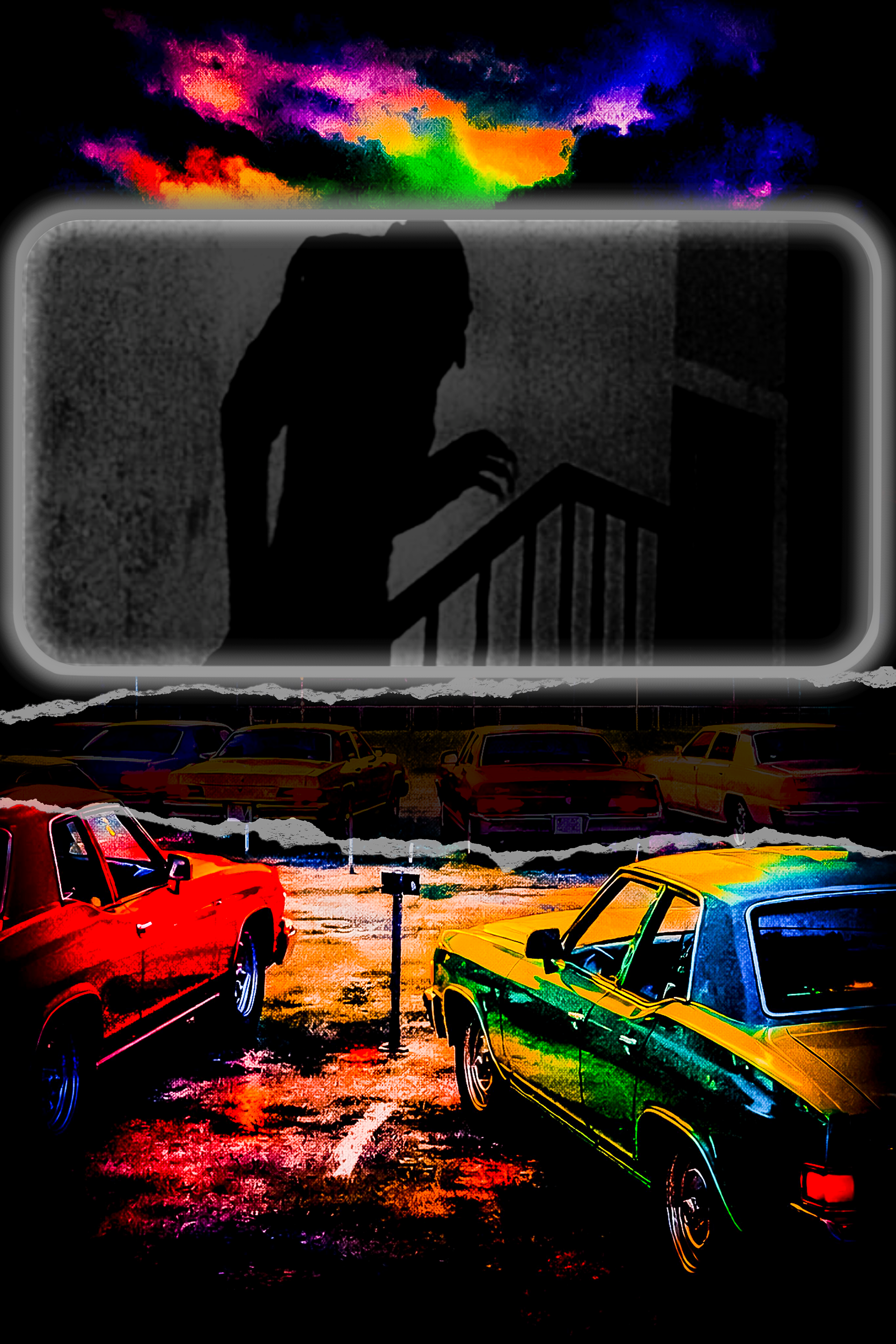
At every stage, They Only Come Out at Night comes back to the same core: horror doesn’t just mirror our fears, it helps manage them. Economic precarity, war, empire, unpaid care, climate breakdown, algorithmic dependency—terrors rooted in how society is organised—are stripped of their causes and turned into single bodies that can be stabbed, burned, exorcised or exploded on cue. The monster dies so the system doesn’t have to.
Behind that argument sits a full documentary spine: hundreds of films and series, production histories, trade papers, censorship records and interviews, all tracked in detailed endnotes. It’s written in plain language, but it treats horror—and the people who make it—with the seriousness of real history.
If you love horror, it will change how you see the work you already know by heart. If you think you hate horror, it might explain why the world keeps needing it.
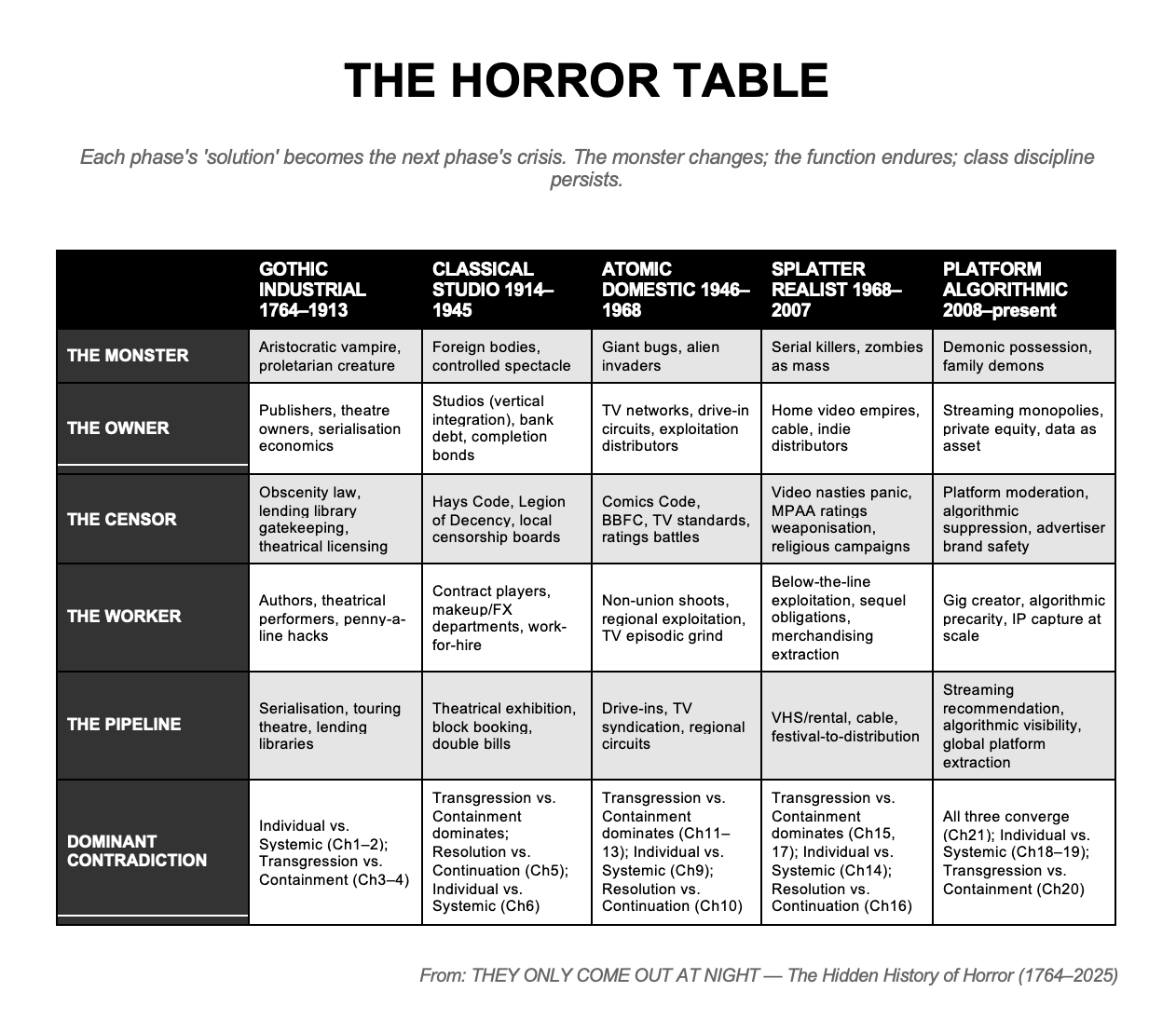
HOW TO READ THE HORROR TABLE
This table maps how the horror system evolved from 1764 to the present. It shows not what filmmakers believed or what reformers tried, but who controlled access to what, how the extraction worked, and how structural critique was systematically blocked.
Two Ways to Read
Read ACROSS a row to see how one element evolved over time. Who censors horror in 1870 (obscenity law, theatrical licensing) becomes something entirely different by 2025 (algorithmic suppression, advertiser brand safety). The system didn't simply grow—it transformed while preserving its core function.
Read DOWN a column to see how all elements aligned at one historical moment. In any given phase, the monster, the owner, the censor, the worker, the pipeline, and the dominant contradiction all interlock. The table shows how coordination works—not through conspiracy, but through structural alignment.
The Contradiction Row (→)
This is the engine of the table. Each phase's solution to the previous crisis creates the next crisis. Lending library gatekeeping worked—until cinema escaped print limits. Code enforcement worked—until it couldn't contain the movements of the 1960s. Platform capture works—until it doesn't.
The system doesn't fail because people made mistakes. It transforms because each solution contains the seeds of its own obsolescence.
The Three Contradictions
The horror system operates through three interlocking tensions that appear in every phase:
Contradiction
What Capital Needs
What Resists
Individual vs. Systemic
Monsters as aberrant individuals (killable, containable)
Systemic horror that can't be killed (capitalism itself)
Resolution vs. Continuation
Cathartic endings (monster dies, order restored)
Franchise logic demanding repetition (monster returns)
Transgression vs. Containment
Marketable rule-breaking (transgression sells)
Transgression exceeding market forms (unrecuperable)
Each phase foregrounds one contradiction while the others persist. The dominant contradiction shapes that era's conflicts, reforms, and moral panics.
The Four Structural Blocks
Four structural blocks persist across all five phases. The content shifts; the function remains:
Ownership & Finance
Controls means of horror production and distribution
Censorship & Moral Panic
Enforces content limits through varied mechanisms
Labour & Contracts
Who works, under what conditions, who owns what they make
Pipelines & Distribution
How horror reaches audiences; what shapes access
The position persists; the occupants shift.
The Censor Stack
How does the horror system coordinate across institutions without anyone planning it? Through structural alignment:
Law
Obscenity, classification, prosecution
Industry Self-Regulation
Hays Code, MPAA, platform ToS
Advertiser Pressure
Brand safety, withdrawal threats
Financial Infrastructure
Insurance, completion bonds, payment processors
Platform Policy
Algorithmic demotion, demonetisation, content ID
No conspiracy required. Each institution follows its own logic, and the alignment emerges from shared class interests and structural pressures.
The Displacement Cycle
What mechanism persists across all phases regardless of content, technology, or institutional form? Horror's invariant function—processing systemic terror into individual monstrosity:
1. Systemic threat emerges (industrialisation, nuclear war, precarity)
2. Threat cannot be named directly (threatens capital)
3. Horror displaces threat onto individual monster
4. Monster is destroyed (catharsis)
5. Systemic threat remains (repetition required)
The monster dies so the system doesn't have to.
The Structural Constants
What persists across all five phases—the invariants that reform cannot touch:
• Ownership of distribution determines what can be said
• Labour precarity produces self-censorship
• Class filtering at every entry point
• Displacement of systemic threat onto individual monster
• Transgression continuously captured into market position
Self-reinforcing: Precarity → self-censorship → gatekeeping → ownership concentration → precarity
The Five Threads
Five threads trace through all phases, appearing in different configurations:
Production-Horror
How labour conditions become content
Colonial/Imperial
How empire structures monster and Other
Race-as-Structure
How racial hierarchy operates industrially
Religious Capture
How religion legitimises and extracts from horror
Monster Evolution
How monster types encode class relations
What the Table Reveals
By the end, readers understand:
Horror is structured — organised by capitalism, not nature or individual genius
The horror system serves capitalism — processing contradiction, enforcing hierarchy, absorbing resistance
"Transgression" has been captured — extremity is market position, not political threat
Reform cannot succeed — ownership and precarity regenerate control after every apparent victory
Moral panics displace class conflict — debates about content obscure structural coordination
Liberation requires organisation — horror threatens only when fused with collective struggle, not as individual expression
Follow the ownership. Follow the coordination. Follow the suppression.
From: THEY ONLY COME OUT AT NIGHT — The Hidden History of Horror (1764–2025)
The screening room at Universal City, spring 1931. A small space off the main administration building, chairs arranged in rows, the projection booth humming behind a square of glass. The air smells of dust, sweat and hot carbon arc lamps. Carl Laemmle Jr. sits in the front row, twenty-three years old, heir to the studio his father built from nickelodeons and real estate, a notepad in his lap, a cigarette between his fingers. The lights go down. The projector clicks and whirs.
On screen, a creature staggers through a laboratory set. Flat-topped skull, sunken eyes, bolts at the neck, arms outstretched in that posture that would become iconic—the monster reaching for something it cannot name. The creature moves slowly, painfully. It looks like suffering given form. The painted shadows on the walls, the angles of the machinery, the crackle of fake lightning all push the eye back to that lurching body in the centre of the frame.
Junior watches. He knows what the audience doesn’t: the suffering is real. Behind that flat-topped skull is Boris Karloff, a British character actor who arrived at the studio at four in the morning to sit in Jack Pierce’s makeup chair. Before the crew has even staggered in for coffee, Pierce is already at work, building the monster’s face onto Karloff’s own—layer after layer of cotton and collodion, spirit gum pulling at skin, the heavy rubber headpiece pressing down on his skull. By the time Pierce finishes, Karloff can barely see, barely breathe, barely eat. The boots add four inches to his height, twenty pounds to his feet, and eventually destroy his back. Then he goes to work: twelve hours on set, moving through take after take, the creature’s shuffling gait a product of exhaustion as much as performance, followed by ninety minutes to remove what had taken four hours to apply.¹
You can read the production memos, the call sheets, the later interviews and know all of this in your head. In that room in 1931, Junior doesn’t need the paperwork; he can see it with his own eyes. The creature’s pain wasn’t acted. It was transferred—from worker to image, from body to product.
Universal at this point is not a temple of art. It is a factory surrounded by orange groves and cheap housing, a place where sets go up and come down in days, where actors are rotated through parts like machinery. Junior has already watched the studio grind out Westerns, melodramas, programmers that exist to fill double bills. What is on the screen now feels different. The monster is suffering, and he can feel the room lean forward.
Junior understands something that morning in the screening room. The audience will pay to watch this. They will pay to see a monster suffer, to feel the thrill of fear, to experience the catharsis of the creature’s destruction. They will pay, and they will come back. Fear sells—but only if you own the fear.
This is a book about who owns the fear.
This is not a coffee-table survey of horror titles, or a tour of favourite monsters, or a set of profiles about visionary artists “pushing boundaries.” Those modes have their place. They give us lineages, aesthetics, influence maps; they let fans and critics talk to each other about style and subtext. They also tend to tell a particular story: filmmakers as rebels, studios as daring patrons, audiences as adventurous consumers of the forbidden. Risk and transgression appear as ornaments the system generously allows.
That story leaves out how uneven the system is. Under capitalism, not all horror travels the same way. Certain forms are pushed hard and reliably—monsters that can be franchised, fears that can be resolved cleanly, stories that sit comfortably inside existing hierarchies. Other strands are tolerated in the margins, briefly promoted and then dropped, or kept on the festival circuit and specialist labels: works that name their targets too directly, that refuse catharsis, that flirt with collective anger instead of private shudders. The same artform can enforce the order in one decade and snarl at it in the next. You only see that if you look at horror as a set of historically specific arrangements—who is allowed to make what, under which conditions, for which market, and how the system responds when something slips out of line.
So the starting point here is not “horror is secretly noble” or “horror is secretly corrupt.” It’s more blunt than that. Horror is an industry that sits inside a larger economic order. To understand what it does, you have to study it in its phases and types: the Gothic boom, the studio monster cycle, the drive-in era, the home-video splatter wave, the algorithmic streaming feed. In each period, the question is the same: what fears are being cultivated, which are being sidelined, and what social purpose that mix serves.
This book examines what I’ll keep calling the horror system: the historically specific organisation of terror, monstrosity and catharsis within capitalist social relations. Not horror as free-floating “genre” or pure aesthetic expression, but the structural system that determines what can be shown as monstrous, under what conditions, through which institutions, and with what consequences.
That machinery includes who owns production and distribution—the studios, networks, publishing houses, streamers and holding companies whose logos flicker before the opening credits. It includes who decides what content is permissible, and who enforces those decisions, whether in a church office, a government boardroom or a platform moderation team. It includes what conditions workers endure to create the product, and who keeps what they make. It includes how horror reaches audiences—through which cinemas, shelves, stores, feeds—and what shapes that access. These aren’t background details. They’re the mechanics that make horror possible.
When you watch a horror film, you’re not just watching a story. You’re watching the output of a system designed to process your fears into profit, to provide you with carefully managed doses of terror, to let you scream in the dark and emerge feeling relieved. The monster dies. Order is restored. You paid for the privilege.
That’s not an accident. That’s the point.
Horror is a class question.
This is the central claim running through these pages. I don’t mean that horror simply depicts class conflict, though sometimes it does. I don’t mean that horror audiences are uniformly working-class, though the cheap ticket, the late show, the drive-in double bill and the streaming subscription sit squarely in working-class leisure. I mean something more fundamental: this whole setup exists because capitalism needs it to exist.
Capitalism generates terrors. Industrialisation tears apart traditional communities and forces workers into factories where their bodies are chewed up by machinery. Economic crises wipe out savings and throw millions into poverty. Wars—fought for markets, resources, territory—kill by the millions. Environmental destruction poisons air and water and soil. Inequality concentrates wealth while spreading precarity. Police, borders, prisons and intelligence agencies enforce all of this with organised violence. These are systemic terrors, built into how capitalism operates. They cannot be eliminated without eliminating capitalism itself.
But capitalism cannot name these terrors directly. To name them would be to indict the system. To say “capitalism is killing you” would be to invite the question: what if we tried something else?
So capital builds industries to process these terrors into safer forms. Horror is one of those industries. So are crime stories, thrillers, disaster movies, true crime podcasts and “prestige” dramas about broken cops. This book focuses on horror because horror shows the machinery especially clearly. Its function is displacement: taking systemic threats that cannot be named and transforming them into individual monsters that can be killed.
Consider how it works. A systemic threat emerges—industrialisation, nuclear annihilation, economic precarity, climate collapse, epidemic disease, racist policing. The threat cannot be addressed directly because addressing it would threaten capital. Horror displaces the threat onto an individual figure: the mad scientist, the atomic monster, the masked killer, the demon, the haunted house, the cursed videotape. The individual monster is hunted, confronted, destroyed. Catharsis achieved. The audience feels relief. The systemic threat remains exactly where it was.
This is the displacement cycle, and it operates across every era of horror’s history. The creature in Frankenstein embodies the terrors of industrialisation—the working body torn apart and reassembled, the fear of what technology creates—but the film ends with a mob chasing the monster with torches, not with workers organising against factory conditions. The giant ants in Them! embody nuclear anxiety, but the film ends with soldiers flamethrowing insects in the Los Angeles sewers, not with citizens demanding an end to atomic testing. The shark in Jaws condenses a whole structure of coastal development, tourism and liability into one animal that can be blown up. The zombies in Night of the Living Dead embody the collapse of social order, but the film ends with a posse shooting survivors, not with any analysis of what caused the collapse.
The monster dies so the system doesn’t have to.
Horror is necessary for capitalism, not merely compatible with it. Capitalism produces terrors it cannot acknowledge; horror acknowledges those terrors in displaced form and provides catharsis that discharges the fear without threatening the source. Without this processing function, the terrors might accumulate into something dangerous—into politics, into organisation, into demands for change. Horror steps in to do that work. It lets you feel scared and then feel better, over and over, forever.
The horror system runs on three contradictions it cannot resolve. Those contradictions shape how horror functions—and why it keeps functioning in recognisable ways even as the surface changes.
The first contradiction: Individual versus Systemic. Capital needs monsters to be aberrant individuals. Individual monsters can be killed, contained, explained away as exceptions. Dracula is staked; Michael Myers is shot; the demon is exorcised. Order is restored because the threat was always located in a single killable figure.
But horror keeps brushing up against systemic threats that can’t be killed. You can’t stake climate change. You can’t shoot economic inequality. You can’t exorcise the police state. When horror approaches these systemic terrors—as it occasionally does—the industry that manages horror moves to contain the critique. George Romero’s zombie films gesture toward systemic analysis: consumerism, racism, military-industrial violence, the way institutions fail or turn openly murderous. The business responds by absorbing his work into franchise logic, spawning endless zombie films and shows that replace analysis with spectacle. Jordan Peele’s Get Out anatomises liberal racism as a systemic operation; awards discourse and studio coverage respond by turning his identity into the story, treating his Blackness as a novelty rather than his insistence on structure.² The systemic is perpetually displaced back into the individual.
The second contradiction: Resolution versus Continuation. Capital needs cathartic endings that discharge fear. The monster dies, the survivors escape, the credits roll, the audience leaves satisfied. This is horror’s ideological function: providing the feeling that threats can be overcome, that order can be restored, that fear has an endpoint.
But capital also needs horror to continue. Fear is renewable revenue. If the monster dies permanently, the franchise dies with it. So the horror business generates forms that allow both resolution and continuation: sequels, reboots, “cinematic universes,” the killer who returns in the final frame. Halloween ends with Michael Myers shot and falling from a balcony; Halloween II begins with him getting up. Friday the 13th ends with Jason’s apparent death; eleven sequels follow. Universal in the 1930s is already playing this game—Frankenstein begat Bride of Frankenstein begat Son of Frankenstein, the creature dying and returning, dying and returning, then colliding with Dracula and the Wolf Man in crossover events that look suspiciously like early IP mash-ups.
This contradiction isn’t a late feature bolted on in the age of Marvel and streaming. It’s there from the moment studios realise that audiences will come back for the same monster with minor variations. Resolution and continuation have always coexisted in productive tension. The film says “it’s over”; the poster for the sequel says “it never is.”
The third contradiction: Transgression versus Containment. Capital needs marketable rule-breaking. Horror sells because it shows what shouldn’t be shown, because it violates taboos, because it promises the forbidden. Controversy generates publicity. “Banned in thirty-seven countries” is a marketing slogan, not a warning.
But capital also needs transgression to remain containable. Content that genuinely exceeds market forms—that can’t be sold, distributed, recuperated—is worse than useless. It’s dangerous. So the horror system generates censorship regimes that simultaneously suppress and produce transgression. The Hays Code doesn’t eliminate horror; it creates a category of “pre-Code horror” that becomes valuable precisely because it is forbidden. The “video nasties” panic in 1980s Britain doesn’t destroy the films it prosecutes; it turns them into contraband, complete with police seizures, tabloid hysteria and mail-order catalogues for collectors. Platform content moderation today doesn’t prevent transgressive horror; it creates tiers of visibility that streaming companies can monetise, from the front-page “elevated” horror hit to the buried microbudget shocker you have to search for by name.
Transgression becomes market position. The “extreme” horror film, the “elevated” horror film, the “controversial” horror film—these are labels on a shelf, not threats to the shelf itself. Real transgression would be horror that names capitalism directly, that refuses catharsis, that links terror to collective organisation and makes that link legible. That horror struggles to find funding, ratings, screenings, hosting, bandwidth. That horror, if it is made at all, is kept marginal.
These three contradictions generate the system’s energy. They also generate its vulnerabilities—gaps where something might escape, moments where the logic briefly breaks down and audiences glimpse more than they are meant to. A film slips through with too much truth; a performance refuses to resolve into stereotype; a production crisis accidentally reveals the labour behind the monster. But those gaps close quickly. The machine is very good at what it does.
This book follows that machine across 260 years, from the publication of The Castle of Otranto in 1764 to the streaming platforms of 2025. The history falls into five phases, each defined by a distinct configuration of ownership, censorship, labour and distribution.
Phase One: Gothic Industrial (1764–1913). Horror industrialises through publishing and theatre. The Gothic novel emerges as commercial form; penny dreadfuls bring sensational horror to mass audiences; the Grand Guignol stages transgression as theatrical spectacle for Paris crowds who pay to watch dismemberment under stage lights. Ownership is fragmented—individual publishers, theatre managers, serialisation syndicates, cheap presses turning out blood-and-thunder stories by the column inch. Censorship operates through obscenity law, blasphemy charges and lending-library gatekeeping. Labour is precarious: penny-a-line writers, touring performers, hack journalists reworking the same material under different titles, authors fighting for copyright in courts built to protect publishers. Distribution runs through serialisation, theatrical circuits, lending libraries and bookstalls at railway stations.
Phase Two: Classical Studio (1914–1945). Horror centralises under Hollywood studio control. Universal builds the monster factory; other studios follow with their own ghost trains. Vertical integration controls production, distribution, exhibition. The Hays Code formalises content limits; the Legion of Decency enforces Catholic discipline; local censorship boards add their own cuts. Labour becomes contractual: studio players bound by seven-year deals, makeup departments churning out monsters on salary, directors as employees rather than independent artists. Distribution is theatrical, block-booked, studio-controlled, with horror slotted into double bills, matinees and carefully timed “chillers.”
Phase Three: Atomic Domestic (1946–1968). Horror disperses into new exhibition contexts. Drive-ins, television and regional circuits fragment the audience. Moral panics erupt—comics panic, juvenile-delinquency panic, foreign-film panic—and are used to discipline smaller competitors while leaving major interests intact. The Cold War shapes content: atomic monsters, alien invaders, body-snatching neighbours, threats from outside the picket fence. Labour spreads to non-union shoots, exploitation productions, low-budget British and Italian horror, television episodic grind. Distribution multiplies: drive-in circuits, TV syndication packages, cheap imports, international co-productions that stitch together finance from multiple territories.
Phase Four: Splatter Realist (1968–2007). The MPAA ratings system replaces the Code, enabling explicit content within managed categories. Independent production becomes viable; horror escapes studio control temporarily, then gets recaptured through distribution deals, output contracts and home-video rights. Home video revolutionises access—and creates new panics, new regulations, new forms of control. Labour intensifies: below-the-line exploitation, non-union stunt work, sequel obligations, the production conditions that produce body horror onscreen and off. Distribution shifts to video rental, late-night cable, the emerging festival circuit that anoints cult hits and feeds them back into the market.
Phase Five: Platform Algorithmic (2008–present). Streaming monopolies consolidate ownership at unprecedented scale. Algorithmic recommendation replaces theatrical exhibition as the primary distribution mechanism for vast swathes of horror. Content moderation automates censorship. Labour becomes gig work: creator precarity, microbudget exploitation disguised as “opportunity,” IP capture at scale through work-for-hire and opaque terms of service. Data extraction transforms audiences from consumers into products, their viewing habits sold and fed back into recommendation engines. The fear machine achieves maximum efficiency and maximum invisibility.
Across these phases, certain patterns persist. Ownership concentrates. Labour precarity intensifies. Censorship privatises—moving from state regulation to industry self-policing to platform automation. Distribution technology shapes content more directly with each transition. The displacement cycle continues: systemic terror processed into individual monster, catharsis, repeat.
Other patterns transform. Monster types evolve with class configuration: the aristocratic vampire of Gothic fiction becomes the urban slum-dweller, the foreign invader, the atomic bug of the 1950s, the masked serial killer of the 1980s, the possessed child or suburban house of the streaming era. Exhibition contexts shift from theatre to drive-in to living room to phone screen. The system reconfigures to meet new conditions while maintaining its essential function.
Twenty-one chapters trace this history through specific carriers—the people whose trajectories make structure visible—and specific events—the moments that crack open the system and reveal how it works. Mary Shelley fighting for authorship of Frankenstein and for the right to be recognised as its creator. Carl Laemmle building the monster factory and then losing the studio in a wave of consolidation. Val Lewton working within B-movie constraints to smuggle dread and suggestion past the Code. George Romero losing control of Night of the Living Dead because of a copyright error, and watching others profit from his zombies. Tobe Hooper’s cast bleeding on the Chain Saw set in Texan heat while the film sells their misery back to audiences. Jason Blum perfecting microbudget extraction in the twenty-first century. The algorithm deciding what you see and what you never even know exists.
These aren’t biographies. They’re lenses. Through them, we see how the horror economy operates—how it processes fear, exploits labour, manages transgression, concentrates ownership and reproduces itself across technological and institutional transformations.
There are a few things this book simply refuses to do, and it’s worth stating them cleanly so there’s no confusion later.
It doesn’t tell a progress story. Horror hasn’t marched from crude beginnings to enlightened present; it has reconfigured around new technologies, new markets and new forms of control. Praising contemporary diversity while ignoring who owns the companies and the catalogues is politics by selfie, not analysis.
It doesn’t hang everything on psychology. Individual filmmakers have talents, traumas, obsessions, but those aren’t enough to explain what ends up on screen. Scripts, schedules, budgets, censorship notes and contracts press in from every side. To talk about “vision” while ignoring the deal that binds that vision to a corporation is to look straight at power and politely pretend you don’t see it.
It doesn’t hand out moral verdicts on the material. The aim here isn’t to save horror or to condemn it. The question that matters is simpler and colder: how does horror function—for whom, at what cost, to what end?
It doesn’t treat representation as the finish line. More faces on posters, more identities in casts, more “groundbreaking” firsts inside the same ownership structure are recognitions, not redistributions. The machine is very happy to widen the casting brief while keeping control of the cheque book.
And it doesn’t fall back on the idea that horror “reflects our anxieties.” Horror doesn’t sit there like a puddle with society gazing into it. It builds things. It manufactures categories of monster, it organises fear into saleable units, it offers tidy catharsis that leaves the underlying conditions untouched. The fear factory is active, not reactive.
What this book does instead is follow structure through individual trajectories. It watches the machine work on specific people in specific moments and traces the marks it leaves. Where other accounts hedge—“on one reading,” “some scholars have argued”—this one is willing to draw the line and name the class function of horror directly, without apology and without dressing it up as just another taste in the marketplace of interpretations.
This isn’t an argument against watching horror. It’s an argument for watching it with your eyes open.
The evidence is in the contracts and the censorship records, in the production conditions, the distribution deals, the ownership filings, the labour disputes, the box office reports. It is in the panics and the press releases, the union fights and the non-disclosure agreements, the festival buzz and the streaming deals. It is in 260 years of horror doing exactly what it was built to do.
After reading this book, you will be able to name something you may already have felt. The fear you experienced in the dark theatre, the catharsis when the monster died, the relief when the credits rolled—all of it was managed. You were processed. Your terror was raw material; your relief was the finished product. Someone profited from the transaction.
You will see how “transgression” has been captured: the horror film marketed as dangerous, as forbidden, as boundary-breaking is a market category, not a political threat. You will see how moral panics serve consolidation, how censorship creates value, how this system produces the very transgression it claims to suppress. You will see why reform cannot succeed—why better representation, better working conditions, better content don’t change the fundamental operation. The machinery reconfigures around reforms. It absorbs critique. It continues.
And you will see what would be required for horror to function differently. Not better horror. Not more diverse horror. Not “elevated” horror that flatters middle-class taste. Horror fused with collective organisation. Horror that refuses catharsis. Horror that names capitalism directly and connects that naming to action.
Whether such horror is possible within the present system is a question this book cannot answer. What it can do is show how the present system was built—decision by decision, contract by contract, panic by panic, phase by phase. If you want to tear something down, it helps to know how it was constructed.
The screening room at Universal City. Junior watching the creature suffer, knowing that audiences would pay for this, knowing that Karloff would be back in the makeup chair tomorrow, and the next day, and the next, as long as the profits held.
They only come out at night—the monsters, the executives, the structures that move in darkness. But the darkness can be illuminated. The machinery can be seen.
This book turns on the lights.
A room in Bath, autumn 1816. Cold outside, the fire dying in the grate. Mary Godwin—not yet married, not yet Shelley—sits at a desk by candlelight, the yellow glow catching the edges of the pages before her. She is nineteen years old. The room is modest: rented lodgings, uneven floorboards, damp in the corners, temporary quarters for a household that moves frequently, always one step ahead of creditors and scandal. The window rattles in its frame when carriages pass in the street below; the glass fogs with her breath. In the next room, Percy Bysshe Shelley argues philosophy with a visitor, his voice carrying through the thin walls, rising whenever he reaches a point he thinks is particularly brilliant. Downstairs, Claire Clairmont manages the household—or tries to, with limited funds and a complicated domestic arrangement that polite society refuses to acknowledge.
Mary writes. She has been writing for months now, whenever she can find the time.
The manuscript before her is a mess of crossings-out and insertions, pages covered in two different hands. Ink blots mark places where the pen stalled or her attention was dragged away. The story came to her months ago, at the Villa Diodati on Lake Geneva, during a summer of rain and ghost stories. The lake was black glass, the sky constantly threatening; the famous “year without a summer” had turned Europe into a laboratory for strange weather. Byron issued his famous challenge; everyone would write a tale of terror. Percy started something and abandoned it. Byron started something and abandoned it. Mary dreamed of a student kneeling beside the thing he had made, and she did not abandon it.¹
The dream was only the starting point. The work is something else entirely.
She writes in fragments, between obligations. There is a baby to tend—William, born in January, her second child. Her first, a daughter, died less than two weeks after birth the previous year.² The shock of that loss is still in her body; she had written in her journal that she dreamed the baby came back to life, warmed by the fire. There is a household to manage on limited funds. There is Percy, brilliant and demanding, whose attention she must compete for with Claire, with visitors, with his own ambitions. There is the social stigma of her position: unmarried mother, daughter of radicals, living openly with a married man whose wife is still alive. Every time she steps outside she feels it in the glances, the small public punishments that say: you are not respectable, and you will pay for that.
She carries more than her own history. She is Mary Wollstonecraft’s daughter: child of the woman who wrote A Vindication of the Rights of Woman and died days after Mary’s birth. She is William Godwin’s daughter too—the man whose Enquiry Concerning Political Justice argued, in the wake of the French Revolution, that monarchy, inherited privilege and organised religion were structures of oppression that could and should be dismantled by rational beings.³ Mary read Political Justice and her father’s novel Caleb Williams as a teenager, absorbing a politics in which crime and monstrosity are produced by institutions rather than individual wickedness.³ Later, in her own novels and travel writing—Valperga, The Last Man, Rambles in Germany and Italy—she would keep returning to the same questions: how power is organised, what obligations the powerful owe to the vulnerable, whether “civilised” societies can be redeemed.⁴ The room in Bath is cramped and cold, but it sits inside that larger inheritance: revolution, reform, scepticism about authority, a refusal to take hierarchy for granted.
Percy brings his own set of detonators into the mix. He has been expelled from Oxford for publishing The Necessity of Atheism, a pamphlet that treated belief in God as a proposition to be tested rather than a command to be obeyed.⁵ His poetry—“Queen Mab,” “The Mask of Anarchy,” “England in 1819,” “Song to the Men of England”—is saturated with calls to revolt and images of trampled workers rising.⁶ His prose essay A Philosophical View of Reform pushes beyond parliamentary tinkering toward republicanism and levelling “inordinate wealth.”⁷ He and Mary will leave England in 1818 partly for health, partly because they are sick of what he calls “tyranny civil and religious.”⁶ They are not quiet dissenters; they are part of a recognisable radical milieu that the British state monitors and harasses.
That politics and that romance are not side-notes to Frankenstein. Mary ran away with Percy as a teenager; they met in her father’s bookshop, reading radical texts in the back room before walking together through St Pancras churchyard to talk about free love, atheism, the remaking of society. Their life together—elopement, exile, poverty, dead children, jealousies, shared reading, shared notebooks—is exactly the kind of unstable, experimental household that respectable England treats as a threat. The love story and the political story interlock: they are trying to build a life on different terms, and the cost is constant insecurity. When Mary sits down to write about a creator who brings something new into being and then refuses to take responsibility for it, she is not doing this from a safe distance.
None of this appears in the mythology that will later accrete around the novel. The story everyone remembers is lightning and inspiration, Byron and Shelley trading ideas in a Gothic villa, the young woman visited by a vision. It’s a tidy story, romantic and flattering. It is also a displacement. It takes the labour out of the work.
The real story is Mary at her desk, night after night, building the creature word by word. The real story is the manuscript pages that show Percy’s handwriting alongside hers, his editorial interventions, his claims on her work. The real story is what it cost her to make this thing, and what it would cost her to lose control of it.
The creature taking shape on the page is a figure of suffering. Assembled from dead parts, jolted into life, immediately abandoned by its creator. It experiences the world as rejection: everywhere it goes, it is met with horror and violence. It learns language by hiding, watching, never belonging. When it finally confronts Victor Frankenstein, its maker, it delivers an accusation: *I was benevolent and good; misery made me a fiend.*⁸
Mary knew something about being made monstrous by circumstance.
The publishing world of 1818 operated on terms that would be familiar to any student of exploitation. Authors produced; publishers owned. The ledgers told the story clearly enough: on one side, printing costs, advertising, paper, binding; on the other, a line for “author” that might cover an advance, a small share of profits, or nothing at all. Once an edition’s accounts were closed, the house decided whether to reprint, repackage, resell the rights. The writer’s part in the process ended long before the money did.
For unknown authors, none of this was really a negotiation. The book trade in Regency England was concentrated in the hands of a few major firms clustered around Paternoster Row, a tight district of booksellers and printers near St Paul’s. Their shopfronts looked respectable—plate glass windows, orderly rows of bound volumes—but behind them were warehouses and counting-houses where decisions about who got printed and on what terms were made. Those firms set the rules. An author with a reputation might secure a generous profit-share. An author with connections might get better rates or some control over later editions. A woman, nineteen, unknown, living in irregular circumstances—she took whatever she could get.
Mary Godwin Shelley—she and Percy had married in December 1816, after his first wife Harriet drowned herself in the Serpentine—had little leverage. Her father, William Godwin, was famous but perpetually broke, cadging loans from anyone who would listen. Her husband came from money but had been cut off by his family over his politics and his first marriage. She herself had no income, no reputation, no independent standing. She was a dependent in every sense, living in a house full of strong personalities and stronger opinions, with no straightforward way to turn her own work into security.
Lackington, Hughes, Harding, Mavor & Jones agreed to publish Frankenstein; or, The Modern Prometheus in late 1817 on a standard “share of profits” basis. Lackington’s had built its reputation on mass sales—James Lackington called his London premises “The Temple of the Muses”—and the house knew how to turn printed paper into steady income. After printing costs were deducted, Mary’s contractual one-third share of the first edition’s profits came to a little over £41—roughly a few thousand pounds in today’s money, perhaps six months of modest living expenses.⁹ In 1831, when the novel was repackaged for Henry Colburn and Richard Bentley’s Standard Novels series, the copyright itself was sold outright for £30.⁹ That was the end of her economic stake. The monster would keep walking; the money would keep flowing; the person who made it would not share in that.
The novel appeared in January 1818, published anonymously in three volumes—the standard format for fiction distributed through circulating libraries. These libraries were the streaming services of their era: subscription businesses that let middle-class readers access expensive books they couldn’t afford to buy. A new three-volume novel might cost thirty-one shillings and sixpence—more than a skilled worker earned in a week. At those prices, almost no one bought novels for themselves. Libraries did.
So publishers formatted novels in three volumes specifically to maximise library purchases. A library could lend all three volumes to separate subscribers simultaneously, tripling their return on investment. The format had nothing to do with literary merit and everything to do with distribution economics. Publishers inflated word counts, padded narratives, stretched stories to fill the three-volume requirement. The shape of the Victorian novel was determined not by art but by the logistics of circulation.¹⁰ Content bent around access.
Circulating libraries, in turn, shaped taste. Mudie’s and its rivals acted as gatekeepers, deciding which novels to buy in bulk and which to ignore. Respectable subscribers read what these institutions stocked; writers learned quickly what kinds of stories moved through those channels without getting stuck. Even at this early point, you can see the outline of something recognisable: a commercial circuit that not only sells stories, but quietly trains an audience in what “proper” fiction looks like.
Anonymous publication was common for first novels and virtually required for controversial ones. A book about creating life, about usurping God’s role, about a creature demanding rights from its creator—this was risky material. Anonymous publication allowed the author to test reception without personal exposure. It also, not coincidentally, made it easier for someone else’s name to be attached.
Percy Shelley wrote the preface. The dedication was to William Godwin, Mary’s father. Reviewers, noting the dedication and the preface’s style, assumed the author was male. Many attributed the novel directly to Percy. Blackwood’s Edinburgh Magazine praised “Mr. Shelley” for his imaginative power.¹¹ Mary’s authorship was contested before the ink was dry.
This wasn’t an unfortunate misunderstanding; it was the system working as built. Anonymous publication, male editorial involvement, dedication to a famous man, and reviewers’ assumptions about who could write what combined into one effect: the literary world had no reliable mechanism for recognising a nineteen-year-old woman as the creator of a major work. When Mary was acknowledged at all, it was as Percy’s protégé, his student, perhaps his collaborator. The possibility that she had simply written the thing herself—that the labour was hers—was structurally difficult to see.
The manuscripts tell a more complicated story than either “Mary wrote it alone” or “Percy wrote it for her.” The surviving drafts show two hands at work. Mary’s writing dominates—the plot, the characters, the structure, the language are hers. But Percy’s interventions are everywhere: words changed, sentences restructured, passages expanded. His handwriting appears in the margins and between the lines, editing as Mary produced pages.¹² The paper itself—cheap, reused in places, with different inks as they ran out and refilled—records a working process that was anything but leisurely.
What does this mean? The romantic interpretation says collaboration: two minds working as one, Percy helping Mary realise her vision. The cynical interpretation says appropriation: Percy taking credit for work that wasn’t his. A structural reading lands somewhere else.
Percy’s editorial role was not unique to Mary. He edited other writers’ work routinely. His involvement reflected his position in the household: he was the professional writer, the one with connections, the one whose name might help a manuscript find a publisher. Mary was his partner, his lover, the mother of his child, and—in the literary economy—his dependent. She produced work; he processed it for market. He moved easily through the world of publishers, patrons, and periodicals; she was the one who produced a story that would outlive all of them.
This arrangement had material consequences beyond the immediate collaboration. When the novel succeeded, its success accrued to the Shelley household as a unit, not to Mary as an individual author. When Percy needed to demonstrate his literary productivity to publishers or patrons, the novel was available as evidence—his preface right there at the front, his editorial work visible throughout. When Mary wanted to claim sole authorship, she had to explain away Percy’s visible presence in the manuscript. The collaboration, whatever its creative merits, had economic effects. It made Mary’s labour partially invisible.
The question “who really wrote Frankenstein” misses the point. Mary really wrote it. The manuscripts prove this beyond reasonable dispute. But the conditions under which she wrote—the household economy, the editorial arrangement, the publishing system, the assumptions about gender and authorship—meant that her sole authorship was never simply legible. She had to fight to establish what should have been obvious.
The creature in the novel faces the same problem. It exists. It thinks, feels, speaks, suffers. But the world cannot see it as what it is. It is read as monster, as aberration, as thing-that-should-not-be. Its interiority is invisible to everyone except the reader, who is granted access to its eloquent self-account. Mary gave the creature what she struggled to claim for herself: a voice that could tell its own story.
Percy Shelley drowned in July 1822, sailing in the Gulf of Spezia. He was twenty-nine. Mary was twenty-four, a widow with a young son, suddenly without the household’s primary earner and literary reputation. The body washed ashore and was half-burned on a beach pyre; the mythology that would grow around that scene—Byron and Trelawny, the supposed removal of Percy’s heart from the flames—was already a hint of what the culture would do with the Shelleys’ lives: turn them into stories for others to tell. Whatever ambivalence she had felt about Percy’s claims on her work, his death clarified her position: she was now solely responsible for establishing her own authorship.
By then, the business had already moved on. In July 1823, one year after Percy’s death, Presumption; or, The Fate of Frankenstein opened at the English Opera House in London. Written by Richard Brinsley Peake, it was the first theatrical adaptation of Mary’s novel. She received no payment, no credit, and no advance notice.¹³
This was legal. Copyright in 1823 covered printed works, not theatrical performances. Anyone could adapt a novel for the stage without permission or compensation. Playwrights routinely mined popular fiction for material. Theatres needed a steady supply of recognizable titles to fill their bills; novelists were essentially an unpaid development department. Mary had no recourse—not because the law had failed, but because the law had never been designed to protect authors from this kind of extraction.
Presumption transformed the story significantly. Peake made the creature mute—a grunting, gesticulating figure of pathos rather than the eloquent accuser of Mary’s text. This single change was devastating to the novel’s argument. In the book, the creature speaks at length and speaks brilliantly; its eloquence is the point. It has learned language, learned philosophy, learned to articulate its suffering and its claims. When Victor refuses to acknowledge it, the refusal is moral failure—the creature has demonstrated its personhood, and Victor rejects it anyway.
On stage, the creature couldn’t make that case. It lurched and groaned and reached out plaintively. It was pitiable rather than persuasive. Audiences could feel sorry for it without having to take its claims seriously. The mute monster became the template for every subsequent adaptation, including the 1931 Universal film with Boris Karloff. Mary had created a creature that could argue for its own rights; the theatre created a creature that could only suffer in silence.¹⁴
Peake simplified the plot, heightened the spectacle, added comic relief through a new character named Fritz—a bumbling servant who would become Igor in later adaptations.¹⁵ He cut the frame narrative entirely, eliminating the Arctic voyage and the nested structure that distanced readers from the creature’s account. He added a love interest, stage effects, dramatic confrontations. He turned a philosophical novel about creation, responsibility, and social exclusion into a melodrama about a mad scientist and his monster.
The adaptation wasn’t a translation; it was a reprocessing. The novel’s systemic critique—the creature made monstrous by a world that rejected it—became an individual horror story: mad scientist transgresses, monster rampages, order restored. The audience got their thrills and went home. The question of what made the creature monstrous, and whether that question implicated the society watching it suffer, disappeared entirely.
Picture the English Opera House on a crowded night: gaslight flaring, the smell of tallow and sweat, a mixed audience of clerks, tradesmen, domestic servants on a rare evening out. The posters outside promise shocks and wonders. Inside, Peake’s grunting monster lurches under painted backdrops and thunder machines. Whatever Mary had meant by her creature’s long arguments about justice and responsibility is now compressed into stage business—chases, crashes, a figure tumbling into the abyss while the orchestra plays.
Mary may have attended the premiere. The historical record is unclear—she wrote about seeing “the first appearance of Frankenstein” but might have meant a later performance.¹⁶ What’s certain is that she witnessed, in one form or another, her work escaping her control. The creature she had built was walking around on a stage in London, performing meanings she hadn’t intended, generating profits she would never see.
And it was only the beginning. In the years following Presumption’s opening, London and provincial theatres mounted a rush of adaptations—at least fourteen dramatizations across Britain and France in the decade after 1823, by one careful count.¹⁷ The demand was extraordinary—audiences wanted the monster, and the industry supplied it. Each version made its own changes, its own interpretations, its own claims on the material. Some played up comedy, some leaned into sentiment, some emphasised spectacle, but all agreed on one thing: the monster would not speak. By the time Mary published a revised edition of the novel in 1831, with a new introduction explicitly claiming her authorship, the theatrical creature had become the popular understanding. Most people who “knew” Frankenstein knew the stage version, not the book.
The 1831 introduction is often read as Mary’s definitive account of the novel’s origin. She tells the Diodati story: Byron’s challenge, the ghost stories, the waking dream of the “pale student of unhallowed arts.” She claims her authorship in no uncertain terms. But she also, notably, downplays Percy’s involvement. The introduction doesn’t mention his editorial work. It presents the novel as solely hers—which it was, substantially, but the claim required erasing the collaboration that the manuscripts document.
Mary had to lie, or at least strategically omit, to tell the truth about her authorship. The conditions had made accurate accounting impossible. Either she acknowledged Percy’s involvement and risked having her authorship diminished, or she denied it and produced an incomplete record. She chose the latter. The 1831 introduction established her sole authorship by suppressing evidence that complicated it.
This is what the industry does to authors. It creates conditions where the only way to claim your work is to falsify the conditions of its production.
The novel itself is about this problem.
Victor Frankenstein is a creator who loses control of his creation. He builds the creature in secret, invests years of labour, animates it—and then, horrified by what he has made, immediately abandons it. The creature escapes into the world. It learns, grows, develops wants and needs. It returns to confront its creator, demanding what it’s owed: companionship, recognition, responsibility.
Victor refuses. He will not acknowledge the creature as his. He will not make it a companion. He will not take responsibility for having brought it into a world that can only reject it. The creature, denied recognition, turns to violence. The novel ends with Victor dead and the creature disappearing into the Arctic wastes, promising to destroy itself.
Read one way, this is a story about individual transgression and its consequences. Victor overreached; he played God; he got what he deserved. The creature is a punishment, a warning, a figure for what happens when ambition exceeds proper limits. This reading positions the horror in Victor’s individual choices and resolves it with his individual death. Mary’s subtitle, The Modern Prometheus, leans into that tradition: Prometheus in Greek myth shapes humankind from clay, steals fire from the gods, and is punished by Zeus with endless torment.¹⁸ Victor, the “modern” version, raids graveyards instead of heavens, but the pattern is similar—creation, theft of power, and the recoil of punishment.
But the subtitle does more than wag a finger at overreaching scientists. Prometheus is also, in some strands of Romantic culture, a rebel hero—a figure who suffers on behalf of humanity. Percy will write Prometheus Unbound, a drama in which the chained Titan becomes a symbol of resistance to tyrants.¹⁹ Mary knows those readings as well. Her choice of subtitle sits right on the fault line: Victor as thief of divine power, the creature as suffering body, both caught in a web of creation, revolt and retribution. You can feel the pressure of the Industrial Revolution in it too: humanity harnessing new energies—steam, chemistry, electricity—and the nagging sense that those energies might turn on their makers.¹⁸ “Modern Prometheus” is a warning label and a diagnosis: this is what it looks like when a new ruling class plays god with other people’s bodies.
The creature’s own account complicates any neat moral about solitary hubris. In the novel’s central section, the creature tells its story directly. It describes its first experiences: confusion, pain, rejection. It describes watching a family through a crack in a wall, learning language and emotion, longing to belong. It describes approaching them and being driven away with violence. It describes finding Victor’s journal and learning that even its creator saw it only as a mistake.
I was benevolent and good; misery made me a fiend. The creature locates its monstrosity not in its nature but in its treatment. It was made monstrous by a world that refused it recognition. Its suffering is not a consequence of Victor’s individual transgression but of a systemic condition: a society that can only respond to difference with violence.
Mary had watched reputations being made and unmade in London reviews, seen how her mother was treated as brilliant and unfeminine in the same breath. She had lived the distinction between who “deserves” to be seen and who is told to stay in the shadows. It is not a stretch to hear some of that knowledge in the creature’s speech, even if the novel never names society as explicitly guilty.
The novel gestures toward this wider critique—and then withdraws from it. The creature’s eloquent self-defence is contained within a frame narrative that distances readers from it. Victor remains the primary focaliser; his horror at the creature is never fully challenged. The ship’s captain who hears the story and writes it down returns us to a respectable male narrator. The ending punishes both creator and creature, leaving the social conditions that made the creature’s suffering possible entirely intact. The villagers who attacked the creature, the family who drove it away, the society that could only see it as monster—none of them are held accountable. The problem is resolved by removing the problem.
This is the Individual vs. Systemic contradiction at work. The story approaches systemic critique, lets the creature articulate it, then contains it within individual tragedy. The creature dies (or promises to die); the world continues unchanged. Whatever the creature represented—the industrial worker, the colonial subject, the woman demanding recognition—its claim is discharged through its destruction, not through any transformation of the conditions that created its suffering.
Mary Shelley wrote a novel about losing control of your creation and having your labour appropriated. Then she lost control of her creation and had her labour appropriated. The system took her critique and processed it into entertainment, just as the novel’s frame narrative takes the creature’s critique and processes it into tragedy.
What does this chapter show?
The horror industry was functioning before cinema, before mass media, before the modern culture machine. Its basic operations were present at horror’s literary origin. Everything that would structure the genre for the next two centuries was already visible in the publication and adaptation of Frankenstein:
Creative labour extracted. Mary did the work. She wrote the novel under conditions of precarity, grief, and domestic obligation. She wrote at night, between nursing and household management, while the men around her debated philosophy and pursued their own ambitions. She produced something that would outlast all of them. She received a modest share from the first edition, then watched subsequent deals and adaptations generate money she would never see. The pattern was set: creators produce, owners extract.
Authorship contested. From the moment of publication, the question of who wrote Frankenstein was open. Percy’s involvement, anonymous publication, reviewers’ assumptions, the structure of literary households—all of these made Mary’s sole authorship difficult to establish and easy to deny. The system had no reliable mechanism for recognising women’s creative labour. It wasn’t designed to see her.
Adaptation without consent. The theatrical productions took Mary’s novel and transformed it. They changed its meanings, simplified its critiques, turned its eloquent creature into a grunting monster. They stripped out the systemic analysis and left the spectacle. She had no legal recourse and no economic stake in their success. The work belonged to the industry, not to her.
Production-horror encoded. Mary’s conditions became the creature’s conditions. Her labour, her invisibility, her lack of control—these shaped the novel at the level of content. The creature’s suffering is also the author’s suffering, processed into narrative, available for consumption. This is the production-horror thread: what happens to workers becomes what happens on screen—or on the page. The machine launders its own violence into entertainment.
Systemic critique displaced. Even a novel that articulates systemic critique—the creature made monstrous by social conditions, not by its own nature—resolves that critique individually. Victor dies, the creature disappears, society continues unchanged. The pattern that would define horror for the next two centuries was already present in 1818. Systemic threats become individual monsters. Individual monsters are destroyed. The system persists.
Mary Shelley eventually got credit. Her name appears on the novel now. The 1831 introduction established her authorship definitively. Literary history recognises her as the creator of Frankenstein and, often, as the originator of science fiction itself.⁴ This is the reform narrative: wrongs were righted, recognition was achieved, justice was done.
But look closer at what “recognition” actually meant. Mary still didn’t own her work when she died in 1851. The copyright had passed through various hands, none of them hers. The theatrical adaptations continued to proliferate without her consent or compensation. The creature she made had become public property in every sense—legally, culturally, commercially. Her name was attached to it, finally, but the attachment was honorific. She was credited as author of a work she had never controlled and would never own. When Universal made Frankenstein in 1931, they based it on a later stage adaptation by Peggy Webling, licensed that script, and paid nothing to Mary’s descendants; the original novel was by then firmly in the public domain.²⁰ Recognition changed nothing structural.
The creature still escapes. It walks through stages and screens, through sequels and reboots, through Halloween costumes and breakfast cereals. It belongs to the machine now. It always did.
In Geneva, in 1816, a nineteen-year-old woman sat down to write a story about creation and loss. She didn’t know she was founding a genre. She didn’t know the creature would outlive her by centuries, appearing on stages and screens she couldn’t imagine, making money for people who would never know her name. She only knew that she had a story to tell, and that telling it was the only way she could make it hers—even if “hers” was a category the world around her was designed to refuse.
The creature she made asked a question the industry has been processing ever since: What do you owe to the things you create? Victor Frankenstein had no answer. Neither did the publishers, the theatre managers, the adapters who took Mary’s work and made it theirs. Neither does Hollywood. Neither do the streaming platforms.
The question remains open. The creature is still asking.
The next chapter follows another author, another monster, another confrontation between creator and creation. Bram Stoker will write Dracula under conditions that echo Mary’s: working for a dominating figure, labouring in someone else’s shadow, producing a creature that will escape him entirely. The monster changes—from proletarian creature to aristocratic vampire, from the suffering worker to the extracting owner—but the system remains. The labour is extracted. The author loses control. The creature walks free.
They only come out at night. But someone has to make them first. And the makers rarely own what they’ve made.