
Read the Reference Tables, Period analysis, and Chapter One below!
Also available on the kindle page.
Also available on the kindle page.
Science fiction promised us the future. What it mostly delivered was training.
Selling Tomorrow follows the money from Hugo Gernsback's "scientifiction" in 1926 to Netflix and Disney+ in the 2020s, showing how a field built by underpaid pulp hacks became a billion-dollar IP farm—and how its "radical futures" quietly teach people that nothing fundamental can change.
It starts with the pulp racket. Gernsback's magazines were printed on paper that crumbled in your hands. Writers were paid late or not at all, churning out tales of engineers conquering the cosmos.
Then John W. Campbell rewires the genre. As editor of Astounding, he centres "competent men" who solve everything through applied rationality. A mass readership is trained to trust experts and treat political problems as engineering puzzles.
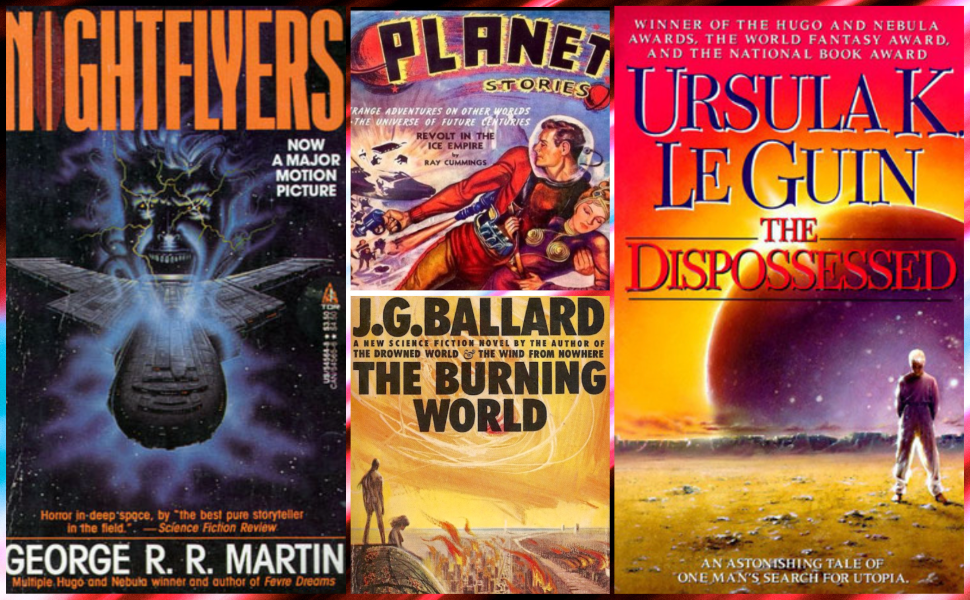
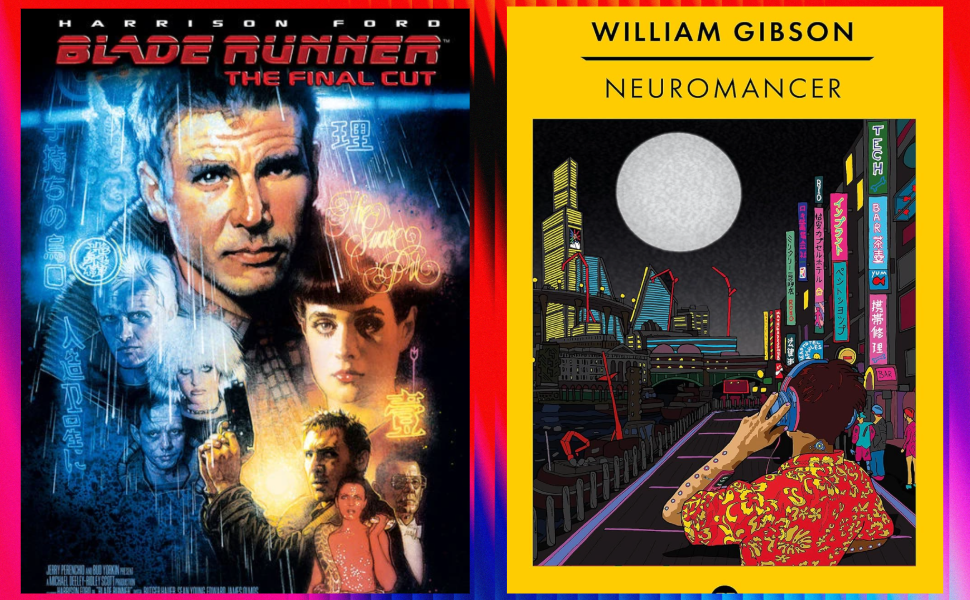
By the 1960s, history tears that fantasy apart. Vietnam, civil rights, feminism—and inside the field, the New Wave. Le Guin, Delany, Russ, Butler drag power and sexuality into a genre that had pretended they were optional. Gibson's Neuromancer says it straight: corporations run the world; the hacker isn't free, he's precarious.
And the system eats it. Cyberpunk's corporate dystopia becomes the visual language of the actual tech sector; executives quote Gibson while union-busting their workers. Once the industry learns to brand dissent, every revolt becomes another shelf.
Star Wars proves where the real money lives. Lucas keeps merchandising rights; toys out-earn the film. Worlds become assets. Characters become trademarks. Work-for-hire writers build universes they don't own, decanonised by memo when strategy changes.
Streaming finishes the turn. Netflix, Amazon, Disney+ put an opaque algorithm at the gate. Residuals collapse. Writers' rooms are cut to bone. The same platforms serving glossy dystopias run their warehouses on the same logic.
Then, in 2023, thousands step off the treadmill. Writers strike for 148 days; actors join for 118. The corporations that looked like permanent scenery suddenly have a problem their algorithms can't optimise away. The workers don't overturn the system, but they prove its "nothing can change" line is a lie.
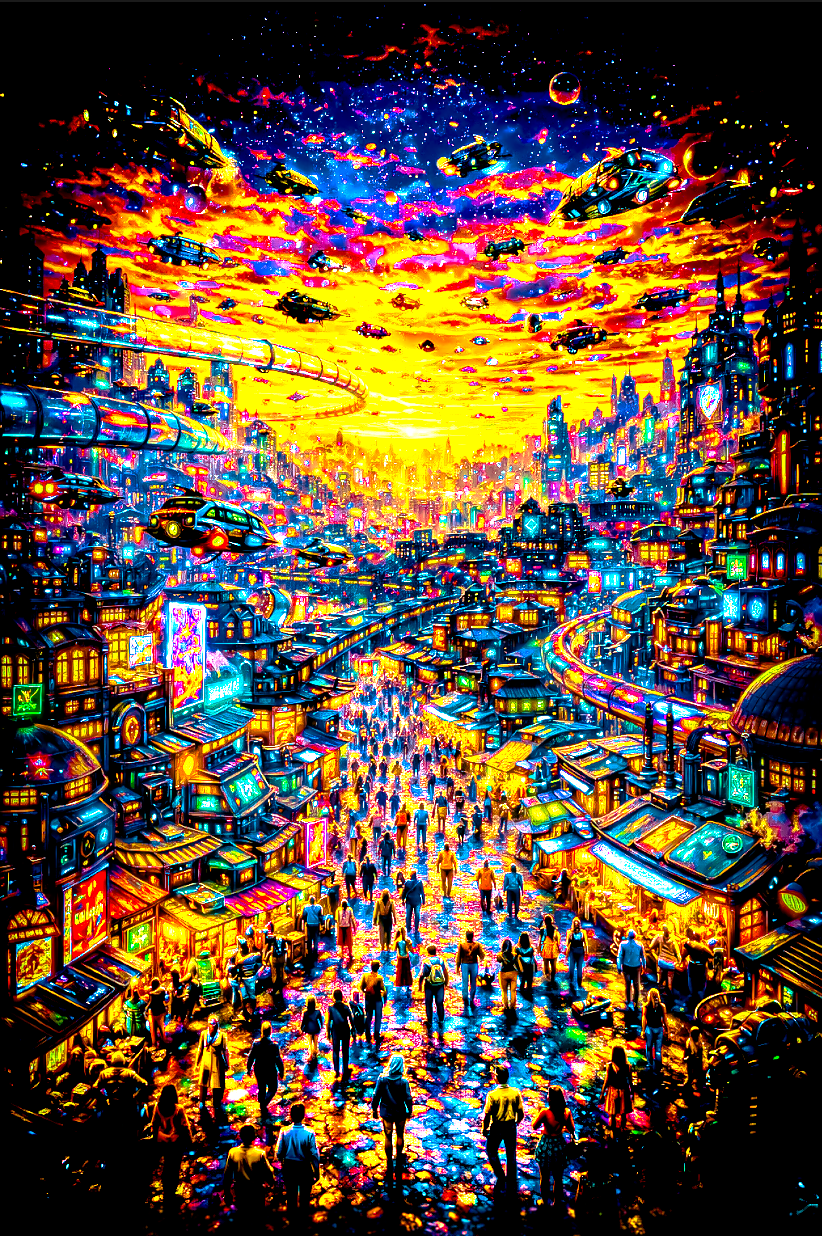
Selling Tomorrow is a structural history of a dream department: who owns it, who works for it, who gets erased, and what its stories train people to accept. Along the way, it keeps asking blunt questions. Why does a genre obsessed with "what if?" almost never show organised workers changing anything? Why are dystopias easier to imagine than socialist futures? Why did SF predict surveillance capitalism so clearly while leaving resistance to lone geniuses and plucky crews? Why do tech billionaires treat SF as a blueprint while stripping their own workforces of leverage?
From pulp racks to platforms, from Gernsback to Gibson, from Astounding to a picket line outside a studio gate—it's about the futures we were trained to buy, and the workers starting to refuse the script. Every major claim is backed by nearly a hundred pages of endnotes, so you can follow the wires yourself.
Science Fiction Is the Dream Department
Science fiction promised us the future. What it mostly delivered was training.
Selling Tomorrow: Sci-Fi, Apocalypse and Worlds of Wonder (1926–2026) argues that science fiction is capitalism’s official dream department: the place where futures are test-marketed, polished and sold back to us as inevitabilities. From Hugo Gernsback’s “scientifiction” magazines in the 1920s to Disney, Amazon and Netflix in the platform age, the book follows how SF became a rehearsal space for new technologies, new forms of work, new wars and new kinds of control.
The book’s core claim is simple: SF has a double job. It has to make the present strange enough to think about, and the coming order familiar enough to accept. That tension—between estrangement and domestication—runs through pulp magazines, Golden Age hard SF, New Wave experiments, blockbuster franchises, prestige TV, gaming, anime, Chinese and Japanese futures, and “hopeful” subgenres.
Selling Tomorrow tracks how this double function is built into the way SF is financed, written, edited, shot, packaged, licensed and streamed. It is not a conspiracy theory. It is an industrial history: who owns the dream factory, who gets to imagine futures for a living, and what kinds of world keep getting pushed to the front of the shelf while others are quietly fenced off as “unrealistic,” “uncommercial” or “too political.”
If you’ve ever finished a dazzling piece of SF and thought, “Why do these futures still feel so narrow?”, this book is the map of the machinery behind that feeling.
From Pulps to Platforms: A 100-Year Map of the Future Business
Across forty chapters, Selling Tomorrow walks through a century of science fiction as a business of futures—who makes them, who pays for them, and how each phase reshapes what can be imagined.
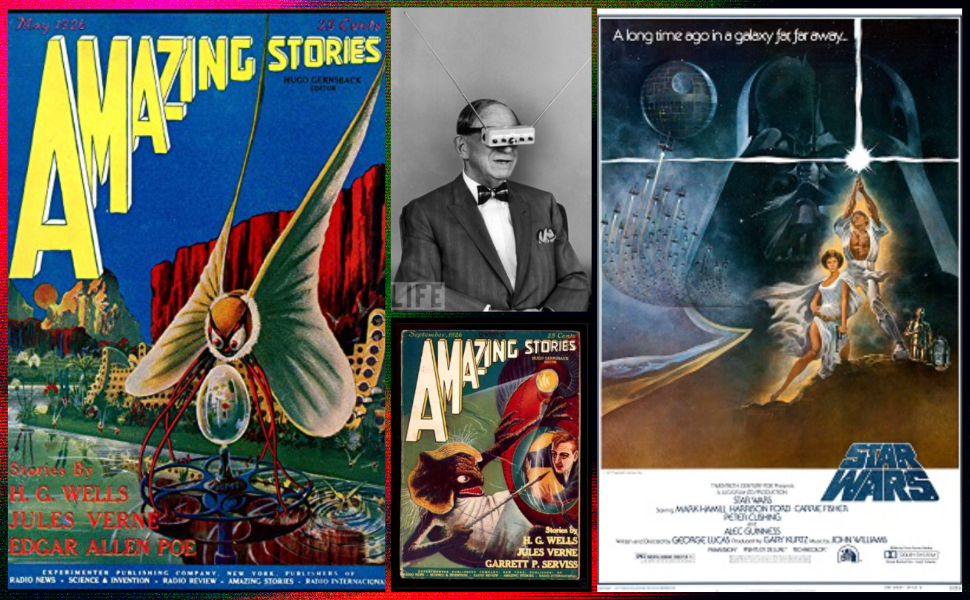
It starts in the pulp era, with Gernsback’s magazines manufacturing “science fiction” as a category and building fan clubs as unpaid marketing infrastructure. It moves into the so-called Golden Age, where John W. Campbell turns a single magazine into an empire of taste, pushing the “competent man” engineer-hero and quietly locking out anyone who doesn’t fit his idea of who belongs on the bridge of the ship.
From there, the book follows the paperback revolution and the New Wave: experimental writers, anthologies and little magazines that seemed to blow the doors off the genre—only to find themselves absorbed into new publishing houses, new prestige categories and new market niches. The pattern continues into the blockbuster era: Star Wars proves that SF can be a billion-dollar franchise, and suddenly the “universe” becomes a business model, complete with merchandise, tie-ins and sequel mandates.
Finally, Selling Tomorrow dissects the platform phase: Marvel’s cinematic universe, Disney’s IP vault, Amazon’s vertical stack from Kindle to Prime Video, Netflix’s algorithmic greenlighting, Chinese box office constraints, global anime and games. Each phase has its own contradictions, but the through-line is the same: the futures that flourish are the ones that fit the needs of the institutions paying the bills.
This isn’t a tour of fun trivia. It’s a structural map of how the future, as a product, gets made.
Inside the Machine: Who Owns Tomorrow—and Who Gets Left Out
Selling Tomorrow is not just about famous titles and visionary creators. It is about the work behind them, the exclusions that built the “canon,” and the way entire possibilities are filtered out long before they reach a shelf or a screen.
The book digs into the economics of pulp word-rates, the piece-work reality of early SF writers, and the way magazine editors and later publishing houses decided what counted as “proper” science fiction. It traces how women were present in the field from the beginning but shunted into pseudonyms, marginal imprints and review sections that treated them as curiosities rather than peers. It follows how non-white writers, artists and readers were structurally blocked, tokenised or used as proof that the system was “open,” while decision-making power and ownership remained firmly elsewhere.
Alongside that, Selling Tomorrow takes apart the more modern infrastructure: Hollywood accounting that claims blockbuster films never make a profit “on paper”; profit-participation deals that mysteriously never pay out; franchise bibles that turn creativity into a system of permissions. It examines military and security-state collaboration on SF film and TV, where access to hardware and locations comes in exchange for script changes and flattering portrayals.
The book also looks at fan labour—wikis, lore-keeping, fan-fiction archives, convention culture—as both a space of genuine alternative creativity and a pool of unpaid research and development that studios quietly draw on. At every point, it asks the same questions: who is doing the work, who is taking the risk, who is capturing the money and prestige, and what kinds of futures get quietly buried in the process.
For Readers Who Feel Something’s Off About the Future
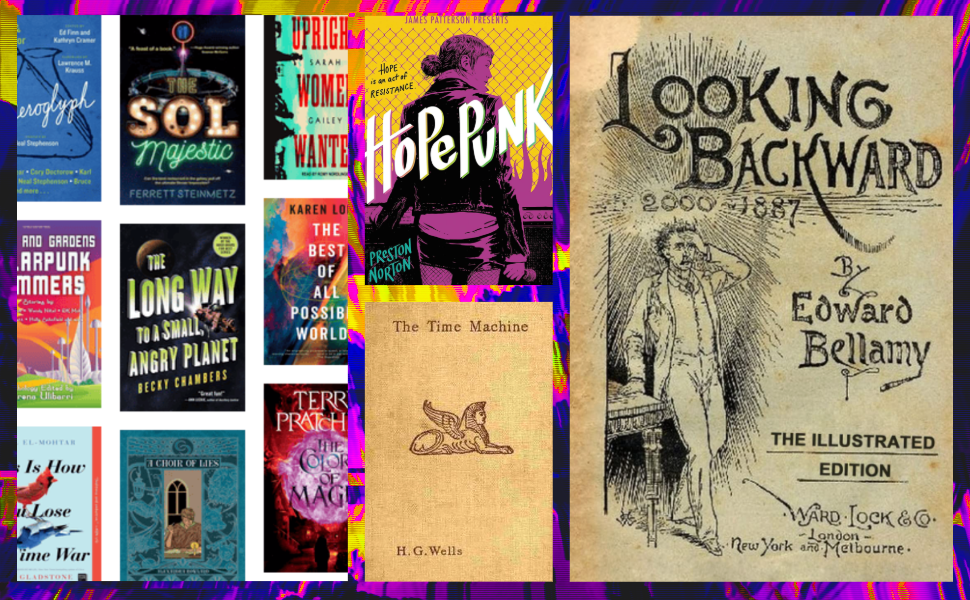
This book is written for people who love science fiction but have started to feel uneasy about the futures they’re being sold.
If you’ve noticed that the hero is almost always alone, that collective action rarely works, that corporations somehow survive every apocalypse, that borders and property quietly remain in place even in wildly imaginative settings—Selling Tomorrow joins those dots. It doesn’t scold you for enjoying space battles or time-travel plots. It treats your unease as evidence that you’re already seeing the pattern.
The focus is global but grounded: US and UK SF as the imperial-core engine; Soviet and post-Soviet work under planned economies; Japanese anime and games built in a developmental, export-oriented system; contemporary Chinese SF navigating party control and world-market demands. Different state forms, same underlying logic: futures that question the ownership of technology, land, debt or labour hit hard limits.
At the same time, Selling Tomorrow is not a catalogue of despair. The final part of the book tracks the “lost line” of counterfutures—utopian socialism, radical SF traditions, Afrofuturist and abolitionist work, solarpunk experiments, fan-run archives and gift economies that keep alternatives alive. It also looks at the cracks in the current order: writers’, actors’ and VFX workers’ strikes, union drives, independent presses, fan communities that refuse to be just a marketing segment.
The message isn’t “the future is doomed.” It’s that the futures we’ve been trained to see as natural are the result of specific institutions, contracts and choices—and that once you understand how the dream department works, you are no longer stuck accepting its catalogue as the only possible range.
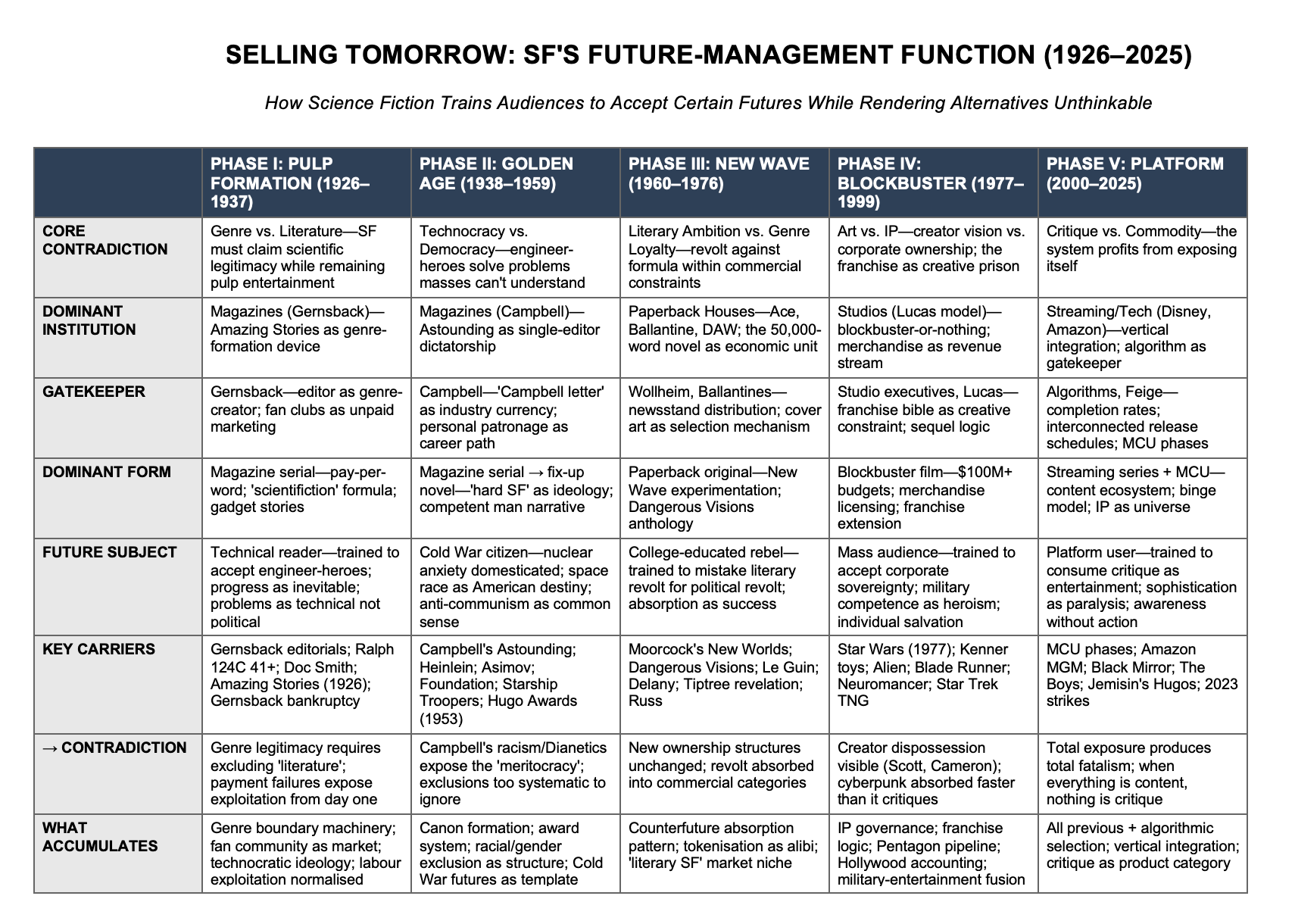
HOW TO READ THE TABLE
This table maps how science fiction's future-management function evolved from the pulp era to the streaming age. It shows not what writers intended or readers believed, but who controlled which futures got imagined, how profit was extracted from that imagination, and how each phase's contradictions produced the next.
Two Ways to Read
Read ACROSS a row
Follow one element over time. The gatekeeper in 1926 (Gernsback, the magazine editor) becomes something different by 2025 (algorithms plus Kevin Feige's interconnected release schedules). The system didn't simply grow. It transformed while preserving its core function: training audiences to accept certain futures while rendering alternatives unthinkable.
Read DOWN a column
See how all elements align at one historical moment. In any given phase, the core contradiction, the dominant institution, the gatekeeper, and the future subject interlock. The table shows coordination — not through conspiracy, but through structural alignment of ownership, distribution, and imagination.
The Core Contradiction
SF must estrange and domesticate simultaneously.
It must make readers feel they're encountering radical possibilities while ultimately reconciling them to existing or extrapolated power relations. The genre makes the present feel strange enough to think about, and the coming order feel familiar enough to accept. This contradiction runs through every phase. The only things that change are how it gets managed and who gets trained to accept which futures.
The system doesn't fail because editors made mistakes. It transforms because each resolution contains the seeds of its own crisis.
Gatekeeper Migration
The key driver in the table is where selection power sits at each phase. Each migration doesn't replace the previous gatekeeper — it adds a layer.
PHASE
GATEKEEPER
I
Gernsback — editor as genre-creator, fan clubs as unpaid marketing
II
Campbell — personal patronage, the 'Campbell letter' as currency
III
Paperback editors — newsstand distribution, cover art as filter
IV
Studio executives — franchise bible, sequel requirements
V
Algorithms + Feige — completion rates, interconnected release schedules
The Eight Structural Rows
Eight rows persist across all five phases. The content shifts; the function remains.
ROW
WHAT IT TRACKS
Core Contradiction
How the estrangement/domestication tension operates this phase
Dominant Institution
Who owns the means of SF production
Gatekeeper
Where selection power actually sits
Dominant Form
What shape SF takes as commodity
Future Subject
Who's being trained to accept what futures
Key Carriers
Texts, figures, events that reveal structure
→ Contradiction
What breaks this phase's arrangement
What Accumulates
What persists and compounds into the next phase
The Ten Threads
Ten threads trace through all phases, appearing in different configurations:
THREAD
WHAT IT TRACKS
Future-Management Function
How SF trains audiences to accept certain futures as inevitable
Estrangement vs. Domestication
The core formal contradiction — making strange familiar, familiar strange
Individual vs. Collective
Isolated protagonists: solidarity foreclosed
Gatekeeping & Canon
Who decides what counts as SF and what gets remembered
Labour Invisibility
Who makes SF, under what conditions, erased how
Military-Industrial Entanglement
Pentagon, tech industry, security state
Racial Exclusion as Structure
Not accidents but industrial policy
Gendered Exclusion as Structure
Women always present, systematically obscured
Counterfuture Absorption
How radical SF gets defanged by commercial success
IP as Governance
Franchise logic as production mode
The Structural Constants
What persists across all five phases — the invariants that reform never touches:
• SF trains audiences to accept futures compatible with existing power relations
• Racial and gender exclusion are built into genre formation, not added after
• Corporate profit flows from owning imagination, not just distribution
• Each phase's 'breakthrough' includes its counter-mechanism
• Reform restores legitimacy without transforming ownership
• Counterfutures get absorbed faster than they can critique
The loop is self-reinforcing: ownership determines selection → selection shapes imagination → imagination naturalises ownership.
What the Table Reveals
By the end, the table makes three things visible:
First: SF's future-management function is structured from above. It's organised by ownership and distribution, not by genius or inspiration. The same imagination is radical in a small press and domesticated in a Disney franchise — the difference is who owns the pipeline.
Second: 'breakthroughs' have been absorbed at every phase. New Wave was a breakthrough. Cyberpunk was a breakthrough. Afrofuturism was a breakthrough. Each wave expanded what could be imagined while leaving ownership unchanged.
Third: the system is sedimentary. Nothing goes away. Algorithms don't replace franchise logic. Franchise logic doesn't replace Campbell's gatekeeping. By Phase V, every previous mechanism is still running. That's not dysfunction. That's the design.
Follow the ownership. Follow the gatekeepers. Follow the futures that became unthinkable.
From: Selling Tomorrow: Sci-Fi, Apocalypse and Worlds of Wonder (1926–2026)
“If you are in difficulties with a book, try the element of surprise: attack it at an hour when it isn't expecting it.”
― H.G. Wells
The conference room could have been anywhere in Silicon Valley—the same glass walls, the same ergonomic chairs, the same whiteboard already smudged with half-erased diagrams. There was a speakerphone in the middle of the table nobody would use, a projector humming quietly, and a catered lunch cooling on a side table in identical cardboard trays. But this was Intel’s campus in Santa Clara, sometime in 2012, and the people gathered weren’t engineers or marketers. They were science fiction writers.¹
Brian David Johnson stood at the front of the room. His title was “futurist-in-residence,” a job that hadn’t existed at Intel until he invented it.² The writers in front of him had been flown in, put up in hotels, and paid fees that compared favourably to what they’d get for a short story sale to a major magazine. They had visitor badges, Wi-Fi logins, NDAs in their bags. What Intel wanted in return was simple: imagine the future.
Not any future. Intel’s future. A future in which computing was ubiquitous—chips in thermostats, light fixtures, cars, door locks—embedded in every surface and object, generating data that would require, not coincidentally, Intel processors to handle. The writers would produce stories, Intel would publish them in glossy anthologies, and the corporation would end up with something more valuable than advertising: narrative legitimacy.³
This is what the dream department looks like when the lights are on. Not a metaphor, not a sociological abstraction, but a room full of professional imaginers being briefed on the parameters of acceptable tomorrows. The futures Intel paid for weren’t predictions. They were constraints dressed as possibilities.
If you walk past the glass wall, it looks harmless. A tech company “supporting the arts,” paying writers to think about what’s coming next, letting engineers and creatives cross-pollinate. On the surface it reads as culture: a company sponsoring fiction about the future, a sort of in-house festival of ideas. Inside the system, something tighter is happening. A corporation with a fixed product roadmap is quietly hiring one of the few public machines for imagining alternatives and bolting it onto its own chassis. What comes out the other side isn’t prophecy. It’s house futures.
You can see the class relationship in the room if you look at it sideways. At one end of the table: salaried staff with stock options and badges that open every building on campus. At the other: freelancers whose usual “office” is a laptop on a kitchen table, flown in for a day or two of billable imagination. The difference in security is the whole point. Intel can treat this as experiment. The writers don’t have that luxury. For them, it’s rent.
Johnson had theorised his own practice. In his book Science Fiction Prototyping, he laid out the method explicitly: use SF narratives to explore future technologies, make those futures vivid and emotionally resonant, then feed them back into the engineering process.⁴ The book was aimed at corporate futurists and R&D departments. It treated science fiction as a tool—which, from Intel’s perspective, it was.
The process worked like this. Johnson would meet with Intel’s engineering teams to understand what technologies were in the pipeline. Then he’d brief writers—sometimes established names, sometimes newer voices—on the broad parameters. The stories should explore ubiquitous computing, ambient intelligence, wearable technology, the internet of things. They should show how people might live with these technologies, what problems they might solve, what emotional resonances they might carry. The engineers would later read the stories for inspiration, looking for human angles they might have missed, for use cases they hadn’t considered, for the texture of lived futures.
On its own terms, it’s a neat loop: engineers explain capabilities, writers turn those capabilities into human scenes, and those scenes drift back into roadmaps as “user-centred insight.” But the loop has a frame. Nowhere in the method is there a step that asks whether these technologies should exist in the first place, or who pays when they do. The only question on the table is how to make them imaginable and emotionally plausible. The “prototyping” is about smoothing the route from lab to market, not about opening a real fight over direction.
The anthologies that emerged—Intel’s Tomorrow Project collections beginning in 2011—were professionally produced, with cover art and author bios and the full apparatus of legitimate publishing.⁵ Intel distributed them at industry conferences, posted them as free downloads, cited them in investor presentations. The message was clear: this company doesn’t just make processors, it makes futures. And the futures it makes are desirable, humane, worth wanting.
The writers who participated weren’t dupes. They were professionals taking paid work, often from corporations whose products they used daily. The brief was interesting. The money was real. And the constraints, while present, weren’t usually spelled out as censorship. No one sat them down and said, “You can’t write X.” The boundaries were implicit: you don’t bite the hand that’s paying you to dream. You adjust, like any worker adjusts, to what the workplace can tolerate.
So what couldn’t you write for Intel’s Tomorrow Project? You couldn’t write a story in which Intel’s chips were instruments of surveillance. You couldn’t imagine a future in which ubiquitous computing enabled totalitarian control. You couldn’t explore the labour conditions in the factories where these chips would be manufactured—the workers at Foxconn, the rare-earth miners in the Congo.⁶ You couldn’t take the story sideways and ask whether a world of embedded sensors is one most people would actually want to live in, or what happens to a warehouse picker when her performance metrics are tracked in real time from ankle bracelet to barcode gun. These weren’t explicit prohibitions. They were structural impossibilities. Intel wasn’t paying for dystopia. It was paying for aspiration.
What Intel purchased wasn’t content. It was credibility transfer. Science fiction writers carry cultural capital—the accumulated authority of a genre that has spent a century positioning itself as prophetic. When a corporation publishes an SF anthology, it borrows that authority. The future described in those pages isn’t Intel’s agenda. It’s a vision, an imagination, a creative work. The interested party disappears behind the disinterested artist.
That’s the trick. Call it ideology laundering. The move works because SF operates in a register that feels like speculation rather than advocacy. An Intel white paper arguing for ubiquitous computing reads as corporate self-interest. An Intel-commissioned story imagining a world of ambient intelligence reads as imagination. The content can be identical. The framing transforms it.
In miniature, that room at Intel shows the whole pattern this book is interested in. SF’s basic tools—estrangement, extrapolation, wonder—are being rented by institutions that already hold power, to make their preferred futures feel inevitable and benign. The genre’s reputation for wildness becomes a safety harness for whatever the client wants to strap to it.
Intel wasn’t alone. By the mid-2010s, corporate SF commissioning had become something like an industry standard for companies with futures to sell. The dream department had gone from one odd experiment in Santa Clara to a normal line on the budget in firms that wanted to look visionary without changing anything structural.
Microsoft published Future Visions in 2015, an anthology of original SF stories by writers including Elizabeth Bear, Greg Bear, Ann Leckie, and Jack McDevitt.⁷ The project emerged from Microsoft Research, the company’s R&D arm, and the framing was careful: these weren’t Microsoft’s futures, just futures that Microsoft researchers found interesting enough to share with writers. The distinction mattered legally and rhetorically, even if the practical effect was the same. Microsoft got to associate its brand with prestigious SF names. The writers got paid and published. The futures imagined were ones in which Microsoft’s core competencies—cloud computing, artificial intelligence, mixed reality—featured prominently.
The anthology’s introduction, written by a Microsoft researcher, emphasised the company’s commitment to “human-centered design.“⁸ The stories themselves were professionally crafted, indistinguishable in quality from what the same writers published through traditional venues. That was the point. If the stories had felt like advertisements, the credibility transfer wouldn’t work. They had to feel like fiction—which they were. The selling job happened one layer down, in the assumptions: that the future would be technological, that technology would be corporate, that the appropriate response to coming change was adaptation rather than resistance.
Shell had been doing this longer than anyone. The oil company’s scenario planning division dated back to the 1970s, when Pierre Wack pioneered the use of narrative scenarios to explore possible futures.⁹ Shell didn’t hire SF writers directly—it developed its own internal practice—but the method was the same: use storytelling to make certain futures thinkable and others invisible. Shell’s scenarios never imagined rapid decarbonisation. They never imagined the end of the fossil fuel economy. They imagined worlds in which oil remained central, even as the terms of that centrality shifted. The futures were plural, which made them feel open. But the range of plurality was bounded by who was doing the imagining and why.
The Shell scenario process became legendary in business schools. Wack famously anticipated the 1973 oil crisis, not through prediction but through scenario—imagining what would happen if OPEC exerted its leverage.¹⁰ The success gave scenario planning enormous prestige. Companies wanted their own Wacks, their own capacity to see around corners. What they didn’t notice was that Shell’s scenarios consistently found oil at the centre of the future, even scenarios labelled “sustainable” or “low-carbon.” The imagination served the imaginer.
By the 2000s, scenario planning had become a consulting industry. Firms like Global Business Network offered corporate clients the service of professional future-making, often staffed by people with SF backgrounds or SF-adjacent sensibilities.¹¹ GBN’s founders included Stewart Brand, whose Whole Earth Catalog had shaped countercultural futurism, and Peter Schwartz, who had led scenario planning at Shell. The countercultural energy was still there in the aesthetics—the workshops felt creative, imaginative, oppositional to stodgy corporate thinking. You could sit on beanbags and rearrange Post-it notes under projected images of rockets and domes. But the clients were corporations, and the futures imagined were corporate futures. The method migrated from Shell to the broader corporate world. Every major company now had a futures practice, a strategic foresight team, a department dedicated to imagining what was coming. What they imagined, consistently, were worlds in which their clients remained central.
In each case, the same shell game runs. The future is presented as multiple and uncertain—many scenarios, many visions—but the anchor never moves. Oil stays at the centre. The platform stays at the centre. The brand stays at the centre. The plurality is real enough on the surface; the structure underneath is fixed. The dice roll. The house still wins.
The military had its own version. SIGMA was a group of SF writers convened periodically by the Department of Homeland Security and DARPA to consult on emerging threats and technological possibilities.¹² The participants included writers like Larry Niven, Jerry Pournelle, and Greg Bear—established names whose security clearances allowed them to receive classified briefings. In return, they offered imaginative scenarios: what might terrorists do with emerging technologies, what might the next asymmetric threat look like, what should military planners be worried about.
The arrangement was almost charmingly explicit. A 2007 gathering, hosted at a private residence, brought together SF writers with intelligence officials.¹³ The writers brainstormed attack scenarios. The officials took notes. The session produced a list of “realistic” threats that the writers had imagined—threats that now had a form the military could plan against.
The exchange was clear. Writers got access, information, the thrill of proximity to power. The military got imagination—the capacity to think beyond existing doctrine, to anticipate threats that hadn’t yet materialised. SIGMA’s participants generally believed they were performing a public service. Perhaps they were. But the service they performed was making certain futures thinkable for the people who would act on them. The scenarios they imagined tended to reinforce existing threat categories: terrorism, rogue states, technological proliferation. They didn’t imagine futures in which American military dominance was itself the problem. They didn’t imagine insurgencies that might be justified. They didn’t imagine alternatives to the security state. The constraints weren’t censorship. They were structural—the product of who was invited, who was cleared, who could imagine “usefully” inside the categories that mattered to the people paying for imagination.
RAND Corporation had pioneered this decades earlier. The Cold War think tank used scenario planning and systems analysis to make nuclear war thinkable—not as apocalypse but as strategy.¹⁴ Herman Kahn’s On Thermonuclear War was, in effect, science fiction: detailed imaginings of how nuclear exchange might unfold, what casualties might be acceptable, what recovery might look like. Kahn didn’t call it SF, but the method was the same. Narrative made the unthinkable thinkable. Imagination served policy. The book was controversial not because Kahn imagined nuclear war but because he imagined surviving it—he made apocalypse manageable, something to be planned for rather than prevented.
Stack all this up and the pattern isn’t subtle. Imagination is welcome, as long as it’s plugged into existing command structures. SF writers can speculate all they like, so long as the frame and the gun stay where they are, so long as the basic categories—ally, enemy, asset, threat—don’t get dissolved in the process.
The through-line from RAND to SIGMA to Intel’s futurist-in-residence wasn’t direct, but it didn’t need to be. The principle had been established: science fiction’s tools could be detached from the genre and attached to institutional purposes. The question wasn’t whether SF would be captured for these uses but who would do the capturing and on what terms.
The feedback loop between SF and technological development runs in both directions, and neither direction is neutral.
When Xerox PARC developed the graphical user interface in the 1970s, the researchers involved had grown up on SF. The desktop metaphor, the mouse, the iconographic display—these weren’t inevitable solutions to human-computer interaction. They were design choices shaped by what the researchers could imagine, and what they could imagine had been shaped by the SF they’d consumed.¹⁵ The future looked like SF because the people building the future had learned to think in SF’s terms.
This isn’t prediction. It’s constraint. SF narrows and channels the imaginable. Technology gets built inside those boundaries. Then SF is credited with “predicting” what it actually helped bound. The smartphone is often cited as an SF prediction—Star Trek‘s communicator made real.¹⁶ But the smartphone’s actual social effects—the gig economy, surveillance capitalism, attention extraction, algorithmic sorting—were not predicted by Trek. They weren’t imaginable within Trek’s cognitive frame, which assumed technology served human flourishing rather than extracting value from it. The “prediction” story celebrates the gadget and ignores the system.
Treating SF as a prediction machine is useful if you’re selling TED talks or coffee-table histories of “the future that came true.” It’s less useful if you want to understand why so many of the futures that get funded share the same blind spots: labour that disappears, extraction that never stops, states and corporations that never lose.
The tech billionaires who now dominate the industry are explicit about their SF debts. Elon Musk cites Asimov’s Foundation series as formative, finding in it a model of civilisational survival that justifies his Mars colonisation ambitions.¹⁷ The Foundation novels imagine a galaxy-spanning empire in decline and the mathematician who creates a secret plan to preserve civilisation through the dark ages to come. Musk read this as a blueprint. Humanity needs a backup civilisation. Mars is the backup. He is the mathematician.
The megalomania is obvious, but the framework matters more. Musk’s Mars project isn’t pitched as a business venture (though it is) or a vanity project (though it is) but as civilisational necessity. The SF narrative supplies the scaffolding. We are in decline. Only visionary action can save us. The collective doesn’t know what’s good for it. The genius does.
Jeff Bezos watched Star Trek as a child and named Amazon’s voice assistant Alexa in homage to the Library of Alexandria—an institution, like Amazon, that aimed to collect all human knowledge in one place.¹⁸ Bezos’s space company, Blue Origin, operates on a similar logic: humanity’s future is in space, resources are finite on Earth, expansion is survival. The Federation’s optimistic frontier is the template. That Bezos’s fortune derives from terrestrial logistics—the warehouses, the delivery drivers, the exploitation of labour that makes two-day shipping possible—is not part of the SF vision. The workers are invisible. The future is elsewhere.
Peter Thiel’s investments follow patterns more adjacent to fantasy than SF, but the principle is the same: narrative shapes what counts as a desirable future.¹⁹ Thiel has funded seasteading projects (floating libertarian utopias outside territorial waters), life-extension research, and surveillance technology for states and corporations. The through-line is a certain kind of speculative imagination—escape from collective governance, technological transcendence of human limits, new frontiers beyond democratic oversight. The futures Thiel funds are futures without politics, or rather, futures where politics has been replaced by exit.
These aren’t incidental influences. They’re structural. When Musk designs SpaceX’s rockets to look like 1950s SF illustrations, he’s not just being nostalgic. He’s borrowing the genre’s accumulated sense of inevitability.²⁰ The retro-futurist aesthetic says: this was always coming, this is the future we were promised, this is destiny rather than choice. The politics disappear behind the romance. You don’t argue with destiny. You don’t unionise against the future.
Mark Zuckerberg renamed Facebook “Meta” and bet the company on the “metaverse”—a term taken directly from Neal Stephenson’s Snow Crash.²¹ The novel was a satire, depicting a dystopian future in which corporate power had replaced state authority and most Americans lived in franchised enclaves while escaping into a virtual world. The metaverse in the novel is where people go because reality has become unbearable—because the public sphere has collapsed, because the economy has failed most people, because corporate logos cover every surface. Zuckerberg either missed the critique or didn’t care. What he wanted was the word, the concept, the imaginative real estate. The metaverse felt like the future because SF had already made it feel that way. That the novel’s metaverse was a symptom of civilisational failure was beside the point. The aesthetic was available for capture.
Once you see it, you can’t unsee it. The world’s richest men are literally moving through life with a handful of paperbacks and TV episodes rattling around in their heads, using them as coordinates. And when they stand up and talk about destiny, exploration, civilisational survival, they are quoting their adolescent reading lists without saying so. The genre’s private myths have become public policy.
The naming tells you everything. Starlink. Neuralink. Project Artemis. Metaverse. Titan. Atlas. The language borrows SF’s authority to shut down political argument in advance.
When a technology has a name that sounds like destiny, it becomes harder to contest. You don’t vote on Starlink. You don’t organise against Neuralink. You adapt to the metaverse or you get left behind. The SF aesthetic positions technological change as something that happens to you, not something you might collectively shape. The grammar is passive: the future arrives. It is not made by particular people with particular interests who could have made it differently.
Apple’s design language owes a documented debt to 2001: A Space Odyssey—the clean white surfaces, the minimal interfaces, the sense of technology as environment rather than tool.²² The HAL 9000’s malevolence has been quietly dropped. What remains is the aesthetic of inevitable sophistication. Apple products feel like the future because they look like what the future was supposed to look like. The design is a citation.
Tesla’s entire brand is an SF proposition. The company sells cars, but what it markets is the future—a future of clean energy, autonomous driving, seamless technological integration. The cars’ names (Model S, Model 3, Model X, Model Y—spelling “S3XY”) are juvenile jokes, but the aesthetics are serious.²³ The falcon-wing doors, the tablet-sized dashboard, the over-the-air updates—all of it says: you are living in the future now. The workers at Tesla’s factories, subject to injury rates above industry average and union-busting campaigns, are not part of this future.²⁴ Their labour is invisible. The future is a consumer experience.
Amazon named its delivery drone programme “Prime Air” and released promotional videos showing drones delivering packages to suburban homes within thirty minutes of order.²⁵ The videos looked like science fiction because that was the point. They were science fiction—short films imagining a future Amazon wanted to make real. The cinematography was polished, the tone optimistic, the suburban lawn impossibly green. The regulatory battles, the airspace conflicts, the labour displacement—these were not part of the vision. The future Amazon sold was a future of frictionless consumption, not a future in which someone had to fight about who controlled the airspace above private property.
Corning, the glass manufacturer, produced a series of “A Day Made of Glass” videos in the early 2010s showing a future in which glass surfaces throughout the home served as interactive displays.²⁶ The videos depicted families cooking with recipe-displaying countertops, children doing homework on glass desks, commuters checking information on glass bus shelters. The technology didn’t exist. Corning was making glass, not computers. But the videos positioned the company as a future-maker, borrowing SF’s imaginative authority to sell a product line that hadn’t been invented yet. The genre’s machinery was being used to generate demand before supply.
Taken together, these examples aren’t just a collage of cute marketing tricks. They’re the texture of an environment in which “the future” is pre-branded before anyone gets to argue about it. Names, interfaces, demo videos and glossy anthologies all lean on the same move: take a particular trajectory, wrap it in borrowed wonder, and present it as common sense.
So what do the contracts actually say? The material conditions of corporate SF commissioning reveal more than the published work ever does.
Writers approached for projects like Intel’s Tomorrow initiative or Microsoft’s Future Visions anthology typically receive flat fees rather than royalties. The amounts vary but are generally equivalent to upper-tier magazine rates—a few thousand dollars for a short story, more for novelette length.²⁷ This is good money for short fiction in a market where most magazines pay in copies or cents per word. The economic incentive is real.
The contracts typically assign intellectual property to the corporation. The story you write for Intel belongs to Intel. You may be credited as author, but you don’t own what you created.²⁸ This is standard work-for-hire, no different from what technical writers or advertising copywriters sign. But it transforms the writer’s relationship to the work. You’re not speculating freely about possible futures. You’re producing material for a client who will own and deploy it as they see fit.
Editorial review is part of the process. Corporations don’t publish SF anthologies to embarrass themselves. Stories go through approval chains.²⁹ This doesn’t necessarily mean heavy-handed “change this political line” censorship. Writers report that the feedback is usually framed as craft—this section is slow, this character isn’t landing, the ending doesn’t work. But the selection process itself is political. Writers who are likely to produce work compatible with corporate interests get invited. Writers who aren’t, don’t. The filtering happens before the contract is signed.
The distribution channels are corporate channels. These anthologies aren’t sold in bookstores or marketed through publishers’ catalogues. They’re distributed at conferences, shared through corporate communications, posted on corporate websites.³⁰ The audience is not the SF-reading public. It’s clients, employees, investors, journalists—people who need to be persuaded that this company’s vision of the future is plausible and desirable. The stories are marketing materials that don’t look like marketing materials.
Writers who participate aren’t selling out in any simple sense. They’re doing work, getting paid, and often producing fiction they’re proud of. The constraints are real but not always felt as constraints. The brief is interesting. The money is welcome. The publication looks good on a CV. And the alternative—refusing corporate commissions on principle—means leaving money on the table while the work gets done by someone else. The system doesn’t require writers to be corrupt. It requires them to be professional.
That’s why it works so smoothly. You don’t need a smoky room full of hacks churning out propaganda. You just need a labour market where serious writers struggle to pay rent, and a set of institutions willing to pay properly for stories that keep the frame intact. Under those conditions, the futures practically write themselves.
And one more turn of the screw: those futures then circulate back into the genre itself. Corporate anthologies appear on bibliographies, get cited in interviews, sit on the same shelves as independent work. The line between “our” SF and “their” SF blurs. What was originally commissioned as private marketing slowly hardens into public canon.
The longer history shows this wasn’t inevitable.
Corporate SF commissioning emerged from scenario planning, which emerged from Cold War strategic analysis, which emerged from wartime operations research. The line runs through institutions: RAND’s systems analysts became futurists became consultants became corporate visionaries.³¹ At each step, the practice was sold as neutral. Scenario planning isn’t advocacy, it’s just exploring possibilities. Strategic foresight isn’t ideology, it’s just preparation for contingencies. The neutrality was always fake. The contingencies explored were the ones that served the institutions doing the exploring.
SF itself wasn’t always ready for this kind of capture. The genre’s early history is full of socialist utopias, feminist speculations, anti-colonial visions. Edward Bellamy’s Looking Backward imagined the nationalisation of industry. William Morris’s News from Nowhere imagined the abolition of wage labour. Charlotte Perkins Gilman’s Herland imagined a world without patriarchy.³² These weren’t marginal curiosities. They were central to the speculative tradition before Hugo Gernsback’s pulp category “science fiction” carved off one branch and trained it to sell gadgets and gee-whizz futures to boys.
The dream department is an end-point, not a natural feature of the landscape. SF became easy to hire because of specific editorial decisions, specific economic arrangements, specific ideological preferences. The pulp magazine format selected for certain kinds of stories. The gatekeepers selected for certain kinds of futures. The commercial pressures selected for what would sell. By the time Intel came looking for a futurist-in-residence, the genre had been shaped for a century to produce exactly the sort of material corporations would want to buy.
The rest of this book traces that shaping. How a genre that once imagined socialist transformation became a genre that mostly imagines corporate tomorrows. How the futures we’re offered got narrowed before we ever saw them. How the dream department was built.
It starts with a magazine, a huckster, and a post office box in New York.
The bookstore has two sections, and they don’t talk to each other.
Over here: Science Fiction and Fantasy. Silver and black spines, neon blues and toxic greens. Starships banking over planets. Dragons wrapped around mountains. Women in armour that would get you killed in the first thirty seconds of an actual battle. Tie-in logos: A Warhammer 40,000 Novel, A Star Wars Story, The Expanse Book 6. Mass-market paperbacks are thick and flexy, with volume numbers stamped down the side. Hardcovers arrive with series brands already baked in—“Book Three of the Something Cycle,” “A Novel of the Whatever Universe.” The people browsing know the drill. They recognise the imprints, they follow the names, they’ve read the previous doorstops. This is genre territory: regular readers, regular releases, steady midlist sales, modest advances spread across a lot of titles, almost no oxygen from the parts of the paper the professional middle classes brag about reading.
Sometimes the SF shelves are literally bent—cheap units sagging under the weight of endless trilogies. Sometimes they’re tucked behind a pillar, wedged up against Games, Tie-Ins and Manga. This is how an industry quietly tells you what it thinks of a form: not in mission statements, but in where it makes you walk to find it.
Over there: Literary Fiction. Desaturated covers, tasteful serif fonts, blurbs that love the word “luminous.” A lot of white space. A single abstract image, a tree, a shoreline, a piece of cloth caught by wind. The novels are shorter on average, mostly standalones. The people browsing are looking for something they can talk about at book club, something that might hit a prize list, something that proves they haven’t “fallen behind.” This is prestige territory, and prestige has its own economy: fewer bets, bigger advances, lavish review coverage in broadsheets and little magazines, a straight corridor into university reading lists and end-of-year “best of” lists.
Kazuo Ishiguro’s Never Let Me Go lives on that side.¹ On the page, it is science fiction in any straightforward sense. The world of the book contains human clones raised in institutions so other people can harvest their organs. There is one speculative change—cloning and the medical system wrapped around it—and Ishiguro builds everything else around that single, precise wound. The children attend a boarding school in the English countryside. They are encouraged to make art and told this art might prove they have souls. They grow up, fall in love, learn what they were made for, and begin the “donations” that will kill them. The world-building is quiet, but it’s still world-building. This is not our England. The difference is a speculative premise.
Ishiguro’s publisher did not put the clones next to the rocket ships. The UK cover was a soft photograph with careful type. No planets, no lasers, no embossed metallic logo. The reviews ran in the New York Times, the Guardian, the London Review of Books—places that treat most of the SF shelf as if it’s not there. When asked, Ishiguro said he didn’t really read science fiction, didn’t know its traditions, didn’t think of himself that way.² Whether that’s literally true is beside the point. The performance does the job. It says: I am not in that drawer. This is not what those people do.
The shelving decision wasn’t about mood. It was about money, status, and which parts of the machine get activated. Literary Fiction shelving meant different reviewers, different prize juries, different advances. It meant Ishiguro could use the full SF toolkit while skipping the penalty that comes with being shelved under “Science Fiction.” When Never Let Me Go was shortlisted for the Booker Prize, nobody suggested filing it instead under “Best Novel” at the Hugos. The label protected it. The file drawer stayed firmly shut around other people.
That’s the first thing to keep in view when we ask “what SF is.” Science fiction is not just a style or a set of toys. It is also a drawer in the back of the shop. The same machinery that, under one label, wins a Nobel becomes a handicap under another, the moment the rocket ship hits the cover.
Before we get precious about definitions, we have to look at what that machinery actually does, and why the label has to be policed so tightly.
The theorist Darko Suvin, writing in 1979, gave science fiction one of its cleanest one-liners: a literature of “cognitive estrangement.”³ Put less clinically: SF’s core trick is making the world you live in suddenly look weird.
A spaceship isn’t just a vehicle; it’s a vantage point. See Earth from orbit and it stops being the natural centre of anything. It becomes obviously one rock among many. An alien isn’t just a creature; it’s a way of seeing humans as one species among possible others instead of the measure of all things. A future society isn’t just a calendar jump; it’s a way of showing that the world you know is temporary. If something else exists later, then this could have been different now.
That’s the estrangement part. SF grabs something we treat as solid—nation-states, families, wage work, gender roles, entire economies—and shows you that it could be otherwise. The ground under your feet becomes contingent instead of inevitable. Once you’ve actually felt that in your body, you don’t go back to “that’s just how things are” quite as easily.
You can see why that would matter for any system built on “there is no alternative.” A literature that trains people to experience their present as one branch among many is, at least in principle, dangerous. You can use that move to imagine universal basic services, the abolition of wage labour, AI running everything, AI running nothing, social orders built on different property systems altogether. SF can make capitalism look like one historical episode instead of the default weather.
If SF stopped at the point of estrangement, that would already be subversive enough. But it doesn’t. The genre almost never leaves you out in open space. It brings you back inside.
After SF makes the familiar strange, it usually sets about making the strange feel familiar again. It domesticates.
The alien planet has a mining company. The galactic empire has bureaucrats and noble houses. The orbital station has supervisors and workers, supervisors and workers, up and down the line. The post-apocalyptic enclave has a council, security patrols, hoarded food and guard rotations. The protagonist learns the rules of the new world and so do you. By the end, the wild new setting has settled into a backdrop for recognisable dramas: friendship, ambition, love, rivalry, revolt—running on social patterns you already know from the present.
Even when SF tries to go further—Octavia Butler imagining Earthseed, Ursula Le Guin imagining anarchist communities on a desolate moon—the narrative gravity pulls toward legibility. The new orders still have councils, conflicts, factions, familiar political arguments in slightly different clothes. That’s not a failure; it’s the form doing its thing. But it matters for what the form can be used for.
That double move—estrange, then explain—is the engine. It’s also what makes SF so incredibly useful to institutions that need to manage other people’s imagination. The story gives you the rush of change and then folds that rush back into shapes that still look like corporations, armies, police forces, stock markets, brands, “disruption” in the service of the same old owners.
You can imagine a galactic empire, but the empire runs on trade, private property, and a recognisable officer class. You can imagine climate-collapse cities, but survivors hustle as individual entrepreneurs. You can imagine an artificial intelligence that runs half of human civilisation, but when you get down to cases, the AI wants what a human striver wants: status, control, recognition, maybe a soul or a vote. The form keeps saying: things could be different, while the content keeps whispering: the things that really count won’t be.
The visual clichés tell the same story. Think of the standard SF cityscape: flying cars, holograms, buildings like needles poking the clouds. Undeniably “the future.” But down on the street there are still jobs, shops, cops, advertising, landlords, people doing unpaid emotional labour to keep households running. Estrangement does the advertising. Domestication delivers the product: the same relations, with a different user interface.
Even dystopias, which look like they ought to break the frame, mostly end up reaffirming it. The villain is a tyrant or a party or a tech company that has “gone too far,” not the basic structure of property and power. The rebels set out to overthrow the regime; the form quietly assumes that once the bad leader is gone, the underlying system can be patched. The plot emphasis is on one gifted, stubborn, special person who learns to beat the system at its own game—sometimes to reform it, rarely to dismantle it. The reader walks away with their anger confirmed and their sense of the possible gently routed back into individual struggle and “speaking truth to power.”
There are exceptions. There are always exceptions: explicitly socialist SF that refuses to snap back, abolitionist futures that dismantle policing, near-future novels that take the wage relation itself apart. But when you step back and look at what gets the big marketing pushes, the Netflix deals, the long franchise runs, the pattern is stark. The industry knows exactly which futures it wants to naturalise.
The point isn’t that SF is secretly conservative by nature. The point is that this double move—make it strange, then fold it up neatly—is a habit of form. Once you see it, you start seeing whose interests it serves, and why certain institutions are willing to pay good money for it.
The boundary fights around genre—“Is this SF or not?”—start to look different once you treat that form as a resource that can be exploited.
Margaret Atwood is the most famous case. For decades she has insisted that The Handmaid’s Tale is not science fiction at all, but “speculative fiction.”⁴ On the page, it is as speculative as it gets: a near-future United States turned into a Christian theocracy where fertile women are enslaved as brood mares. The book extrapolates from the religious right, from existing reproductive laws, from authoritarian policing—using world-building, defamiliarisation and all the other tools SF honed.
Atwood keeps drawing a line. Her version is that speculative fiction deals with things that could really happen, while science fiction deals with “talking squids in outer space.”⁵ It’s a knowingly ridiculous image that does some quiet work. On one side of the line: her, the serious novelist engaging with real politics. On the other side: pulp, plastic aliens, and adolescent daydreams.
Anyone who has spent ten minutes with the SF shelves knows the reality is the other way around. The field is full of harshly plausible extrapolations. There is enough realistic SF about climate, surveillance, policing, debt and empire to fill several courses. The “talking squid” is not the centre of anything.
Atwood’s distinction isn’t trying to describe the books. It’s trying to defend a position. It says: don’t push me into the drawer that means smaller advances and fewer prizes. Keep my work in the territory where the Booker juries, the Nobel committee and the New Yorker are already browsing.
The strategy has paid off. The Handmaid’s Tale was shortlisted for the Booker in 1986. Atwood’s later speculative novels are reviewed as literature, taught in political theory classes, adapted as prestige television. The SF machinery is doing a lot of the work. The SF label is kept far away.
Kurt Vonnegut went through the same system from the other side. His early novels—Player Piano, The Sirens of Titan, Cat’s Cradle—were published and shelved as SF.⁶ They are all speculative to the bone: near-future automation, interplanetary conspiracies, weapons that freeze oceans. They’re also ferociously good novels. But for a long time they lived in the SF drawer, and the serious critical establishment simply didn’t open that drawer.
By the time Slaughterhouse-Five came out in 1969, Vonnegut and his agent had learned how the machine worked. The book includes time travel, alien abduction, and a protagonist who drifts non-linearly through his own life. It could easily have been sold as straight SF. Instead, it was positioned first as a war novel, a book about Dresden and trauma. The speculative elements were treated as devices rather than as category. Reviewers read it as a statement about American history. The book slid past the label and onto school reading lists.
Vonnegut later described the SF tag as a “file drawer” that kept his books out of view.⁷ Nothing about his sentences changed when he crossed the line. Only the drawer changed.
Cormac McCarthy’s The Road is the bluntest example of the same machinery.⁸ Strip the name off and you have a post-apocalyptic survival story: a man and his son travelling through a burned world after an unspecified catastrophe, scrounging for food, avoiding cannibals, hoping there is something left at the end of the highway. If a debut writer had sent those pages to a genre imprint, it would have been sold as SF. Same structure as a hundred smaller books: the ruined landscape, the “after,” the journey.
But The Road went to Knopf with McCarthy’s name already carrying literary weight. It was published as literary fiction, reviewed as a major American novel, and won the Pulitzer. No one in prize land stood up and said, “Hang on, isn’t this a science fiction potboiler?” The drawer never closed around it.
Place The Road next to Octavia Butler’s Parable of the Sower, which also follows a young protagonist through a collapsing United States, invents a new belief system and uses the journey structure to talk about race, class, climate and power. Butler’s book goes in the SF section. McCarthy’s goes in Literary Fiction. The cognitive work is not wildly different. The institutional treatment is.
You can repeat this comparison with Le Guin’s The Dispossessed and any number of “serious” political novels, with J.G. Ballard’s catastrophe books and officially literary climate fiction, with Samuel Delany’s city novels and the urban canon taught in English departments. The same underlying operations—estrangement, structural critique, formal experiment—are valued differently depending on whether a rocket ship ever touched the cover.
The point is not that “genre” writers are universally better or more radical. The point is that the same basic machinery—estrangement, world-building, speculative extrapolation—earns radically different returns depending on which label gets glued on and which cabinet it disappears into.
Once you grasp that, all the squabbling around labels stops being “is this really SF?” and becomes: who’s allowed to borrow the tools without paying the stigma, and who gets stuck holding the drawer.
The shelving is the obvious part, but it’s tied into a wider system that stretches from warehouse to prize podium.
Where a book physically sits decides who even has a chance to stumble across it. Put it in Science Fiction and Fantasy, and genre readers will see it. So will the people who make a conscious effort to haunt those shelves. A lot of other readers will never go near it. They have absorbed, very early, the message that those aisles are “for someone else.”
Put the same book in Literary Fiction, and you flip the exposure. The genre crowd might miss it entirely. But the people who take their cues from the Booker list, from the New York Times Book Review, from whatever their university has set this semester, now see it as fair game. The bookstore layout—front table versus back corner, eye-level display versus a narrow aisle next to Games—functions as a diagram of whose attention is considered worth chasing and whose tastes are treated as fringe.⁹
The layout maps directly onto business models. Genre is built around reliable regulars: readers who buy several books a month in their niche, who follow series, who pre-order, who come back for volume seven. Advances are smaller but spread across more titles; lists are long. Literary fiction is built around spikes: a prize, a big review, a splashy launch, a TV adaptation. Fewer bets, heavier bets, much more noise per title. The spreadsheets don’t write moral judgements, but they hard-code patterns.¹⁰ Once the accountants have a model that works, they stick to it. Genre keeps the line healthy; literary keeps the prestige brand alive.
Prizes bolt status and sales on top of this. Inside SF, the Hugo and Nebula Awards tell you which books mattered to fans and professionals that year. Inside the broader literary world, the Booker, the National Book Award, the Pulitzer tell you which books the establishment has decided to call important.¹¹ The two systems barely overlap. They might as well be on different planets.
N.K. Jemisin’s Broken Earth trilogy won three Hugos in a row, a first in the field.¹² Inside SF, it was a seismic moment—a signal that the mainstream of the genre had shifted and that a particular kind of politically explicit, structurally ambitious work had become central instead of marginal. Outside that bubble, it barely registered. The prizes that control the syllabi and the reputational “canon” didn’t adjust. The drawer absorbed the shock and stayed shut.
When Ishiguro won the Nobel in 2017, Never Let Me Go was part of the case for his importance.¹³ The Nobel committee had no problem recognising the power of a clone novel. They simply didn’t have to recognise it as SF. The work got the benefit of the toolkit without the penalty of the label. The sorting had been quietly done for them decades earlier.
Marketing categories multiply without actually disturbing this basic hierarchy. “Literary SF” says: this is genre but you’re allowed to be seen with it on the train. “Space opera,” “grimdark,” “cli-fi,” “afrofuturism,” “dystopian YA” carve the SF/fantasy pie into thin slices, each with its own niche audience and conventions and micro-brands. “YA” in particular is not just a description of audience age; it’s an entire industrial track with its own imprints, sales reps, school-library circuits, festival circuits, and separate charts.¹⁴ The same manuscript could plausibly be titled and covered as adult SF, as YA dystopia, or as “literary speculative fiction” depending on what the publisher thinks will sell and where they want the book to live. A single author might be three different “kinds” of writer on three different parts of the same floor.
These labels are not neutral taxonomies. They are routes to money and attention. The hierarchy—literary at the top, genre below—holds because it serves specific institutions. Publishers get to segment their lists and manage risk. Retailers get to map their floor space and their recommendation engines. Review editors get to decide what is under the remit of “serious” coverage. Prize juries get to keep their club coherent. The SF drawer is as real as any other drawer in a filing cabinet: someone built it, labelled it, and uses it every day.
To see why SF, out of all the drawers, became so attractive to corporations and states, it helps to line it up next to its neighbours and watch how each one bends reality.
Science fiction, when it’s actually doing its job, estranges and then explains. It introduces a novum—a new element in the world: a technology, a social order, a biological change, a different history. It then presents that novum as something that can be understood. Even when the pseudo-science is nonsense, it’s performed as if it’s coherent. The FTL drive has technobabble; the alien biology has rules; the future society has a history that links from our present to its present. The world is different, but it’s still meant to be map-able.¹⁵
That’s why infodumps exist. The dreaded exposition paragraphs—“How the Jump Gate Works 101,” “A Brief History of the Pan-Galactic Union”—aren’t a glitch; they’re a structural requirement. The reader has to feel that, in principle, they could draw a crude diagram of this place. The estrangement pulls you out of the present; the explanation hands you a user manual.
Fantasy estranges and accepts. The world is not ours, but it doesn’t need to line up with our physics. Magic exists because, in this world, magic exists. Dragons fly because they’re dragons. Spells work because they do. There is still an internal logic, but that logic is its own thing. The core emotional ask is wonder rather than understanding.¹⁶ You need to believe that the rules hold; you don’t need an appendix about mana flow or a lecture on how the ley lines were formed.
Horror estranges and threatens. Something is wrong with reality: a presence, a creature, a place, a curse, a gap. Its existence is the problem. Horror protagonists might figure out a handful of rules for survival—don’t open that door, don’t say that name, don’t look behind you—but the core experience is that the world has sprouted something that should not exist. Explaining that wrongness in neat scientific terms usually kills the effect. Once the monster is fully classified and moved into a lab, you’ve drifted into SF. Horror’s power comes from the refusal of full legibility.¹⁷
Mainstream literary fiction, the stuff that gets to pretend it’s not a genre, estranges lightly or not at all. The world is our world. The laws of physics hold. The estrangement, when it’s there, comes from perception or language or psychology: making a marriage feel alien, a city feel uncanny, a workplace feel like a machine. It rarely says: here is a systemic difference in how the world itself works.¹⁸ The pact is that this could happen down your street, to people like you.
Now put this next to what corporate and military futures departments need. They don’t want magic. They don’t want unspeakable wrongness that can’t be handled by procurement and a new doctrine. They definitely don’t want people seeing their own world as historically contingent in a way that encourages revolt. They want futures that can be planned for, managed, built into slide decks and budget lines.
Science fiction’s habit of turning strange setups into legible systems is perfect for that. A corporate client wants the feeling of boldness—“we’re thinking about the year 2050”—wrapped in the reassurance that the year 2050 will still have companies, markets, brands and managed risk. A defence agency wants threats that are imaginative enough to be worth paying attention to, but still analysable, still something you can draw arrows around on a PowerPoint.
So when Intel or Microsoft commission SF stories, they are not just buying prestige names or fun marketing. They are buying a specific cognitive service: make this future feel wild enough to impress people and orderly enough that we can picture ourselves profiting in it. When DARPA convenes SF writers to imagine threats, it is buying plausible nightmares that still fit into the structure of a grant proposal and a budget line.
The same pattern holds at the retail end. A company selling “the future of mobility” or “the home of tomorrow” wants ads that say: yes, the future is different, but you’ll still have a home, a car, a job, a family; only the gadgets change. Estrangement sells novelty. Domestication sells comfort. Science fiction specialises in that double sale.
People inside SF have been losing and winning versions of this argument for half a century, and the history of that fight shows how much is built into the structure rather than into individual taste.
Ursula K. Le Guin never tried to escape the label. She kept “science fiction and fantasy writer” on her business card and then went to war with the idea that this meant lesser work.¹⁹ In essays collected in The Language of the Night and Dancing at the Edge of the World, she went straight at critics who treated realist fiction as the only adult form. She argued that SF and fantasy could carry as much intellectual and emotional weight as anything in the “serious” section, and that dismissing them was a failure of imagination, not an index of quality.
She won the critical argument in plenty of rooms. But the outer machinery barely moved. Her books remained SF-shelved. She won Hugos and Nebulas, not Bookers or Pulitzers. She became central to SF and fantasy studies courses, not to “modern literature” surveys in general. The work forced people to look down into the drawer. The drawer stayed where it was.
The New Wave of the 1960s and ’70s tried to detonate the problem from within.²⁰ Writers like J.G. Ballard, Samuel Delany, Joanna Russ and Thomas Disch loaded SF with modernist techniques: fractured timelines, experimental prose, unreliable narrators, overt sexuality, explicit politics. The gamble was that if the work inside the SF section became formally ambitious enough, the label would crack.
In practice, a few people climbed out. Ballard escaped, at least partially; his later work was reviewed as serious literature even when the premises were deeply speculative. Delany became a star in academic circles and a cult figure in the field. Russ is now rightly recognised as a foundational feminist critic and writer. But the category itself remained, and the main reward for the experimenters was to improve what could live inside it, not to change its status in the larger economy.
Bruce Sterling’s “slipstream” essay in 1989 was a slightly bitter joke about all the work that sat in the cracks: books that felt weird, half-genre, half-literary, “the kind of writing that makes you feel very strange.”²¹ It named a real zone of work—Kelly Link, early Jeff VanderMeer, half of what gets called “weird fiction” now. But “slipstream” never turned into a shelf, an imprint, or a prize. Without those, it remained a word critics used to nod at each other while the market carried on sorting things into the same old bins.
From the prize side, you can watch the boundary being defended in more or less polite ways.²² The Booker will occasionally flirt with speculative premises—The Handmaid’s Tale, Never Let Me Go, the loosened realism of writers like Marlon James—but always framed as “serious literature that happens to use speculative devices.” Meanwhile, the idea that a space opera or a climate-collapse novel from a genre imprint might win the Booker is still treated as a concept for a satire, not a real possibility. The prize economy needs its sense of “seriousness,” and seriousness is defined partly by not sharing shelf space with dragons and warp drives.
Inside SF, that produces a mix of resentment and a dark, petty satisfaction. Resentment, because the field has done the science and the politics for decades and then watched outsiders be praised for reinventing wheels. Satisfaction, because it’s hard not to miss the pattern: when the establishment goes hunting for futures, it keeps stealing from the drawer it pretends to despise.
So where does that leave us if we want a definition that actually helps?
Science fiction is not a shopping list of props. You can stick a spaceship into a realist novel as a metaphor and not turn it into SF, and you can write an SF novel with no visible hardware at all. You can have dragons in SF if they’re gene-edited war machines. You can have AI in a realist social novel if it never moves beyond background tech.
It’s not a quality rating. There is great SF and garbage SF, and the same for literary fiction. The drawer doesn’t decide how good the sentences are.
For the purposes of this book, science fiction is a specific way of bending reality—estrange, then explain—operating inside a specific industrial and cultural cabinet. A text becomes “science fiction” not only when it uses the estrangement–explanation engine, but when it gets filed into the SF drawer: SF imprints, SF cover language, SF shelves, SF awards, SF marketing channels.
That sounds circular because it is circular. The circle is the structure. The boundary between “science fiction” and “literary fiction” is not a natural border in the wild waiting to be found by scholars. It is a line drawn by publishers, retailers, critics, prize juries, marketers and readers, then enforced over time. Writers move along that line as best they can. Sometimes the fence shifts under them. Sometimes they jump it. The engine stays the same.
None of this cancels what happens in your head when you read or watch SF. The stories still do their work. They still make the present look strange and then offer you a map of a world that is different but legible. They still generate that double sensation: “things could be radically otherwise” and “the basic structures will probably still look familiar.” That is a real experience, and it matters.
But if we want to understand why SF became capitalism’s favourite dream language, we can’t stop at the feeling. We have to follow the cabinet: who builds the drawers, who funds the imprints, who owns the studios that turn futures into IP, who runs the festivals and prize dinners, who quietly decides which futures are stocked and which never make it to the shelf at all.
The previous chapter showed what happens when the engine is plugged directly into institutional power: Intel, Microsoft, Shell, RAND, DARPA and friends buying imagination by the short story. This chapter has tried to pin down the engine itself and the drawer it lives in.
Now we go upstairs. If science fiction is the dream department’s house style, the next step is to look at who signs off on the budgets, who owns the catalogue, and who quietly decides which futures are allowed to feel inevitable, and which are kept permanently out of print.